
 I’ve been meaning to get to this for a while. I promised Michael Korcuska that I would review the new Sakai book that he co-wrote with Alan Berg. This is a particularly important milestone for the Sakai community because it is the first one published about the LMS. When you have only one book on a system, it needs to cover a lot of ground to satisfy the different audiences. In contrast, because there are at least ten books written about Moodle, it is possible to have one written just about using it to teach 7- to 14-year-olds. Can the new Sakai book be all things to all audiences? Does it meet the challenge? The short answer is “mostly”.
Category: LMS & Learning Platforms
Everything you want to know about Learning Management Systems and whatever comes after them.
-
Review: Sakai Courseware Management
-
The State of the LMS: An Institutional Perspective
The Delta Initiative, a consultancy group, just did a terrific webinar in cooperation with the Cal State system on the state of the LMS. This is not one of those predict-the-demise or predict-the-next-flux-capacitor presentations, though. It’s just an excellent, down-to-earth institutional view of how LMS adoption is going in the real world and what the challenges are, especially for large university consortia. To begin with, you have to love any presentation that includes a graphic like this one:
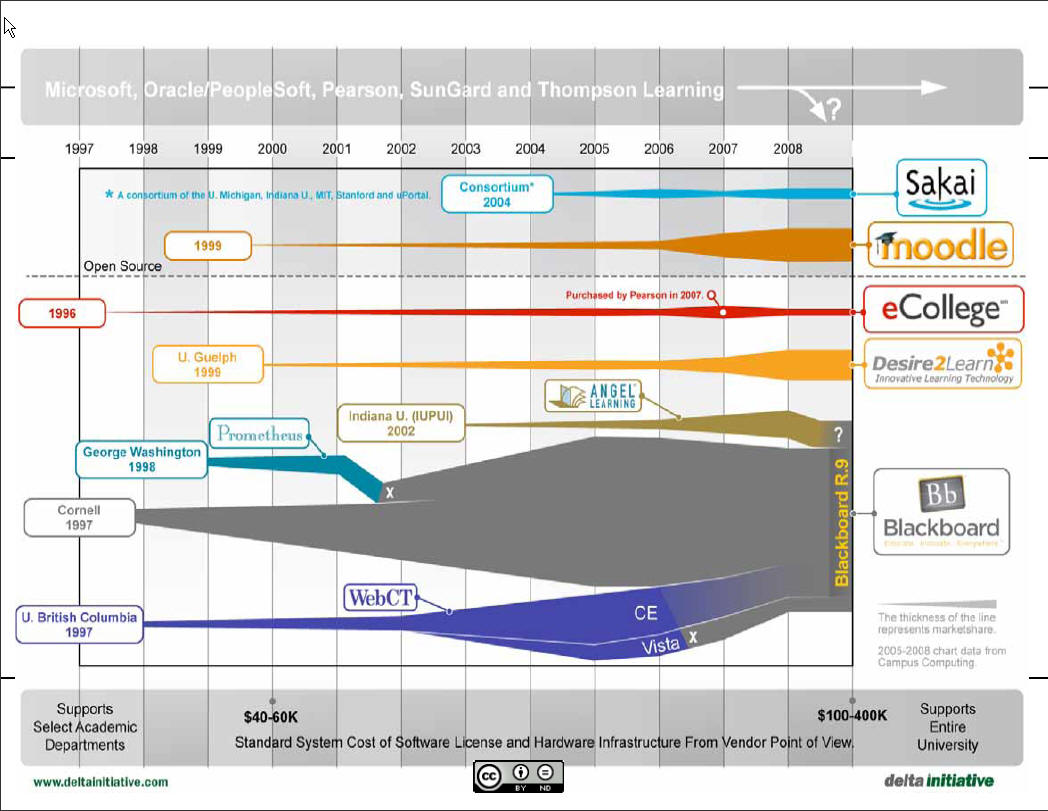
It is incredibly dense with information yet completely readable. Even better is the narrative that the presenter (Phil Hill, at this point in the presentation) weaves around it:
- Virtually all of these LMSs were started at universities.
- Innovation has all but flatlined (my word, not his) since 2004.
- At the same time, prices have gone up anywhere from 250% to 1,000% in the last decade.
Really good stuff. There are some good (if painful) lessons in the presentation about scaling for large systems too. The whole thing is well worth a watch. Thanks to Phil Hill of Delta and Kathy Fernandes of CSU for inviting me to attend.
You can see the slides here and the WebEx archive (which is worth watching) here.
-
Trying To Follow Blackboard v Desire2Learn

photo credit: Kongharald There’s a blog post update from Desire2Learn on the latest back and forth between them and Blackboard over the patents. (Remember, there’s more than one patent now.) Here’s the latest, as near as I can follow it:
- On the original ‘138 patent suit in U.S. courts, there’s no word yet on any appeal by Blackboard of their recent defeat in the appeals court. There should be a final ruling soon from the USPTO. My guess is that Blackboard will let this suit die, even as they pursue other lines.
- Relatedly, the action by the US International Trade Commission has been suspended pending the final results of the ‘138 litigation.
- Meanwhile in Canada, litigation continues on the Canadian version of the original patent, as Blackboard continues to sue D2L there.
- There’s some wrangling back and forth in the United States of Blackboard’s continuation patent. D2L pre-emptively filed for a declaratory judgment in Maryland in the hopes of heading off a suit on that patent. Blackboard has filed a motion to dismiss while simultaneously filing an infringement suit in the East District of Texas, also moving to consolidate it with another patent suit against D2L. Since I’m out of the business of reading patents, I’m not 100% sure what these are about, but as far as I know they are essentially extensions/revisions of the original patent.
Oy.
-
Another Victory for D2L, Another Opportunity for Blackboard
Update: Patently-O blogger Dennis Crouch has posted a legal analysis of the ruling in which he concludes, “Defendant Desire2Learn wins a complete victory (after a few million in attorney fees).”
Via Desire2Learn’s patent blog, we learn today that the U.S. Court of Appeals re-affirmed the invalidation of claims 1-35 and newly invalidated claims 36-38 of Blackboard’s original ‘138 patent. You may recall from my previous post that Blackboard was stalling in the USPTO because they thought their odds would be better in court. I haven’t read the opinion, but from D2L’s post, it appears to be pretty damaging to the patent in the U.S.—perhaps decisively so. Now, that doesn’t mean that Blackboard has exhausted its legal options by any means. There’s the continuation patent, the trade board fight, and the Canadian patent suit, to name a few of the remaining loose ends. But this is, once again, an opportunity for Blackboard to put this brand-damaging fight behind them by quitting the field.
-
Sakai 3 As Mac OS X, Part Deux
At the risk of sounding a little silly, I’m going to attempt to extend the analogy between Sakai 3 and Mac OS X that I made in my last post. The reason I think this exercise is worth trying is that the Mac OS X transition is a relatively clear and uncluttered example of a successful rearchitecture of a product with an installed base, and it provides us with a good model of what could happen with Sakai 3 if the initiative is executed well over a number of releases. Please understand that I am not predicting anything here. I’m just trying to model possibilities so that we can set a ceiling on expectations.
-

Does Google Wave Mean the End of the LMS?
I suppose it was inevitable. At a time when even The Chronicle is asking whether Blackboard can be replaced by WordPress, a slick demo of a super-cool product like Wave was bound to trigger breathless speculation about the demise of the LMS. Equally predictably, the most enthusiastic predictions that the LMS will be replaced are being made by people who have already replaced their LMS. It is not terribly shocking to read Jim Groom predicting that this time the LMS is REALLY doomed!!!! (I mean that to be taken affectionately.) If you are comfortable teaching a class using WordPress or PBWiki or [insert hip and free Web 2.0 technology du jour], then there is a good chance that you will be comfortable teaching a class with Wave.
Me, I’m a live-and-let-live kind of guy. I think people who are comfortable using these flexible tools and who don’t want the traditional trappings of an LMS (e.g., grade book, assignments tool, test engine, etc.) should be able to have what they want, while the people who want the full LMS toolset should also have what they want. That’s one reason why I think we need a Learning Management Operating System (LMOS) upon which flexible and individualized virtual learning environments can be instantiated. If you want a grade book and a test engine, great. We got those. If you don’t want ’em, that’s fine too. Let pedagogical needs and university policies drive these decisions rather than the technology.
So the question I’m interested in is more nuanced than the one of whether the LMS is “dead.” What I want to know is where Wave could fit with the range of capabilities that somebody might want in a virtual learning environment. What is it not good for? What else does it need?
-
What Intrigues Me About Google Wave
 Now that I’ve had a little while to think about it, I’m ready to distill my initial enthusiastic reaction to Google Wave down to a manageably short (and hopefully non-fanboi) post. Let me say at the outset that I have no idea whether Wave will succeed. I am convinced, however, that something like Wave will succeed, in part because much about it is not new. My initial thought was was, “Hey, somebody finally got Apple’s OpenDoc to work.” Scott Wilson twittered that Google had reinvented ActiveX. In some ways, Wave is, like many great inventions, an old idea with some new twists. This is not to minimize the value of those twists. To the contrary, they are astonishing. My point is simply that the essence of Wave will survive whether ore not Wave itself is a success because many of the core ideas have been proven to be compelling in the past.
At any rate, there are a number of elements to Wave that are particularly attractive and likely to change practice in the field of e-learning:
(more…)