e-Literate

Present is Prologue

Category: LMS & Learning Platforms

Everything you want to know about Learning Management Systems and whatever comes after them.


  • Bad News for Blackboard, Good News for Moodle

    The American Association of Community College’s Instructional Technology Council (ITC) has just published its 2007 Distance Education Survey Results, covering data from 154 U.S. community colleges. And there’s a lot of interesting stuff in it. Here are the headlines that I drew from it:

    • Distance education continues to grow at a very healthy clip, particularly in this market segment.
    • Blackboard is losing market share rapidly
    • Moodle doubled it’s market share in the past 12 months and now has the highest market share after Blackboard/WebCT in this market segment.
    • ANGEL and D2L also grew their market share.
    • We have reason to expect more LMS churn in the near future, which is bad for Blackboard.
    • The top 5 areas of likely distance learning-related service growth in this segment are (1) online student organization web site and services, (2) online counseling and advising, (3) online plagiarism evaluation, (4) audio/video streaming, and (5) online textbook sales.

    As you can imagine, the LMS market share stuff is what interests me the most at the moment.

    (more…)

  • Case Study on Moving from WebCT to Moodle

    EDUCAUSE has posted a presentation by SUNY Delhi’s Clark Shah-Nelson on their transition from WebCT CE to Moodlerooms-hosted Moodle. It’s quite good. By all accounts (including the presentation), it has been a pretty smooth transition for Delhi. But the biggest deal is the cost comparison, which Clark lays out in his slides. The total cost is just way cheaper than the alternatives. Particularly for schools that are just looking for a decent all-around LMS and don’t have very specific functional or integration needs, the Moodlerooms offering is tough to beat.

  • On Open Source, Open Standards, and Lock-in

    I’ve been meaning to comment on D’Arcy Norman’s frustrations with not being able to export Moodle courses to a common standard. He makes a very important point:

    Moodle happily ingests those formats, acting to absorb content into what then becomes an inescapable pit of quicksand. It’s a one-way trip. Content can check in, but it can never leave.

    If Blackboard did that, there would be villagers marching in the streets with torches in hand. The Blackboard SCORM import/export stuff might not be perfect, but at least they try to let people move content out.

    With Moodle, it’s currently a vendor lock-in proposition. The only saving grace is that the vendor just happens to be an open source project. But it’s still lock-in.

    Now, I don’t know any of the specifics around Moodle’s export capabilities but, in general, universities should insist on support for some standard export capability in any platform they adopt. We all know that the cost (in time and/or dollars) of moving content from one system to another is one of the major barriers to universities who would otherwise be motivated to switch. So unless you plan on sticking with your next platform forever, make sure you press your vendor or open source community hard about supporting some sort of content exit strategy. Heck, even if your school loves Moodle (or whatever) and plans on staying with it as long as, say, John McCain wants the U.S. to stay in Iraq, individual teachers move from school to school and, depending on their contract, are usually entitled to take their course content with them. That is, if they can get it out of the LMS.

    To be fair, supporting a robust, standards-based export facility is a hard problem, in part because we keep adding tools to our learning environment and each tool needs an import/export format to work in the standard. Nevertheless, basic support for export (focusing maybe on a handful of widely used tools) is far better than none.

  • The Latest on the Edupatent Front

    As I noted in an earlier post, I’m traveling this week, so this post is going to be relatively short and light on analysis. If you’re trying to get a comprehensive picture of what’s happening, I’d start with the article in The Chronicle. (Incidentally, Katherine Mangan, who is new to the edupatent beat at The Chronicle, has been doing a good job of capturing some of the legal nuances that I haven’t seen covered in most of the other mainstream media stories.) Next, you’ll want to check with Al and Barry. Like both of these guys, there are some aspects of the ruling that I’m still trying to process. The judge came down with a pretty tough injunction against D2L along with some strict orders about how and when D2L must inform customers and prospects. The judge has placed an injunction on D2L regarding existing customers as well as new ones, which was more than Bb asked for. On the other hand, he also gave D2L a 60-day grace period to try to implement a work-around and pushed the two parties to negotiate a royalty settlement. You can find the rulings here and here.
    To my mind, there are two crucial details that we’ll find out in the short term. First, we have to see whether D2L’s work-around allows them to get a non-infringement ruling. In addition to being crucial for D2L and their customers going forward, this will be another indication of just how hard the patent is to get around and therefore how much liability risk other systems will face. Second will be the royalty settlement. If Blackboard gets a royalty anywhere close to the 25% that they are asking for, that will be very tough for D2L or any other competitor found to infringe. If outcome breaks for Bb in both of these outcomes, then Bb will effectively have a legal stranglehold on the product category.

    Update: D2L has a new post up on the orders. Here is their interpretation of them:

    The combination of these orders is consistent with Desire2Learn’s expectations from the hearing. On March 10, the Court discussed two activities: first, that Desire2Learn go to market as soon as possible with a product that would not infringe, and second, that the parties make a good faith effort to talk about what payment should be made for use of any infringing products that may still be in use. Blackboard has consistently represented that it intended for Desire2Learn to be able to serve existing customers; that it was seeking not an injunction, but rather a reasonable royalty, for those clients. The Court’s order for the parties to meet requires discussion about a reasonable royalty.

    Moreover, the 60-day stay period provides Desire2Learn with the opportunity to finalize and to implement its design-around, as we mentioned yesterday. At the hearing, the Court based its willingness to issue an injunction in part on the fact that we could easily, inexpensively and quickly design around the Blackboard patent claims. The product that we anticipate will include the design around – Learning Environment version 8.3 – will be available to all clients and prospects quite soon. Further, since the trial we have not, and will not, sell any product found to have been infringing.

    Finally, the stay period provides an opportunity for Desire2Learn to file its post-trial motions to limit the scope of the injunction and request other relief. For example, we intend to file a motion that, that as a matter of law, D2L does not in fringe the patent respect to clients hosted in D2L’s Canadian facilities. The injunction should be narrowed and damage award reduced to reflect this.

    In related news, Katherine Mangan has a report on the new edupatent suit (the one in which universities are being sued) that confirms the details that I had posted earlier. A lawyer representing the patent troll is quoted in the article as saying, “Nonprofits don’t need to worry about us chasing them. We’re an ally of theirs.” Recall that Bb promised D2L’s existing higher education customers would not be impacted by their request for an injunction. Clearly, children should not be allowed to play with loaded guns. Unfortunately, many of the parents are too busy loudly defending their right to bear arms while not paying attention to the fact that they left their own gun cabinets unlocked and in easy reach.

    We’ll have more here as soon as we can, including some analysis from Jim Farmer on the long-term big picture.


  • Some Court Documents

    Well, it’s later than we expected, but we did finally get a copy of the jury questionnaire as well as Blackboard’s motion for prejudgment interest. (Both of these were provided by instructional media + magic and acquired from public sources.) And there are a few interesting details.

    Update: At the request of Blackboard’s legal counsel, we have removed the link to the motion for pre-judgment interest.

    Later Update: A link to the redacted version of the motion has been added back. In answer to some of the questions that I’ve been getting, the reason that Blackboard requested that the document be taken down in the first place is that there was a clerical error in which Exhibit D (referenced in the post below) should have been submitted under seal since it contained D2L’s client list. (Both companies have a right to keep their client lists confidential, and the customers of both companies have the right not to publicize which platform they use.) Blackboard’s legal counsel corrected the error through official channels and asked that we take down the part of the document that shouldn’t have been released in the first place. No threats were made. After thinking about it a bit and seeking a second opinion, I came to the conclusion that it was a reasonable request and took appropriate action. With Jim’s help, I got a copy of the filing minus Exhibit D and reposted it as soon as I had the chance.
    As to the question of why the instructional media + magic web site is down, it is undergoing maintenance for unrelated reasons.

    (more…)

  • Blackboard Advertises an 'Open Source LMS'

    Update: I just ran another Google search today (two days after the original post) and Blackboard’s ad no longer shows up. It looks like they may have pulled it. If so, good for them.
    Blackboard ad

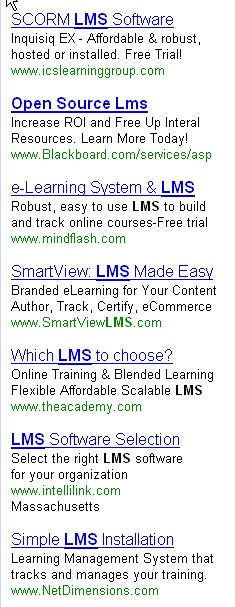
    A friend of mine sent me this ad, which appeared in his GMail account. Blackboard could have its ad show up with the key search terms “open source” and “LMS” (which I wouldn’t object to in and of itself) without having to have the words “Open Source LMS” headline its ad with a hyperlink (thus giving the strong false impression that Blackboard’s offering is open source). To prove this point, check out the ads that appear when I search on those terms in Google:

    Note that all of these ads are for proprietary LMSs, but only Blackboard chooses to actually use the phrase “Open Source LMS” in the ad text itself.

    Blackboard needs to take this ad down. On the eve of their self-destructive court case with D2L, the last thing they need is another self-inflicted PR wound from an ad that misleads people who are searching for an open source product.

  • Blackboard Bought Xythos

    The Chronicle just confirmed it. For those who don’t know, Blackboard Content System is based on the Xythos Content Server product. So now Bb owns a content management engine and can integrate it pervasively with the rest of its product line. (To date, the integration between Bb Content System and their LMS is relatively weak.) This fits well with the trend we’re seeing elsewhere, e.g., Moodle and Sakai both building JSR-170 repositories underneath all of their various LMS tools, ANGEL and D2L both selling some kind of content management add-ons, etc. Clearly, the integration of content management into core teaching tools and processes is going to be a big story in 2008.

    Damn. I shoulda included that in my eLearn predictions.