e-Literate

Present is Prologue

Category: Ed Tech

The “Ed Tech” category includes posts about educational technology products themselves, including LMSs and other learning platforms, adaptive learning and other digital curricular materials products, learning analytics, and educational apps of all types. It also includes technical aspects of ed tech products, especially interoperability.

  • California and the Right to Educational Access

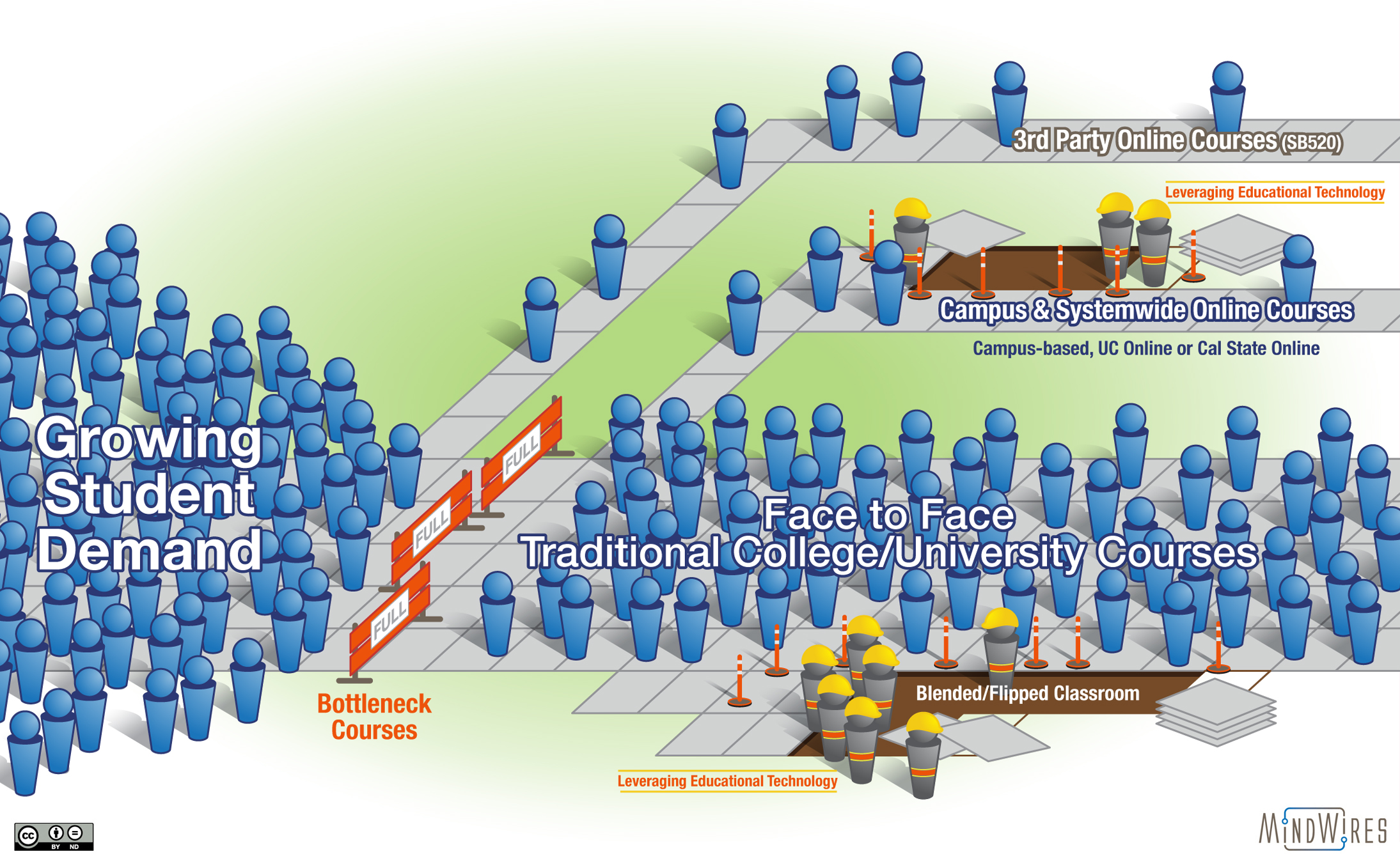
    We are pleased to announce the publication of our white paper on California’s bottleneck course issue. Many thanks to the paper’s sponsor, the 20 Million Minds Foundation, for giving us the support and freedom to write exactly what we believe. If there is anything that you find wrong or objectionable in the paper, then blame us.

    The central idea in the paper is that California should adopt the principle that students have a right to educational access. There is a fundamental difference between saying that we should do whatever we can to give students access and saying that we have an obligation to enable students to exercise their right to access. And that change of frame is critical to solving the problem of bottleneck courses.

    The current incarnation of SB 520, which we have written about here repeatedly, has been accused by its detractors as being a potential vehicle for gutting and privatizing California’s public higher education. We believe that concern is legitimate. However, in the context of a larger bill supporting the students’ right to access, it could be not only positive but essential as path of last resort. As part of supporting every citizen’s right to due process when accused of a crime, the government is required to provide access to a public defender. But few people who have financial means are likely to choose a public defender over a private attorney because private attorneys, by and large, have access to resources (including time for individual attention) that public defenders do not. Likewise, we believe that access to third-party online courses disconnected from a student’s home institution is a poor solution to the student’s access problem. The only worse solution is not to have one at all, which is the current situation. If Californians believe that students should have a right to access, then they must provide a means of last resort for students to exercise that right.

    But the best solution would be to eliminate bottleneck courses altogether, which is why much of our proposal centers on providing mechanisms and funding to empower faculty members, campuses, and systems to solve these problems within the California public education system, where students have the benefit of the campus support network and expertise of local faculty. Even the main funding for the third-party course provisions, which we characterize as the “safety valve” of the plan, would go toward developing infrastructure that would be equally useful to support students taking courses from other campuses within the California systems. If the faculty and administrators will lead an effort to solve the bottleneck course problem organically, with appropriate support from the state, then the actual use of the safety valve option by students could become a rarity.

    CalStudentFlow Graphic copy

    We acknowledge that technology is not the only possible solution to the bottleneck course problem; nor do we assume that the underlying budget challenges should be accepted at face value. We have written about technology as one avenue to solve the problem because educational technology is what we know about and what we were asked to write about. None of what we suggest precludes discussions about allocation of funding in college budgets, levels of state funding support, allocation of faculty time to lower-division courses, or other relevant questions.

    We believe strongly that students should have a right to educational access and that technology can be one useful tool in enabling them to exercise that right. We also believe that the educators in California’s public college and university system are still critical enablers of that right and have a central role to play in making that ideal a reality. And we think there is real value in bringing together educators across the state to focus on sensible application of technology to solve a real educational problem. The culture and collaboration, knowledge and infrastructure that could be created to solve the access problem could also be applied to problems such as improving completion rates, improving course quality, and lowering tuition costs.

    You can read the white paper here.

  • Getting students useful feedback from machine learning

    Last month, I wrote this narrow defense of automated essay grading, hoping to clear the air on a new and controversial technology. In that post’s prolific comments section, Laura Gibbs made a comment echoing what I’ve heard from every teacher I speak to.

    I am waiting for someone to show me a real example of this “useful supplement” provided by the computer that is responding to natural human language use – I understand what you want it to be, but I would contend that natural human language use is so complex (complex for a computer to apprehend) that trying to give writing mechanics feedback on spontaneously generated student writing will lead only to confusion for the students.

    When we talk about machine learning being used to automatically grade writing, most people don’t know what that looks like. Because they don’t know the technology, they make it up. As far as I can tell, this is based on a combination of decades-old technology like Microsoft Word’s green grammar squiggles, clever new applications like Apple’s Siri personal assistant, and downright fiction, like Tony Stark’s snarky talking suits. What you get from this cross is a weird and incompetent artificial intelligence pointing out commas and giving students high grades for hiding the word “defenestration” in an essay.

    My cofounder at LightSIDE Labs, David Adamson, taught in a high school for six years. If we were endeavoring to build something that was this unhelpful for teachers, he would have walked out a long time ago. In fact, though, David is a researcher in his own right. David’s Ph.D. research isn’t as focused on machine learning and algorithms as my own; instead, his work brings him into Pittsburgh public schools, talking with students and teachers, and putting technology where it can make a difference. In this post, rather than focus on essay evaluation and helping students with writing – which will be the subject of future posts – I’m going to explore the things he’s already doing in classrooms.

    (more…)

  • Political Philosophy

    This is going to be a more personal blog post than I typically make here at e-Literate.

    The open letter from San José State University’s philosophy department in protest of the edX JusticeX course being taught at SJSU is getting a lot of attention, as is the follow-up statement from the SJSU faculty senate. I have some concerns with both of these letters—particularly the one from the philosophy department—but before I get into them, I’d like to emphasize my points of agreement and solidarity with the department:

    • As a former philosophy major and a former teacher of philosophy courses to seventh and eighth graders, I strongly believe that a course in social justice is critical to every American’s education.
    • I also strongly agree that, in order for such a course to be effective, it must be up-to-date, relevant to the students, and involve in-depth facilitated discussion.
    • I agree that there is a bit of a bait-and-switch going on, possibly unintentionally, with the rhetoric about MOOCs providing superior pedagogy over lecture classes (which is probably somewhat true) and then moving to swap out discussion classes for MOOCs instead.
    • I agree that some MOOC fans (though by no means all of them) have simplistic notions of how MOOCs can make university education cheaper without thinking through the consequences either to the quality of education or the fiscal health of the colleges and universities that still provide tremendous value to our nation and our culture.
    • I agree that intellectual diversity is very important, particularly when discussing complex issues that are essential to a functioning democracy, and that the potential for an intellectual monoculture is a concern worth taking very seriously.
    • While I have no knowledge of the negotiations between edX and SJSU, I strongly agree that such partnerships should be conceived and implemented with active consultation and collaboration with faculty unless there is exceptionally strong justification to do otherwise.

    Despite all this common ground on values that are dear to me, I find aspects of the department’s letter to be deeply problematic.

    (more…)

  • Cengage MindTap and the Evolution of Courseware

    So MindTap just won a CODiE award for “Best Post-secondary Personalized Learning Solution.” In and of itself, this isn’t a big deal. No offense intended to current or prior winners, but the CODiEs often feel like awards for “Best Instant Coffee” or “Best New Technology Product by an Important Sponsor of Our Awards Program.” They’re not exactly signals of breakthrough educational product design. But I’m glad that the award was given in this case because I think MindTap does represent an important innovation that addresses some of the trends that we’ve been blogging about here at e-Literate (which was one of the reasons that I was enticed to work on MindTap at Cengage for a while).

    MindTap is not a “personalized learning solution.” While it does allow students to do things like integrate their Evernote accounts and choose whether they want to read or listen to texts, the level of personalization for the learners is not terribly different from other products on the market. (And it certainly is nowhere near as radical as the vision for a Personalized Learning Environment which came from the UK’s JISC and elsewhere, and from which terms like “personalized learning solution” and “personalized learning experience” have been bastardized). Nor are there adaptive analytics or other sorts of machine-driven personalization in the product at this time. Rather, the key differentiator in the current incarnation of MindTap is the way in which it creates a more refined and complete learning experience out of the box while still enabling faculty to customize those experiences to the needs of their students in pretty significant and, in some cases, new ways. This is exactly where the textbook, LMS, and MOOC markets are all headed, and MindTap got there first.

    The Problem to be Solved

    In order to understand the value of a product like MindTap, it’s important to understand where textbook publishers do and do not compete. You’re not going to see a lot of MindTap-style products for courses like “Advanced Topics in International Trade Policy,” “Research in Genetics,” “Greek Film,” or “Intermediate Killer Shark Genre.” These smaller courses are relatively uninteresting to textbook publishers because they don’t have the scale necessary to generate significant revenues, and they are also better suited to hand-crafted course designs that are tailored to the strengths of the particular professor doing the teaching and can be highly tailored to the needs and interests of the students in the class. Rather, the courses in question are more like “Introduction to Psychology,” “General Biology I,” “Microeconomics,” or “Survey of Western Civilization.” (English Composition is an anomaly in this categorization because of the way it is taught.) These courses are generally taught in large lecture halls with little or no writing—and when there is writing, it is often graded quickly on a narrow range of criteria by overworked graduate students—and relatively generic syllabi (particularly in non-elite institutions).

    A lot of the heated debate over whether college is “broken” revolves around these sorts of classes without ever explicitly defining the scope of the problem. Those who say school is broken and need to be disrupted tend to argue as if all college courses are giant, boring lecture courses. Those who argue against the “school is broken” meme tend to characterize these large lecture-centric courses as exceptions. Neither characterization is entirely accurate. On one hand, there are huge swaths of courses in just about any college catalog that are not large lecture courses. On the other hand, because the large lecture courses are concentrated in core curriculum and core major classes, most students have to take a handful of these courses in order to graduate.

    Regardless of how pervasive or rare you think these courses are, everybody seems to agree that they are not terribly effective. But what should be done about the problem? Shrinking the class size is simply not going to happen, given both budget realities and the moral imperative to increase access to education. And yet, the current situation is bad not only for the students but also for the instructors. Keep in mind that the people teaching these survey courses are disproportionately either junior faculty who are doing all kinds of other duties to earn tenure or adjuncts who are working unreasonable course loads just to make ends meet. They generally don’t have a lot of time to either carefully craft a course or give students a lot of (or any) individual attention. They often have little choice but to take what the publisher is giving them as their course outline and run with it. In and of itself, the direct adoption of a publisher’s curriculum isn’t necessarily bad for many of these courses. The whole idea of a core course is that it helps all students getting a particular degree or a particular major to master certain competencies that they should have. There is a strong argument for consistency of curriculum across core courses. But the current situation neither guarantees consistency of curriculum nor saves the instructor time for either thoughtful customization of the curriculum or any other purpose. There is still a lot of hand assembly required to pull together reading assignments, assessments, slides and lecture notes, and so on. It is generally not a creative process because there is little time for creativity, but it is nevertheless a labor-intensive process and one that is prone to introduce variation in hitting those core competencies without any checks or even necessarily a lot of reflection on it.

    A Better Compromise

    If instructors are going to adopt a third-party course curriculum anyway, then we should at least use technology to remove the hand assembly. Why not provide the readings, multimedia, assignments and assessments, neatly integrated with a basic syllabus, into one ready-to-use digital package for the students? At its most basic, this is what “courseware” is and what MindTap does. It provides students and instructors with a ready-to-go complete course structure with all the materials and assessments placed in a logical and easily navigable order. Joel Spolsky once defined poor user interface design as forcing users to make choices that they don’t care about. That is also an apt description for 80% of the pre-semester course preparation process that instructors go through with these big survey courses. Pre-assembling the elements of the vanilla version of the course frees up the instructors’ time to focus on the customizations that they actually do care about. To begin with, the course structure is already assembled and visible, which makes it easier for the instructor to think about its total shape. Removing unwanted content or changing content order is trivially easy, making the roughing in of the course structure very quick.

    But things get really interesting when you start looking at adding to the learning path structure in MindTap rather than just moving or deleting things. In ed tech discussions, we tend to talk about APIs as if the main differentiation is having them versus not having them. Can you or can you not integrate Google Docs into a course? But in reality, the specifics of the integration can make an enormous difference in how practically useful the added functionality is to teachers and students. Do you want to make a folder of your documents (like your syllabus) available to the students at all times in the course with one or two clicks, or do you want to insert your own supplemental document right into the course reading, zero clicks away for the student and on their default navigation path? These two types of integration serve fundamentally different purposes in the course. In MindTap, you can do both and more. And importantly, making these different customizations is intuitive and almost trivially easy. Radical customization of the course structure is very much possible. But both because there is far less instructor time wasted with hand assembly of course elements and because customizations are visible and visualizable in the learning path structure, the percentage of time spent on meaningful instructional activities, whether that’s course customization or student interaction, is likely to be higher. For this reason, the MindApp model and the learning path structure are MindTap’s crown jewels.

    Table Stakes

    Of course, MindTap doesn’t have a monopoly on useful courseware platform design. For example, WileyPLUS enables instructors to see which course materials and assessments are associated with which learning objectives. This helps instructors to align what they’re teaching and assessing on to what they think the student should be learning. More importantly, none of these innovations from any of the platforms are going to magically change poor large lecture classes into great educational experiences. The key to solving that problem is not the technology by itself but the learning design that it enables. The classroom flipping craze is a craze precisely because it is a learning design that can improve the pedagogical impact of these large survey classes. But anyone who has actually tried to flip their class will tell you that it’s not easy to do well. Faculty need pedagogical models other than the ones that they learned from their own professors, including the practical tips and support necessary to make those models work in the real world. They need course designs based on learning science and collected experience of innovators, and supported by technology. The MindTap platform doesn’t provide that. No technology platform does. And as far as I can tell, Cengage is not yet designing courseware for MindTap that even attempts to do this. But in order to accomplish the bigger goal, we first need to strike a new balance regarding course design customization. It’s not a question of “more” versus “less.” There will always be times when it is wise to allow a skilled instructor to tune a course. But there needs to be more of a sophisticated collaboration between the individual instructor, a curriculum design team (whether that team works for a textbook publisher or a university), and the other instructors teaching the course at the same institution in order to arrive at better pedagogical approaches that can be adopted and adapted to best effect by individual teachers. In order to accomplish that, you need to start with a combination of platform and content that makes meaningless course assembly unnecessary and meaningful course customization both easy and visible. This is what we mean at e-Literate when we write about “courseware.” And at the moment, MindTap is the best example I know of what a next-generation courseware platform will look like.

  • Knewton (Quietly) Pivots

    Knewton CEO Jose Ferriera has an interesting and revealing blog post up about “the coming adaptive world.” In part, it is a response to a report on adaptive learning by Education Growth Advisors. Jose writes, “Despite our constant protestations to the contrary, observers often confuse Knewton with the many adaptive learning app makers who are now popping up. Or they confuse app makers with platforms. Or they think we’re all competitors.” It’s a bit of a red herring, since the report does distinguish between platform and publisher business models. That said, the meaning of the distinction between these two categories isn’t drawn terribly clearly, and it’s fair for Knewton to try to clarify its market positioning. But in doing so, Jose reveals what appears to be a shift in their thinking about the market for a platform like theirs which tells us something important about the ed tech market in general. (more…)

  • Blackboard Changes Underway: Jay Bhatt Interview and Management Changes

    There is an interesting article today from Bill Flook , who has covered Blackboard as a business, including the story of Michael Chasen’s departure in late 2012 along with two rounds of layoffs.

    Blackboard Inc. has been a company in transition long before CEO Michael Chasen announced his upcoming departure.

    In fact, the presence of Blackboard’s longtime chief has been its most visible constant. So the big question coming out of Monday’s news is this: What will the ed-tech behemoth look like, sans Chasen? [snip]

    If anything, it’s surprising that Chasen stayed on so long after the private equity buyout. He and Providence had “mutually sat down and worked out the right time frame for there to be a transition,” Chasen said in an interview Monday afternoon. “I’ve been here 15 years,” he said. “While I love Blackboard, and I think there is huge opportunity in front of us, I’ve been doing this since I was 25 years old and looking for there to be a good time for me to phase out.”

    Today we are starting to get more insight into the changes, based on Bill’s interview with Jay Bhatt, Blackboard’s new CEO, and coverage of management changes at the company.

    What hasn’t changed are the external pressures. Competitors in the core learning management system (LMS) market like Instructure and Desire2Learn are eating into Blackboard’s once-dominant market share. Open source is challenging the traditional licensed software model, just as mobile and cloud-based services challenge native desktop software. Blackboard is an internationally recognizable brand, with a broad array of products and a powerful private equity player behind it. It is, however, still seen as the legacy player.

    In his first in-depth interview since joining Blackboard, Bhatt laid out his vision for navigating those challenges. And with less than half a year in the role, he’s marked off two key areas of investment: the online program management market, and international.

    Bhatt emphasized the need to grow top-line revenue.

    Bhatt was equally emphatic about what his mission at Blackboard isn’t.

    “Make no mistake, our goal is to be a top-line growth company,” he said. “Obviously, we want to be profitable, and we want to generate the returns that our investors want. But we need to grow the top line. Software companies that grow the top line effectively are really adding value to their industry, they’re not just monetizing their industry.”

    According to the article, there have been some significant management changes at Blackboard as well. Tim Hill (president of global marketing), Siegfried Behrens (president of global sales, recently hired from Microsoft) and David Mills (VP of R&D, formerly of ANGEL and MoodleRooms, key visionary behind xpLor) have all left the company in the past two weeks. Kayvon Beykpour (general manager of Blackboard Mobile and co-founder of TerriblyClever) is also on a leave of absence. Matthew Small has been promoted to president of international, and Jim Kelly from McGraw-Hill has been hired as VP of business development.

    Bill indicates that he will have more information and insight on Blackboard’s future direction coming out soon. Read the whole article here.

  • We’re from the Valley and We’re Here to Help

    The other week I had the pleasure of attending the annual GSV Advisors Education Innovation Summit in Scottsdale. For those who aren’t aware, the main purpose of the event is to help ed tech startups and investors find each other. After last year’s summit, I wrote a post called “What Are Ed Tech Entrepreneurs Good For?“, the main lessons of which could equally apply to this year:

    • The main stage speakers generally tilted to the right, ideologically (although there was a visible effort to achieve more balance this year). But by and large, that didn’t matter, since the important work of the conference was generally driven by what ed tech startups were available for funding.
    • Many of the ed tech entrepreneurs have good intentions but varying degrees of knowledge about the theory and pragmatics of education.
    • The degree to which ed tech entrepreneurs need that knowledge varies widely depending on the specifics of what problems they are trying to solve with their offerings.
    • The success or failure of these startups are often heavily influenced by the market conditions, which means that we should be thinking about things like improving institutional purchasing practices if we want more from our vendorsThe main difference this year was that the conference was roughly twice the size of last year’s.

    I’ll have more to say about the dynamism and/or frothiness of the ed tech startup market in a future post. For now, I want to focus on that continuing disconnect between what happens on the main stage of the conference and what happens in the rest of it, because I think there is a lost opportunity. (more…)