e-Literate

Present is Prologue

Category: Ed Tech

The “Ed Tech” category includes posts about educational technology products themselves, including LMSs and other learning platforms, adaptive learning and other digital curricular materials products, learning analytics, and educational apps of all types. It also includes technical aspects of ed tech products, especially interoperability.

  • A Taxonomy of Adaptive Analytics Strategies

    I almost never quote a blog post in its entirety, but this one from Dan Meyer is so good that I just can’t bear to cut a single word:

    Stephanie Simon, reporting for Reuters on inBloom and SXSWedu:

    Does Johnny have trouble converting decimals to fractions? The database will have recorded that – and may have recorded as well that he finds textbooks boring, adores animation and plays baseball after school. Personalized learning software can use that data to serve up a tailor-made math lesson, perhaps an animated game that uses baseball statistics to teach decimals.

    Three observations:

    One, it shouldn’t cost $100 million to figure out that Johnny thinks textbooks are boring.

    Two, nowhere in this scenario do we find out why Johnny struggles to convert decimals to fractions. A qualified teacher could resolve that issue in a few minutes with a conversation, a few exercises, and a follow-up assessment. The computer, meanwhile, has a red x where the row labeled “Johnny” intersects the column labeled “Converting Decimals to Fractions.” It struggles to capture conceptual nuance.

    Three, “adores” protests a little too much. “Adores” represents the hopes and dreams of the educational technology industry. The purveyors of math educational technology understand that Johnny hates their lecture videos, selected response questions, and behaviorist video games. They hope they can sprinkle some metadata across those experiences — ie. Johnny likes baseball; Johnny adores animation — and transform them.

    But our efforts at personalization in math education have led all of our students to the same buffet line. Every station features the same horrible gruel but at its final station you can select your preferred seasoning for that gruel. Paprika, cumin, whatever, it’s yours. It may be the same gruel for Johnny afterwards, but Johnnyadores paprika.

    Dan captures most of what I was trying to get at with my rant on the big data hype, but much more clearly and succinctly. Points two and three are the most salient here. First of all, the sort of surface-level analysis we can get from applying machine learning techniques to the current data we have from digital education system is insufficient to do some of the most important diagnostic work that real human teachers do. Think about the math classes is which you had to show your work on your homework. Why was that important? Because the teacher needs to see not only what you got wrong but why you got it wrong. Teachers generally don’t just say, “You got three out of five problems involving converting decimals to fractions wrong. Go study some more.” They sit down and work through the problems with the student to find the source of the errors. It’s really hard to get computers to do this well, even with highly procedural domains like math. (Forget about, say, literary analysis.) So in the vast majority of cases, we don’t even try to design systems where students show their work. And without the step-by-step data, no fancy algorithm is going to teach Johnny.

    Second, if the problem is that your content isn’t what the student needs, no fancy algorithm is going to fix that either. Videos are a prime example. I know of one textbook publisher whose teacher customers report that students won’t watch the publishers’ videos, but they can and do find videos on the same topic on YouTube and share them with each other. Think about that. Video-based pedagogical support is valuable enough to the students that they will expend energy searching for videos and sharing them. But they reject the expensive, carefully crafted videos from the publisher that are served up to them on a silver platter. It’s not that the publisher-supplied videos are necessarily “bad” in the sense that they have poor production qualities or are unclear or factually inaccurate. But the students have a particular use in mind for the videos. Maybe they’re struggling with a particular homework problem and just need a quick walk-through of a technique so that they can see the step that they are missing, for example. If the video doesn’t fit their needs—both utilitarian and aesthetic—then it won’t get used. Serving it up adaptively isn’t going to help that problem.

    That said, it’s worth taking a little time to break down the different types of adaptive learning analytics into a couple of categories and see just what we should and should not reasonably hope to gain from them.
    (more…)

  • Emerging Student Patterns in MOOCs: A Graphical View

    Update (3/10): Patterns and descriptions have been updated based on feedback in a new post. Added links to Astronomy, AI Planning courses.

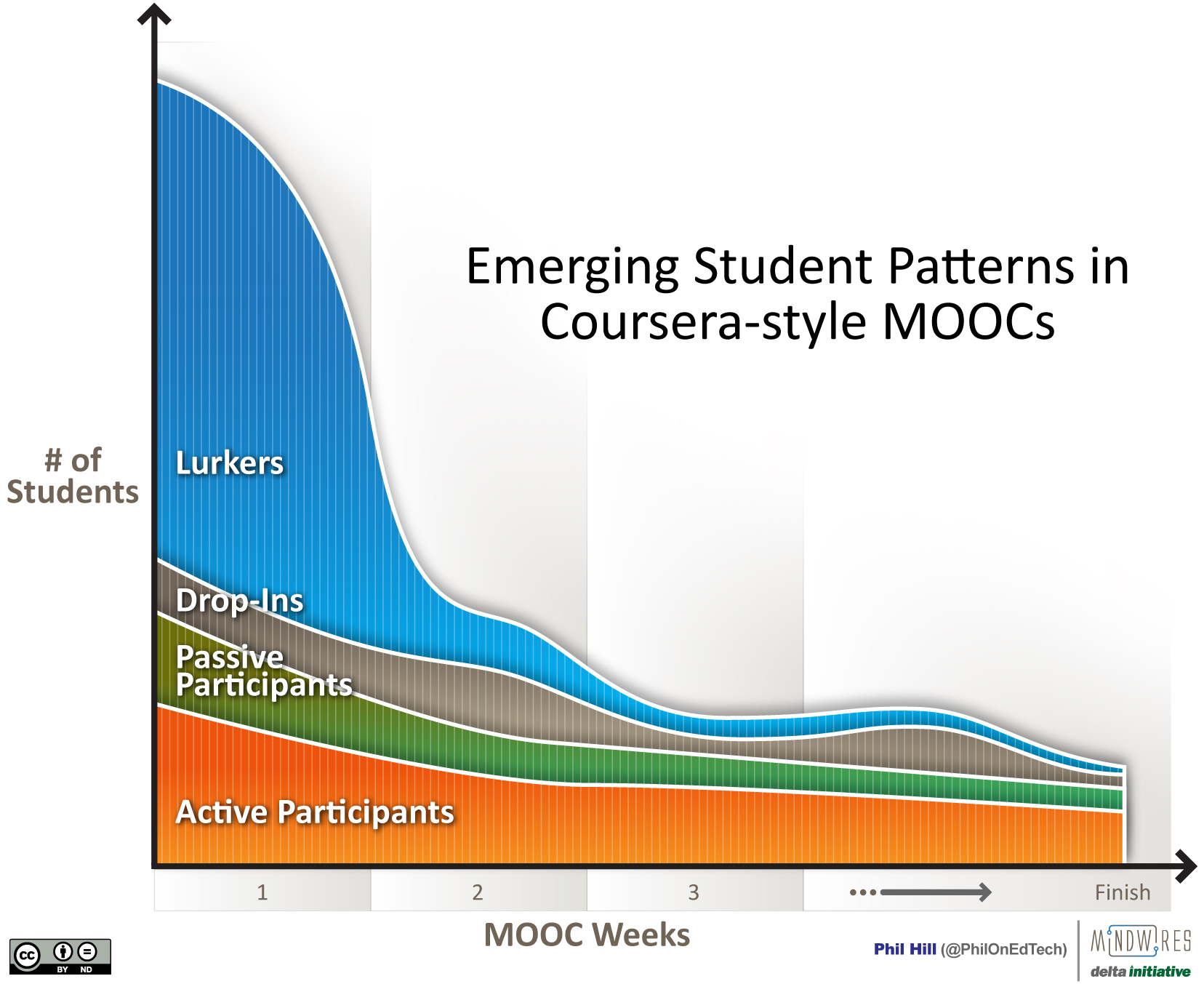
    Thanks to feedback from my last post, I have modified the proposed description of patterns for students engaged in MOOCs. I also want to introduce a graphic to visually represent these patterns.

    studentPatternsInMoocs2

    • I have removed the language comparing passive participants to traditional students based on the idea that they expect others to define academic goals for them and ‘expect to be taught’ (thanks to Colin Milligan for description). While this distinction between passive and active participants is important, I have removed the direct reference to traditional students – the reader can apply their own comparisons.
    • I have removed the usage of the term archetype. As Satia Renee put it so well on Google+, archetype implies “more an internal personality type expressing itself in patterns of behavior” when I am trying to capture the patterns of behavior. Thus I’m sticking with the less loaded term of patterns.
    • I have added language, thanks to Kevin Kelly, that captures the growing case of Drop-Ins as students focused on a particular topic within a MOOC for usage outside of that MOOC.
    • Finally, I have moved Drop-Ins right after Lurkers based on Colin’s comments and to help with the graphical view below.

    (more…)

  • The OpenClass Vision: An Example

    In my last post, I described a vision for combining elements of MOOC-like scale with a more traditional face-to-face classroom experience, as articulated by Pearson’s Adrian Sannier. (Full disclosure: Pearson is a client of MindWires Consulting.) A couple of months ago, I suggested in an interview with Josh Kim for Inside Higher Education that this is where MOOCs would go next:

    Question 6. Will MOOCs replace accredited curriculum? Why or why not?

    I don’t know how to answer this question, because I’m not convinced that we know what a MOOC is yet. Will there be massive elements that are integral to many curricula? Almost certainly, although I don’t know how much of it we will see in 2013. Will the curricula be all massive? Probably not in most cases. Will we consider the mix of massive and non-massive elements to be “MOOCs”? I don’t know.

    The problem that we have right now is that we have very few models for how this might work. So when Sannier mentioned a course called Habitable Worlds being developed by Professor Ariel Anbar and Lev Horodyskyj at Arizona State University that will eventually be brought to OpenClass to support this model, I asked to speak with Professor Anbar in order to get some specifics. The conversation shed some light not only on possibilities for the mixed model, but also on possible futures for the liberal arts and the role of the professor.

    (more…)

  • The Four Student Archetypes Emerging in MOOCs

    The Four Student Archetypes Emerging in MOOCs

    Update (3/10): Patterns and descriptions have been updated based on feedback in a new post.

    As discussed in my last post, the focus on “completion rates” in MOOCs is somewhat misplaced, as open education is not simply an extension of traditional education. As several others have noted, not every student is attempting to complete a course, and in fact different students have different goals while participating in the same open course. This holds true for both cMOOCs and xMOOCs.

    Does this mean that we should throw out the completion rate data? No. As Katy Jordan described quite well in the comments:

    A lot of people have asked whether completion rates are the right way of framing the success of a MOOC; I agree that there is much more to the potential positive impacts of MOOCs for students than completion rate but, at the moment, completion rate is what the providers are measuring most consistently.

    In my mind, we should augment the models we use to evaluate MOOCs rather than throw the baby out with the bathwater. The challenge, therefore, is to move beyond the simplistic view of one type of student with one type of goal (course completion), and find patterns of student behavior that will give additional insight into the different goals and therefore different measures we should have in evaluating whether MOOCs are effective.

    (more…)

  • The Most Thorough Summary (to date) of MOOC Completion Rates

    How many times have you heard the statement that ‘MOOCs have a completion rate of 10%’ or ‘MOOCs have a completion rate of less than 10%’? The meme seems to have developed a life of its own, but try to research the original claim and you might find a bunch of circular references or anecdotes of one or two courses. Will the 10% meme hold up once we get more data?

    While researching this question for an upcoming post, I found an excellent resource put together by Katy Jordan, a graduate student at The Open University of the UK. In a blog post from Feb 13, 2013, Katy described a new effort of hers to synthesize MOOC completion rate data – from xMOOCs in particular and mostly from Coursera.

    Via a combination of thinking about ‘what makes a successful MOOC?’, and looking for a topic for my final project on the Infographics MOOC, I decided to try to pull together the various statistics floating around online about MOOC completion rates. I’m trying to see if any differences emerge on the basis of platform or the assessment methods used.

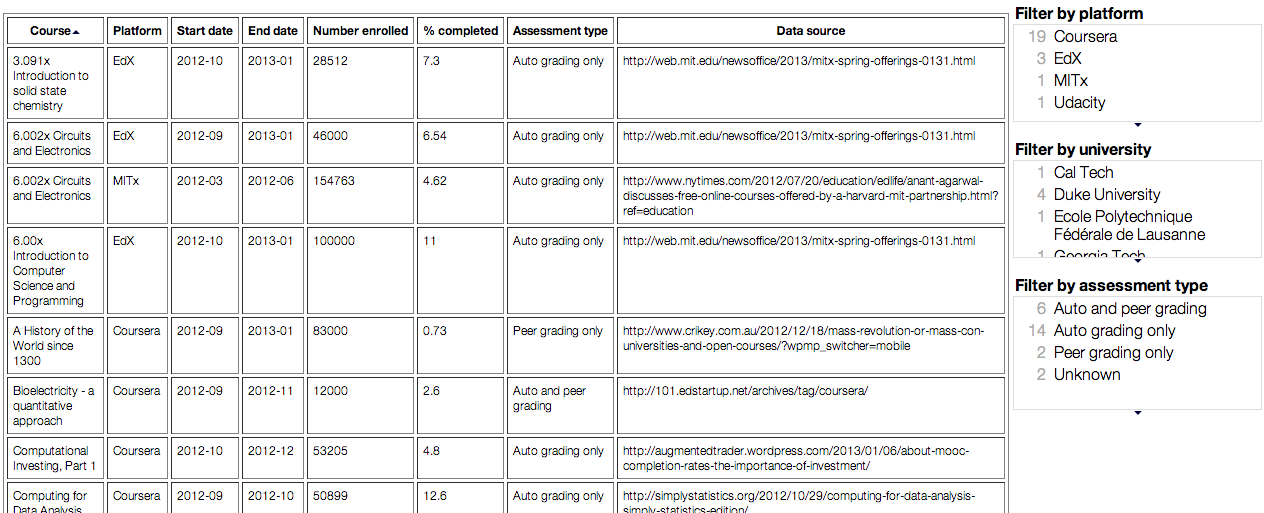
    My draft graph synthesising everything I’ve found so far can be found here: http://www.katyjordan.com/MOOCproject.html

    What Katy has done so far is compile completion rate data from 24 MOOCs – 19 from Coursera, 3 from edX, 1 from Udacity and 1 from MITx (a precursor to edX). The data is available in a table format or in a graph.

    table


    (more…)

  • OpenClass vs the MOOC

    When Pearson’s OpenClass was announced about a year and a half ago, the natural question to ask was whether it would disrupt the LMS market. But that was then and this is now. (Full disclosure: Pearson is a client of MindWires Consulting.) The more interesting question today is where OpenClass stands vis-à-vis the MOOCs. To begin with, it certainly appears that the LMS and MOOC markets may be on a collision course. But beyond that, Pearson is a content provider first and foremost. With both the content and the platform at their disposal, as well as an array of assessment tools, they certainly have all the raw materials to build MOOCs. Is that where OpenClass is going? I recently had a short conversation with Pearson’s SVP of Product, Adrian Sannier, to find out. And the answer appears to be, “Not exactly.”

    (more…)

  • Snapshot of LMS Market for Large Online Programs in the US

    The transformation of the higher education LMS market continues, and I expect more changes over the next 2 – 3 years. However, it seems time to capture a key segment of the market based on two recent announcements that directly impact large online programs.

    UMUC Selects Desire2Learn

    Following a multi-year strategic study and product selection, the University of Maryland University College (UMUC) selected Desire2Learn to replace the homegrown WebTycho LMS in use for over a decade. While there has been no press release, there are now official documents publicly available that describe this effort. Per the Faculty Advisory Committee (FAC) Newsletter:

    As announced last year, UMUC is planning to replace WebTycho with another learning management system. After a great deal of questions for the vendors, references checks and tests of functionality, Desire2Learn was chosen. More than 200 faculty, staff and students worldwide were part of the decision which was reported to have been by an overwhelming majority. The roll out will occur gradually over the next year or two. [snip]

    Not only is UMUC moving away from the WebTycho platform to the Desire2Learn (D2L) learning management system, but additional changes are in the works which will transform the online learning experience for our students and faculty.

    UMUC is part of the University of Maryland system, and it has a global focus – serving over 90,000 students worldwide.

    Mississippi Community Colleges Select Canvas

    The Mississippi Virtual Community College (MSVCC) provides the LMS for the system’s online program as well as for all 15 campuses. After a 6-month RFP process, MSVCC will be migrating from Blackboard Learn and Desire2Learn and implementing Canvas as the new LMS. From the press release:

    (more…)