
e-Literate

Present is Prologue

Category: Ed Tech

The “Ed Tech” category includes posts about educational technology products themselves, including LMSs and other learning platforms, adaptive learning and other digital curricular materials products, learning analytics, and educational apps of all types. It also includes technical aspects of ed tech products, especially interoperability.

  • Google Introduces Course Builder, an Open Source Project Targeted at MOOCs (but the Real Competitor Might Be Amazon)

    Google quietly made an educational technology announcement yesterday about the release of Course Builder, an “open source project” targeted at massive open online courses (MOOCs). This platform follows on the heels of Google’s own MOOC this summer. We should find out more information over the coming months, but here are my initial observations after reading the Research Blog on Google’s site:

    In July, Research at Google ran a large open online course, Power Searching with Google, taught by search expert, Dan Russell. The course was successful, with 155,000 registered students. Through this experiment, we learned that Google technologies can help bring education to a global audience. So we packaged up the technology we used to build Power Searching and are providing it as an open source project called Course Builder. We want to make this technology available so that others can experiment with online learning.

    We really shouldn’t be surprised at Google’s interest in the MOOC movement, since Peter Norvig, their Director of Research making the announcement, was one of the two professors at Stanford, alongside Sebastian Thrun, to develop and teach the influential Artificial Intelligence course (CS221). This course started the Stanford branch of MOOCs (also known as xMOOCs). Coursera and Udacity spun out as venture-funded startup companies based on the internal Stanford MOOC courses.
    (more…)

  • Clarification on Cloud, SaaS and Multi-tenant Language

    In several recent posts I have argued about the importance of cloud-based platforms, and Michael Feldstein has written some insightful analysis on the subject. Quite often the terms Cloud and SaaS (software as a service) are misunderstood, or at least used differently as the terms get redefined, which is common in technology markets.

    Last week I wrote a post that included a comment about Desire2Learn and their usage of cloud and SaaS terms.

    The terms cloud and SaaS, as used in Desire2Learn’s and NEA’s descriptions, tend to blur the distinction between Desire2Learn’s enterprise software virtualization model and multi-tenant platform models. Desire2Learn has made great strides in developing a virtualized cloud servers for business model that is not multi-tenant (where all or most clients run on the same defined application instance on the same version).  There are arguments that this issue only matters to the provider. I’ll write more on this subject in a subsequent post, but for now I’ll just point out that the cloud model used by Desire2Learn has significant differences with the model used by Instructure’s Canvas LMS, Pearson’s OpenClass, Lore’s platform, and the majority of new learning platforms coming out.

    John Baker, CEO of Desire2Learn, did not agree with this statement as shared in the comments.

    One key correction is that our Cloud or Software-as-a-Service (SaaS) solutions are multi-tenant. Multi-tenancy has been part of our solution for over a decade. It may also be important to point out that approximately 90 percent of our clients use our SaaS offering. We’d be happy to share more infromation with you and others on how we have evolved over the years.

    (more…)

  • Desire2Learn Raises $80 Million in First-Time Venture Capital Funding

    Desire2Learn has been around since 1999, and John Baker, CEO and founder of the company, has made it a point of pride that the company has grown to over 500 employees without external funding. From a financial perspective, however, the Canadian company just reversed its long-standing approach and raised $80 million in venture capital (VC) funding. From a strategy perspective, there are no changes – rather a plan to accelerate the corporate growth based on the existing strategy. This might seem to be a large investment for this situation, but Desire2Learn’s two VC investors clearly think the possibilities are just now emerging.

    The two venture capital firms behind the investment are OMERS Ventures, the VC arm of a Canadian pension fund, and New Enterprise Associates (NEA), one of the lead investors in Coursera and Edmodo. The $80 million is the 5th largest north american series A VC deal and the largest ever VC deal for a Canadian software company.

    (more…)

  • More Venture Capital for Higher Education: $10.75 million for rSmart

    On August 16 rSmart Group Inc. announced securing funding from Asahi Net Inc., GSV Capital Corp., and private investors. GSV investment advisor Michael Moe expressed confidence in the firm saying “rSmart is helping universities realize lower total cost of ownership and higher quality products that are easy to use. Most importantly, rSmart’s customers are becoming part of a sustainable, collaborative movement using solutions built by higher education for higher education. GSV wants to be part of this movement, and rSmart is the company to make it happen.”

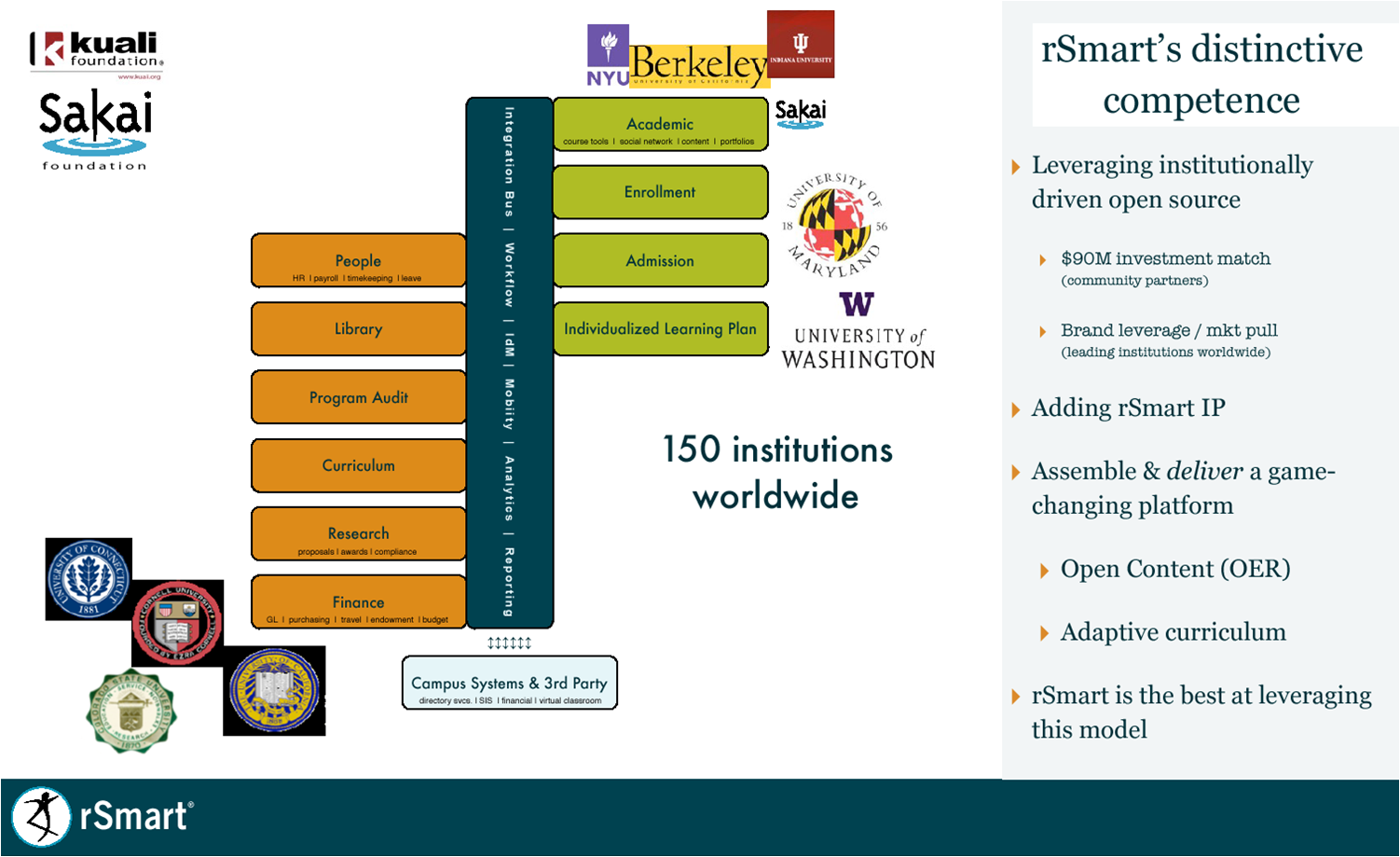
    rSmart is a more mature and experienced company than the 26 others who presented at the “sold out” April “Education Innovation Summit.” GSV Advisors and Arizona State University hosted the third annual Summit with presentations on innovation and by new companies seeking to enter the education market. (Presentations are available here; rSmart’s presentation is available here and here). rSmart has participated in the Kuali and Sakai open source software initiatives to meet the needs of colleges and universities. Moe lists open source as a major trend in education. rSmart also has had an international presence teaming with Asahi Net Inc. and its U.S. subsidiary in cloud services. rSmart Chairman John Robinson is a visionary with 35 years experience with innovative higher education software technology. rSmart is one of the first to contribute to software architecture that spans both administration and learning using current software design techniques and technology—a goal of the Kuali Foundation.

    (more…)

  • Bundling Textbook Costs with Tuition

    With all the talk about the “unbundling” of education, it’s interesting to see several universities start to experiment with a re-bundling of sorts — that is, bundling textbook expenses along with students’ course fees and tuition, and as such requiring students purchase the course materials (often in digital format) for their classes. In doing so, the schools argue, they’re able to negotiate lower prices with publishers by promising bulk sales of textbooks and other materials.

    Indiana University was among the first to pilot this sort of program several years ago, and similar efforts are underway at other schools. According to a recent story in USA Today, this includes the University of California-Berkeley, University of Minnesota, University of Wisconsin, University of Virginia and Cornell University.

    It’s an experiment that seems to be catching on with schools, with bookstores, and with publishers. The latter are looking to survive the shift from print to digital; the former want to help students afford the materials they need to do well in their classes.

    (more…)

  • ANGEL LMS: Dead or Alive?

    After the recent news of two significant ANGEL LMS customers leaving for other vendors – Washington State Board of Community and Technical Colleges selected Instructure’s Canvas LMS in the spring, and Michigan State University selected Desire2Learn’s Learning Suite in the summer – there is an interesting question of whether ANGEL is still a viable LMS solution, at least for current clients.

    ANGEL was created at Indiana University Purdue University Indianapolis in 2000, and after a successful 9 years Angel Learning, the company behind ANGEL, was purchased by Blackboard in May 2009. Shortly after the purchase, Blackboard announced they would place ANGEL in end-of-life status by 2014. This decision to end ANGEL, along with a similar decision for WebCT product lines, has been fueling a large percentage of the LMS market churn over the past 2 – 3 years (more from WebCT than from ANGEL, however).

    In March 2012 Blackboard changed their strategy – no longer pushing all new “acquired” customers to migrate to the Learn 9.x platform, and instead looking to support multiple LMS solutions. The least discussed part of the March announcements was the decision to cancel the end-of-life notice for ANGEL. As described in an open letter to the community from Blackboard:

    (more…)

  • Michigan State University Moves from Blackboard’s ANGEL LMS to Desire2Learn’s Learning Suite

    Michigan State University has been one of the most well-known implementations of the ANGEL LMS for the past 9 years. Penn State selected ANGEL in 2001 under an agreement that also provided the school perpetual access to the source code. The next major higher education institution to select the LMS was Michigan State in 2003, essentially putting ANGEL on the map as a significant LMS solution to compete with Blackboard, WebCT and Desire2Learn (which won the University of Wisconsin System contract in the same year).

    After a selection process triggered by the 2009 Blackboard acquisition of Angel Learning (parent company of ANGEL), Michigan State announced a decision at the end of July 2012 that the school will migrate to Desire2Learn’s Learning Suite as the new LMS. As described in The State News article:

    After many technical difficulties, lost homework assignments, complaints and deliberation, MSU announced Tuesday the selection of Desire2Learn, or D2L, as the university’s new online learning management system, or LMS.

    Blackboard’s purchase of the company that built ANGEL in 2009 was the push for MSU to officially start looking for a new LMS, Brendan Guenther, director of teaching and learning support teams in MSU Information Technology, said.

    MSU considered proposals from two systems to potentially replace ANGEL: Blackboard and D2L.

    (more…)