e-Literate

Present is Prologue

Category: Ed Tech

The “Ed Tech” category includes posts about educational technology products themselves, including LMSs and other learning platforms, adaptive learning and other digital curricular materials products, learning analytics, and educational apps of all types. It also includes technical aspects of ed tech products, especially interoperability.

  • How Do You Choose Your Textbook?

    This is a question for e-Literate readers who are teachers. I’m trying to understand how instructors in different disciplines choose their books for a class. My sense is that it varies widely by discipline. For example, my wife teaches a lot of English Composition, so the didactic manual isn’t as important as the anthology of short stories and/or essays. I would imagine that her selection criteria for a good anthology would be quite different than, say, a macroeconomics professor looking for a good textbook. And the macroeconomics professor, in turn, might have very different criteria than an art history professor.

    All of this matters because it will have a profound influence on how content is digitized, disaggregated, and made available under open licenses. The change is likely to be different discipline by discipline, depending on how well the decision process of the faculty works in the new digital world. Many composition teachers would probably like a world in which they could assemble their own anthologies. On the other hand, if you’re an economics professor who tends to use Greg Mankiw’s book because you like his overall take on economics, a disaggregated, digital world might offer you a different set of pros and cons.

    So I’m asking: How do you choose your texts for class? Do you go by publisher/brand? By author? Do you look for a particular theme? Do you think about cost for the students, or open licenses? Is convenience a factor? Please let me know in the comments thread, and please don’t forget to tell me what subject you teach as part of your answer.

  • A Big Vista to Blackboard 9.1 Win

    Following up on my two-part series on the changing LMS market, I am going to write short posts noting LMS evaluation decisions of Vista, Blackboard Enterprise, and select ANGEL customers (as well as any others that seem noteworthy) when I hear of them. Today, via Ray Henderson’s tweet, I note that the San Diego Community College District (131,403 students) has chosen to migrate from Vista to Blackboard 9.1.

  • The Evolving LMS Market, Part II

    I have gotten a lot of very nice compliments in the last 24 hours about the first post in this two-part series. I do want to emphasize that a huge portion of the value in that post comes from the great survey work that Casey Green does. All I did was tease out a few implications and make a few new graphs (which, I admit, were very pretty). If you want to see analysis like this continue in future years, then support the Campus Computing Project.

    In this next part, we’re going to go “off-road” a little and see what we can figure out in areas where we don’t have quantitative data that is as solid as Casey’s. As I wrote in the previous post in this series, there are roughly 875 WebCT and ANGEL customers who will have to migrate to a new LMS in the next few years, in an environment of strong budget pressures. This creates an atmosphere in which more and different schools may be in play than has typically been the case. But evaluating options and choosing to move are two different things. What happens in the next few years is likely to shape the LMS landscape for years to come, at least in North America.

    Let’s see if we can read the tea leaves.

    (more…)

  • The Evolving LMS Market, Part I

    As Casey Green said in my recent interview with him, the LMS space is a “market in transition.” In 2005, the year that Blackboard acquired WebCT, the two platforms had a combined total of 75.6% U.S. higher education market share, and the next closest competitor had barely cracked 2% market share. Today, the situation is substantially different and changing rapidly. But the narratives around exactly what’s happening tend to be off. Typically, I hear the frame as being a contest between Blackboard and “open source.” Has “open source” (by which we mean Moodle and Sakai, the two open source LMSs with significant market share in the United States) made inroads into the market?  If you read what the majority of sell-side financial analysts ((Sell-side analysts are financial analysts who work for major brokerage houses and provide stock analysis to retail investors. Comments by analysts that you read in business news articles are typically from sell-side analysts.)) are writing, you may see the claim that “open source” is not putting a major dent in Blackboard. If you talk to Moodle or Sakai advocates, you might hear that they are crushing the company in sales. Neither account is really capturing what’s happening in the market, so I’m going to try to explain what we know about what’s really going on in a two-part series. In this post, I’ll talk about what the data are telling us so far about the recent shifts in the market, describe how colleges and universities come to decide that they need to go to market for an LMS, and assess the degree to which we may see an uptick in the number of schools that decide to look around and evaluate their options. In the second post, I’ll describe how the next four years of market transition may be different than the previous four and what signs we should be watching for to see which way the market is going to break.

    (more…)

  • The CDW-G 2010 Annual Surveys: CIOs and Faculty Differ on Education Technology?

    This is a guest post by Jim Farmer. Jim is Chairman of instructional media + magic.

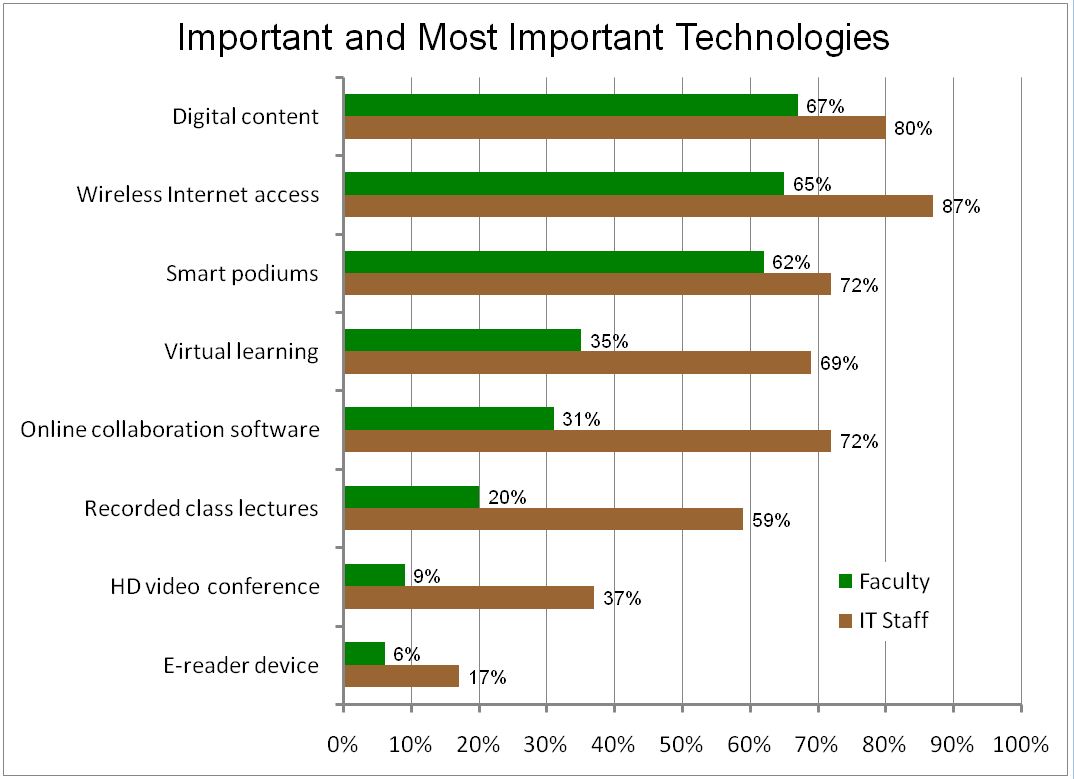
    Interpreting the CDW-G 2010 survey summary report, Campus Technology magazine concluded: “Faculty members and campus IT staff aren’t exactly in agreement on the necessity of some technologies in education.” The can be interpreted to show CIOs consistently rank the individual technologies higher than faculty. Summary data from the CDW presentation is shown in Figure 1.

    The real innovation in higher education it is not the technology itself. This may seem obvious now, but it wasn’t in the past. It’s a recent revelation that comes with changes in the roles of IT staff and faculty in innovation with technology for teaching and learning and in IT organizations and departments on campus.
    Trent Batson in Campus Technology, 2 June 2010

    In July the “2010 21st Century Campus Report: Campus 2.0” was released at the Campus Technology conference held in Boston. Sponsor CDW-G is “a leading source of Information Technology (IT) solutions for education, government and business.” Their report was a series of summary slides from the survey data.

    But the data may suggest a different interpretation.

    (more…)

  • Blackboard, Ray Henderson, and Progress

    When Blackboard acquired ANGEL back in May of 2009, there was a lot of noise about how the acquisition was going to change the company. I wrote a post then called Three Tests for the ‘New’ Blackboard, which outlined some indications I was going to be looking for to see whether there was substance behind the hype. The first sign I got that something was changing happened within days (hours?) of my publication of that post, when Ray Henderson publicly accepted my challenge on Twitter. How well have he and Blackboard done since then?

    Really well, actually:

    • Challenge 1, drop the patent suit: Done. To be honest, I did not expect this to be the first one ticked off the list. But it was. Blackboard and Desire2Learn settled in December of 2009.
    • Challenge 2, support IMS Common Cartridge, including export: Done. I wasn’t following this too closely, so I don’t know exactly when this was released, but some time this year Blackboard provided full support for IMS Common Cartridge, including export.
    • Challenge 3, support IMS Learning Information Services: In Progress. Yesterday, Ray Henderson declared in a blog post that Blackboard is “committed to supporting” LIS. To my knowledge, this is the first time that Blackboard has made an unequivocal, public commitment in writing to implement the standard. This declaration has been backed up by activity in the LIS working group that indicates Blackboard is actually taking steps to implement the specification.

    If Blackboard succeeds in implementing LIS by the 2011 IMS Learning Impact conference, then Ray will have met all three challenges within 24 months of coming to Blackboard. That’s pretty impressive.

    Update: I received an email response to this post from Ray (who is at an IMS meeting today), which I reprint in part here with his permission:

    1. Common Cartridge: we actually have NOT shipped this, just demo’d it. My public statement was to show progress at the 2 IMS meetings this year, and ship by end of year. We’re on target for that.
    2. IMS Basic LTI: this was another area I clarified earlier–that we’d ship LTI. We got conformance cert at this meeting. And so we’ll ship that too, by end of year.

    Related story: I mentioned in my blog a mega relationship between Bb and McGraw. We really are using basic LTI as a production technology — and one for a major strategic partner — in 2011. Adoption is key, and I’m delighted to see it brewing up.

  • Sakai Board Platform — Josh Baron

    This is a guest post by Josh Baron, a nominee in the 2010 Sakai Foundation Board of Directors election. His bio and platform are available here.

    Challenges and Opportunities

    As I look toward the horizon I see challenges, but believe that these also represent opportunities for Sakai, both the product and community, if the right strategic path it charted.

    The Challenge and Opportunities of a Two Product Community: The Sakai Open Academic Environment or OAE (the system previously known as Sakai 3) represents a bold step towards evolving not just Sakai but more fundamentally the LMS/VLE as we know it today. At the same time, thanks to the work of many dedicated community members, we are ever increasing (to barrow a phase from Dr. Chuck) the “awesomeness” of the Sakai CLE (2.x). This parallel effort are both evidence of our community’s core value to seek out and drive towards innovation, but also poses challenges with regards to resources, communication and governance. How do we (the community) organize the resources to maintain two products over the long term? How do we talk about our two products to those considering adoption? How do we move the “managed” project that the Sakai OAE represents today to a more “organic” development model over time? Although these parallel efforts raise challenging questions, they also represent a tremendous opportunity to affect not only change in the LMS/VLE market space but to fundamentally transform teaching, learning and research in ways that help academia meet the many challenges confronting it over the coming decades.

    The Challenge and Opportunities of Sustainability: Like many of our institutions, Sakai is now operating in the “New Normal” of shrinking budgets and rising expectations. Whereas institutions 3-4 years ago, some who had not even adopted Sakai, became members of the Foundation as means to demonstrate support for the concept of open-source, few have this luxury of resources today and as a result we have seen revenues decline. We, as a community must now justify the “value proposition” for becoming a member of the Foundation which is a challenge to an organization that is based on principles of openness and inclusion. At the same time, the realities of the “New Normal” hold the potential to drive us and our colleagues in other open-source higher education communities to consider new alliance that a few years ago may have not been considered priorities. A tangible example of this opportunity is the Sakai-Jasig alliance that was recently announced, which- I believe, will lead to a more sustainable future for both organizations.

    The Challenges and Opportunities of OER: I believe that the Open Educational Resource (OER) movement represents the next “grand experiment” in open-source development and will bring both tremendous opportunity as well as challenges to Sakai, as well as academia as a whole. The ability to share, remix and redistribute open educational content (e.g. courseware, journals, instructional software, etc.) within Sakai could transform education as we know it; freeing instructors from endlessly re-venting content, dramatically reducing costs of instructional materials and facilitating self-directed learning that could empower a new generation of students. Achieving this will require addressing technical, coordination and adoption challenges related to bringing OER materials into the Learning Management System. Although these challenges are far from trivial, the values we hold as a community position Sakai well to play a leadership role in making this opportunity a reality.

    Sakai in Three Years

    As I look to the horizon, I see a new era in the history of the higher education open- and community-source movement; an era in which a suite of innovative and mature software “built by education, foreducation”, encompassing everything from infrastructure to application, will exist. This mature “open”software stack will allow us to leverage and support the Open Educational Resource movement instrategic ways; providing our users with robust, rich and re-mixable content and an infrastructure tocreate powerful new learning experiences with it. The benefits, if realized, could go well beyond Sakaiand become a global transformative force in education.

    More specifically, over the next three years I believe Sakai will have demonstrated a new approach toproduct transition with institutions introducing, through “hybrid mode”, the new capabilities found inthe Sakai OAE gradually and based on user needs and desires. This model will be in stark contrast tothe traditional vendor “big bang” approach of “sun-setting” a product on their terms rather than thoseof their clients. I firmly believe that the Sakai CLE will continue to mature and compete strongly in thetraditional LMS space while at the same time we will see the maturing of the Sakai OAE and the initialrealization of its potential to transform teaching, learning and research. The Sakai OAE’s transformativepowers will be derived from the core design values it has embraced, many of which are outlined in the Learning Capabilities Design Lenses. These include its support for “openness” in all of its forms, supportfor academic networking, and rich collaborative content authoring capabilities.

    Beyond the future of our products, I believe our community will continue to grow and mature, boththrough our internal processes as well as through our plans to merge with Jasig. Today we have severalemerging new governance structures, including the “managed project” model being used by the SakaiOAE Steering Committee and the newly formed Technical Coordination Committee (TCC). Theseapproaches to self-governance will mature to become established community practices that will help us manage the development challenges that we will face as a multi-product community.

    Steps That We Must Take

    As I’ve outlined above, the road ahead is filled with both challenges and opportunities. To realize ourpotential over the next three years our community, with strategic leadership from the Foundation and Board, will have to address a number of key issues.

    Foremost for the Board is the need to ensure that we have a long-term sustainable financial modelfor the Foundation and our products. On a strategic level, I believe this will include the need to formalliances across other open-source initiatives. Whereas some alliances may be along the lines of thework going on to merge with Jasig, others may be lighter weight and more focused on shared servicesand/or alignment of missions. For example, forming an overarching alliance among the majority ofopen-source communities could create a single point of contact and reference for institutional decisionmakers and allow us to speak with one voice with regards to the value of open source. Such an alliance would not, in my mind, involve a merging of projects/initiatives nor an effort to bundle our products “ala” a proprietary vendor model, but instead simply represent an aligning of our message and missionsacross projects.

    On a more operational front, which is the clear domain of the Executive Director and Foundation staff,we will need to seek new models for membership. This may include, for example, approaches whichencourage membership among those institutions hosted by Sakai Commercial Affiliates as means tomaintain and possibly grow the revenue stream for the Foundation. In addition, we need to work toreposition the “value proposition” for institutions on the benefits of becoming members. This mightinclude the introduction of things such as new awards programs, (e.g. best new implementation thisyear,) for which only member institutions and commercial providers are eligible.

    Last but not least, the Board and Foundation must work to facilitate the maturing of community-drivengovernance models. We have learned from the past few years that the introduction of governancestructures from the “top down” have not been successful, yet expecting the community to self-organizewithout support or encouragement has also been an issue. I would like to see a new approach in whichgovernance issues are identified by the community with the Foundation staff then providing necessarysupports to help the community move to address them. The Sakai OAE’s “managed project” model maybe a good example of how this might happen as the Foundation Executive Director is now serving asco-chair of the Steering Committee with the Foundation helping to facilitate certain financial and legal tasks.

    Final Thought

    As we travel the road ahead we will be faced with major challenges including how to sustain, govern andcoordinate our community efforts. We will need to seek new solutions, from alternative funding modelsto alliances with other communities around shared services, values and common needs. I believe thatmy experience and passion for Sakai strongly positions me to help chart the course toward a futurewhere Sakai transcends our software and community; a future in which our efforts have revolutionizedacademia as we know it today. Though this task is a tremendous challenge, it is one I am prepared forand confident I can contribute to through my dedication, knowledge and leadership.