
e-Literate

Present is Prologue

Category: Ed Tech

The “Ed Tech” category includes posts about educational technology products themselves, including LMSs and other learning platforms, adaptive learning and other digital curricular materials products, learning analytics, and educational apps of all types. It also includes technical aspects of ed tech products, especially interoperability.

  • Higher Education Recession: A new role for information technologists?

    This is a guest post by Jim Farmer. Jim is Chairman of instructional media + magic.

    Monday, 11 October the Browne report, “Securing a Sustainable Future for Higher Education,” was released in the UK. ((A copy of the Browne report is available here. Information from the JISC CETIIS Conferences can be found at the JISC web site. Inside Higher Education referenced the Times Higher Education article describing both the report and reaction—largely critical. There was also a separate commentary by editor Doug Lederman.)) If implemented there will be major cuts in funds available to U.K. universities and higher tuition for students. The combination of less funding and higher enrollment is also the new future in the U.S. Even more and bigger funding limits are expected next year. A combination of lower state revenues, higher costs, and limits on federal funding when stimulus funds will no longer be available will impact available funds..

    Although UK universities pleaded, and continue to plead, for more funding, the Joint Information Systems Committee began quietly more than 5 years ago to develop a capability for information technologists to contribute to a unified managed IT service for better university planning.
    (more…)

  • Interview with Martin Dougiamas

    Here it is! All about the past, present, and future of Moodle:

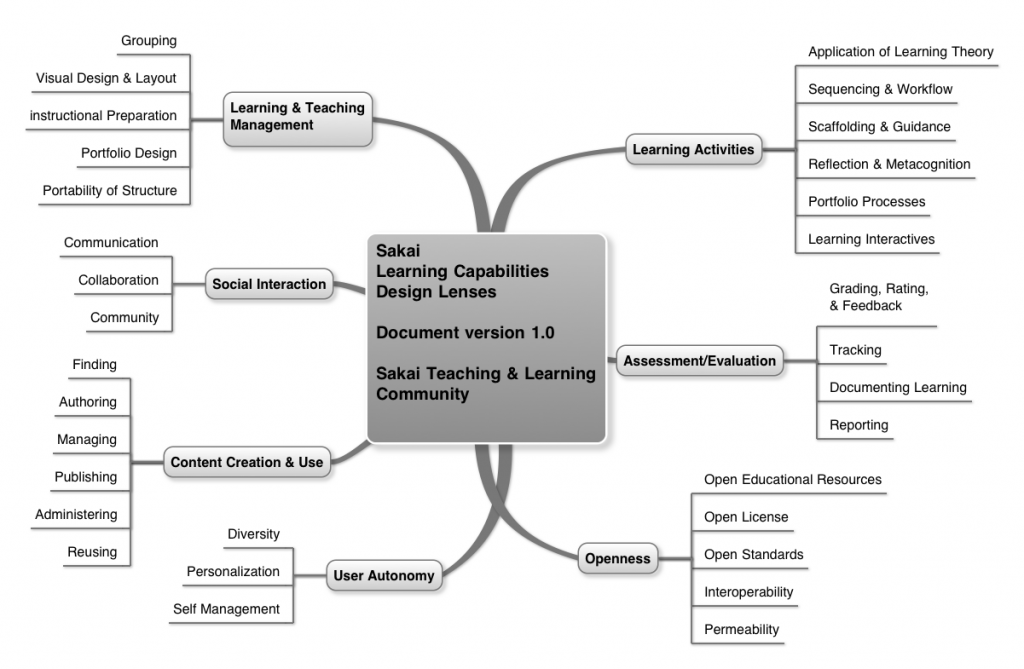
    It’s interesting to compare Moodle’s trajectory with Sakai’s. On the one hand, there’s evidence that the Moodle and Sakai communities are moving toward each other in terms of vision. The design principles that Martin describes as having guided Moodle development from the beginning are similar in approach and overlapping in content with the “lenses” that the Sakai community is adopting to guide Sakai 3 design:

    Sakai Learning Capabilities Design Lenses
    Sakai Learning Capabilities Design Lenses

    At the same time, the description that Martin gives of his early thinking about the design goals for Moodle 3, as well as its relationship to current-generation learning management, is quite similar to the path that the Sakai community has taken with Sakai 3, particularly vis-a-vis Sakai 2.

    On the other hand, the Moodle and Sakai sustainability and governance models are quite different from each other and show no signs of converging. Moodle’s model puts a company with a strong central manager in charge of most core development. Money flows from adopting schools, through Moodle support partners, and into Moodle Pty., under Martin’s direction, to pay for the core developers. Sakai, in contrast, works on a consortial model with a foundation at its center. Both approaches have pros and cons, but the point is that they are quite different and have different risks for adopting schools to manage. We tend to talk about the choice between private source and open source as if the latter were monolithic, but actually there’s huge variety in the ways that these projects work. You have to evaluate the strengths and risks associated with each open source support ecosystem individually, just as you would evaluate the strengths and risks associated with each private source vendor individually.

    Anyway, many thanks to Martin for an illuminating discussion.

  • Interview With Casey Green

    The 2010 Campus Computing survey is out, and it’s chock full of interesting information. I was fortunate to be able to sit down with Casey Green, the Founding Director of the Campus Computing Project, and talk about some of the highlights and a few related topics. I apologize for the abrupt ending; my camera ran out of disk space in the middle of Casey’s last answer. In any event, there’s good stuff here about the transition happening in the LMS market, the challenges of getting good survey data, ((Many thanks to the ever-thoughtful Scott Siddall for suggesting this line of inquiry.)) and more.

    You should definitely also read the survey report. It covers a lot of topics that we didn’t even touch on in the interview.

  • New Blog About SOA and Higher Education from Oracle Employees

    Some Oracle colleagues and I have started a new blog about service-oriented architecture (SOA) in higher education in general and with regard to Peoplesoft Campus Solutions in particular. ((The usual disclaimer applies: The views expressed on that blog (like this one) are solely the authors’ own and do not reflect those of Oracle Corporation.)) We’re just getting started and would love to hear from people about what they’d like us to write about.

    Check it out: http://serviceorientedcampus.com/.

  • Pre-EDUCAUSE Announcements and Other Odds and Ends

    We’re in that period leading up to EDUCAUSE when everybody makes their big announcements. Two caught my eye as being relevant to e-Literate; I’m sure there will be more.

    First, Blackboard announced some improved integration of Wimba and Elluminate with competing LMS platforms. I argued previously that there’s good reason to believe that they would live up to their promise of continuing to support such integrations, and now we have the evidence. Several Wimba products now support the cross-platform IMS Basic LTI integration standard, and Elluminate now has a new (or improved?) Moodle-specific integration connector. As Blackboard continues to widen their portfolio of products, I think you’ll see more and more about them actively working with competing LMS providers.

    Second, Desire2Learn announced progress on their mobile support. I’ve been meaning to blog about their efforts in this area since they announced their plans at their conference this summer, but I just haven’t managed to get around to it before now. Like Blackboard and Moodle, D2L is pursuing a belt-and-suspenders approach to mobile by building out both phone-specific apps (Blackberry and iPhone for sure; they’ve hinted about Android but I don’t know if they’ve announced anything about it explicitly yet) and a device-independent HTML-based mobile interface. As I have written before, this strikes me as an expensive strategy. But I guess if you can’t be sure which way the market is going to go in an important area like mobile, you invest the resources necessary to hedge your bets. Anyway, what I appreciate about D2L’s current press release is that they tell you exactly what subset of LMS functionality their mobile interface supports. None of these mobile apps are going to do everything that their native interface does at this point, and the details can really matter. I’d love to see a feature list like this one from all the LMS providers.

    I’ll be at EDUCAUSE on Wednesday and Thursday and hope to come back with some tidbits and possibly some interviews to share. If you want to try to catch up with me while I’m there, your best bet is probably to go to the community source reception.

    One last non-EDUCAUSE-related tidbit: If you haven’t watched Robert Scoble’s interview with Blackboard’s VP of Mobile Kayvon Beykpour, you should. Beykpour founded the company Terribly Clever that Blackboard acquired for its mobile academic portal. In the interview, he proves himself to be…well…terribly clever. He has some interesting insights into where the academic mobile space is going, and Scoble does a good job of asking the right questions.

  • The Sakai/Jasig Merger Proposal

    You may or may not have seen the recent press release with the headline, “Jasig and Sakai Foundations to Pursue Merger.” It’s a big deal. I am on the joint Sakai/Jasig committee that put this proposal together, and I’m pretty excited about it. I’d like to fill you in on what the deal is and why, in my personal opinion, it’s a really good idea.

    (more…)

  • Migrating to Sakai

    When I speak to people from schools that are currently involved in an LMS selection process, I very often hear the following assumptions and line of reasoning:

    • Sakai 2 hasn’t set the world on fire, and anyway, it’s going to be replaced by Sakai 3 soon.
    • But Sakai 3 isn’t ready yet, and we aren’t sure exactly when it will be ready or how to go about evaluating it now.
    • Since we have to make a decision soon, we are going to have to forget Sakai as a candidate.

    This is a reasonable and understandable train of thought, but it is built upon mistaken beliefs about Sakai 2, Sakai 3, and the relationship between the two projects. The Sakai community has a vision and a plan that ensures both Sakai 2 and Sakai 3 will remain healthy and under active development for some time to come. In fact, far from being merely an awkwardly timed product transition, the two-product approach the community is taking actually provides what I believe is a unique strategy in the LMS space for supporting schools’ present needs, fulfilling their vision for their future, and providing a path from one to the other. Rather than being a reason to dismiss Sakai from consideration, the Sakai 2/Sakai 3 dichotomy is actually reason to look at the Sakai community and family of software especially closely.

    (more…)