e-Literate

Present is Prologue

Category: Ed Tech

The “Ed Tech” category includes posts about educational technology products themselves, including LMSs and other learning platforms, adaptive learning and other digital curricular materials products, learning analytics, and educational apps of all types. It also includes technical aspects of ed tech products, especially interoperability.

  • SunGard Delivers Sakai Support Through rSmart Partnership

    This is pretty big news. SunGard will be providing Sakai support services to its customers. If you’re interested in Sakai, you can contract with SunGard to get help migrating, setting up integration, and training faculty, as well as ongoing hosting and support. They’ll be doing this, in part, through a partnership in which rSmart is basically subcontracted by SunGard to provide the hosting and support subscription services. This is great news for both companies, SunGard’s customers, and the Sakai community in general, the latter of which I expect to expand substantially because of this development. But this also provides a textbook case of just how well open source and open standards can work to provide better offerings in the marketplace when they are working well. People who don’t have experience with them—particularly with open source—often scratch their heads at how they can possibly work out. In fact, open source allows for the unbundling of services that are typically tied together in a private source vendor model, opening up new possibilities for business models and risk management strategies. Open standards enhance that flexibility while creating new opportunities for collaboration among even competing vendors.

    Let’s take a closer look at how this deal works for each of the parties involved.

    (more…)

  • Great OER Presentation in Eastern Mass Next Week

    My good friends and fellow SUNY escapees Steven Zucker and Beth Harris will be giving a talk about their amazing art history open educational resources website smARThistory on Friday, October 1st at UMassOnline. There are several reasons why this talk is worth attending. First, smARThistory is simply one of the best OER collections I know of, both in terms of the quality of the individual OERs and in terms of the extensive scaffolding on the site to help both teachers and students weave the content together into coherent and personalized curricula. Second, Steven and Beth are both great, highly entertaining presenters. And third, there probably will be food.

    Register here.

  • The Future of the LMS

    Here’s the ninety-minute video and slides from a presentation I made to UMassOnline ((For other presentations in the UMassOnline speaker series, as well as a list of upcoming speakers, see https://confluence.umassonline.net/display/OBS/Speaker+Series.)) last month called W(h)ither the LMS?

    It’s a fairly institution- and enterprise-centric vision, but it has the potential to cohabitate rather nicely with more distributed, informal personal learning networks. Formal and informal educational paths should co-exist and cross each other in a seamless ecosystem, rather than being walled off from each other.

    It’s a shame that the video doesn’t capture the technology demo. I’ll try to get a screencast up at some point.

  • How to Sell a Migration to Moodle

    The folks at Wesleyan University have a blog up that is a stellar example of how to evangelize for an LMS platform to faculty when you’re facing the front end of a migration. ((Another great example is UNC’s Sakai pilot blog.)) For starters, their FAQ is rich with information, including analysis by peer schools.

    Here’s a sample:

    (more…)

  • Social Learning and the Re-bundling of the College Experience

    Just a couple of hours after I posted on social network analysis and the LMS, Scott Wilson tweeted about an article from Wired Magazine that he correctly identified as having serious implications for social learning. An economic sociologist from MIT used social network analysis to show that behaviors spread more quickly in social networks of clustered close connections.

    Clustered and diffuse network maps
    From Wired Magazine

    (more…)

  • Social Network Analysis and the LMS

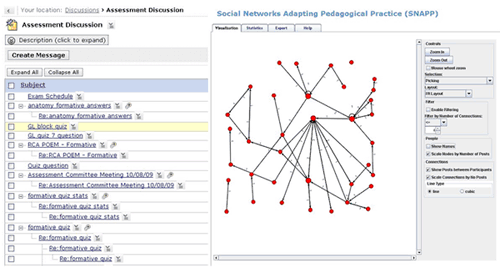
    Many thanks to George Siemens for pointing out SNAPP: Social Networks Adapting Pedagogical Practice. This is something I’ve been urging various LMS communities to  build for seven or eight years (since I was involved with dotLRN). SNAPP extracts information from the discussion boards in your LMS course and provides social graphs that help you to visualize interactivity.

    Example layout of discussion forum posts and replies in a learning management system, and the same discussion as a network diagram using SNAPP
    Example layout of discussion forum posts and replies in a learning management system, and the same discussion as a network diagram using SNAPP

    It works with Blackboard, ANGEL, Desire2Learn, and Moodle (but not Sakai). The mechanism by which it works isn’t entirely clear from the project site, but it looks like you use a bookmarklet to call a web service hosted elsewhere while browsing the discussion forum you want to analyze.

    There’s quite a bit that you can do with a tool like this. Here are some applications that the SNAPP site suggests:

    (more…)

  • Restructuring higher education: NCES Stats-DC 2010 Conference

    This is a guest post by Jim Farmer.

    As you know, the Statewide Longitudinal Data Systems program is funding states’ work to improve their data systems. Over the past four years, 41 states and the District of Columbia have received more than half a billion dollars from this program. It has supported states as they link data from preschool, K-12, and postsecondary education. In some states, it supports their work to track students into the workforce. We’re committed to helping all states.

    Keynote presentation – Secretary of Education, Arne Duncan

    For 40 years institutional and policy researchers and information technologist have met with staff from the U.S. Department of Education’s National Center for Education Statistics to learn and advise on NCES data collection efforts. NCES is a source of useful statistics on K-12 and higher education. As described by Secretary Duncan, this year NCES staff and consultants provided detail data on the anticipated changes in higher education being implemented through the state agencies and conditions for any federal funding.

    At last year’s STAS-DC conference the primary focus of the 600 participants was qualifying to receive federal grants to develop statewide longitudinal data systems (SLDS). The $500 million was for in grants to state education agencies. Higher education did not receive any of those funds directly or via the state higher education executive officers.

    Now NCES has become the leader of perhaps the largest information technology (IT) implementation ever attempted in the U.S. It spans 4.339 colleges and universities and 98,916 public schools with annual revenue of $1.1 trillion. The Stats-DC 2010 conference, held 26-30 July in Bethesda, Maryland, focused on this implementation.

    This year’s conference provided evidence of the Department’s perspective of higher education and the requirements that would be placed on public colleges and universities and incentives for private non-profit and for-profit colleges to participate as well. Statewide Longitudinal Data Systems (SLDS) have become an unfunded mandate for higher education through new state-required data reporting requirements and data exchanges among colleges, universities, and schools. States that received funding agreed to build state-level data warehouses of these data; the model was centralization within each of the states or the use of servicers.

    In the long term higher education will be restructured by the metrics used to represent the success of college and university management and teaching faculty. The Stats-DC Conference offered an opportunity to learn the underlying assumptions about education and perception of the value and use of data. A caution: The U.S. Department of Education has a number of knowledgeable, dedicated, and hard-working educators. This is also true of the state education agencies. But the design and beginning implementation of a national education data system within the available time does not permit the thoughtful planning that would have reduced the risks of unintended consequences.

    (more…)