e-Literate

Present is Prologue

Category: Ed Tech

The “Ed Tech” category includes posts about educational technology products themselves, including LMSs and other learning platforms, adaptive learning and other digital curricular materials products, learning analytics, and educational apps of all types. It also includes technical aspects of ed tech products, especially interoperability.

  • Moodle Developer Martin Dougiamas Honored at OSCON 2008

    This is a guest post by Jim Farmer.

    Martin Dougiamas was named Best Education Enabler at last week’s OSCON (Open Source Conference) 2008 in Portland. The Google-O’Reilly Open Source award was made for his contribution to Moodle, an open source learning system. This is the first year anyone from education was nominated for the annual awards.

    Other awards this went to Chris Messina as Best Community Amplifier, Angela Byron, as Best Contributor (Drupal), Andrew Tridgell for Best Interoperator (Samba and Rsync), and Harald Welte, gplviolations.org, as Defender of Rights.

    Accepting the award for Dougiamas, Remote-Learner.net CEO Bryan Williams “Thanked Google and O’Reilly for the award and their support of Moodle, and expressed Martin’s regrets for not being able to attend the conference in person. He was honored by this award.”

    “Moodle has a vibrant community of teachers, professors and business trainers collaborating on ways to improve learning. Moodle.org has become a real community of practice over the years for the advancement of online instructional design and student management.”

    The Moodle Foundation is located in Perth, Australia. Remote-Learner.net is a Moodle Partner.

  • SIS to Facebook Direct. Introducing Schools on Facebook.

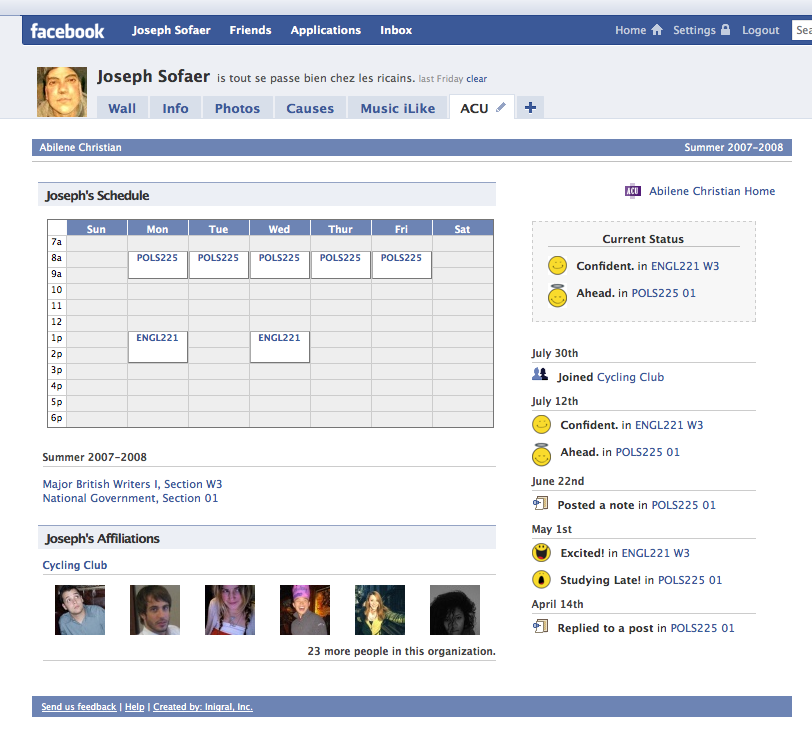
    tab_view.png
    Hi!  I’m Michael Staton and I’m a guest blogger.  What I say in no way represents Michael Feldstein or his ancestors.  Also, our screenshot here is of our app with Abilene Christian University, a school known for being a thought leader in instructional technology and mobile learning products. (They give their students iPhones.  No, really.  They do.)  I am also not representing ACU, its trustees, nor their ancestors.

    So, as I said yesterday, Oracle’s had a short few partners for this upgrade.  With the others included being mainstream LMS systems, you might wonder why Oracle would bother with an upstart like Inigral who hasn’t even invested in a good marketing site.  I hope to answer that question here.  If you read Michael’s blog often, this post will be of interest to you.

    We are introducing a product we’re calling “Schools on Facebook” (in private beta) that is a private, secure application (on Facebook) that can be skinned with a schools branding and connect with their current technology infrastructure.  It doesn’t compete with but complements CMS and LMS systems by focusing on socialization and relationship building; more on how below.

    It’s a cliche when a start up claims to revolutionize this or that.  So, at Inigral we try to stay realistic: we’re focusing on adding a social layer to what already exists.  We want to change the conversation about the internet in education from one of using the web to “manage courses” to one about using the web to facilitate the relationships that develop on campuses already.  After all, a real learning environment is one built on the mortar of person-to-person exchange.   Why not have an application that focuses on that?

    No software is a better example of this than Facebook, which took your campus by storm less than four years ago.  Students started engaging in high-frequency, (some might say mindless) contact that seemed to help students connect with their peers to build and maintain relationships throughout their campus experience.   And you never even paid for it.  Some of you[r colleagues] (not you, you’re too savvy for that) even talked about shutting it out.  But as time went on more of you (and you were early on this one) started to realize what Nicole Ellison documented in her research: that Facebook magnifies the “connectedness” that people feel to your school, one relationship at a time.

    Students use Facebook to represent their identity, and they fill out all sorts of information to that end.  Our product, Schools on Facebook, delivers course schedules, majors, organization memberships and other on campus affiliations to Facebook.  It also shows that “campus safe” identity to classmates and instructors, which helps to build conversations by introducing “primer” information,  i.e. “I see you’re a member of the economics club, are you planning on being an economist?”

    Students use facebook to talk about school all the time, our application just enables a students’ course information to be a part of those conversations.  It also enables contact between faculty and classmates who are not “friends” with a student on Facebook.  Faculty that have ventured on to Facebook have struggled with whether or not to be “friends,” and the safest bet with the least amount of line crossed is to not be friends.  Through our application, campus exchanges can stay out of the personal part of Facebook, and the personal part of facebook can stay out of campus exchanges.

    It has some other great features, too.  But I don’t want to take up any more of Feldstein’s blog with our pitch.

    This is the first public announcement that we are currently selecting two more schools to participate in our limited beta this fall.  We’re only taking three, and we’ve signed up one and have a big name other in the pipeline (huge name, actually).  We’re looking for the “right” school, one that’s going to be excited to see what the Oracle upgrade can enable, one that isn’t afraid to say “we think Facebook adds value to our campus,” and one that’s not afraid to talk about using cool technology openly to others in higher ed.
    Contact me at mpstaton a t inigral.com if you’re interested.

    As you know, the beginning of the school year is a hectic time for all of us!!  I will try to get to all emails as quickly as I can.

  • Purse String Paradigm Shift

    Michael just introduced me two posts below.  I’m Michael Staton, and I’m a guest blogger.
    As Michael already mentioned, my fledgling start up, Inigral, has been included in the alpha partnership with Oracle’s new release of their SIS. I wanna take this post to toot Michael’s horn a little, as he wouldn’t do something like that himself. Some people have been contentious on this blog as to why he might have joined a company like Oracle. I can’t speak for him but I can say, as someone who believes himself to fight for the forces of good, this next release of Oracle Campus Solutions 9 that he’s been working on is going to be one small step for software, one giant leap for educational technology.

    This release has so much excitement attached to it because it enables a real-time relationship between the SIS and third party software, meaning that it’s now possible to run multitudes of prepopulated and always fully updated tools for a university without any extra overhead. Getting a new vendor up and running is as easy as flipping a light switch.

    Activating new vendors with such speed and simplicity will result in a paradigm shift: the Higher Ed community will need to reorient its purse strings to move out of the single-stop, clunky LMS and start getting ready for more agile vendors that cost less to operate. Yeah, you heard it, more products for less money. Campuses will also need to change their vendor adoption process from lengthy conversations with all stakeholders coupled with producing top-down buy-in to an approach designed for efficiency, choice, and bottom-up adoption.

    Ultimately, having more vendors compete in the marketplace that is your school will result in happy faculty, happy students, and lots of conversations about how to use web tools to improve the campus community. We’re happy to be a part of the dialog.

    Tomorrow, I’ll have to toot my own horn and show you how Oracle can sync to Facebook using our product, Schools.

  • The Second Anniversary: Blackboard v. Desire2Learn

    This is a guest post by Jim Farmer

    Two years ago while speaking at the Desire2Learn Users Conference, CEO John Baker learned that Blackboard Inc. accused Desire2Learn of infringing a Blackboard patent. Following a jury’s decision and failed attempts to reach a settlement, the dispute is now headed for appeal at the U.S. Court of Appeals for the Federal District, the Patent Office has yet to rule on the two challenges to parent validity by the Software Freedom Law Center and Desire2Learn, and, according to The Chronicle’s Jeff Young, a new trial looms over the latest version of Desire2Learn’s software.

    (more…)

  • Please Welcome Guest Blogger Michael Staton

    Michael is the CEO of a company called Inigral, the company that produces the Facebook Courses application. You may have seen his earlier guest post for the On the Horizon. I have been talking a fair bit with Michael lately because my team at Oracle has been working with his company on integration through the IMS Learning Information Services specification. (Again, more on this real soon when we release our product.) We’re entering a new era with Web 2.0 where the university (with the students’ permission) may want to share data with outside applications for specific educational purposes. These new software configurations lead to new kinds of business partnerships, where the university’s relationship with the vendor is quite different than the traditional model. This is all in addition to the basic question of how these Web 2.0 capabilities should fit with and influence the unversity’s approaches to teaching and learning with technology.

    Michael is grappling with all of these issues right now, so I’ve invited him to come and think out loud with us here about them here on e-Literate.

  • Desire2Learn Conference Summary

    I had fun at the D2L conference last week. As usual, I don’t have as much time as I would like to blog about the details, so this highlight post will have to do:

    • Conference attendance was good. There were about 550 attendees this year, up from about 400 last year.
    • I had chance to get a brief tour of D2L’s new ePortfolio product. It’s quite good, although I continue to be struck by how much effort all the LMS vendors have to put into writing content management capabilities that have been implemented 6,947 times in other systems already. In an ideal world, they would be able to call existing code and focus their efforts on building education-specific enhancements.
    • After my rant about conference bags, D2L made a point of giving out bags that can be re-used as cloth grocery sacks. Now that’s a company with values! I have already re-used my bag for this purpose and am happy to report that it works great.
    • D2L is also the only company I’m aware of that produced a theme album for their conference. Since it was in Memphis, they licensed well-known music that was appropriate for the venue and put it on a CD with the conference program.
    • The attendees seemed to be both well informed and realistic about the patent fight. Despite the risks, new customers are still signing on with D2L. (I even saw an old SUNY colleague from Suffolk County Community College, which just left Blackboard for D2L.)
    • I had a highly enjoyable if somewhat chaotic panel discussion with Barry Dahl, Stephen Downes, and Robbie Melton. It was I have taken to calling The Stephen Downes Experience, with the chat backchannel projected for the audience and speakers to see. I admit that I struggled to keep up with the conversation flow, especially when I was speaking, but the struggle was definitely worth it. I will say, though, that it’s important to set expecations with the audience. Some attendees told me they were not expecting a Web 2.0 social experiment and were a little disappointed that they didn’t get a more traditional panel discussion.
    • I missed the D2L Version 8.3 product launch, but I’m told that their integration story is a big part of it and that they highlighted work that they’ve been doing with my team at Oracle on implementing IMS Enterprise Services v2 (now called Learning Information Services). I’ll have much more to say about that Real Soon Now, when we release our own product.
    • Good news: I managed to avoid spilling beer on Barry Dahl this time. Bad news: That’s partly because I didn’t drink any beer this time.
  • Victory for D2L, Opportunity for Blackboard

    Well, my flight was delayed, so I missed the opportunity to witness D2L’s court victory celebration at Graceland. And I’m sure that they celebrated tonight The court denied Blackboard’s motion for contempt, meaning that Desire2Learn version 8.3 was found to be “more than colorably different” than the infringing version of the software and the court will not find that D2L’s software infringes under the framework of this trial. This does not necessarily mean D2L 8.3 is now and forever free from Blackboard’s patent. What it does mean is that, in order to pursue D2L 8.3, Blackboard would have to start a whole new trial–basically the same long, drawn out and expensive process that they just went through.

    This is another big opportunity for Blackboard to choose discretion as the better part of valor and quit the field. Blackboard still has a small but quickly diminishing chance to salvage their brand, but in order to do so they need to stop this patent foolishness now.