
With Jim Farmer’s post, we have completed the series. I want to thank both the authors and the readers who have commented on this post. I’m hopeful that this process has shaped the final product, which will be a journal issue published some time early next year. We hope to have the contents of that issue published through some open access venue and will keep you posted on the details as they shape up.
Category: Ed Tech
The “Ed Tech” category includes posts about educational technology products themselves, including LMSs and other learning platforms, adaptive learning and other digital curricular materials products, learning analytics, and educational apps of all types. It also includes technical aspects of ed tech products, especially interoperability.
-
Distributed Learning is Here: Ask Any College Student
This is a guest post by Jim Farmer for a special issue on distributed learning environments for On the Horizon. Jim is Coordinator, Scholarly Systems Group at Georgetown University and editor at the eReSS project, University of Hull.
This fall more than 17 million students will be using publisher-provided online services. More than 5 million students will be enrolled in distance learning courses. More than 15 million will be using the Internet. 6.7 million will use Wikipedia. More than 11 million students will use the public library propelled by the increased use of libraries by today’s youth—often to use online materials.
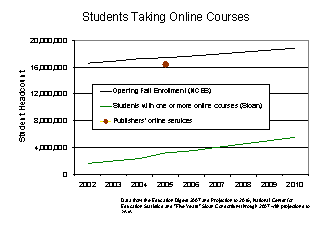 Almost 15 million students work full or part-time; 8.3 million use computers at work. An estimated 4.4 million student employees will receive online training from their employers.
These estimates do not include the several learning and library systems that may be available on the campus. Nor the online tutorial services and learning resources marketed directly to students.
Today’s college students are already in an environment of distributed learning and increasingly they, not their professors, are making decisions about which resources and services they use.
This rich distributed learning environment benefits graduate students who are motivated, demonstrated their ability to learn, and have faculty advisors guiding their learning. The current distributed learning environment may not be best for beginning undergraduate students who are less well prepared, have instructors with large class sizes, and who have less financial resources to purchase access to learning services.
-
Going to the D2L Conference
Correction: My presentation with Bill Lee is on Wednesday, not Thursday.
I’ll be going to the Desire2Learn conference Monday night through Wednesday morning this coming week. I’ll be on a lunch panel on Tuesday (I finally will meet Stephen Downes F2F) and will be doing a presentation on IMS Learning Information Services and Oracle/D2L integration with D2L’s Bill Lee on Thursday AM. If you’re going to the conference, feel free to ping me or to track me down.
-
Connecting Blackboard to Sakai and Moodle
I didn’t intend to post about this, but people keep asking me what I think, so I guess I need to get something up. For starters, you should read Michael Korcuska’s post on the subject. I agree with everything he says. Beyond that, here’s what I think:
-
The Cost of Instruction: A Different Conversation?
This is a guest post by Jim Farmer.
 Vance Fried may change the conversation about the costs of higher education. Critics of higher education have repeatedly pointed out the costs of higher education—often referring to tuition and fees—have increased faster than the Consumer Price Index (CPI). Higher education has claimed education is “labor intensive” and students and their parents pay only a portion of the cost of instruction. All are true.
Fried, Professor of Management at Spears School of Business, Oklahoma State University, developed a “pro forma” business plan for a residential undergraduate college. The results yield an annual full cost of instruction of $7,376—60% less than current baccalaureate and 50% less than masters institutions.
-
Sakai Paris 2008: The State of the Union
Let me cut to the chase. If you looked at Sakai in the past and ruled it out, it’s time to look again.
This is a new Sakai.
-
At EUNIS and Sakai the Next Two Weeks
I’ll be at the EUNIS conference this coming week (arriving Monday morning on the red eye) and the Sakai conference the next week (arriving in Paris on the night of Friday, 6/27 and leaving on Friday, 7/4). Feel free to track me down if you’re at either event and want to chat.
If you do track me down and we have met before, you should know that I’m really bad at remembering names and faces. There’s a good chance that I will remember our prior conversation once reminded of it. I just may not remember its sensory connections to the physical world. It’s the way my brain works. (Which is why I tend to walk–and drive–into things.) Please don’t be offended if I need a little help making the connection. It doesn’t mean I didn’t enjoy our last conversation.