e-Literate

Present is Prologue

Category: Ed Tech

The “Ed Tech” category includes posts about educational technology products themselves, including LMSs and other learning platforms, adaptive learning and other digital curricular materials products, learning analytics, and educational apps of all types. It also includes technical aspects of ed tech products, especially interoperability.

  • Some Thoughts on OER

    Last week I had the good fortune to co-keynote the Northeast Regional OER Summit at UMass Amherst. My counterpart keynoter was Don Kilburn, the current CEO of UMassOnline and former CEO of Pearson North America. We each gave brief talks, followed by a conversation facilitated by UMass Amherst’s Marilyn Billings. It was a lively discussion that inspired a lot of passionate debate on Twitter. That, in turn, inspired requests for more information about the conversation from people who weren’t able to come. So this is my recap.

    Don’s talk

    Don was there in his UMassOnline capacity but he spoke from his perspective as a long-time senior executive at a major textbook publisher. From the beginning, it was clear that having Don on stage would be both potentially interesting and inevitably fraught. Many folks in the OER community have a visceral negative reaction to the way of thinking and the kind of language that Don employs instinctively due to his particular professional history. And Don, for his part, didn’t seem to have had a whole lot of exposure to or understanding of the audience he would be addressing. The most cringe-worthy moment was when he trotted out the old “free as in puppy” chestnut as if it were a novel statement and not something that the OER community, and the open source community before it, had heard ad nauseam for at least a decade. That cultural clash between the audience and the opening speaker…resulted in the kinds of tweets that you would expect, and appeared to have an outsized influence on the way a vocal segment of the audience reacted to the whole conversation.

    That’s unfortunate, in part because Don knows a lot that could be useful to people who want to learn how to be more effective at driving OER adoption and understanding how a broad cross-section of faculty approach curricular materials adoption in general. He knows about the many experiments, both successful and unsuccessful, that the textbook industry has tried in order to figure out which value propositions persuade faculty to adopt curricular materials. He knows what’s happening in the market right now, how the publishers think, where they are gaining traction, and where they are struggling. Whether or not you agree with him, he can provide useful intel that is normally inaccessible to academics.

    I won’t summarize his talk here, but since the first part of my talk built off of Don’s, you’ll hopefully get a rough sense of the ground he covered through my summary of my own talk.

    My talk, part one

    I’m not going to recap the discussion in strict chronological order. Instead, I’ll address the piece of my talk that built off of Don’s now and circle back to the other part—which was really the main part of my talk—later. In retrospect, the conversation after the talk provides some good context for understanding the main point I was trying to make.

    A lot of Don’s talk was about how curricular materials prices are coming down and how the industry is trying to establish the value of its product in the face of this change. This seemed like a good place for me to pick up, since the most common argument for OER is about affordability There is absolutely no question that the value of base informational content—the part of a textbook that could easily be replaced by a Wikipedia article, for example—has commoditized. This is one reason why textbook prices are coming down. (I could tell another story about used books and rentals and Amazon and Chegg, but the two narratives are really just two sides of the same coin.)

    In the curricular materials markets, there are two pricing bands that are beginning to emerge. The first one is in the $10 to $40 range, and it is often presented as either a cheap version of the print textbook—a black and white softcover, for example—or something close to a direct digital replacement of the book. The other band, in the $60 to $100 range, tends to have products with lots of formative assessments, student and instructor dashboards, nudges and reminders, and maybe adaptive capabilities. Here, publishers are trying to establish a different value proposition from the print textbook. The “courseware” products that typically inhabit this price band can provide both students and instructors with a lot more information about how the students are doing, whether they are coming prepared to class, and where they need help. I have written several posts about these two competing value propositions, labeling them as “good enough” versus “better enough”.

    As long as those two value propositions dominate the way in which curricular material choices are framed for (and by) the faculty, they will also frame the way that OER are valued. And I mean that partly in economic terms, since not all OER are cost-free to the students and none are cost-free to the creators and maintainers. If the Wikipedia-like portions of the textbook have little to no economic value, then what else are students paying for and how much should they have to pay for it? How much is professional curation—in the form of scope and sequence—worth? How much is it worth to have somebody align learning objectives, assessment questions, and the informational content? To keep the content up-to-date? To provide frequent, auto-graded or easy-to-grade formative assessments? To provide dashboards that show progress on those assessments? To provide adaptive learning tools as differentiated instruction aids? There is no one correct answer for each of these questions, but now at least the pricing is starting to become transparent enough and product options unbundled enough that it is possible to answer them. The affordability problem, while not yet solved, is moving in the right direction. Because unbundling is part of this movement, educators can start making more fine-grained, student-centered choices about any potential trade-offs between accessibility and effectiveness.

    In my view, the OER community needs to become more sophisticated in its discussions of these trade-offs and more respectful of the individual decisions faculty make as they try to find the right trade-offs for their particular contexts. “Free as in puppy” may be glib, but that doesn’t mean it’s completely false. On the one hand, I don’t know anybody who got a free puppy that didn’t…you know…already want a puppy and know that puppies require care and feeding. On the other hand, some people do underestimate the amount of care and feeding a puppy requires. If you want to make sure that those puppies don’t get given to a shelter or abandoned at the side of some road, you need to make sure that somebody is prepared to be responsible for them. You need a puppy sustainability strategy. Some puppies are more work than others, and some families are more prepared to care for puppies than others. Sometimes you’d be better off adopting a dog that’s already been house trained. Or to pay for a trainer. Or to get a cat instead. Or a goldfish. Any resource that has a cost of upkeep needs a sustainability plan. Resources that do more will often—though certainly not always—require more initial investment and more upkeep. A puppy that is going to be a family pet requires a different level of investment—both up front and ongoing—than a rescue dog or an agility dog.

    The utility of an open license, part 1

    Of course, “good enough” and “better enough” is not the only way to frame the value of either affordability or OER. This is where the conversation among OER advocates can (and did) get chaotic quickly. For example, one topic that came up during Q&A was the utility of an open license to enable faculty to customize the content to their students’ needs. I said that faculty can and do customize with proprietary content all the time, and that anyone who believes the only way to do this is with OER is fooling themselves.

    This comment caused some consternation. I stand by it.

    When faculty want to adjust proprietary content, they skip chapters, supplement with other content (including some they may have made themselves), reorder the content, combine different texts, and so on. Instructors are endlessly creative in the ways that they slice and dice proprietary content. In fact, this exact tendency is one reason why textbook publishers got into pricing trouble in the first place. They have known forever that English comp professors are likely to use maybe one out of every three readings in an anthology, and that the particular readings which get used will vary from professor to professor. So they produce anthologies with three or four times as many readings as any class could use in a term. They do the same thing with problem sets. Or textbook chapters. Maybe one Biology 101 professor likes to spend more time on cellular biology while another is into ecology. No problem; the publishers just put in lots of chapters on both. Faculty will use what they want.

    What you end up with by employing this publishing strategy is a puppy that has been house trained, agility trained, and rescue trained. That is one very expensive puppy. And the students—who, after all have to buy that puppy—get irritated because it is obvious to them that they will never have to use their dog for an avalanche rescue.

    Customization happens regardless of license. Yes, a license makes certain kinds of customization easier. It’s an affordance. If you train your puppy yourself, you can decide what you want to teach it to do. Our dog, who we adopted as an adult, was trained by her prior family to ring a bell with her nose when she wants to go out. That was apparently useful to them. But I’ve had lots of dogs during the course of my life, and we never had to train them to do something specific when they wanted to let us know that they had to go out. Each had his or her own way of accomplishing this function. We didn’t suffer from that particular loss of control.

    The definition of open education is an open question

    One weird aspect of the “free as in puppy” analogy is that it treats the dog like a possession whose primary salient characteristics are cost of purchase and cost of ownership. That’s certainly one valid way to think about curricular materials (though not about puppies). But if what you’re really interested in is a pedagogical approach—let’s call it “open education”—then this is not the only way, or even the best way, to think about OER. Some OER advocates are interested in open education as a way of teaching, with OER being a set of raw materials designed to support that way of teaching. The problem is that we don’t have anything close to a consensus on what “open education” actually is.

    Some of the summit attendees talked about the value of having students create and edit the content. Say you want your kid to learn some responsibility and empathy, as well as something about animal behavior and psychology. Having a dog will give them some of that. Having your kid train the dog will give them a lot more of it. Having two of your kids train the dog together will also teach them something about cooperation. In this case, the “cost” of training and caring for the dog is actually a benefit.

    There is overwhelming evidence that having students learn by doing (including by researching and authoring) can be very effective. But there are two caveats regarding how this general principle of learning translates into the specific activity of student co-creation of curricular materials. First, having students write and edit their own curricular content is not inevitably effective as an active learning strategy. Sometimes, sure. But like everything else in education, it’s highly context-dependent. Second, depending on how broadly the students are sharing this work, it’s not clear that you need an open license on it, or that you need all content and source materials to be openly licensed. If the instructor doesn’t put any license at all on the student-created content but makes it freely available on the web, is it OER? In spirit, probably, but that would not be consistent with common usage of the term.

    As a teaching strategy, I’m enthusiastic about having students co-create curricular materials. As a teaching philosophy, I’m agnostic and utilitarian about it. As teaching dogma—no pun intended—I’m deeply skeptical, as I am about all blanket generalizations about the “best” way to teach regardless of context.

    My favorite variation on student production of curricular materials as a teaching strategy is Mike Caulfield’s notion of choral explanations. It adds the dimension that having a handful of different explanations can be more helpful than having just one. Think about your own behavior when you’re looking up a health condition on Google or a how-to demonstration on YouTube. Do you tend to look at just one search result? Or do you look at a few different ones? I often look at a few, and sometimes more than a few. The reason we can have the benefit of that diversity is because, on the web, there are many different people producing content resources and sharing them for free. They may not have Creative Commons licenses, but they are OER in a real sense.

    Again, I’m enthusiastic about this approach as a teaching strategy and utilitarian about it as a teaching philosophy. If it works for your students, in your subject, with your pedagogical activities, that’s great.

    Not all open education advocates define it this way. And to be clear, I’m not trying to provide a comprehensive list of useful definitions for open education here. I’m summarizing and reflecting on last week’s conversation. But I do want to touch on a subset of those other definitions that are often less well defined, more essentialist, or both. Because they did come up in that conversation, and because that’s where there are real problems.

    Real problems

    One question I got in the Q&A was what advice I had about things that the open education community isn’t doing as well as it could. That’s easy: Stop bickering so much.

    Teaching, when done right, is deeply personal. That’s both good and bad. On the good side, first, many educators are motivated to be good teachers even when their environment actively disincentivizes them, because they care about their students. It’s one reason why educational systems produce so many success stories in spite of the fact that the systems themselves are deeply, disturbingly messed up. Also, there is evidence that the very fact that a teacher cares about a student has a strong chance of positively impacting that student’s physical, emotional, and financial wellbeing for the rest of their lives. (Many of us have our own personal stories about this, but there is also hard, longitudinal evidence.)

    The bad side of teaching being so personal is that it can be very hard to maintain ego boundaries when you care so deeply about so many students in a messed up environment like the modern classroom (or, really, like human existence in general). I speak from personal experience as well as from knowing, working with, and living with many educators over the course of my life. It’s hard to separate the job from your personal identity. For some people, “open education” is an affinity group of sorts.

    In and of itself, that’s fine. Teaching is hard, teachers deserve and need emotional support, and one way to get that support is to find your “tribe.” But I have observed a lot of infighting about shibboleths that mark membership in the open education tribe. Too often, it gets unreasonably heated and personal. At its worst, this behavior metastasizes into a particularly noxious form of identity politics. At that point, it is no longer about helping students.

    As I said in answer to the question at the summit, there are only two essential goals that I care about in education: (1) increasing access and (2) increasing the value that students get from the education that they can access. I am agnostic and utilitarian about everything else. To the degree that discussion, debate, or usage of open education teaching strategies or open educational resources furthers one or both of those goals, then I’m for it. To the degree that it distracts from activities that could further those goals, then I’m against it. In recent years when I have attended conferences that are billed as “OER” or “open education” events, I have not been impressed with the ratio of constructive conversations to painful distractions.

    This is absolutely fixable—if the participants decide that it is something they want to fix. I hope they do. Some of the brightest, most talented and dedicated educators I know are among these people. I would like to see them accomplish all the good in the world that they can.

    My talk, and the utility of an open license, part 2

    All of the conversation I described above is important. I’m glad we had it. But it wasn’t the conversation I had hoped to provoke. In the main part of my talk, I recapped the four levels of empirical education:

    1. Intuitively empirical: This comes down to whether you pay attention to your students and do something differently with them based on what you observe. Do you always do the same thing, or do you have a bag of tricks that you can draw from when you see students struggle? I believe that the substantial majority of educators are empirical in this sense. They may not think of it as empiricism, but they are observing student behaviors and are adjusting their strategies based on what they see, guided by some sort of rationale for choosing which strategy to employ in different circumstances.
    2. Mindfully empirical: Mindfully empirical educators think about how they can get the maximum amount of useful diagnostic information from day-to-day course work. They design their courses with a goal of creating many feedback loops that enable them to be adjust their teaching to the needs of the students.
    3. Meta-cognitively empirical: Meta-cognitively empirical educators are empirical not only about how they use their existing bag of tricks but also about which tricks they should have and how effective those tricks really are. They consciously and regularly test their own assumptions about effective teaching, and they are open to trying new appropaches. My read of Lauren Herckis’ research is that the barrier of moving from mindfully empirical to meta-cognitively empirical (and to the next level, socially empirical) is where a lot of the difficult work needs to be done. Lots of educators are intuitively empirical, and the transition from there to mindfully empirical is not a huge leap. Getting them to test and challenge their deeply held beliefs about what constitutes effective teaching is a lot harder.
    4. Socially empirical: Socially empirical educators view effective teaching not as an individual art but as a shared pool of knowledge and experience that everyone can learn from and contribute to. They seek out common vocabulary, methods, and standards of proof so that they can learn with their colleagues and raise the collective bar. This is the beginning of disciplinarity.

    One possible defining purpose of “open education” is fostering socially empirical education. We can learn together and teach each other, teacher to teacher, teacher to student, student to student, and student to teacher. We can collectively learn how to teach and learn more effectively. We can conduct experiments, check each other’s work, and develop shared notions of what constitutes “evidence” of effective education. With this formulation of open education, as with the others, an open license is not a necessity; it’s an affordance. But substantial kinds of openness are essential to socially empirical education. You can’t build a shared body of knowledge without sharing.

    The strategy of having students collaboratively construct knowledge artifacts fits in with this ethos nicely. Students learn how to negotiate the development of shared understanding. Here again, I am endorsing a strategy, not a dogma. But by framing student creation of curricular content as “learning how to negotiate the development of shared understanding,” we take the motivation for the educational activity out of the realm of say, social constructivism, which individual instructors may or may not buy into, and reframe it as a life skill that all humans should have. Doing this will help more instructors better understand why, when, and possibly even how they might want to utilize the strategy of having students co-create curricular materials.

    Framing open education in terms of socially empirical education is intended to be a provocation rather than an argument. Since I am a critical friend of the open education community rather than a member of it, I don’t really get a vote. But I hope that the notion of socially empirical education can enrich the conversation among proponents of open education.

  • Interview with CEO of Instructure on changes to executive team

    Interview with CEO of Instructure on changes to executive team

    Instructure is now a decade old as a company and faces a crucial test this year with recent changes to their executive management team and the need to scale both Canvas (academic LMS) and Bridge (corporate learning LMS). The long-time head of sales, Marc Maloy, and head of marketing, Misty Frost, left Instructure in the fall. The company eventually hired a new head of marketing, Bjorn Eriksson from the world of corporate HR, in January. After a months-long search, Instructure did not directly replace Marc with a new head of sales, but instead they hired a new president, Dan Goldsmith, who also has sales leaders reporting directly to him. With this move, Mitch Macfarlane, the long-time chief operating officer and former head of client services, will be leaving the company this summer. ((Disclosure: Instructure and D2L are subscribers to our LMS market analysis service and were sponsors at our recent Empirical Educator Project summit.))

    We’ve written about previous executive changes for Instructure – when their two founders left the company and when their CTO departed after just one year – but in each case the company managed the transitions and came out stronger in the end. As we have shared in our LMS Market Analysis service and on e-Literate, the Canvas track record is remarkable in terms of not losing customers and gaining new customers from most other LMS providers.

    But the executive changes over the past year come at a time when Instructure faces new challenges in product development and implementation support. At InstructureCon 2016, the company announced their next-generation quizzing platform, Quizzes.Next, stating that it would be “made available to you over the course of the next several months”. Last summer at InstructureCon 2017, Quizzes.Next entered a limited beta program, but the new set of tools is still not fully in production. To our knowledge, this might be the biggest product schedule miss in the company’s history, and it will be quite interesting to see what happens with this summer’s InstructureCon.

    In addition, we have had several people contact us privately, even before the most recent management change, telling us about a new level of frustration in implementation projects and product upgrades. None of the tales were extreme, but they were unusual for Canvas clients and in general spoke to distractions from staff and lack of clear answers and updates.

    The press release announcing the hiring of Dan Goldsmith included this description:

    With more than 20 years of experience in software and services, Goldsmith’s career is marked by directing high-performing global teams and achieving outstanding penetration and growth in challenging markets. Goldsmith spent the last eight years as a senior executive at Veeva Systems, a cloud-based software company, where he started and ran Veeva’s international business, led the company’s strategy in new markets and products, and most recently was responsible for Veeva’s global engagement and growth in strategic accounts.

    “It is an exciting time for Instructure. We are well positioned for success as we focus on the continued growth of Canvas, expansion of Bridge, and international execution,” said Josh Coates, CEO of Instructure. “Dan’s energy, creativity and proven track record in driving go-to-market strategies and rapidly scaling businesses make him a tremendous addition to Instructure at the perfect time to lead us through our next phase of growth.”

    Goldsmith was one of the first 50 employees at Veeva. He helped lead the company through a successful IPO and a growth path to a $10 billion market cap. Prior to Veeva, he worked in various executive positions at top companies, including Accenture, PwC and IBM. During his years in management consulting, Goldsmith led initiatives in global markets and developed new offerings. Goldsmith will have an immediate impact on Instructure’s strategy. His initial focus will be on market growth, with the sales leaders reporting directly to him.

    This was the setup for an interview that we had with Josh Coates, the CEO of Instructure, last week. Given our focus at e-Literate on education markets, we in particular wanted to ask about how the company is balancing the needs of Canvas and Bridge.

    Coates came prepared for the interview, and up front he made the point that the “vast majority of company resources” are allocated to the academic markets and that this is their foundational business. After we pointed out that the majority of discussions on quarterly earnings calls focus on Bridge, Coates noted that Wall Street is overly focused on corporate learning markets and unfortunately takes Canvas’ academic market performance for granted. He does not do so, but some of the investor community seems to.

    The primary selling points bringing Goldsmith to Instructure are that he helped Veeva grow into a $10 billion company, having joined as one of first ~40 employees, and that he specifically helped them grow international markets. According to Coates, Goldsmith spent his first three years opening up the Europe, Middle East, and Africa (EMEA) markets, and that yes, his international experience is a big reason for Instructure recruiting him.

    We have noted at e-Literate that Canvas really began international expansion just 3-4 years ago. According to our current data, Canvas leads in higher ed adoptions in Europe and Australia / New Zealand, but interestingly, D2L is beating Canvas in Latin America higher ed adoptions despite Instructure having a bigger investment in its regional office in São Paulo. At some point Canvas’ market share growth rate in North America will have to flatten out and international markets will naturally increase in importance for company finances. While market wins in Europe and Australia / New Zealand are impressive, Instructure will need more aggressive growth in other markets, and clearly Goldsmith is being tapped as a catalyst to increase sales overseas.

    We pointed out that Goldsmith had no education background and appears to be more closely aligned to corporate learning markets than higher ed or K-12 markets. Coates responded that Goldsmith has done quite well for himself at Veeva but is also passionate about education, as evidenced by his experience as the chair of the Montgomery School board of trustees. Coates acknowledged that this is not deep academic sector experience and that the company will need to give Goldsmith a big education on higher ed and K-12 markets. If we had a dollar for every time we heard of a rich dude who is passionate about education, well, we’d be rich dudes who are passionate about education. It is good to hear, however, the acknowledgement that the new executive brings rich software company scaling and international market growth experience but not domain knowledge of the academic markets for Canvas.

    We asked for an update on Quizzes.Next – when it will be generally available (GA) and whether the schedule challenges are related to the executive changes. Josh Coates assured me that no executives are working on the code, but Jared Stein, VP of higher ed product strategy, answered more directly.

    Quizzes.Next’s GA release is scheduled for Summer 2018. This is later than planned because we underestimated the complexity of building assessments entirely as a micro-service at the level of quality we set for ourselves and our users.

    The executive management team over the years has played a big role in establishing the company culture that is a large part of Instructure’s success. Now that the three M’s (Marc, Misty and Mitch) are out, the question is not whether the culture will change, but how. Coates’ acknowledges this reality and trusts that Instructure’s internal rudder is strong enough to keep the company on course.

    There are two company risks that stand out in trying to balance Canvas and Bridge. First is that complacency sets in not just with some in the investment community but with Instructure itself, and they begin to take their strong position in the academic market for granted. Second, and related, is that resources and talent end up flowing disproportionately to the corporate learning market given its increasing importance. These are risks to watch and not observations of actions, however, and Coates was emphatic that the academic market will always be the foundation of Instructure’s business. The corporate learning market is significantly larger than the academic market, however, and Coates estimated that in ten years or so, corporate will likely drive a larger portion of Instructure’s revenue.

    It should be noted that growth in corporate does not have to come at the expense of the academic market. It actually has the potential to strengthen product offerings in higher ed and K-12 as Instructure gains deeper insights into teaching and learning more broadly. There is also the potential for convergence, or at least cross-pollination, in these markets as the profile and needs of learners evolve.

    We’ll keep a close eye on academic LMS market trends in the coming months for signs of new developments. For the near term, at least, Instructure’s success is predicated on the continued success of Canvas in higher education and K-12 despite the quarterly investor calls skewing toward the corporate learning markets and new management hires with experience outside of the education sector.

  • Top Hat’s OER Announcement: Doubling down on faculty engagement

    Top Hat’s OER Announcement: Doubling down on faculty engagement

    Several months ago I wrote a post looking at the Top Hat’s push into digital curricular materials through their Textbook product and Marketplace for digital course content. Leading up to that post, I had been planning to cover the Open Educational Resources (OER) angle, as the Marketplace included a number of openly-licensed material, much of it from OpenStax, and Top Hat had already begun marketing itself as an OER provider. At the time, the OER strategy seemed a work in progress. In fact, I found that some of my questions for company staff about OER basics – the role of Creative Commons licenses, community dynamics exhibited at the OpenEd conference, etc – led to a lack of answers, and at the time there was no export capability to get OER out of the platform.

    To Fee or Not to Fee

    The situation has changed since January, and with last month’s announcement of Top Hat’s Open Content Initiative the company is taking a stand on whether it is appropriate to charge for platform access. The idea of hosting and modifying OER on a fee-based platform became a big topic last year. Lumen Learning pioneered the Red Hat type model in 2014, and last year there was a big movement with Cengage, Knewton, OpenStax, Macmillan, and Top Hat all offering OER within their platforms. In many cases, the OER content itself has been redesigned from traditional textbook-in-PDF format to learning objective-driven content with aligned assessments. ((Disclosure: Lumen is a client of MindWires, and I recently gave a paid keynote at a Top Hat user’s conference.))

    Top Hat has now removed the student platform fees and added an export-to-epub feature. As evidenced in a company blog post by CEO Mike Silagadze, they are not shy about it either.

    At Top Hat, we’ve been working on making education more effective and affordable since 2009. Now, we’re happy to make a move that delivers on both fronts. Beginning April 12, with the launch of our Open Content Initiative, we’re offering completely free access to thousands of textbooks and other Open Educational Resources (OER)—freely accessible and openly licensed learning materials—on the Top Hat Marketplace.

    It’s about time. Students have been forced to weigh the pros and cons of emptying their wallets and draining their financial aid to buy textbooks for far too long. [snip] Just as bad, digital publishing platforms and e-readers have been charging a toll to students—disguised as a platform fee—to access free, openly licensed OER.

    Enough is enough.

    I asked Silagadze about a point I noted when describing Cengage’s OpenNow product:

    For each course [VP of Content Strategy] Constantini estimates that the modifications take $50k – $100k of internal work, including verifying of licenses for embedded elements. I would note a certain irony here in that OpenStax produces more-or-less traditional digital textbooks requiring publishers or OER services companies like Lumen to break apart and realign to competencies or outcomes.

    Silagadze brushed off this description and stated that the modifications made by other providers were far smaller and easier to make than is being claimed. We now have a third variation in the OER market, with the provision of wrap-around platform and a clear argument that these platforms not only will be free on Top Hat, but that they should be free as a matter of principle.

    • Free content, not dependent on specific platform
    • Free and modified content, available on a paid platform, content available for export
    • Free and lightly modified content, available on a free platform, content available for export

    While this is a marketing position by one of the competitors in a new field, this move by Top Hat is a further sign of the OER movement breaking into different branches. From our perspective, the fractures in the OER community have been widening for the past several years, but to a degree this is a sign of success. Openly-licensed content usage is becoming more and more common in education, and even traditional publishers mostly accept the value of OER.

    Faculty Engagement

    Perhaps more significantly, at least in terms of understanding Top Hat as a company, is that the OER initiative doubles down on their bet on faculty engagement. A well-known issue with OER (and even with non-open content) is that few faculty end up taking advantage when given the ability to modify the course materials in any significant manner. In theory many people talk about open pedagogy in terms of faculty modification and collaboration on content, but in practice this rarely happens. Top Hat’s view is that the barrier has been flat content and cumbersome platforms, as best described in an eLearning Inside interview.

    “We think the promise of OER has fallen down,” said Nina Bilimoria Angelo, VP of product and customer marketing at Top Hat. The Toronto-based company has created a platform to house, customize, and share OER and other educational resources. It has been used by over 2.8 million students to date.

    “The promise was there’s a community that continues to build on open materials,” Angelo said. “But when those materials are trapped behind static PDFs, and then people are making changes to it on their own without a mechanism to share it back, that’s where things fall flat. We really wanted to create a system where things can be improved in real time, not over a 3 or 4 year cycle like with traditional publishers.”

    “Discoverability is a challenge with OER,” Angelo said. “Quality can be perceived as uneven which is probably why OER adoption has stalled at the 5-10% level for instructors. There’s a lot of skepticism amongst higher educators. We’re trying to make sure all the high quality material is available in the Marketplace. Once it’s adopted, it’s really customizable. But then those customizations – this is the magic – those customizations can be shared back with the author and the team so that they can improve upon what they’ve created.”

    This is the best way to interpret Top Hat’s OER move, in my opinion, and you can see more details in my January post about the Marketplace to better understand the customization and sharing capabilities of the platform.

    According to an internal Top Hat survey of users, 89% of adopters make changes to digital textbooks that they adopt, with 22% reporting “lots of customization”. If this internal data is representative, there may be some indicators that faculty can be more involved in modifying and sharing content. Top Hat is betting on faculty engaging with content, modifying it, sharing it, updating it. And they are betting that this model will drive faculty adoption decisions.

    There are a lot of unknowns about faculty adoption and modification of OER content through the Top Hat Open Content Initiative, but it is clear that the company is positioning itself differently than other providers. The transformation of digital curricular materials continues.

  • Textbook Authors Sue over Cengage Unlimited Royalties

    Textbook Authors Sue over Cengage Unlimited Royalties

    Back in January, I wrote of Cengage’s “all you can eat” Unlimited pricing announcement:

    We don’t know whether Cengage will be a winner from this strategy, but we do know who will be the losers: textbook authors. Cengage, of course, denies this. Cengage CTO George Moore, when asked about the contract renegotiations with the authors to make this fly, said only that “Cengage renegotiates contracts with authors all time.” Michael Hansen claimed that Cengage’s interests and their authors are aligned, and that their authors are all very concerned about the affordability of textbooks.

    Really?

    In February of 2015, Greg Mankiw—Cengage’s blockbuster economics textbook author who has made literally millions of dollars from his relationship with Cengage—expressed perplexity at the The New York Times’ call for less expensive textbooks:

    To me, this reaction seems strange. After all, the Times is a for-profit company in the business of providing information. If it really thought that some type of information (that is, textbooks) was vastly overpriced, wouldn’t the Times view this as a great business opportunity? Instead of merely editorializing, why not enter the market and offer a better product at a lower price? The Times knows how to hire writers, editors, printers, etc. There are no barriers to entry in the textbook market, and the Times starts with a pretty good brand name.

    My guess is that the Times business managers would not view starting a new textbook publisher as an exceptionally profitable business opportunity, which if true only goes to undermine the premise of its editorial writers.

    Given that Mankiw was name-checked in the Cengage Unlimited announcement press release, management must have worked something out with him to keep him happy. We are hearing whispers from the company’s competitors that not all authors were given such an opportunity and that lawsuits may follow. We’ll see whether that bears out. Regardless, though, this model does fundamentally change the relationship that the publisher has with its authors. With buffet-style pricing at a low rental price point, a model like Cengage Unlimited is likely to do to textbook authors what Spotify and other music subscription services did to musicians. There may still be a handful of superstar authors whose books are such outsized hits that they can still command royalties and large advances. But the vast majority of authors will see their income shrink. They either will get smaller royalty agreements or will be paid once on a fee-for-services basis so that the company can own the content outright. My guess is that there will be a lot more of the latter than the former. Keep in mind that copyright negotiations for a textbook or textbook-equivalent involve more than just the author(s). There may be literally hundreds of permissions to track for photographs, videos, animations, and so on. To the degree that “good enough” wins out over “better enough”, publishers will be under strong pressure to own as much of their content outright as they can.

    Today’s Inside Higher Ed headline: Textbook Authors Sue Cengage Over Subscription Model.

    To be clear, I don’t know if, contractually, this lawsuit has merit or what is likely to happen with this particular suit. But the handwriting is on the wall. If textbook prices come down, then textbook royalties also have to come down.

    Regardless, all of this is transitional. As students are asking, “Why should we pay all this money for content that is increasingly available online for free?”, textbook publishers are asking themselves the same question. Rights management is an expensive nightmare for them. Their businesses would be much more manageable if they could use either OER, fee-for-service content that they own outright, or both. Their biggest challenge is that faculty are used to using a particular textbook and may have some attachment to the particular author. If the publishers replace that book with one that doesn’t have all of those royalty entanglements, then faculty are more likely to look around at competitors’ offerings since, hey, if they have to rework their class for a book anyway, they might as well look around. If it weren’t for that problem, I suspect that publishers would be swapping out titles more quickly.

  • Portentous Changes in Instructure’s Executive Management

    Portentous Changes in Instructure’s Executive Management

    Instructure just announced the hiring of a new president. Dan Goldsmith is a software executive with experience in SaaS, international markets, and business-to-business sales, but not with education. He “will have broad responsibilities overseeing sales, marketing, product, customer experience, engineering and business development.” At the same time, COO Mitch Macfarlane is leaving. So this is a major reorganization. Taken together with the earlier departures of the company’s long-time sales and marketing executives, there has been a near complete turnover and reorganization of their top-level management.

    To some extent, this is to be expected. People do start to cash out after an IPO. But the turnover and reorganization at Instructure seems quite significant—at a company that has stood out in the industry for having a tight, highly functional management team.

    We’ll have more to say about these changes in the coming weeks. For now, I’ll predict that 2018 and 2019 will continue to be eventful in the higher education LMS space.

  • OPM Market May Be Growing, But It’s Not Without Chaos

    OPM Market May Be Growing, But It’s Not Without Chaos

    There has been growing interest in the Online Program Management (OPM) market, as more schools try to develop a strategy and revenue model for online programs (particularly for master’s level), and as 2U continues its rapid rise in the stock market (with a nearly $4.8 billion market cap). Typically the description of this market is that the total annual revenue is somewhere between $1.5 – $2.5 billion and that it is growing. The implications are that we have a land grab as companies get rich off the new programs.

    The reality, however, is more complicated. The OPM market may be growing, but it is chaotic and messy. Consider the following problems within the market:

    • This is not an easy market, as many programs take millions of dollars of investment by the OPM provider before an account becomes profitable, often 3 – 5 years down the road.
    • 2U’s Semester Online initiative, targeted at the undergrad market as a consortium, shut down in 2014 due to the departure of several founding member institutions and due to low enrollment.
    • Later that same year Cal State Online shut down in all but name, along with its usage of Pearson as its OPM partner.
    • In 2015 Synergis Education pulled out of its work with USC’s Master of Integrated Design, Business and Technology program, to be eventually replaced by 2U.
    • In 2016 the University of Florida Online (UF Online) canceled its contract with Pearson and pivoted to a new approach not using an OPM partner.
    • After raising $230 million from Bertelsmann in 2015, HotChalk has failed to bring in any new clients of the scale of Concordia University, and in 2016 the company paid a $1 million settlement (though not admitted any fault) based on a federal investigation and lawsuit.
    • Sometime in 2016/17, the nonprofit OPM Educators Serving Educators from Excelsior College shut down.
    • In 2017 after a management shake-up, DeVry Education Group (now Adtalem) pulled out of the OPM market and got rid of its Integrated Education Solutions group.
    • In late 2017 the Eastern Michigan University’s chapter of the American Association of University Professors filed a complaint against EMU’s contract with Academic Partnerships, although an arbitrator sided with the school earlier this year.
    • Also in late 2017 Greenwood Hall – a call center-based fee-for-service OPM provider – collapsed in dramatic fashion, with AnswerNet eventually buying the remaining assets.
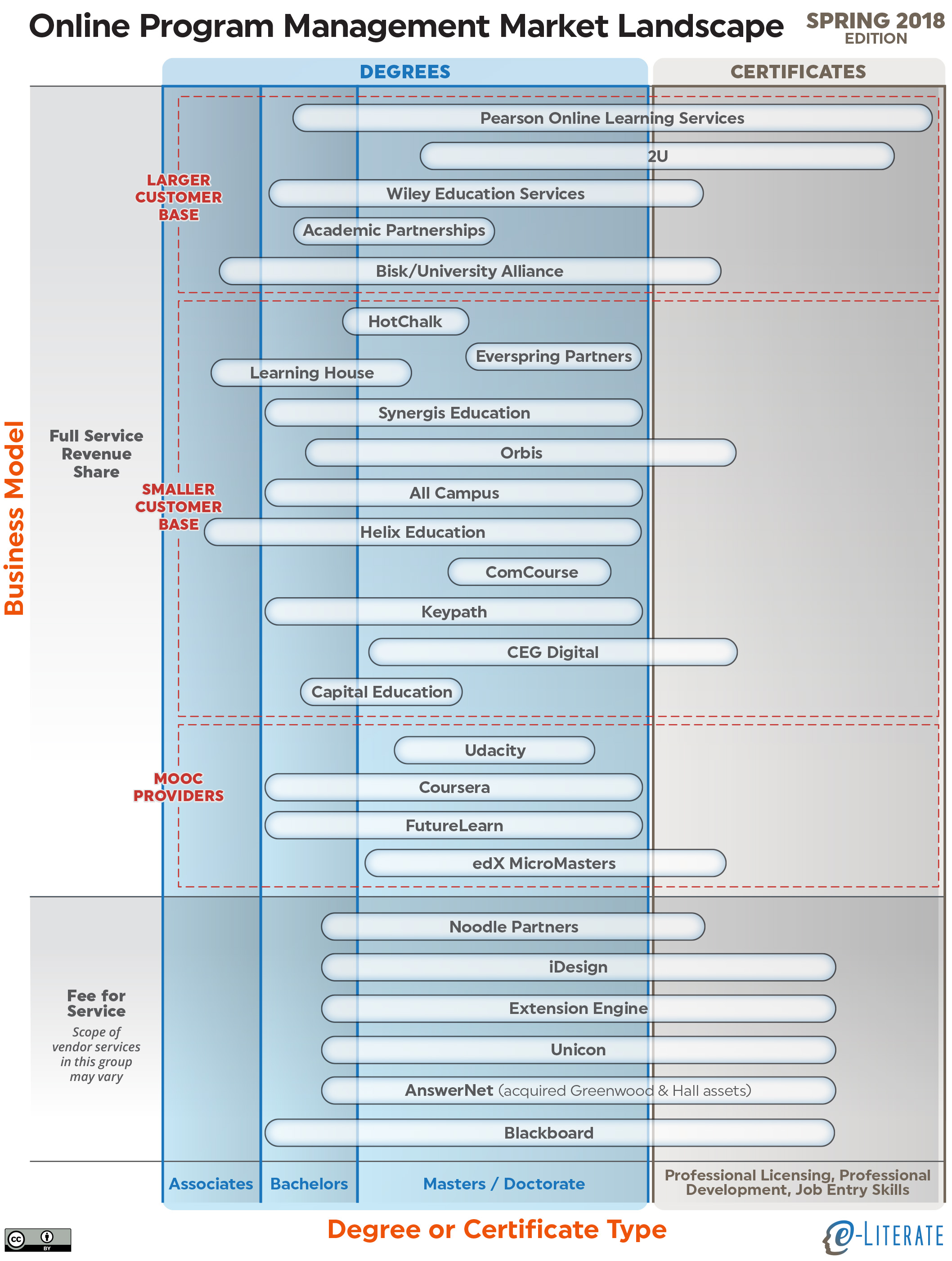
    • There has been growing pushback on the mainline revenue-sharing model, where full-service OPM providers make 50% or even more of tuition dollars from online programs. This has led to the rise of unbundled, fee-for-service category of OPM providers.

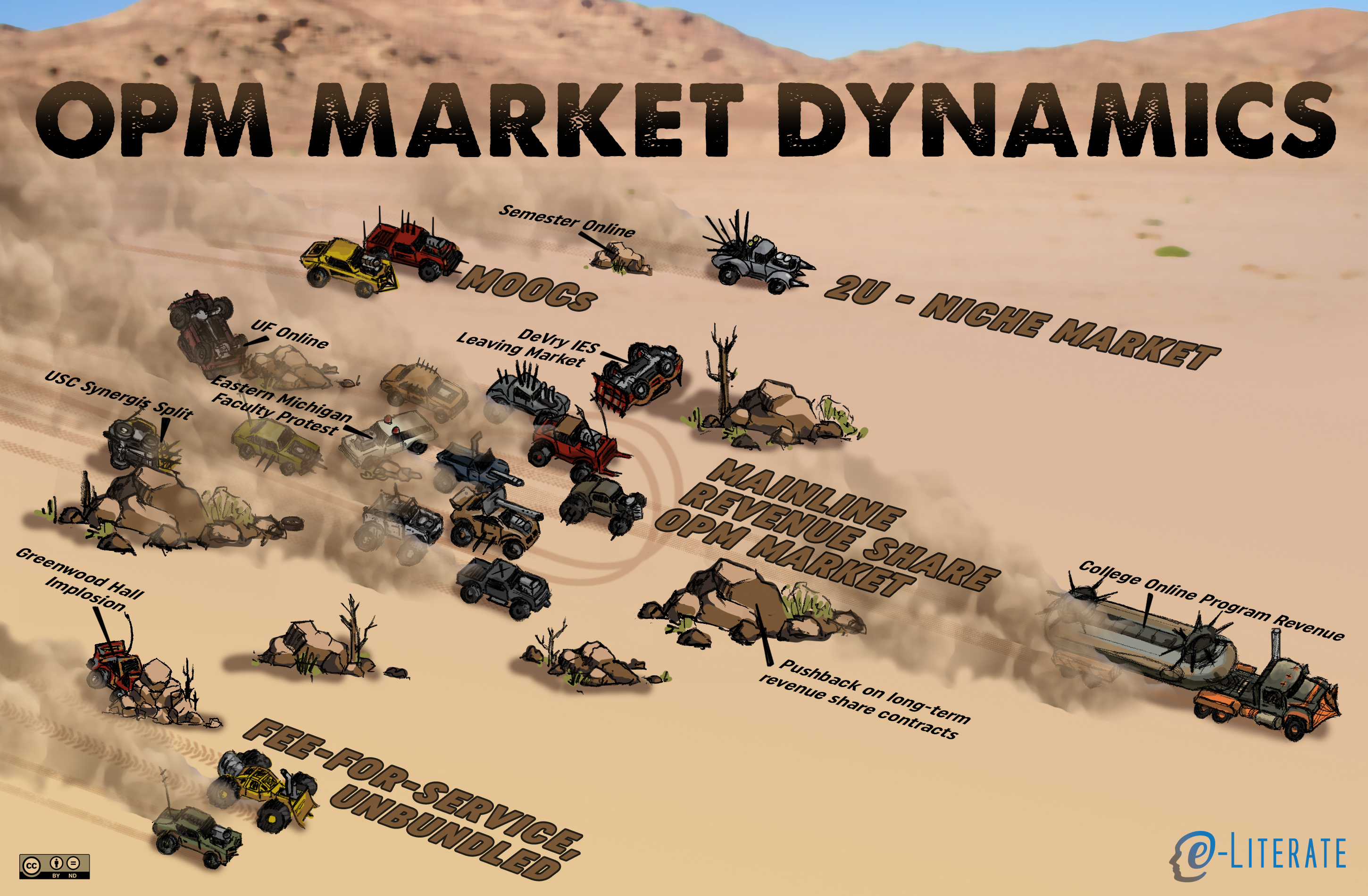
    The picture one gets is of a chaotic market that is not for the faint of heart, and one that will likely see further consolidations and category changes. 2U, for its part, has been successful partially due to a niche strategy where they go after elite master’s programs and mostly avoid direct competition or engagement with the rest of the market. And recently we have started to see the MOOC providers become OPM providers – where the primary revenue for Coursera and FutureLearn are based on revenue sharing with online programs, albeit with lower sharing rates and with very different marketing approaches. In other words, there seems to be several efforts to enter into the same OPM race, but if possible to avoid being in the mainline rev-share OPM market. The Toecutter would feel right at home.

    The Mad Max view of OPM market dynamics

    Not even represented here is the movement of former for-profit institutions (e.g. Grand Canyon University, the parent company of Kaplan University) becoming OPM providers.

    This means that our landscape view of the market is temporal in nature – expect more shake ups and category changes as the OPM market continues to grow in new ways.

    Market landscape of OPM vendors

  • Rio Salado College As Exemplar: A critical external view

    In yesterday’s post I described how a review of two courses at Rio Salado College indicated reasons to question the use of this school in the ASU / BCG case study report on Digital Learning ((Disclosure: Our e-Literate TV series was funded in part by the Bill & Melinda Gates Foundation who also funded the ASU / BCG study.)). The report, titled “Making Digital Learning Work: Success Strategies From Six Leading Universities and Community Colleges”, has the following description [emphasis added]:

    How can the use of digital technologies in postsecondary education impact students’ access to education, student outcomes, and the return on investment for students and institutions? What are the biggest challenges for an institution seeking to implement high-quality digital learning opportunities? What promising practices enable an institution to achieve impact at a larger scale? [snip]

    The answers, at least in part, lie in case studies of six colleges and universities: Arizona State University, the University of Central Florida, Georgia State University, Houston Community College, Kentucky Community and Technical College System, and Rio Salado Community College. The first three institutions in this list are public research universities, representing different geographic populations and access missions. The other three institutions include two community colleges and a state-wide community college system.

    These six institutions have a strong track record of using digital learning to serve large, socioeconomically diverse student populations, and each has been a pioneer in innovating to expand access to postsecondary education, improve student outcomes, and provide higher education at an affordable cost.

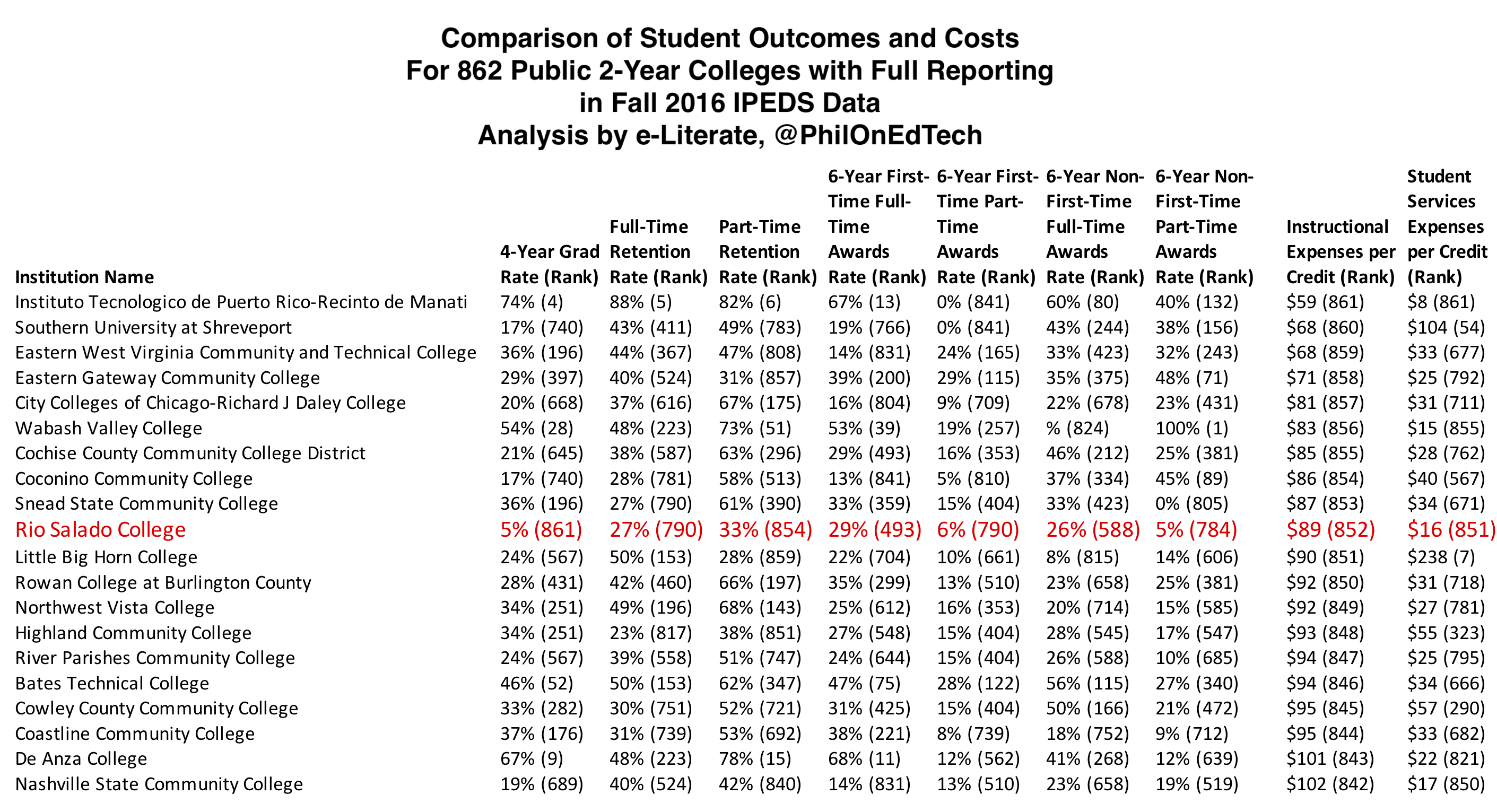
    Let’s look at the track record of Rio Salado College in terms of aggregate academic student outcomes to see how appropriate it is to include them as an exemplar in such a case study-based report. For much of my analysis, I looked at the 862 public 2-year colleges fully reporting data in the Fall 2016 IPEDS data set.

    Reduced Expenditures

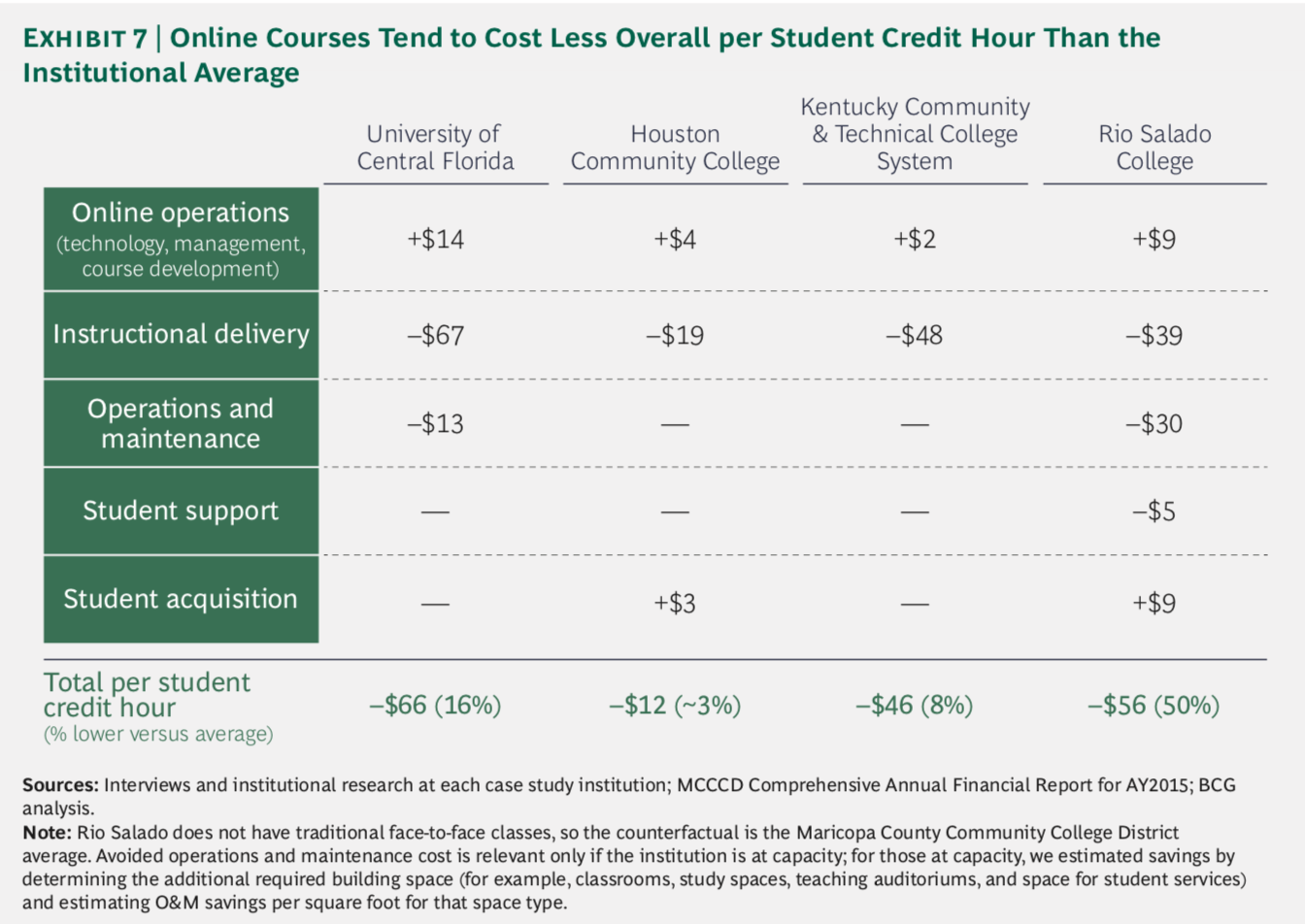
    The primary claim made in the ASU / BCG report is that Rio Salado is has reduced costs.

    This claim does hold up to scrutiny, as Rio’s $89 of instructional delivery costs per student credit hour and $16 of student services costs are 10th and 9th lowest in the country for the 862 colleges I reviewed.

    The primary outcomes claims made in the case study quickly brush off the standard metrics for Rio.

    Rio Salado’s success is not defined solely by improvements in graduation and retention rates. In particular, the college has a high transfer-out rate (32% compared to an average of 19% for other MCCCD colleges [ed. – the other schools in the Maricopa County Community College District]), and the students who transfer to Arizona universities from Rio Salado have a 74% four-year graduation rate—3 percentage points higher than the average for other MCCCD transfer students. At Rio Salado itself, students’ course-level success rates have slowly been improving over time, to about 64% in 2016.

    Graduation and Retention Rates

    It is all well and good to point out the importance of transfer students, but we should not ignore graduation and retention rates. And we should explore whether the data supports the phrase “improvements in graduation and retention rates”.

    The report describes Rio’s investment in a suite of advising tools.

    Obtaining these advisory tools required an initial investment of $1 million, but the tools pay for themselves by increasing Rio Salado’s term-to-term retention by 7%, increasing ROI through improved student progress and the additional tuition dollars that the institution receives from retained students.

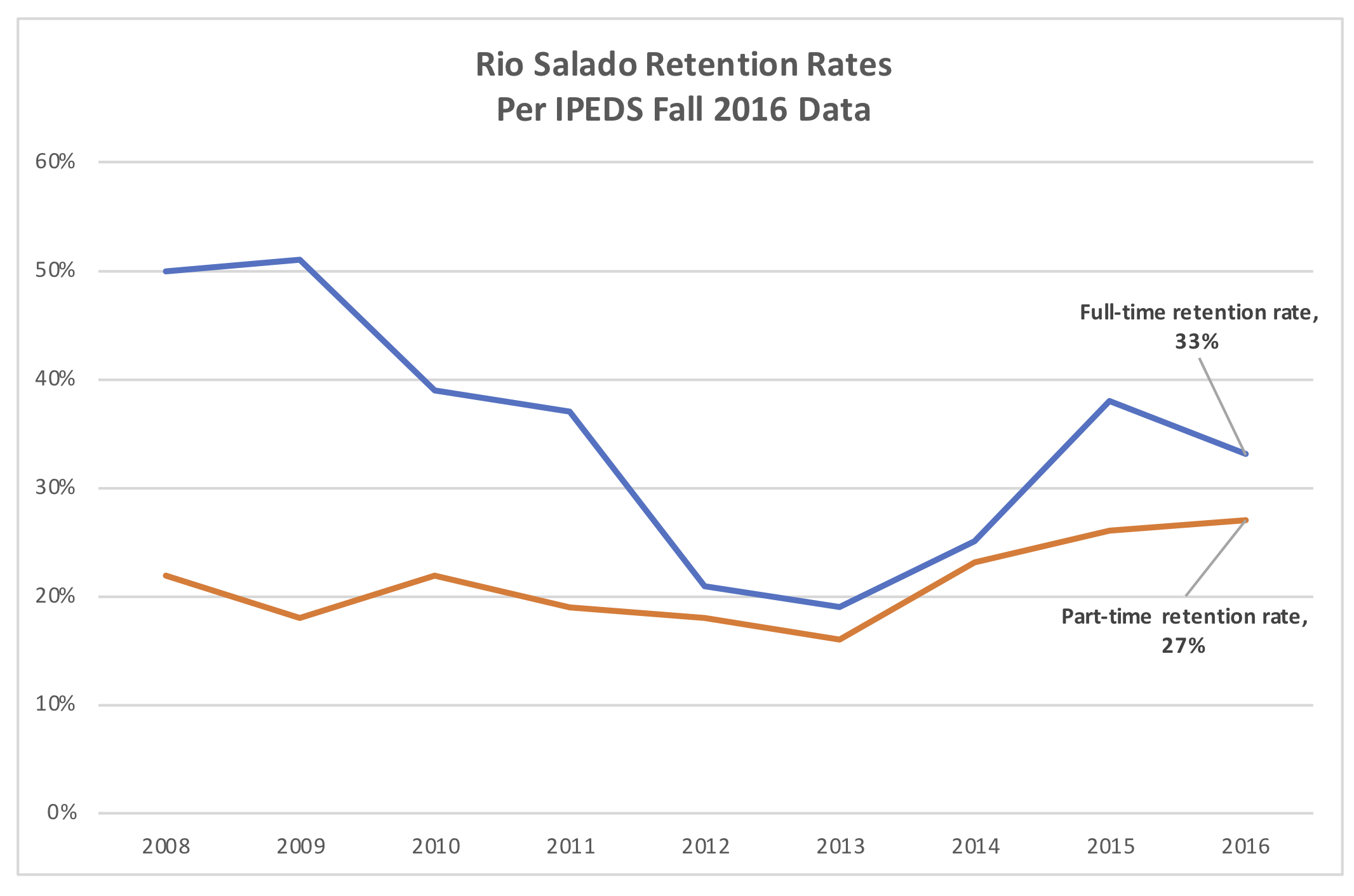
    Looking at IPEDS data, we can see Year 1 to Year 2 retention rates (not quite the same as term-to-term), and it shows improvement since 2013. Unfortunately, Rio’s retention rates for full-time and part-time students are both in the bottom 10% of all community colleges at 33% and 27%, respectively. And the full-time rate is lower than it was prior to 2011.

    Rio Salado Year 2 Retention Rates

    While the ASU / BCG report does not mention graduation rates directly, there have been several claims made about Rio’s numbers in other publications.

    The problem is that Rio Salado’s 4-year graduation rate for first-time full-time students as reported in IPEDS is 5% – the second lowest of any public 2-year college in the nation. How can we resolve this discrepancy?

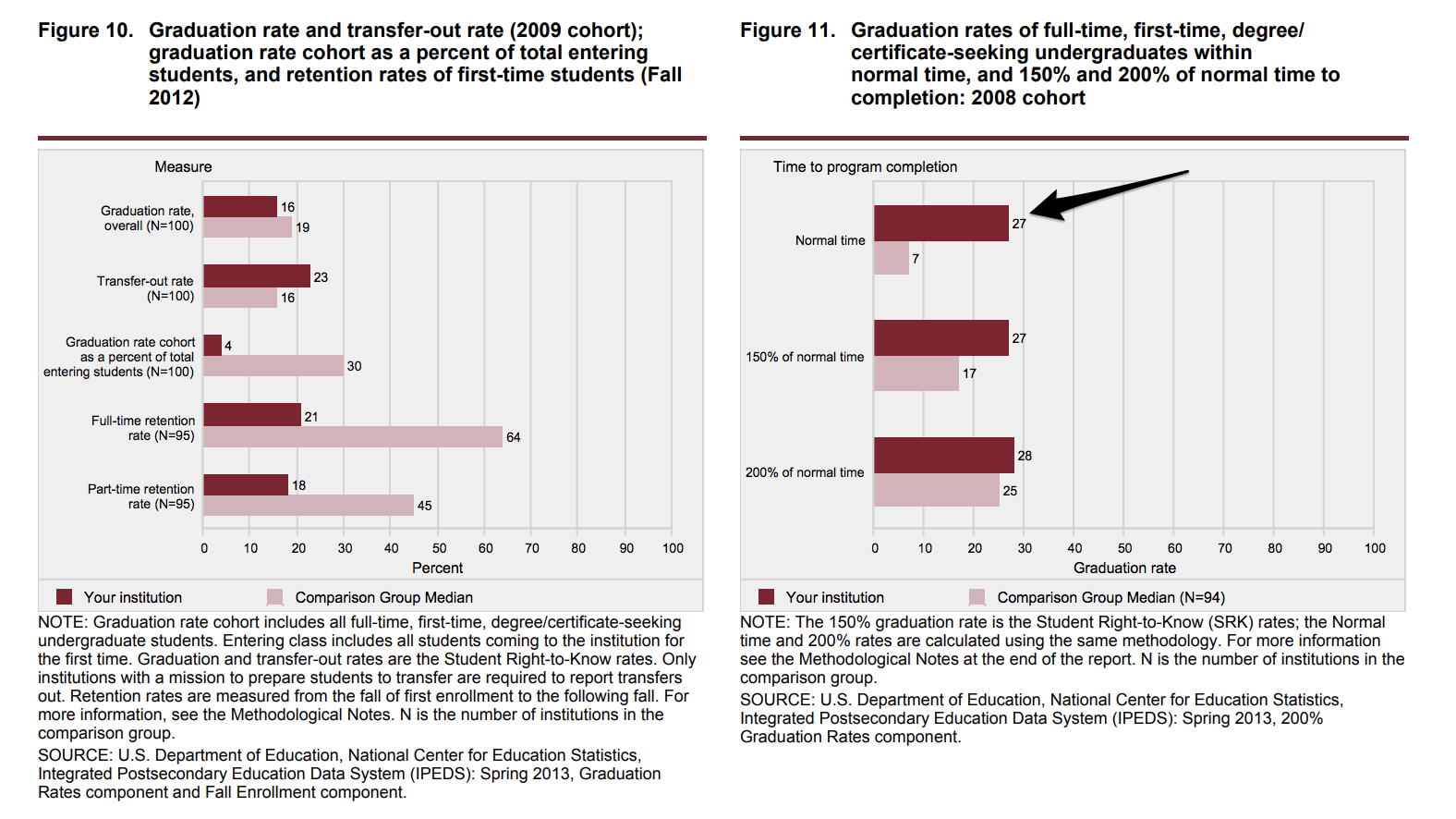
    The key to understanding the claims in these four articles is to follow the two links, which both point to a customized IPEDS Feedback Report from 2013 for Rio against their selection of 100 peer institutions.

    Figures 10 and 11 from IPEDS report

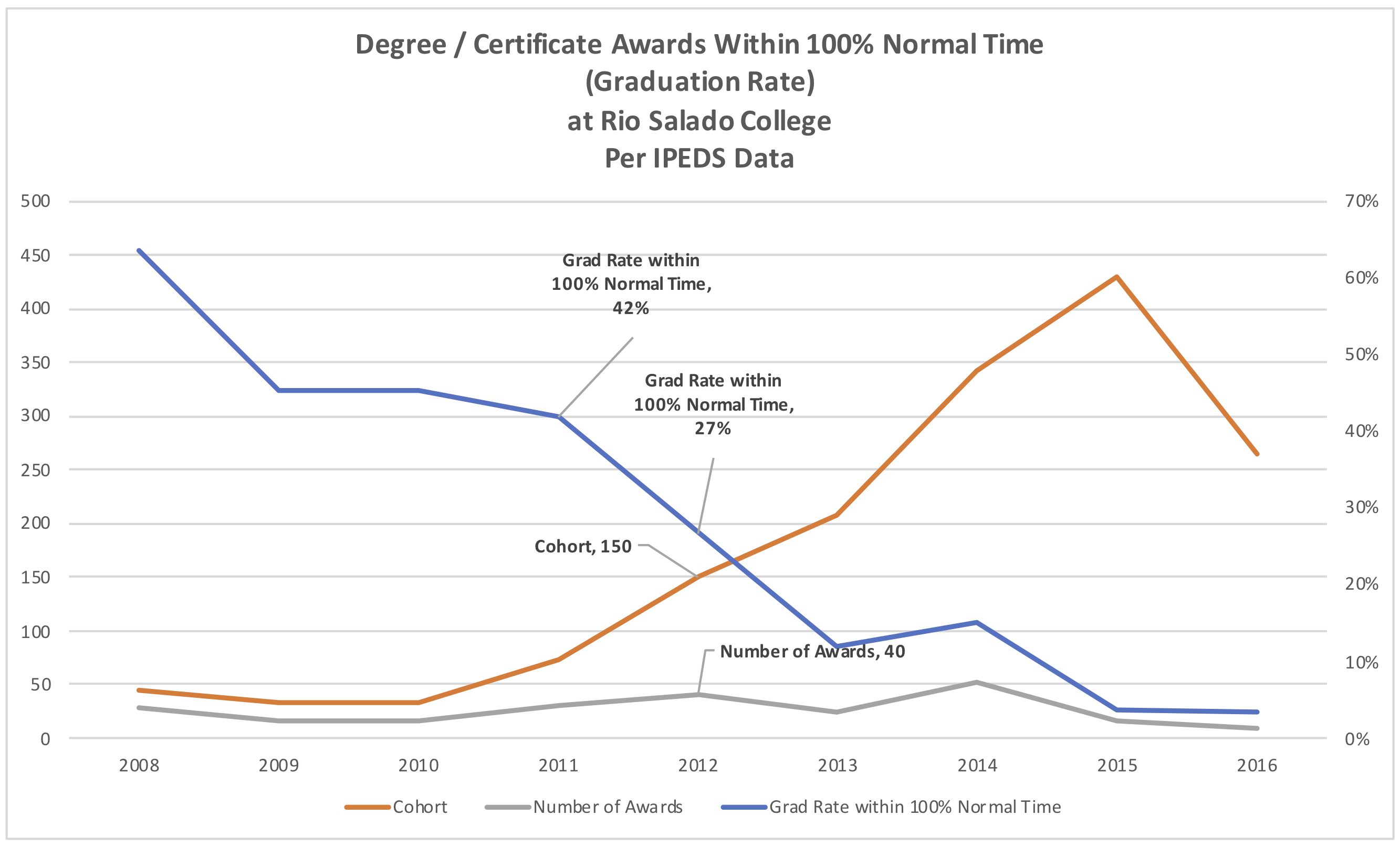
    This measure captures any award – degree or certificate – for a small cohort of entering full-time students at Rio from 2009. If you trace that data through IPEDS, you see that this measure is for a 150-student cohort (in 2012) out of the 45,000+ students at Rio.

    Using this specific metric, you can find the 42% graduation rate in 2011, and the “four times greater” rate of 27% in 2012, both as the rate plummets from 64% in 2008 to 3% in 2016.

    Using broader, up-to-date metrics for graduation and retention rates as well as the new IPEDS outcomes measures (which allows comparison outside of just full-time first-time cohorts), we see that Rio Salado College has some of the lowest student outcomes measures in the country.

    For all but two measures (6-year First-Time Full-Time Awards and 6-year Non-First-Time Full-Time Awards), the performance is in the bottom 10% of all colleges in the study. For those two awards measures, the performance is in the bottom half of the country and represents just 11% of the student body.

    Transfer Rates

    What we are left with are reports about high transfer rates and subsequent success rates 3% higher than other transfers out of the same district. The IPEDS data set now includes transfer rates in its new Outcomes Measures section, and it is true that Rio Salado College does transfer out a significant portion of students. For all cohorts defined below, Rio is in top 20% of public 2-year institutions.

    • First-Time Full-Time Students: 39% transfer rate, Rank 170 out of 862
    • First-Time Part-Time Students: 47% transfer rate, Rank 112 out of 862
    • Non-First-Time Full-Time Students: 46% transfer rate, Rank 196 out of 862
    • Non-First-Time Part-Time Students: 59% transfer rate, Rank 121 out of 862

    Note that this data indicates that students transferred to another institution and are still enrolled there. This data does not indicate what portion of the transfers were planned versus students deciding to move on for other reasons. Nevertheless, for a community college, especially one with very close ties to ASU (I have been told that a large percentage of Rio students are ASU students trying to fill out their schedule based on saving money and more convenient schedules), this is a favorable metric.

    I cannot provide independent confirmation on the subsequent success rates, so we’ll accept that claim at face value.

    Case Study Questions

    I should note that Rio Salado College does provide accurate information on the metrics mentioned in this post, both through IPEDS reporting and through their Research & Planning section of the web site. The picture that emerges from the aggregate outcomes data is of a large school that:

    • transfers out greater than average percentage of students;
    • is just below average for awarding certificates for full-time students;
    • is among the poorest performing in the country for retaining students;
    • is among the poorest performing in the country for awarding degrees; and
    • is among the poorest performing in the country for awarding certificates for part-time students.

    At best, this is a school with mixed results that should not simply be labeled a success without caveats or explanations.

    One question we should ask is whether it is appropriate to hold up a school with some of the lowest student outcomes measures in the country as an exemplar. Yes, Rio Salado has found a way to spend as little as possible on instruction and student support services, and yes, a lot of students transfer out, but that is not enough. We need greater evidence of student success if we are to use them as a case study for others to emulate. And we also need a more robust genre of a case study that looks across, at a minimum, a relatively standard set of publicly-available information, and deeper dives where appropriate, to understand educational practices and their impacts on students. These case studies should present information in context – the good and the bad – since education is complex and challenging, and a clear focus on evidence will benefit all parties in the end.