
e-Literate

Present is Prologue

Category: Ed Tech

The “Ed Tech” category includes posts about educational technology products themselves, including LMSs and other learning platforms, adaptive learning and other digital curricular materials products, learning analytics, and educational apps of all types. It also includes technical aspects of ed tech products, especially interoperability.

  • Dammit, the LMS

    Count De Monet: I have come on the most urgent of business. It is said that the people are revolting!

    King Louis: You said it; they stink on ice.

    – History of the World, Part I

    Jonathan Rees discovered a post I wrote about the LMS in 2006 and, in doing so, discovered that I was writing about LMSs in 2006. I used to write about the future of the LMS quite a bit. I hardly ever do anymore, mostly because I find the topic to be equal parts boring and depressing. My views on the LMS haven’t really changed in the last decade. And sadly, LMSs themselves haven’t changed all that much either. At least not in the ways that I care about most. At first I thought the problem was that the technology wasn’t there to do what I wanted to do gracefully and cost-effectively. That excuse doesn’t exist anymore. Then, once the technology arrived as Web 2.0 blossomed—remember that term?—I thought the problem was that there was little competition in the LMS market and therefore little reason for LMS providers to change their platforms. That’s not true anymore either. And yet the pace of change is still glacial. I have reluctantly come to the conclusion that the LMS is the way it is because a critical mass of faculty want it to be that way.

    Jonathan seems to think that the LMS will go away soon because faculty can find everything they need on the naked internet. I don’t see that happening any time soon. But the reasons why seem to get lost in the perennial conversations about how the LMS is going to die any day now. As near as I can remember, the LMS has been about to die any day now since at least 2004, which was roughly when I started paying attention to such things.

    And so it comes to pass that, with great reluctance, I take up my pen once more to write about the most dismal of topics: the future of the LMS.

    (more…)

  • Kuali, Ariah and Apereo: Emerging ed tech debate on open source license types

    With the annual Kuali conference – Kuali Days – starting today in Indianapolis, the big topic should be the August decision to move from a community source to a professional open source model, moving key development to a commercial entity, the newly-formed KualiCo. Now there will be two new announcements for the community to discuss, both centering on a esoteric license choice that could have far-reaching implications. Both the announcement of the Ariah Group as a new organization to support Kuali products and the statement from the Apereo Foundation center on the difference between Apache-style and AGPL licenses.

    AGPL and Vendor Protection

    Kuali previously licensed its open source code as Educational Community License (ECL), a derivative of the standard Apache license that is designed to be permissive in terms of allowing organizations to contribute modified open source code while mixing with code with different licenses – including proprietary. This license is ‘permissive’ in the sense that the derived, remixed code may be licensed in different manners. It is generally thought that this license type gives the most flexibility for developing a community of contributors.

    (more…)

  • Michael’s Keynote at Sakai Virtual Conference

    Michael is giving the keynote address at tomorrow’s (Friday, Nov 7) Sakai Virtual Conference #SakaiVC14. The virtual conference is only $50 registration, with more information and registration link here. The schedule at a glance is available as PDF here.

    Michael’s keynote is at 10:00am EDT, titled “Re-Imagining Educational Content for a Digital World”. At 4:30pm, there will be a Q&A session based on the keynote.

  • Flipped Classrooms: Annotated list of resources

    I was recently asked by a colleague if I knew of a useful article or two on flipped classrooms – what they are, what they aren’t, and when did they start. I was not looking for any simple advocacy or rejection posts, but explainers that can allow other people to understand the subject and make up their own mind on the value of flipping.

    While I had a few in mind, I put out a bleg on Google+ and got some great responses from Laura Gibbs, George Station, and Bryan Alexander. Once mentioned, Robert Talbert and Michelle Pacansky-Brock jumped into the conversation with additional material. It seemed like a useful exercise to compile the results and share a list here at e-Literate. This list is not meant to be comprehensive, but a top level of the articles that I have found useful.

    There are other useful article out there, but this list is a good starting place for balanced, non-hyped descriptions of the flipped classroom concept. ((I did not include any directly commercial sites or articles in the list above. Michelle’s book was included as the introduction is freely available.)) Let me know in the comments if there are others to include in this list.

  • Significant Milestone: First national study of OER adoption

    For years we have heard anecdotes and case studies about OER adoption based on one (or a handful) of institutions. There are many items we think we know, but we have lacked hard data on the adoption process to back up these assumptions that have significant policy and ed tech market implications.

    OtC Cover PageThe Babson Survey Research Group (BSRG) – the same one that administers the annual Survey of Online Learning – has released a survey of faculty titled “Opening the Curriculum” on the decision process and criteria for choosing teaching resources with an emphasis on Open Educational Resources (OER). While their funding from the Hewlett Foundation and from Pearson ((Disclosure: Pearson is a client of MindWires Consulting – see this post for more details.)) is for the current survey only, there are proposals to continue the Faculty OER surveys annually to get the same type of longitudinal study that they provide for online learning.

    While there will be other posts (including my own) that will cover the immediate findings of this survey, I think it would be worthwhile to first provide context on why this is a significant milestone. Most of the following background and author findings is based on my interview with Dr. Jeff Seaman, one of the two lead researchers and authors of the report (the other is Dr. I. Elaine Allen).

    Background

    (more…)

  • LISTedTECH: New wiki site and great visualizations

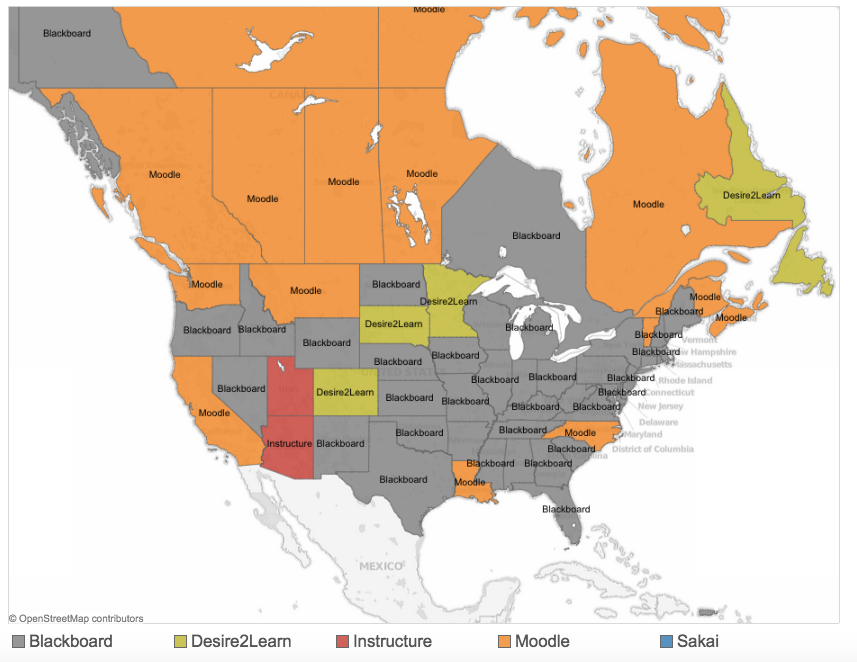
    Last year I wrote about a relatively new site offering very interesting data and visualizations in the ed tech world. LISTedTECH was created by Justin Menard, who is Business Intelligence Senior Analyst at University of Ottawa. First of all, the site is broader in scope than just the LMS – there is a rich source of data & visualizations on MOOCs, university rankings, and IPEDS data. Most of the visualizations are presented by Tableau and therefore interactive in nature, allowing the user to filter data, zoom in on geographic data, etc. Since e-Literate is not set up for full-page visualizations, I have included screen shots below, but clicking on the image will take you to the appropriate LISTedTECH page.

    Top_Learning_Management_System__LMS__by_State_or_Province_-_LISTedTECH

    (more…)

  • What Faculty Should Know About Competency-Based Education

    I loved the title of Phil’s recent post, “Competency-Based Education: Not just a drinking game” because it acknowledges that, whatever else CBE is, it is also a drinking game. The hype is huge and still growing. I have been thinking a lot lately about Gartner’s hype cycle and how it plays out in academia. In a way, it was really at the heart of the Duke keynote speech I posted the other day. There are a lot of factors that amplify it and make it more pernicious in the academic ecosystem than it is elsewhere. But it’s a tough beast to tackle.

    I got some good responses to the “what faculty should know…” format that I used for a post about adaptive learning, so I’m going to try it again here in somewhat modified form. Let me know what you think of the format.

    (more…)