e-Literate

Present is Prologue

Category: Ed Tech

The “Ed Tech” category includes posts about educational technology products themselves, including LMSs and other learning platforms, adaptive learning and other digital curricular materials products, learning analytics, and educational apps of all types. It also includes technical aspects of ed tech products, especially interoperability.

  • Fall 2012 US Distance Education Enrollment: Now viewable by each state

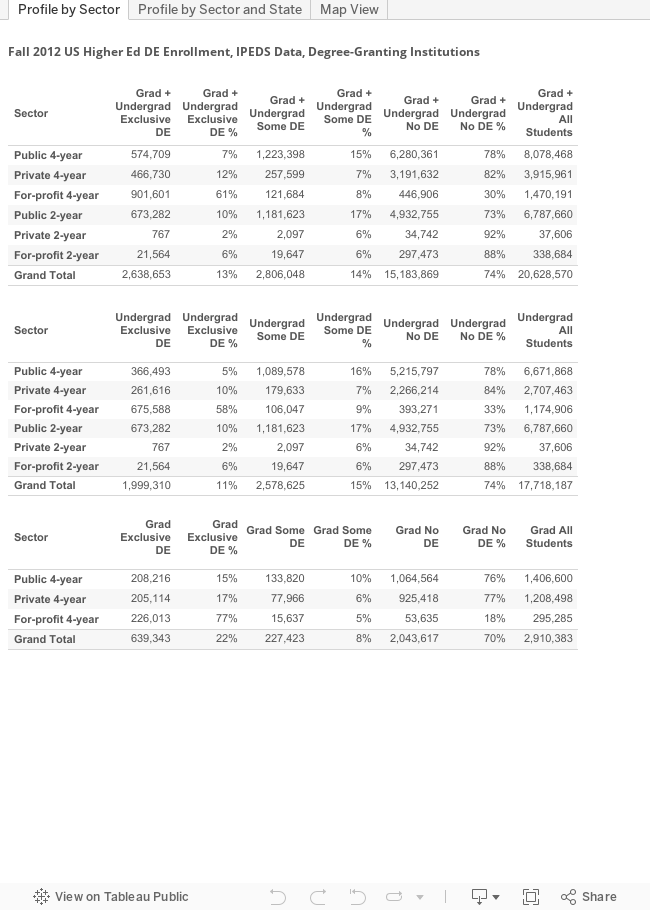
    Starting in late 2013, the National Center for Educational Statistics (NCES) and its Integrated Postsecondary Education Data System (IPEDS) started providing preliminary data for the Fall 2012 term that for the first time includes online education. Using Tableau (thanks to Justin Menard for prompting me to use this), we can now see a profile of online education in the US for degree-granting colleges and university, broken out by sector and for each state.

    Please note the following:

    • For the most part distance education and online education terms are interchangeable, but they are not equivalent as DE can include courses delivered by a medium other than the Internet (e.g. correspondence course).
    • There are three tabs below – the first shows totals for the US by sector and by level (grad, undergrad); the second also shows the data for each state (this is new); the third shows a map view.

  • Is the DOE backing down on proposed State Authorization regulations?

    Now witness the firepower of this fully written and delivered WCET / UPCEA /Sloan-C letter!

    – D. Poulin

    One of the policies that we’re tracking at e-Literate is the proposed State Authorization regulation that the US Department of Education (DOE) has been pushing. The latest DOE language represents a dramatic increase in federal control of distance education and in bureaucratic compliance required of institutions and states. In the most recent post we shared a letter from WCET, UPCEA and Sloan-C to Secretary Duncan at the DOE.

    What does it take to get all of the higher education institutions and associations to agree? Apparently the answer is for the Department of Education to propose its new State Authorization regulations. [snip]

    Here’s what is newsworthy – the idea and proposed language is so damaging to innovation in higher ed (which the DOE so fervently supports in theory) and so burdensome to institutions and state regulators that three higher ed associations have banded together to oppose the proposed rules. WCET (WICHE Cooperative on Educational Technologies), UPCEA (University Professional and Continuing Education Association) and Sloan-C (Sloan Consortium) wrote a letter to Secretary Arne Duncan calling for the DOE to reconsider their planned State Authorization regulations.

    While it is unclear how direct an impact the letter had, yesterday brought welcome news from Ted Mitchell at the DOE: they have effectively paused their efforts to introduce new State Authorization regulations. As described at Inside Higher Ed: (more…)

  • WWW-based online education turns 20 this summer

    I’m a little surprised that this hasn’t gotten any press, but Internet-based online education turns 20 this summer. There were previous distance education programs that used networks of one form or another as the medium (e.g. University of Phoenix established its “online campus” in 1989), but the real breakthrough is the use of the world wide web (WWW), effectively creating what people most commonly know as “the Internet”.

    To the best of my knowledge (correct me in comments if there are earlier examples), the first accredited school to offer a course over the WWW was the Open University in a pilot Virtual Summer School project in the summer of 1994. The first course was in Cognitive Psychology, offered to 12 students, as described in this paper by Marc Eisenstadt and others involved in the project (the HTML no longer renders):

    In August and September 1994, a Virtual Summer School (VSS) for Open University undergraduate course D309 Cognitive Psychology enabled students to attend an experimental version of summer school ‘electronically’, i.e. from their own homes using a computer and a modem. VSS students were able to participate in group discussions, run experiments, obtain one-to-one tuition, listen to lectures, ask questions, participate as subjects in experiments, conduct literature searches, browse original journal publications, work in project teams, undertake statistical analyses, prepare and submit nicely formatted individual or joint written work, prepare plenary session presentations, and even socialize and chit-chat, all without ever leaving their homes. The term ‘Virtual Summer School’ was used to mean that the software packages supplied to students emulate many aspects of a residential summer school, but without requiring physical attendance. As with many other Open University activities, we feel that face-to-face tuition and peer group interaction would still be preferable if it could be achieved. However, there are sometimes circumstances which preclude physical attendance, so we want to provide the best possible alternative. Virtual Summer School was a first step in this direction. This year, it was only an experimental option for a dozen already-excused students, which gave us a low-risk entry in order to assess the viability of the approach.

    There is even a concept video put together by the Open University at the end of 1994 that includes excerpts of the VSS course.

    And now for your trip down memory lane, I have taken the paper, cleaned up the formatting, and fixed / updated / removed the links that no longer work. The modified paper is below for easier reading: (more…)

  • Coursera shifts focus from ‘impact on learners’ to ‘reach of universities’

    Richard Levin, the new CEO of Coursera, is getting quite clear about the new goals for the company. At first glance the changes might seem semantic in nature, but I believe the semantics are revealing. Consider this interview with the Washington Post that was published today in the Washington Post [emphasis added in both cases below]:

    Richard C. Levin, the new chief executive of Coursera, the most widely used MOOC platform, wants to steer the conversation back to what grabbed public attention in the first place: the wow factor.

    Sure, Levin said, the emerging technology will help professors stimulate students on campus who are tired of old-school lectures. The talk of “flipped classrooms” and “blended learning” — weaving MOOCs into classroom experiences — is not mere hype.

    “But that is not the big picture,” Levin said in a visit last week to The Washington Post. “The big picture is this magnifies the reach of universities by two or three orders of magnitude.”

    Contrast this interview with Daphne Koller’s December article at EdSurge:

    Among our priorities in the coming year, we hope to shift the conversation around these two dimensions of the learning experience, redefine what it means to be successful, and lay the groundwork for products, offerings, and features that can help students navigate this new medium of learning to meet their own goals, whether that means completing dozens of courses or simply checking out a new subject. [snip]

    Still, we are deeply committed to expanding our impact on populations that have been traditionally underserved by higher education, and are actively working to broaden access for students in less-developed countries through a range of initiatives

    There are valid criticisms of how well Coursera has delivered on its goal of helping students meet their own learning goals, but now it is apparent that the focus of their efforts is shifting away from the learner and towards the institution. Below are a few notes based on these recent interviews.

    Changing Direction From Founders’ Vision

    This is the second interview where Levin contradicts the two Coursera founders. In the case above Levin shows the point of Coursera is not primarily impact on learners but is reach of great universities. In a New York Times interview from April he made similar points in contrast to Andrew Ng. (more…)

  • “Personalized Learning” Is Redundant

    Dan Meyer has just published a provocative post called “Don’t Personalize Learning,” inspired by an even more provocative post with the same title by Benjamin Riley (as well as being a follow-up to Meyer’s post “Tools for Socialized Instruction not Individualized Instruction“). Part of the confound here is sloppy terminology. Specifically, I think the term “personalized learning” doesn’t really mean anything, so it’s hard to have an intelligent conversation about it.

    (more…)

  • InstructureCon: Canvas LMS has different competition now

    For the first few years of the Canvas LMS, Instructure’s core message was ‘Canvas is better than Blackboard’. This positioning was thinly veiled in the company’s 2011 spoof of the Apple / 1984 commercial and even hitting the level of gloating in a company blog commenting on Blackboard’s strategy reversal in 2012. Instructure made their name by being the anti-Blackboard.

    At InstructureCon 2014, there was hardly a mention of Blackboard or any of the other LMS providers. In fact, most of the general sessions avoided any direct or indirect comparison of LMS products. This year there were three observations that surprised me:

    • Snow in June;
    • Canvas growth in K-12 markets; and
    • Lack of mention of LMS competitors or product one-upmanship.

    Snow in June

    (more…)

  • Happy Birthday, e-Literate

    Ten years ago today, I wrote my first blog post on e-Literate. At the time, my only real ambitions were to learn about blogging and use the fact that I was writing in public to force myself to think more clearly about what I believed about educational technologies. I never could have imagined that, not only would I still be writing a decade later, but that it would be come such a large and important part of my professional and personal life. I have met many wonderful people and had unbelievable opportunities as a result of this blog.

    At the beginning of my career as an educator, I was a middle school and high school teacher. I am the son of teachers, brother of teachers, husband of a teacher, and father-in-law of a teacher. I still consider myself to be a teacher. I particularly loved teaching 8th grade and plan to go back to it someday. Occasionally I wonder if I’m doing the right thing by doing what I do now instead of going back to the classroom immediately. But then I run into people like Jon and Chris Boggiano at someplace like the GSV conference. These two brothers enlisted in the army after 9/11, went to West Point, and served in active combat duty in places like Iraq, Kosovo, and Afghanistan. After they got out of the Army, they turned down lucrative careers in corporate America to create a startup training veterans and other folks in green jobs. They were recognized by the White House for their success. They then sold their startup, enrolled in graduate school in Stanford together, used their proceeds to become educational technology angel investors, and are busy planning their next startup. Here’s a video of them in action, presenting their thoughts on childhood and educational philosophy at a Stanford event:

    One more thing: Jon and Chris are my former seventh and eighth grade students.

    Their choices make me feel better about mine. If they think that developing technology in the service of education is a good way to try to change the world, then I am going to do everything I can to help them and people like them. I don’t always trust my judgment about what’s the best thing to do for our future, but I trust theirs.

    They are also a reminder that we often don’t know the consequences of the actions we take. I was absolutely stunned to see their names on the attendee list for the ed tech conference, but I also felt incredibly proud. Jon and Chris deserve 100% credit for who they have become and what they have accomplished, but I feel privileged to have played a small part in their grand adventure.

    And in that spirit, I want to ask you all if you might consider giving e-Literate a birthday present. When Phil and I write our blog posts, we are in our respective homes. Maybe we talk to each other a little bit about what we’re writing, but it’s mostly a solitary experience. We get sporadic feedback, often long after we have written our pieces. We get some idea of what people are thinking by the comments and the web traffic, but we don’t know if what we’re doing really matters. So if something we’ve written here has made a difference, if there was a decision you made differently or some post that influenced your thinking, we’d be grateful if you would let us know in comments or in email. It would mean a great deal to us to know that we’ve had even a small impact.

    Thanks for sticking with us, and I hope that you will still find us worth reading ten years from now.