
e-Literate

Present is Prologue

Category: Ed Tech

The “Ed Tech” category includes posts about educational technology products themselves, including LMSs and other learning platforms, adaptive learning and other digital curricular materials products, learning analytics, and educational apps of all types. It also includes technical aspects of ed tech products, especially interoperability.

  • Outcomes-Based Education and the Conservative Radicalism of the AAC&U

    I have been invited to participate on the Digital Working Group of the Association of American Colleges & Universities (AAC&U’s) General Education Maps and Markers (GEMs) program. (As we will see, AAC&U loves its acronyms.) GEMs is a really interesting project made even more interesting because of who is doing it. AAC&U is a fundamentally conservative organization in the sense that their purview is to help conserve that which is valuable and distinctive about the American college education. GEMs is part of a larger alphabet soup of AAC&U initiatives that are clearly about outcomes-based education and arguably about competency-based education (CBE). (For more on the distinction between these two, see Phil’s earlier blog post on the subject.) The organization’s leadership is frank about the fact that these have been at least partly defensive moves; given all the pressure for increasing accountability, the Association felt that academics should lead the charge on defining what that should mean before others define it for them. (GEMs is the latest in a series of related efforts to that end.) But the trail they are blazing has the potential to be pretty radical. Maybe even more radical than the organization has fully come to grips with.

    I’m going to be doing some of my homework for the working group here on the blog in future posts, but before I do that, I’d like to take the time in this one to outline what I understand to be the goal and context of GEMs. Fair warning: I’m not sure that my understanding is correct. I am new to AAC&U and, to be honest, they were not terribly good at articulating the goals for GEMs at the first summit. (I am not the only participant who had trouble parsing the goals and priorities.) With any luck, some AAC&U veterans will read this and correct any mistakes I make along the way.
    (more…)

  • New e-Literate TV Episode – CourseWare: What Comes After the Textbook

    We’ve just published our fourth episode in the e-Literate TV pilot series. This one is about CourseWare. Frequent e-Literate readers will know that this is a topic Phil and I think is important and growing in importance. You’re most likely to have heard of the products from the big publishers—Pearson’s CourseConnect, McGraw Hill’s SmartBooks, Cengage’s MindTap, and Wiley’s WileyPLUS—but there are also a lot of smaller entrants that are worth paying attention to.

    For this episode, I got to interview two of my favorite people in ed tech: Soomo Publishing’s David Lindrum and Lumen Learning’s Kim Thanos. Both of these folks run small companies that are doing good and novel work with the courseware product category without having huge technology budgets or whizzy adaptive engines. And they have some really interesting things to say about how the advent courseware changes the way we have to approach the development of curricular materials.

    Take a look.

  • New e-Literate TV Episode: MOOC Mania

    We have just published our third episode in the first ETV series—an interview with Stanford University’s Amy Collier about MOOCs. As is often the case with these episode, there are lots of different angles we could have taken. This episode is really the answer to a colleague who asks, “What is this thing that Tom Friedman has been talking about?” Amy does a terrific job of delivering a hype (and anti-hype) antidote.

    Take a look.

    We’ll have broader coverage in the full series about MOOCs we’ll be releasing after this current one, developed from the interviews that Phil and I conducted at the MOOC Research Initiative Conference.

  • edX forced to block access to students in Cuba, Iran and Sudan

    In late January I wrote here and here about the US Treasury Department, through the Office of Foreign Assets Control (OFAC), blocking access to Coursera courses by students in Syria, Cuba, Iran and Sudan (also see Kris Olds article here and IHE article here). The reason for the decision appears to be that MOOCs were classified as educational services instead of informational materials. At the time, edX was permitted to operate in those countries based on their reliance on getting licenses approved by OFAC, whereas Coursera was relying on a broad interpretation by OFAC. edX president Anant Agarwal even posted on a blog a somewhat congratulatory note:

    At edX, we are pleased to announce that no one, in any country, is blocked from taking one of our courses, and we have never blocked students from receiving education on the edX platform because of where they live.

    EdX has worked for many months with the U.S. Office of Foreign Assets and Control (“OFAC”) and the U.S. State Department to determine how we can assure that no one in any country is blocked from taking an edX course.

    Now comes word that edX has been forced by OFAC to block access to several courses for students in Cuba, Iran and Sudan. From The Harvard Crimson late yesterday:

    (more…)

  • A response to New Yorker article on ‘A MOOC Mystery’

    The New Yorker published an article yesterday titled “A MOOC Mystery: Where Do Online Students Go?” which tried to explain low MOOC completion rates by comparing the situation to the General Educational Development (GED) exam. Right off the bat, the article conflates MOOCs with “online students”. MOOCs are but one form of online education, and a very recent one at that. Worse, however, is that the entire basis for the article is quite flawed – GED results do not give much insight into MOOC students patters, and it turns out there is not much of a mystery in the first place.

    The hook in this article seems to be the coincidence of two numbers [emphasis added]:

    (more…)

  • Four numbers to consider from 2U’s IPO filing

    With the emergence of large-scale MOOCs over the past few years, it has become common to hear discussions of online education in terms of access and scale – access to low or no cost courses and scale of tens or hundreds of thousands of students. Of course MOOCs are but one form of online ed, and with 2U, Inc filing for an IPO in 2014, we have another example of a very different, and lucrative, approach to online education. 2U’s model extends high-tuition, elite programs to a small group of students. To get a sense of this approach, consider four remarkable numbers that are based on 2U’s S-1 filing.

    To provide context for these numbers, 2U’s model is somewhat unique, as described in Techonomy:

    . . . 2U offers weekly live online (synchronous) classes and a sophisticated social networking platform that lets students and instructors interact. Most degrees offered through 2U also require completion of physical components such as global MBA residencies, student teaching apprenticeships, and, for nursing students, operating room training on campus and clinical experience in their communities. [snip]

    Another difference is that 2U classes are small—just 10 to 15 students and a professor onscreen in a Brady Bunch grid—so admission is selective.

    2U makes $10,000 – $15,000 in revenue per student per year

    From our inception through December 31, 2013, a total of 8,540 unique individuals have enrolled as students in our clients’ programs. [p 1]

    For the years ended December 31, 2011, 2012 and 2013, our revenue was $29.7 million, $55.9 million and $83.1 million, respectively. [p 2]

    (more…)

  • Villanova Distance Learning Task Force: A case study in missing attribution

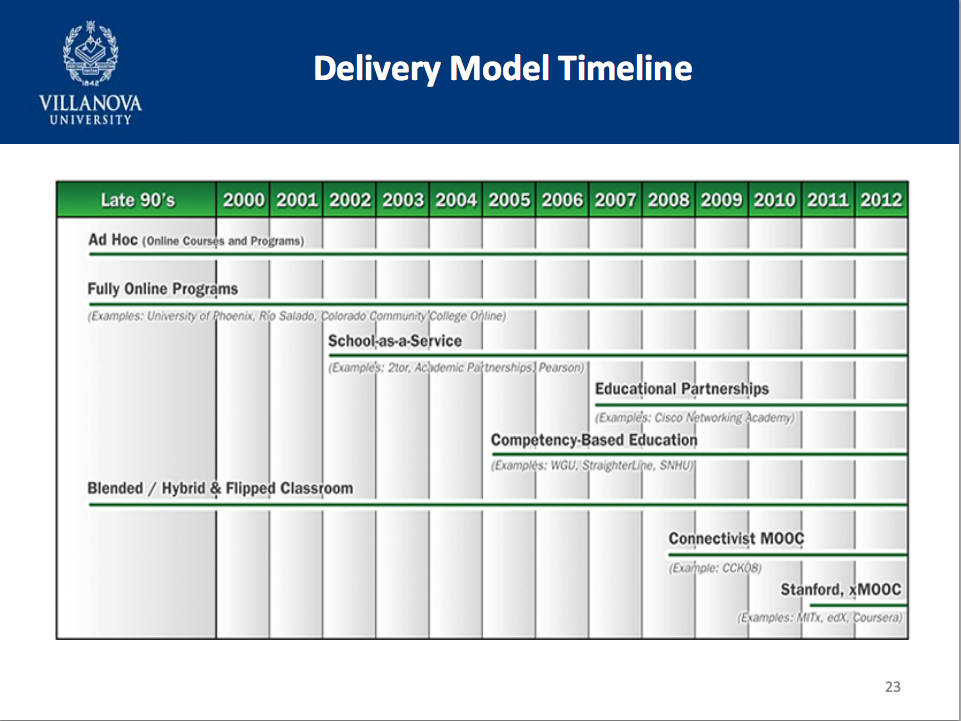
    While doing research for a blog post about 2U filing for an IPO, I ran across a presentation given last year by the Villanova University Distance Learning Task Force for a Faculty Forum. In this presentation I found one of my graphics that was shared on e-Literate and in EDUCAUSE Review.

    Slide 1I’m flattered that they would find this information useful, and this usage is why I usually include a footer to many of the graphics showing that they are licensed under creative commons to facilitate sharing. All I ask is for attribution and occasionally no derivatives.

    However, not only was there no attribution in the presentation, but the footer has been stripped off (I do not know if this was done by Villanova personnel or if they found a stripped-down version). Maybe that was just an unfortunate situation.

    But wait, just five slides down I find another graphic, same situation. (more…)