Update: This paper can be found at the 20MM site and has also been broken into four separate posts on e-Literate:
Introduction
When the Master Plan was adopted in California starting in 1960, the basic premise was to guarantee students a place within one of the three public systems based on their high school record. It was assumed that by having a place in a public institution, the student would have access to needed courses. ((As described in http://ucfuture.universityofcalifornia.edu/documents/ca_masterplan_summary.pdf, the Master Plan created the framework of the three systems with interdependent missions, and established the principle of universal access based on high school graduation rankings.))
For various reasons, this assumption is no longer valid.
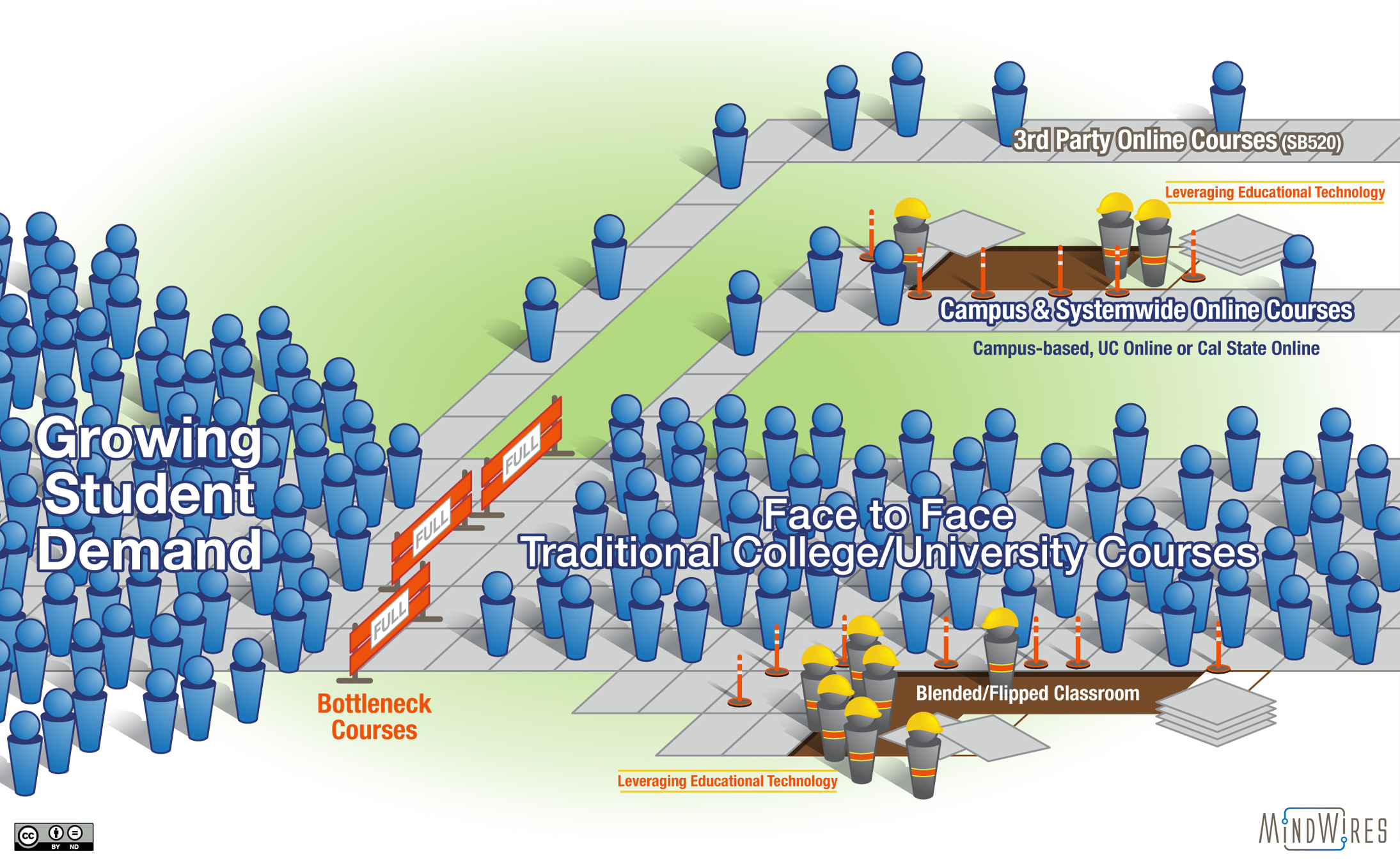
Both the Governor and the California State Senate have identified the problem of bottleneck courses as a serious problem that harms both students in the California public college and university systems and California taxpayers.
A bottleneck course is one that students are required to take in order to graduate but are overenrolled or unavailable during a reasonable schedule, and therefore, not available to the students when they need the courses.
The consequences of such a bottleneck are varied and serious:
- Students who are not able to get into the course must stay in school an extra semester or more.
- Because financial aid often depends on a full course load, students will often take not just one extra class but a full semester of extra classes.
- Taking a full load of classes for an extra semester often means that students are prevented from entering the workforce and earning a full-time income for another semester.
- Students can be frustrated at the lack of course access and lack of progress and drop out.
- Tuition for in-state student is subsidized by the state; therefore, every student who stays an extra semester because of a bottleneck course problem costs the state taxpayers money.
- To the degree that the student’s college costs are further subsidized by Federal financial aid, college-specific scholarships, or other public sources of money, the student adds further cost to taxpayers.
- To the degree that the student’s college costs are covered by loans, the student goes further into debt.
- Students who do not graduate in a reasonable amount of time have a lower chance of graduating at all.
- Meanwhile, students who are slower to graduate means that there are fewer spaces available for students who want to get into college.
In short, bottleneck courses cost students money, drive them further into debt, and lower their chances of graduation. Bottleneck courses also force state and federal taxpayers to subsidize those students taking not one but multiple courses, most of which they do not need or want to take. And this problem prevents other students from being able to start their college education while doing so.
How big of an issue is the bottleneck course problem? While we do not have the data necessary to quantify it exactly, consider the following:
- As of 2010, 34.8% of students graduate California public baccalaureate colleges in four years, while 65.1% graduate within six years.
- As of 2010, only 25.3% of California community college students graduated within three years.
- Also in 2010, a survey of California community college students found that 20% reported difficulty in gaining access to required courses, while in 2012, as many as 80% of California community colleges reported wait lists for some classes.
- Programmatic funding per student in the 2012 California state budget is $5,447 for the community colleges, $12,729 for Cal State, and $24,909 for UC. The delay in student graduation adds to the state-subsidized costs of education.
- California colleges and universities currently have an average of 7,000 students on their waiting lists. It is clear that the state systems are not meeting student demand.
These data points strongly suggest that bottleneck courses pose a serious moral and fiscal challenge that is worthy of the attention of the Governor and State Legislature.
The Nature of the Problem and the Role of Online Education
At its heart, the bottleneck course is the problem and online education presents an opportunity to address the problem – but it is not the only opportunity. As the bottleneck course is a resourcing problem, there are any number of non-technological solutions that could be adopted in addition to the application of online education. Several non-technological approaches to address the bottleneck course problem include increased state funding, re-allocation of faculty to focus more on lower-division courses, increased revenue from tuition increases, and broader articulation agreements to support concurrent enrollment and credit transfers.
That said, both the Governor and the Legislature have expressed an interest in exploring the degree to which educational technology in general and online learning in particular can be employed as a tool to address the bottleneck course problem.
The intention of this paper is to make recommendations for educational technology-enabled solutions as viable options without dismissing other approaches. To the contrary, our view is that any statewide framework for a solution should provide a mandate for the student right to educational access and a set of tools to help meet the mandate, while still empowering individual colleges and universities, as well as individual faculty members, to solve the bottleneck course problems in the ways that best suit their local needs.
Scope of Paper
While there are other potential benefits of online education – including expanding the number of students served and increasing revenue – we believe the state should focus on the bottleneck course problem first and ensure our public higher education systems serve matriculated students.
Educational initiatives should focus on the student, not the institution, and specifically on admitted students. Admitted students should have the right to get the lower-division courses they need, and if the school cannot provide the courses, there should be statewide access to either face-to-face or online courses to fill the same need.
This paper will focus on the application of state-driven online education initiatives to address the bottleneck course problem at the three public systems in California – California Community Colleges (CCC), California State University (CSU) and the University of California (UC).
Current Initiatives From Three Systems
California colleges and universities are no strangers to online education, at least at the individual campus level. While campus-based online education can be a valuable service for students, institutional collaboration across the state offers the greatest opportunity for addressing bottleneck courses.
While the following data points are based on distance education, note that approximately 9 out of 10 distance education courses are delivered online, via the Internet. These data points combine online courses offered to students off campus and on campus.
- Per the Chancellor’s Office Distance Education (DE) Fact Sheet, approximately 28% of CCC students take at least one distance education course and 18% of all CCC courses are offered by distance education. This equates to roughly 41,000 DE course sessions within a calendar year. Of the three systems, CCC has the greatest usage of online education at the campus level.
- Per the Katz and Associates study “Distance and Online Education in the CSU“, approximately 9% of all CSU for-credit courses are offered as distance education (combining full-time students with extended studies and continuing education). This includes 63 fully-online or hybrid programs (19 baccalaureate and 44 masters).
- Per the January 2013 Regents meeting, the ten UC campuses offer more than 2,500 online courses, but the vast majority are through extension programs for non-matriculated students. Approximately 114 online courses are offered for credit for matriculated undergraduate students, but of these, only 27 are available during the academic year.
Prior to 2010, all of the California efforts were based on campus or district-wide programs – there simply were not any online courses designed to be available outside of a home campus other than through the transfer process.
A key question to address, therefore, is: what online initiatives are the three systems (CCC, CSU, UC) providing and how do these initiatives address the challenge of bottleneck courses?
California Virtual Campus
The California Virtual Campus (CVC) was established in 1999 “to support development and delivery of online learning in California community colleges” at the individual college level. Over time, the mission of CVC has expanded to include system-wide products and services, and in 2009, the CVC mission further expanded to cover the CSU, UC and independent/private California colleges.
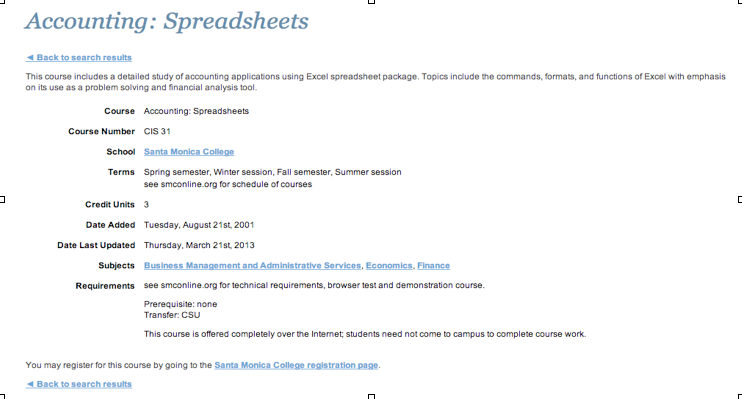
Today the online course portal – the CVC Catalog – forms the core of CVC’s mission, and it “serves as a clearinghouse for information about distance education programs and courses”. Prospective or current students can search for individual courses by keyword, college, subject area, and academic term.
There is no aggregation of data, however – the results are listed as specific courses offered by specific colleges or universities – and there is no direct link to the course within the campus student information system. The results include a summary description of the course and schedule as shown in figure 1 above. The links do not take you to the specific course, just to the registration page of the appropriate college, and there is no process to streamline or support concurrent enrollment or ability to transfer course credits between colleges.
Cal State Online
In 2011 the Technology Steering Committee (TSC), comprised of campus presidents and Chancellor’s Office staff, proposed the initiative that became CSU Online (since renamed Cal State Online). Cal State Online was operationally established later that year with the hiring of an executive director and the selection (in 2012) of Pearson as a services partner.
Based on the Sep 2012 board of trustees presentation, the mission of Cal State Online is to:
- Increase student access to CSU Programs;
- Facilitate success by leveraging technology;
- Centralize marketing and outreach efforts to make sure that students know about CSU-wide online options;
- Provide additional revenue for the campuses that can be used to support campus programs and priorities;
- Offer a central unit that powers outreach, marketing and technology support for online degree programs;
- Herald the University’s name, reputation and quality programming in places well beyond the reach of the traditional campuses;
- Redefine and greatly expand the University’s outreach and connection to its community;
- Centrally address the need for quality education online for students unable or unwilling to be in residence;
- Centralize and expand the University’s position as a leading provider of superior online programs; and
- Future proof the CSU.
The initial and current focus is to leverage perceived strengths of CSU, including:
- The 50+ fully online self-support programs that currently exist; and
- The undergraduate degree completion program options which are focused on returning students and welcoming back students with strong CSU campus connections.
For the Spring 2013 term Cal State Online provided initial support of two baccalaureate degree completion programs (where the student needs to transfer in with 60 credits and then complete the degree online) and five master’s level fully-online programs. Each program is offered and developed by a specific campus – Cal State Online plays the role of supporting the campus with appropriate services.
By Fall 2013, Cal State Online plans to have five baccalaureate degree completion programs and six master’s programs.
None of these courses are available for students outside the host campus program – they are intended for students entering a fully-online program at a specific campus.
Course fees are based on $500 per credit hour, leading to a cost of $6,000 per semester for students in a fully-online program.
UC Online
UC Online (also known as UCOE for University of California Online Education) was created in 2010 with the goal of expanding access to UC courses and creating new revenue for the system. The idea was to offer courses with the same quality standards as applied on UC campuses to new students, addressing the enrollment and revenue gaps due to state funding decreases.
UC Online also seeks to increase online offerings by specific campuses, thus helping time-to-degree for students at a particular campus.
Prospective UC students can take UC Online classes, and if admitted to a UC campus, have the credits accepted by the campus. These students form the basis of the mission to expand enrollment and revenue.
UC Online sought to fund itself primarily through external grants, but those grants have not materialized, leading UC Online to take out a $6.9 million loan from the UC system. Further plans for funding are based on revenue from non-UC students, and these plans include a $4.3 million investment in marketing.
However, as of Spring 2013, UC Online offered 14 courses, with 11 non-UC students registered for a course. As described by the Chronicle of Higher Education in October 2012, UC Online “needs to attract at least 3,000 non-UC students this year [2012-2013] and add 1,000 more each year until it reaches 7,000 non-UC students to pay back its loan on time, said DoQuyen Tran-Taylor, project manager for UC Online.”
UC Online originally planned to offer 25 – 40 high-demand courses and allow UC students to take these for credit at their institution. Based on the current course catalog, there were only three courses listed for spring 2013 with seven courses proposed and awaiting faculty approval for future terms. Approximately 1,700 UC students have taken UC Online courses, primarily as offerings from their home campus.
According to the January 2013 Regents meeting, “21 additional UCOE supported courses are in development and 12 of their courses are the only online systemwide courses currently approved to be offered to all UC undergraduates”. This information is not reflected on the UC Online website and its upcoming courses page.
From the Regents meeting:
“The Academic Senate is slated to consider an inter-UC articulation process patterned after the system already in place for course articulation between UC campuses and the California Community Colleges. Such a system would leave approval of courses in the hands of the home campus faculty for major or GE requirements when students take them from other UC campuses and would generate a searchable database of pre-approved courses linked to major or GE requirements so that the current staff- and time-intensive approval process could be replaced with a more efficient system. This process could apply to any systemwide course, including campus-developed online courses and offerings from systemwide programs.
Finally, the infrastructure and processes needed to recruit, enroll, and support eligible non-UC students in for-credit UC courses have been developed by UCOE in partnership with Blackboard Services. The system is supported by UC Merced to provide enrollment and support services. Winter/spring 2013 will be the first major test of the marketability of approved systemwide courses to non-UC students. The infrastructure and processes developed for non-UC students provide the foundation for the systems and services needed to support UC student enrollment across campuses; e.g., the systemwide catalogue, cross-campus data transfers, and support services.”
These are noble goals, but the ability of UC Online to deliver is in question – particularly in terms of developing courses and cross-campus enrollment.
UC Online documents (official web site and discussion document for Regents’ meeting) call out the problem.
- Web site: “While UC students have the opportunity to enroll in any UC course offered by another campus through the simultaneous enrollment process, access through this procedure will likely be very limited for UC Online courses during 2012-13. We hope to have alternative methods for enrollment in UC Online courses originating from other UCs available by fall, 2013.”
- Regents meeting: “It is clear now that both the campuses and UCOE would benefit from an infusion of funding on a temporary basis to facilitate continued development. The cross-campus hub needs to be developed, and there is currently no budgeted fund source.”
Course fees range from $1,400 – $2,100 per course.
Summary
As currently designed, CVC and Cal State Online do not address the problem of bottleneck courses, while UC Online has yet to prove that it can hit its planned targets and become self-sustaining. In sum, initiatives at all three systems fall short of solving the access problem for bottleck courses.
- California Virtual Campus (CVC) is the statewide initiative originally formed to serve the CCC system. This initiative makes it easier for a student to find individual online courses at each campus, but the portal merely gives visibility across systems, it does not provide for the aggregation of course offerings or a centralized registration system . The only route for a student to benefit from the discovery of an online course at a different campus is through the transfer process.
- Cal State Online was formed by CSU, and targets full-online degree completion programs at the baccalaureate level and fully-online master’s programs, for students who cannot or do not desire to attend classes on campus. There is no expressed intention from Cal State Online, based on official documents, to allow admitted CSU students to take these courses unless the students enter a fully-online program.
- UC Online was formed by UC, and is the only systemwide initiative designed to allow students to take online courses offered from another campus and help shorten time-to-degree, at least based on program plans. The problem with this initiative is that it has failed to meet its targets, and there are serious questions about the ability to become self-sustaining and deliver on the mission.
The state of California needs to be very targeted in its investments into online education to ensure that these investments address the problem of bottleneck courses.