
e-Literate

Present is Prologue

Tag: ASU Online

  • ASU Is No Longer Using Khan Academy In Developmental Math Program

    In these two episodes of e-Literate TV, we shared how Arizona State University (ASU) started using Khan Academy as the software platform for a redesigned developmental math course ((The terms remedial math and developmental math are interchangeable in this context.)) (MAT 110). The program was designed in Summer 2014 and ran through Fall 2014 and Spring 2015 terms. Recognizing the public information shared through e-Literate TV, ASU officials recently informed us that they had made a programmatic change and will replace their use of Khan Academy software with McGraw-Hill’s LearnSmart software that is used in other sections of developmental math.

    To put this news in context, here is the first episode’s mention of Khan Academy usage. (more…)
  • Personalized Learning Changes: Effect on instructors and coaches

    Kate Bowles left an interesting comment at my previous post about an ASU episode on e-Literate TV, where I argued that there is a profound change in the instructor role. Her comment:

    Phil, I’m interested to know if you found anything out about the pay rates for coaches v TAs. I’m also interested in what coaches were actually paid to do — how the parameters of their employable hours fit what they ended up doing. Academics are rarely encouraged to think of their work in terms of billable increments, because this would sink the ship. But still I’m curious. Did ASU really just hike up their staffing costs in moving to personalised learning, or was there some other cost efficiency here? If the overall increase in students paid off, how did this happen? I’m grappling with how this worked for ASU in budgetary terms, as the pedagogical gain is so clear.

    This comment happened to coincide with my participation in WCET’s Leadership Summit on Adaptive Learning, where similar subjects were being discussed. For the purposes of this blog post, we’ll use the “personalized learning” language, which includes use of adaptive software as a subset. Let’s first address the ASU-specific questions. (more…)

  • Instructor Replacement vs. Instructor Role Change

    Two weeks ago I wrote a post about faculty members’ perspective on student-centered pacing within a course. What about the changing role of faculty members – how do their lives change with some of the personalized learning approaches?

    In the video below, I spoke with Sue McClure, who teaches a redesigned remedial math course at Arizona State University (ASU) that is based on the use of Khan Academy videos. There are plenty of questions about whether this approach works and is sustainable, but for now let’s just get a first-hand view of how Sue’s role changed in this specific course. You’ll see that it took some prodding to get her to talk about her personal experience, and I did have to reflect back what I was hearing. Note that the “coaches” she described are teaching assistants.

    (more…)

  • NYT Michael Crow Condensed Interview: More Info needed . . . and available

    The New York Times ran an “edited and condensed” interview with Arizona State University (ASU) president Michael Crow, titled “Reshaping Arizona State, and the Public Model”.

    Michael M. Crow sees Arizona State as the model of a public research university that measures itself by inclusivity, not exclusivity. In his 13 years as its president, he has profoundly reshaped the institution — hiring faculty stars from across the country, starting a bevy of interdisciplinary programs, growing the student body to some 83,000 and using technology to bring his ideas to scale, whether with web-based introductory math classes or eAdvisor, which monitors students’ progress toward their major. Last year, Dr. Crow made headlines when the university partnered with Starbucks to offer students the chance to complete their degree online for free. His new book, written with the historian William B. Dabars, is called, appropriately, “Designing the New American University.”

    (more…)

  • ASU, edX and The Black Knight: MOOCs are not dead yet

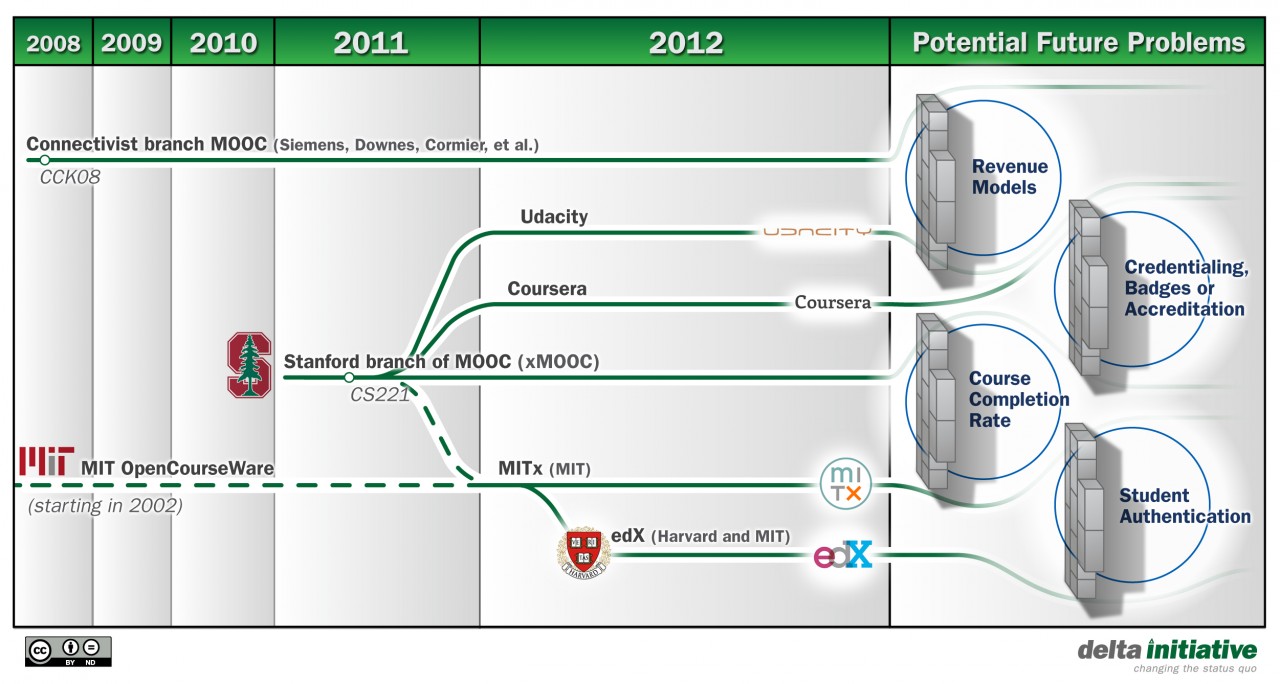
    In 2012 I wrote a post during the emergence of MOOC mania, pointing out some barriers that must be overcome for the new model to survive.

    So what are the barriers that must be overcome for the MOOC concept (in future generations) to become self-sustaining? To me the most obvious barriers are:

    • Developing revenue models to make the concept self-sustaining;
    • Delivering valuable signifiers of completion such as credentials, badges or acceptance into accredited programs;
    • Providing an experience and perceived value that enables higher course completion rates (most today have less than 10% of registered students actually completing the course); and
    • Authenticating students in a manner to satisfy accrediting institutions or hiring companies that the student identify is actually known.

    Fig 3 EvolutionCombine20120927

    Since that time, of course, the MOOC hype has faded away, partially based on the above barriers not being overcome.

    Today, Arizona State University (ASU) and edX announced a new program, Global Freshman Academy, that takes direct aim at all four barriers and could be the most significant MOOC program yet. From the New York Times story: (more…)

  • Adaptive Learning Market Acceleration Program (ALMAP) Summer Meeting Notes

    I recently attended the ALMAP Summer Meeting. ALMAP is a program funded by the Gates Foundation, with the goals described in this RFP webinar presentation from March 2013:

    We believe that well implemented personalized & adaptive learning has the potential to dramatically improve student outcomes

    Our strategy to accelerate the adoption of Adaptive Learning in higher education is to invest in market change drivers… …resulting in strong, healthy market growth

    As the program is in its mid stage (without real results to speak of yet), I’ll summarize Tony Bates style with summary of program and some notes at the end. Consider this my more-than-140-character response to Glenda Morgan:

    Originally planned for 10 institutions, the Gates Foundation funded 14 separate grantees at a level of ~$100,000 each. The courses must run for 3 sequential semesters with greater than 500 students total (per school), and the program will take 24 months total (starting June 2013). The awards were given to the following schools:

    (more…)