
e-Literate

Present is Prologue

Tag: big data

  • White House report on big data will impact ed tech

    Yesterday the White House released its report on big data and privacy implications. The focus was broadly on big data, but there will be implications for ed tech, with several key recommendations specifically focused on the education sector. Specifically, there will be a push to update and revise the Family Educational Rights and Privacy Act (FERPA, enacted in 1974) and Children’s Online Privacy Protection Act (COPPA, enacted in 2000). Education Week set the context quite well in its article:

    FERPA, which was written before the Internet existed, is intended to protect disclosure of the personally identifiable information contained in children’s education records. And COPPA, which requires parental consent under certain conditions for the online collection of personal information from children under age 13, was written before the age of smartphones, tablets, apps, the cloud, and big data.

    Think Progress, part of a group founded by John Podesta, who also led the White House study, summarized the key findings as follows:

    1. Giving consumers more protection and control over their private data with a bill of rights

    2. Pass a singular data breach law to prevent the next Target fiasco

    3. Strengthen outdated and archaic laws, such as the Electronic Communications Privacy Act (ECPA), which dictates how the government accesses emails

    4. Give non-citizens the same privacy protections

    5. Ensure data collected on students is used only for educational purposes

    Ed Tech Sections of the Report Itself:

    First, there is a description of the situation in pages 24 – 26 that is too long to quote but worth highlighting: (more…)
  • Links to External Articles and Interviews

    Last week I was off the grid (not just lack of Internet but also lack of electricity), but thanks to publishing cycles I managed to stay artificially productive: two blog posts and one interview for an article.

    Last week brought news of a new study on textbooks for college students, this time from a research arm of the  National Association of College Stores. The report, “Student Watch: Attitudes and Behaviors toward Course Materials, Fall 2013″, seems to throw some cold water on the idea of digital textbooks based on the press release summary [snip]

    While there is some useful information in this survey, I fear that the press release is missing some important context. Namely, how can students prefer something that is not really available?

    March 28, 2014 may well go down as the turning point where Big Data lost its placement as a silver bullet and came down to earth in a more productive manner. Triggered by a March 14 article in Science Magazine that identified “big data hubris” as one of the sources of the well-known failures of Google Flu Trends,[1] there were five significant articles in one day on the disillusionment with Big Data. [snip]

    Does this mean Big Data is over and that education will move past this over-hyped concept? Perhaps Mike Caulfield from the Hapgood Blog stated it best, including adding the education perspective . . .

    This is the fun one for me, as I finally have my youngest daughter’s interest (you made Buzzfeed!). Buzzfeed has added a new education beat focusing on the business of education.

    The public debut last week of education technology company 2U, which partners with nonprofit and public universities to offer online degree programs, may have looked like a harbinger of IPO riches to come for companies that, like 2U, promise to disrupt the traditional education industry. At least that’s what the investors and founders of these companies want to believe. [snip]

    “We live in a post-Facebook area where startups have this idea that they can design a good product and then just grow, grow, grow,” said Phil Hill, an education technology consultant and analyst. “That’s not how it actually works in education.”


  • Why Big Data (Mostly) Can’t Help Improve Teaching

    Here’s a nifty video summary of a doctoral dissertation by Derek Muller that a client pointed out to me:

    The basic gist is that students have pre-conceived notions that are wrong, and it is very hard to dislodge those mistaken notions. If you show them a video with an accurate explanation, the students will say that the video was clear and helpful, but they will misremember it as confirming their (mistaken) preconceived notions. In short, they won’t learn. In contrast, if you show them a video that starts by directly stating and then refuting their misconception, they like the video less and say it is confusing, but they actually learn more. This is a really important pedagogical point to know whether you are giving traditional in-class lectures, writing curricular materials, or creating one of those oh-so-modern video lectures that all the cool kids are into these days.

    It’s also a good example of the kind of insight that big data is completely blind to. And it gives us good reason to be skeptical that taking large lecture courses online, turning them into REALLY large lecture courses (with nice videos), and expecting that new and more effective pedagogies will rise out of the data because, you know, science or something, is more of a hope (or a fantasy) than a plan to improve education.

    (more…)

  • Open Secret: Pittsburgh’s Ed Tech Revolution

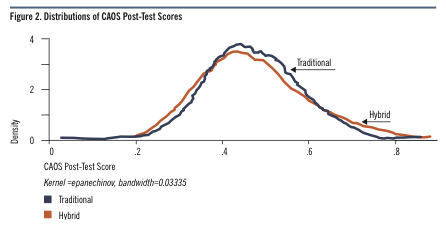
    Generally when we talk about goals for educational technology, we talk about one of two things: improving access or improving effectiveness. Rarely do we get an opportunity to talk credibly about an innovation that can move both of those needles at the same time. And yet, I saw just such innovation in Pittsburgh this week at the LearnLab Corporate Partners Meeting. LearnLab, jointly run by Carnegie Mellon University and the University of Pittsburgh, is not widely known in ed tech circles. However, it’s close cousin OLI is. For example, an independent study by ITHAKA S+R made a splash when it showed OLI could cut instructional time in half and still achieve the same level of effectiveness. Two groups of students across six different public universities took the same introductory statistics class. The first group took a traditional version of the class, with an average of 3 hours per week spent in the classroom. The second group took a hybrid version, where they spent one hour a week in the classroom and some time studying independently with the OLI cognitive tutoring software. So that second group spent one-third of the time in the classroom, which amounts to a very significant cost savings and an opportunity to teach more students for less money. Students themselves spent more time on homework in the second group than the first, but even so, they spent 25% less total time on the class than the ones in the traditional class. And yet, both groups achieved essentially the same competence at the end of the class:

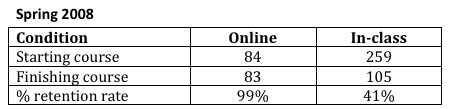
    To sum up, OLI was able to teach more students at lower cost and with less time on task from the students yet with the same effectiveness of a traditional class. Another, smaller study with similar traditional vs. cognitive-tutor-hybrid for an introduction to logic course found that while students in the hybrid condition saw a small (though not statistically significant) gap in learning effectiveness relative to their peers, they achieved more than double the completion rate:

    OLI is pretty well known in the broader ed tech community. They show up at conferences. The ITHAKA study got lots of play. I find it odd that we have not had a broader conversation about how they have achieved their results. Because the techniques developed by OLI, their colleagues at LearnLab, and their collaborators in other institutions have serious implications for OER, MOOCs, the textbook industry, and really, the future of education.

    (more…)