
e-Literate

Present is Prologue

Tag: Blackboard-Inc.

  • Openness: The Proof of the Pudding is in the Eating

    In my last post, I said that I thought Blackboard’s announcement of making it easy to add a Creative Commons license to a Common Cartridge export is significant. One day later, we have some evidence of just how significant. e-Literate featured blogger Audrey Watters has a post up on her own blog about a big announcement out of Washington state:

    With help from matching funds from the Gates Foundation, the Washington State Board for Community and Technical Colleges has built a Open Course Library (OCL), which launches today. The idea behind the library is to address the increasing cost of textbooks by making openly licensed course materials available for 81 of the state’s most enrolled classes. Some of the materials in the OCL are free, but some aren’t. The only stipulation: no required material or textbook can cost a student more than $30.

    The first phase of the project, which is available today, features materials for 42 of these classes, including Introduction to Literature, Introduction to Chemistry, Calculus I, and Microeconomics. (The other 39 should come online in the Spring of 2013)….

    As the materials in the OCL are licensed CC-BY, instructors will be able to adopt the course modules or adapt the materials to suit their own classes’ needs. The materials are available via Google Docs and Google Sites so that they can be shared between faculty and institutions, but there are also options to import the content into standard LMSes.

    By “options to import the content into standard LMSes,” she means that the content will be available as IMS Common Cartridges. How are they being produced? It turns out that the Washington State Board for Community and Technical Colleges has a state-wide license for ANGEL, which happens to export to Common Cartridge. So this initiative, which could turn out to be a big deal in terms of community college affordability, is partly enabled by a for-profit LMS vendor’s decision implement Common Cartridge export. Who was the guy in charge at ANGEL at the time that technology decision was made? Ray Henderson, the same guy who announced Common Cartridge export for Blackboard.

    By the way, there’s plenty of room for Pearson to play here too. Production of OERs is only part of the problem. You still need to drive adoption. If OpenClass made it very easy for faculty to find and import OCL content, either through Google Apps integration or through Common Cartridge import, that would be a significant step forward in at least one kind of Openness.
  • Perhaps ‘Open’ Is a Flag of My Disposition…

    Anyone who went to EDUCAUSE this year had to come away with the impression that Open is the new black. This product now comes with 50% more openness! That one’s openness is 99.44% pure! It’s easy to get jaded about all of this and cry “openwashing,” as Anya Kamenetz did, among others (including me, at times). But while it’s perfectly appropriate to hold vendors accountable for hype, it’s also important to look carefully at the announcements beneath the hype. Because they are not all the same. I proudly serve on the Sakai Foundation Board of Directors and proudly provide all content on this blog under a Creative Commons license, but I also recognize that there are different kinds of “open”—and different kinds of “free”—vendors can provide that have different kinds and levels of utility.

    Case in point: The respective announcements by Pearson and Blackboard last week reflect very different ideas of both “open” and “free.” Those differences matter. If we simply throw up our hands and declare the use of these words by all for-profit entities as meaningless marketing babble, then we will miss some valuable information.

    (more…)

  • Analysis of Blackboard Response to Recent Disclosure of Security Vulnerabilities

    There’s been an interesting set of public relations based on the recent news of Blackboard security vulnerabilities.  SC Magazine’s Australian edition broke a story on September 16 about an investigation by two or more anonymous Australian universities working with a security firm, Securus Global.  In conjunction with the magazine, this investigation exposed a number of security vulnerabilities with Blackboard Learn 8.0, 9.0 and 9.1 (the mainline legacy LMS from Blackboard, but not the WebCT or ANGEL acquired LMS product lines).  Blackboard has confirmed the majority of the issues are valid and issued a security advisory on September 16, subsequently updated on September 22.

    That is where the agreements stop, however.  Blackboard took issue with the tone of the article in a blog post from September 23, subsequently updated on September 27.  Blackboard disputes the assertions that they were not responsive to customer requests, and further, they are trying to downplay the significance of the vulnerabilities. (more…)

  • Blackboard Mergers and Acquisitions

    This is just a quick post to note the fact of two pretty big announcements coming out of Blackboard. First, the acquisition of the company by Providence Equity has been completed. Second, Providence immediately turned around and executed a merger between Blackboard and Edline, makers of an LMS-like product aimed at the K12 market. I haven’t had time to look into the details of this latest move, but it may suggest that Providence believes the K12 market is ready to experience a growth spurt.

  • Hawaii Dept. of Education Moving from Moodle to Blackboard

    Blackboard just put out a press release announcing that the Hawaii Department of Education is moving their Hawaii Virtual Learning Network (HVLN) from an open source LMS to Blackboard. The press release doesn’t name the platform, but HVLN is currently running Moodle. This is notable because it’s the first move I have heard of away from open source to Blackboard in the United States and one of a very few that I’ve heard of globally. One data point does not make a trend, but this does bear watching.

  • SunGard HE and Blackboard Acquisitions: Compare and Contrast

    UPDATE:  In the section on ‘Cash Cow vs. Growth Potential’, my choice of words could have caused misunderstanding.  I did not mean to equate Operating Income with Cash Flow, and my choice of the word ‘cash’ in this section should really have been ‘income’, as my analysis was obviously based on Operating Income.  I have made this correction below.  My apologies for any misunderstanding.

    Consider the recent news this summer that private equity firms have agreed to acquire both SunGard Higher Education (SGHE) and Blackboard in separate deals:

    • Two market leaders in technology solutions for education,
    • both generating revenues of several hundred million dollars per year,
    • both business strategies at risk due to eroding market share in their core business since 2007,
    • both facing challenges to integrate product lines and offer a clear road map for customers,
    • and both sold to private equity firms for more than $1.6B.

    SunGard Higher Education (SGHE) and Blackboard – brothers in arms.

    At first glance, there are some strong similarities between the acquisition perspectives of both market leaders, but if you look deeper, the differences provide a good insight into the future of technology markets for higher education.  These differences can explain why the ERP market seems to be consolidating with fewer choices while the LMS and educational technology market seems to be expanding with more choices.

    Cash Cow Income Machine vs. Growth Potential

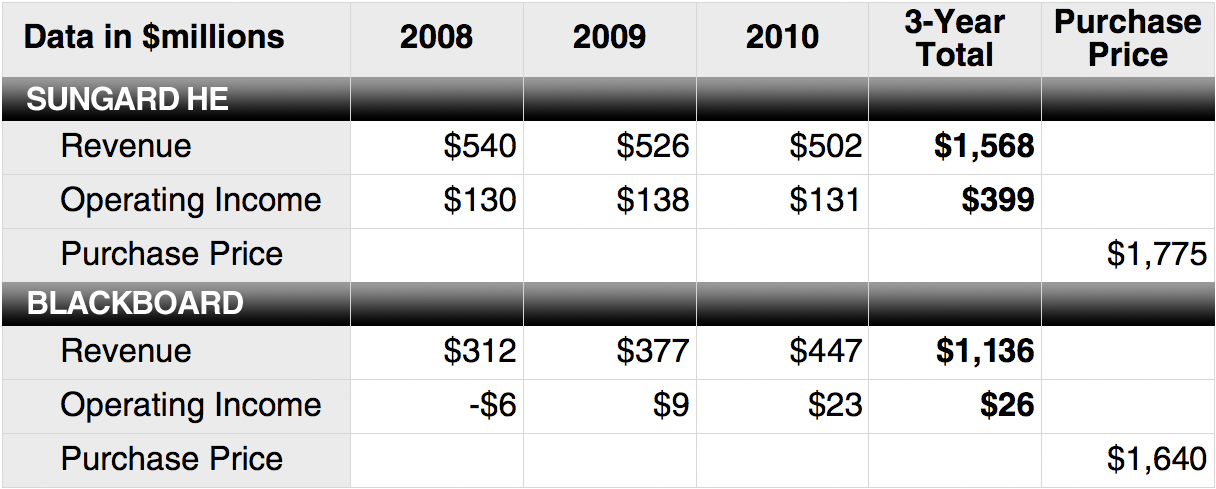
    During research for this post, I was surprised to find out how much cash income that SGHE generates and how close Blackboard has come to SGHE’s revenue numbers.  While Blackboard has seen its revenue increase due to corporate acquisitions of its own, it has only had a combined operating income of $26M over the past 3 years.  In that same time, SGHE has seen its revenue decrease by almost 10%, but it has had a combined operating income of $399M.

    It is somewhat difficult to compare the financials of the two companies, as they employ different accounting methods, so use the following table to see the big picture rather than the details.  I have attempted to show total revenue (numbers are fairly solid) and operating income (not as solid), while ignoring provisions for income taxes.  This data is based on SunGard’s annual report for 2010 (p. 36 as printed) and Blackboard’s annual report for 2010 (p. 26 as printed).

    (more…)

  • On Innovation and Commodification

    I had a wonderful time at the Moodle Moot two weeks ago. Conferences for different LMSs tend to have very similar presentation types (how to migrate, tricks for making the grade book usable, great Web 2.0 tools that integrate with the platform, ways to improve training and help, etc.), but the crowds are different. Moodle Moots tend to be heavy with people who are very pedagogically focused and sophisticated. (They also, apparently, attract a high percentage of iPad owners.) Anyway, it was fun.

    One of the best parts of the experience was getting to spend time with David Wiley (who, in addition to being a pioneer and major driver of OER propagation, is also one of the truly great human beings in the field of educational technology). David and I had dinner the last night of the conference and got to talking about how textbook publishers are moving in the direction of developing platforms that go well beyond the book in terms of what they deliver to students, e.g., Cengage’s MindTap, Pearson’s MyLabs, etc. He asked me whether I think open source and open content could build something similar. I replied that the infrastructure being built around Khan Academy is a step in that direction. David mused that it must be frustrating for textbook publishers to face not only competition from other publishers but also the open content movement constantly working to undermine their business model. I didn’t give him a very good answer that night. This blog post is my attempt to formulate a better one.

    (more…)