e-Literate

Present is Prologue

Tag: CCSF

  • Digging Deeper Into CCSF Story: $39 million for non-usage of LMS not really about DE

    When I wrote my initial post on Tuesday about the City College of San Francisco (CCSF) having to repay the state $39 million for non-usage of LMS, there was one number that kept bugging me.

    We’re not talking about an isolated problem with some faculty forgetting or refusing to use the official LMS. 92% of all courses (based on FTES count) did not comply with collegiate policy, and therefore there are no official participation records ensuring students understood the course requirements or that faculty interacted with students.

    The original San Francisco Chronicle article described the problem as occurring “in hundreds of online classes from 2011 to 2014”, and the independent audit document describes their charge to “review compliance of contact hours claimed for distance education” by CCSF. But 92% of faculty choosing to not use the campus LMS for an online course goes beyond sloppy processes or faculty resistance. There had to be more to the story. (more…)

  • Price Of Faculty Not Using LMS? $39 million for CCSF

    Price Of Faculty Not Using LMS? $39 million for CCSF

    This morning the San Francisco Chronicle published an article about City College of San Francisco (CCSF) having to repay the state of California $39 million due to an audit of distance education courses.

    City College of San Francisco, struggling for every dollar it can muster, must repay the state nearly $39 million because it can’t prove that instructors taught thousands of students in hundreds of online classes from 2011 to 2014, an audit revealed.

    City College has been unable to verify teaching about 16,000 students in 587 online courses — from Accent Improvement to Cardiorespiratory Emergencies — over the three-year period, according to the state-commissioned audit that ended in September.

    It took a little bit of digging during a conference call (shh, don’t tell the hosts), but it looks like the issue was that the vast majority of faculty teaching online or hybrid courses chose to not use the centralized Moodle LMS system despite district policy that the LMS is the official record of student and faculty interaction.  (more…)

  • CCSF Update: Accreditation appeal denied, but waiting for court date

    It looks like I’ll have the California trifecta for the past week, having already posted on Cal State and University of California news recently. Maybe I should find a Stanford or some other private university story.

    In my last post on CCSF from January:

    Last week, as expected, a California superior court judge ruled on whether to allow the Accrediting Commission for Community and Junior Colleges (ACCJC)  to end accreditation for City College of San Francisco (CCSF) as of July 31, 2014. As reported inmultiple news outlets, the judge granted an injunction preventing ACCJC from stripping CCSF’s accreditation at least until a court trial based on the city of San Francisco lawsuit, which would occur in the summer 2014 at the earliest. This means that CCSF will stay open for at least another academic term (fall 2014), and it is possible that ACCJC would have to redo their accreditation review.

     In the meantime, ACCJC reviewed CCSF’s appeal of the accrediting decision, and ACCJC is sticking to its guns on the decision, as described in the San Francisco Chronicle:

    City College of San Francisco remains out of compliance with eight accreditation standards, so the threat to revoke its accreditation stands, said the commission that set July 31 for the action that would shut the college down.

    Accreditation won’t be revoked on that date, however, because a judge delayed the deadline until an October trial can determine if the Accrediting Commission for Community and Junior Colleges properly conducted its 2012 evaluation of City College.

    In other words, ACCJC has changed its determination that CCSF should lose accreditation. There are only two caveats at this point:

    • The injunction that prevents ACCJC from revoking accreditation until the October court date; and
    • A new loophole called “restoration status”.

    (more…)

  • CCSF Accreditation Injunction: The decisions and implications

    Last week, as expected, a California superior court judge ruled on whether to allow the Accrediting Commission for Community and Junior Colleges (ACCJC)  to end accreditation for City College of San Francisco (CCSF) as of July 31, 2014. As reported in multiple news outlets, the judge granted an injunction preventing ACCJC from stripping CCSF’s accreditation at least until a court trial based on the city of San Francisco lawsuit, which would occur in the summer 2014 at the earliest. This means that CCSF will stay open for at least another academic term (fall 2014), and it is possible that ACCJC would have to redo their accreditation review.

    What was the actual decision and what are the implications for other schools?

    Law Suits

    The original issues found by ACCJC were raised in the 2006 review, leading to multiple follow-up reports and actions. By summer 2012 ACCJC issued a Show Cause ruling based on a new review – the one that is the crux of the lawsuits and injunction. The full 2012 report documented the new evaluation that in order to “fully meet each ACCJC Accreditation Standard and Eligibility Requirements [sic]”, the college must follow 14 recommendations by March 2013 to keep its accreditation. CCSF did not meet this timeline and ACCJC in July 2013 sent a letter stating that CCSF accreditation would be revoked as of July 31, 2014. For full background, read this post.

    Despite the seven-year buildup, CCSF finally got serious about changes in summer 2013, and they replaced their Board of Trustees with a “special trustee” (Robert Agrella) “with unilateral powers to try and save the school from losing accreditation in one year”.

    As CCSF is the largest college in California (85,000 students before 2012) and potentially the largest college ever to lose accreditation, the issue quickly became political. Three groups filed law suits seeking for force ACCJC to maintain CCSF accreditation – the City of San Francisco’s attorney Dennis Herrera, the American Federation of Teachers (AFT) Local 2121 and the California Federation of Teachers (CFT), and the Save City College Coalition (which was not part of last week’s ruling). Much of these three lawsuits’ arguments were based on a Department of Education notification from August 2013 that ACCJC was “out of compliance in several areas related to its sanctioning of City College”.

    (more…)

  • Ruling expected this week on court challenge to CCSF loss of accreditation

    Over the summer I covered the drama surrounding the impending shut down of the largest college in California – City College of San Francisco, or CCSF – due to termination of accreditation. The short version is that the Accrediting Commission for Community and Junior Colleges (ACCJC) voted to end accreditation for CCSF as of July 31, 2014. Unless reversed, the loss of accreditation would likely force the 80,000 student college to shut down. CCSF would be the largest US college to date to lose accreditation.

    Since this summer there have been several lawsuits, most notably by the City of San Francisco and the CCSF faculty union (California Federation of Teachers), seeking an injunction to stop ACCJC’s removal of accreditation. The DOE findings (documented here) form much of the basis of these lawsuits that will likely come to a head soon as the superior court judge is expected to rule on the injunction this week.

    Meanwhile, CCSF administration is actually supporting the accrediting commission regarding the lawsuits. As also reported by the San Francisco Chronicle, the CCSF administration is  attempting to reverse the decision by working within the ACCJC process by addressing the deficiencies.

    (more…)

  • Postscript on accreditation transparency: Basic financials of two accrediting commissions

    Last week I wrote a post on two significant accrediting actions related to City College of San Francisco and Tiffin University.

    If there really is a shift in the DOE’s views on accreditation or in the accrediting commissions’ interpretation of standards, then that could have fairly profound cascade effects on competency-based learning programs, private online colleges, MOOCs, and online service providers.

    That is also why the lack of transparency from the accrediting commissions is so troubling. They are making decisions that have profound effects on many institutions, not just the specific schools under review.

    Mathieu Plourde asked a good question in the comments.

    Do you know how these accrediting bodies get their funding? If it’s at least in part from government funding or through membership fees from public institutions, I’d say it’s time to make them open up their data.

    While I have not figured out if there is a method to force the accrediting commissions to “open up their data”, I would like to answer the first part of Mathieu’s question on funding.

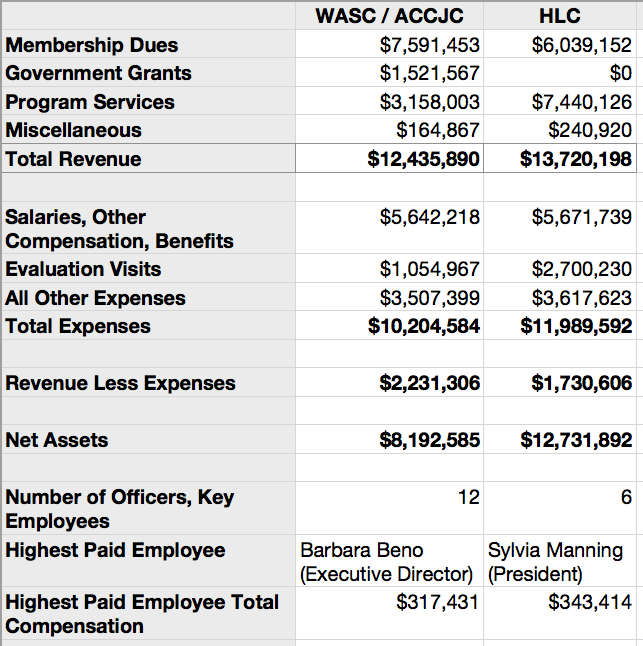
    Accrediting commissions are designated non-profit organizations, typically designated as 501 (c) (3) by the IRS. This means they have to file annual returns (form 990) to maintain their tax-exempt status. One sight that has this information is the Foundation Center. I’ve pulled up the most recent forms for the  Accrediting Commission for Community and Junior Colleges (ACCJC), responsible for CCSF’s accreditation, and the Higher Learning Commission (HLC), responsible for Tiffin University’s accreditation. Some notes before getting to the data:

    • There are six regional accrediting agencies in the US covering postsecondary education. Each agency has one or two commissions as members that are responsible for the actual accreditation reviews, for a total of eight regional accrediting commissions (New England and Western agencies have two commissions each).
    • ACCJC is part of the Western Association of Schools and Colleges (WASC). Since there are two commissions in WASC, WASC files the form 990 instead of ACCJC. Their most recent form available is for the tax year ending June 30, 2011 (I do not know why the 2012 data is missing).
    • HLC is a member of the North Central Association of Colleges and Schools (NCACS). Since there is only one commission in NCACS, HLC files its own form 990. Their most recent form available is for the tax year ending August 31, 2012.
    • “Membership Dues” covers the fees paid by accredited institutions.
    • “Program Services” combines paid workshops, consulting and annual conference revenues – typically from the member institutions.
    • “Evaluation Visits” are primarily travel and direct expenses for peer review teams visiting institutions during review.

    The actual forms can be found here for WASC / ACCJC and here for HLC . I have combined the most relevant data into one table.
    Form 990


    I went back and forth on whether to highlight the ‘highest paid employee’ data. In the end I chose to include this in the table as it seems relevant in terms of the organization’s motivations for self-preservation. In the case of ACCJC, there have been many charges of conflict-of-interest for the commission members, and the Department of Education has even found that the commission does not have adequate conflict-of-interest policies. The people running accrediting commissions are few in number but make a decent living. There is more information available in the form 990s.

    So, for my long-winded answer to Mathieu: Accrediting commissions get their revenue primarily from membership dues and additional program services from member institutions, many of which are themselves public entities; they also make some revenue directly from government or foundation (e.g. Lumina Foundation, Gates Foundation) grants but not every year.

  • Higher Ed Accrediting Commissions: Transparency for thee, not for me

    Why do I keep covering accreditation issues on e-Literate, a blog nominally about online learning and educational technology? The reason is that accrediting commissions have enormous influence on higher education institutions, particularly as the industry wrestles with questions of which changes are necessary, which changes are worth trying but might not work, and which changes should be avoided. If there really is a shift in the DOE’s views on accreditation or in the accrediting commissions’ interpretation of standards, then that could have fairly profound cascade effects on competency-based learning programs, private online colleges, MOOCs, and online service providers.

    That is also why the lack of transparency from the accrediting commissions is so troubling. They are making decisions that have profound effects on many institutions, not just the specific schools under review.

    Case 1: Tiffin University and HLC

    Tiffin University was forced to drop its partnership with Ivy Bridge College – an private college owned by Altius Education – earlier this month. From the press release:

    (more…)