
e-Literate

Present is Prologue

Tag: CCSF

  • Major Twist in CCSF Accreditation Crisis: DOE Threatens Accrediting Agency

    I have recently described the seven-year accrediting crisis that City College of San Francisco (CCSF) faces as well as a summary of the dissenting voices.

    Now it’s time to be petty.
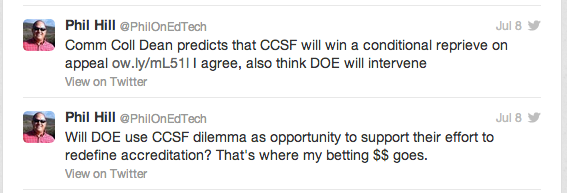
    Your_Twitter_archive


    We are now seeing just the intervention that I  predicted one month ago. Per Inside Higher Ed today:

    City College of San Francisco’s regional accreditor is now in the same existential bind as the college, having been told by its overseer to fix several problems, pronto, or risk being stripped of power.

    The U.S. Department of Education on Wednesday notified the Accrediting Commission for Community and Junior Colleges that it is out of compliance in several areas related to its sanctioning of City College. The commission must take “immediate steps” to avert the suspension or termination of its federal recognition as an accrediting body, according to a letter from the department.

    What this development, which stunned many in California, means for the fate of City College is less clear. Most involved parties said they were still absorbing the letter and its ramifications.

    The DOE directly responded to the California Federation of Teachers (CFT) complaints about the process itself – not the actual findings and whether CCSF was in compliance. As can be read in the letter, the DOE listed 4 issues that ACCJC must address.

    1. The agency does not have a policy for the on-site evaluation teams. The issue is that the teams were administrator heavy.
    2. The agency does not have a policy on conflict-of-interest. The issue is that the spouse of the ACCJC president was on the evaluation team, and this could bias the commission to favor the team’s findings over other voices.
    3. The agency letters (see post on history of warnings) did not clearly differentiate issues that indicated the college was out of compliance from issues which were mere recommendations.
    4. The agency’s use of the word “recommendation” was not clear. One one hand, ACCJC gave strong language for correction, but they did not start the two-year clock on resolution until the agency formally sanctioned the school. The policy is not clear on when the time period starts.

    Note that the DOE did not address the CCSF findings, but rather they accepted the CFT complaints about technicalities in the accrediting review process.

    Rather than give ACCJC the normal 12 months to fix their internal policies, the DOE “determined that in order to avoid initiation of an action to limit, suspend or terminate ACCJC’s recognition [authorizing it as accrediting agency], ACCJC must take immediate steps to correct the areas of non-compliance identified in this letter”.

    Given my accurate prediction one month ago, I’ll make two more predictions:

    • This is a complete victory for the CFT, and the DOE has taken sides in this dispute. I predict ACCJC will be forced to reverse the CCSF accrediting decision as “a conditional reprieve on appeal” as noted by Community College Dean. At the very least, CCSF will get another two years to comply.
    • This action will enable the federal government, through DOE regulations, to dramatically step up its involvement in accrediting policy. I predict new DOE-driven demands on revisions to accrediting policies for all seven regional agencies within the next 12 months.

    Update 8/21: CCSF formally asked the commission to reverse its decision, according to a story at the San Francisco Chronicle.

    City College of San Francisco asked a commission on Tuesday to reverse its devastating decision to revoke the school’s accreditation next year – but has been told not to share any details of its request with the public.

    And, unwilling to upset those who hold its fate in their hands, the college made its request without citing mistakes the commission made when it evaluated the college that were recently identified by the U.S. Department of Education.

    The news disappointed faculty, who had hoped the Accrediting Commission for Community and Junior Colleges would be forced to withdraw its decision to revoke City College’s ability to operate after the Department of Education upheld complaints by the faculty union last week. The Department found the commission had violated four regulations in its scrutiny of the large college – including giving the appearance of a conflict of interest when it let the husband of commission President Barbara Beno help evaluate the college.

    The Department of Education said its findings could be used as part of the college’s appeal of the accrediting decision.

    Unlike a court of law, however, accrediting appeals are made to the same commission that issued the original verdict. So the college considered a complaint about the commission too risky.

  • CCSF Accreditation Crisis: The Dissenting Voices

    I recently wrote about City College of San Francisco (CCSF) and its impending loss of accreditation, which would essentially shut down the largest community college in California (85k students).

    Last week the Accrediting Commission for Community and Junior Colleges (ACCJC), which operates under the corporate entity the Western Association of Schools and Colleges (WASC), voted to end accreditation for the City College of San Francisco (CCSF) as of June 2014. Unless reversed, the loss of accreditation would like force the 85,000 student college to shut down. CCSF would be the largest college to date to lose accreditation, and it is also the largest community college in California.

    The rest of the post walked through the seven years of history that led to the current crisis. In essence, CCSF was notified originally in 2006 by ACCJC that they were potentially out of compliance on three issues.

    Based on this evaluation, the ACCJC “took action to reaffirm accreditation, with a requirement that the college complete a Progress Report and a Focused Midterm Report”. In the letter, two areas were highlighted for further review.

    • The Commission asked that the Progress Report be submitted in 2007 to specifically cover resolution of Recommendation #4 (Financial Planning and Stability).
    • The Commission required a Focused Midterm Report in 2009 “which must give evidence of progress” on specific recommendations #2 (Planning and Assessment and #3 (Student Learning Outcomes).

    But this is all one side of the story – the view according to the accrediting agency. What are the dissenting views?

    Emerging Consensus from Institution and Political Leaders

    There have been many complaints about the ACCJC process and decision, and the vast majority that disagree with the decision have originated from faculty and faculty unions. Despite their concerns over the potential closing of such a large college, most non-faculty groups have essentially supported the process.

  • CCSF Accreditation Crisis: Seven Years in the Making

    Last week the Accrediting Commission for Community and Junior Colleges (ACCJC), which operates under the corporate entity the Western Association of Schools and Colleges (WASC), voted to end accreditation for the City College of San Francisco (CCSF) as of July 31, 2014. Unless reversed, the loss of accreditation would like force the 85,000 student college to shut down. CCSF would be the largest college to date to lose accreditation, and it is also the largest community college in California.

    Update 8/21: Date corrected to July 31.

    It might be useful to recap the process and issues that led to the current accrediting crisis. This summary is based on the accrediting body’s findings. In a later post I’ll address the counter arguments made by the school and faculty unions.

    Spring 2006 Evaluation

    The immediate story did not start in 2012 with the institution’s request for reaffirmation of accreditation and subsequent ACCJC evaluation, but rather started back in 2006. In the 2006 evaluation report the commission “validated that that the college meets the eligibility requirements for accreditation and complies with the standards of accreditation” and identified eight key recommendations.

    Recommendations #2, #3, and #4 were “overarching concerns that should receive the college’s focused attention and emphasis”. The recommendations are summarized below.

    • 1) Mission Statement: Regularly review and approve the mission statement in a discrete process
    • 2) Planning and Assessment: Build planning and assessment efforts in an integrated process linked back to the annual budgets, including clear criteria for resource reallocation and / or program and service development, expansion, or termination
    • 3) Student Learning Outcomes: Ensure that student learning outcomes are fully institutionalized as a core element of college operations, with specific focus on curriculum and program development
    • 4) Financial Planning and Stability: Develop a financial strategy that will: match ongoing expenditures with ongoing revenue; maintain the minimum prudent reserve level; reduce the percentage of its annual budget that is utilized for salaries and benefits; and address funding for retiree health benefits costs
    • 5) Physical Facilities Contingency Planning:Ensure the development of adequate contingency plans, which should be implemented in a timely manner in order to reduce potential exposure to losses
    • 6) Physical Facilities Maintenance Planning: Include the future costs of operating and maintaining new and existing facilities in its planning models and allocate funds in a timely manner to ensure the effective operation of these facilities
    • 7) Technology Planning: Bring all unit technology plans up-to-date, and develop a unified college-wide technology plan; this plan should be integrated with facilities and budget plans; funds for technology acquisition and maintenance, including regular replacement of outdated hardware, should be integrated into the institution’s budget
    • 8) Board of Trustees Evaluation: Establish a method of self evaluation for the Board of Trustees, determine the schedule for this process, and complete self evaluations on a regular basis

    (more…)