e-Literate

Present is Prologue

Tag: Cengage

  • OER Survey and Adoption Growth: It pays to check source material

    OER Survey and Adoption Growth: It pays to check source material

    I had a trip to the UK this month and only had time to read media coverage of the recent Babson Survey Research Group (BSRG) survey on open educational resources (OER). What a mistake. The Chronicle of Higher Education had a flawed description of a key question – actual and planned adoption of OER material by faculty – that misinformed readers like me who didn’t read the actual survey report, at least initially.

    The open-educational-resources movement, commonly known as OER, is an effort to encourage academics to use open-licensed materials in their classrooms as a way to lower costs. Some nonprofits, like OpenStax, have produced textbooks based on this material. The survey shows that OER has made inroads: 22 percent of people who teach introductory courses, subjects in which free textbooks are most commonly available, use it as required material, up from 15 percent last year.

    Yet the percentage of faculty members who say they will use, or consider using, open materials in the next three years actually dropped slightly, with the numbers now at 6 percent and 32 percent respectively.

    On the surface, this description indicates that OER adoption increased for faculty teaching introductory courses, but the second paragraph shows a potential drop in adoption over the next three years for all faculty. That would be major news showing that the OER movement hit an inflection point and is likely to drop soon, even though faculty have a natural affinity for the same issues that OER offers – lower cost and the ability to remix / reuse.

    It turns out this interpretation is wrong. The actual BSRG survey report states the following [emphasis added]:

    Each year, this survey asks faculty members who are not current users of open educational resources whether they expect to be using OER in the next three years.

    This question is only for non OER-adopting faculty. In other words, it measures growth potential, not total adoption potential. In fact, the percentage of faculty who used required OER material in any of their courses more than doubled this year, and based on the question above should continue to grow. BSRG further described the numbers for non OER-adopting faculty.

    There have been minimal changes in the proportion of faculty who report that they will use OER in the next three years, dropping slightly from 7% in 2015-16 and 2016-17, to the 6% reported this year. The number who report that they “Will consider” OER grew from 31% in 2015-16 to 37% for 2016-17, before dropping to 32% for 2017-18.

    This description is poorly worded and misses the context provided earlier, which I assume was part of the problem with Chronicle coverage.

    As for actual adoption, the category of “all faculty” grew significantly over the past year.

    Nearly one-quarter of faculty that teach large enrollment introductory courses report that they are using OER in some fashion, with more of these faculty responding that use OER as supplemental rather than as required materials. The rates are lower across all faculty, with 13% reporting using OER as required course material in at least one of their courses.

    These numbers represent a large increase over those in previous years, with the overall faculty rate of required OER use climbing from 5% two years ago to 6% in 2016-17, and then making a large jump to 13% this year. Given the sometimes vague understanding of the OER and its licensing, care must be taken in interpreting these results. Are faculty lumping any free resource into the OER category, even those that are not licensed as OER? Based on previous results we have to assume that there is some level of over-reporting in these figures of OER use; we just don’t know how much of an impact this is having.
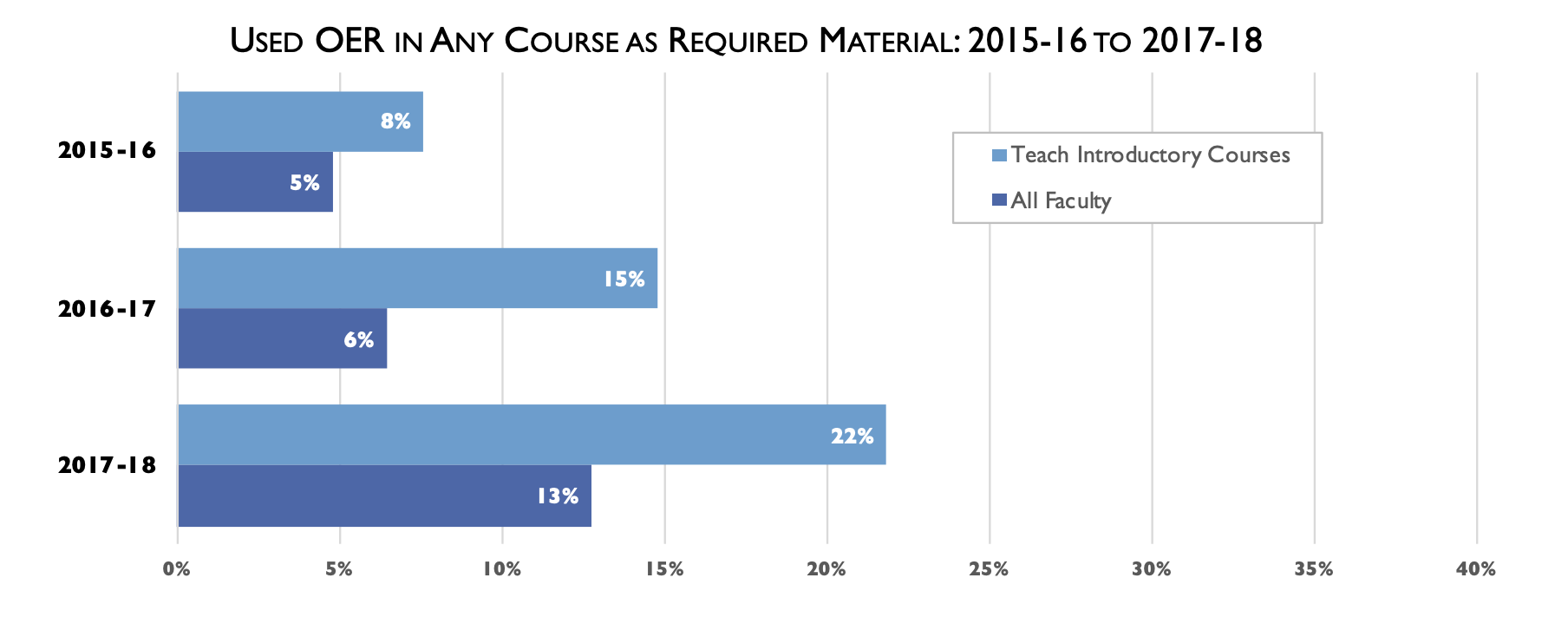
    Chart showing growth of OER adoption

    What is interesting is that this adoption growth aligns with an independent source, the Cengage OER survey from Fall 2016.

    Open Educational Resources (OER) in higher education have the potential to triple in use as primary courseware over the next five years, from 4 percent to 12 percent, according to a survey of more than 500 faculty by Cengage Learning.
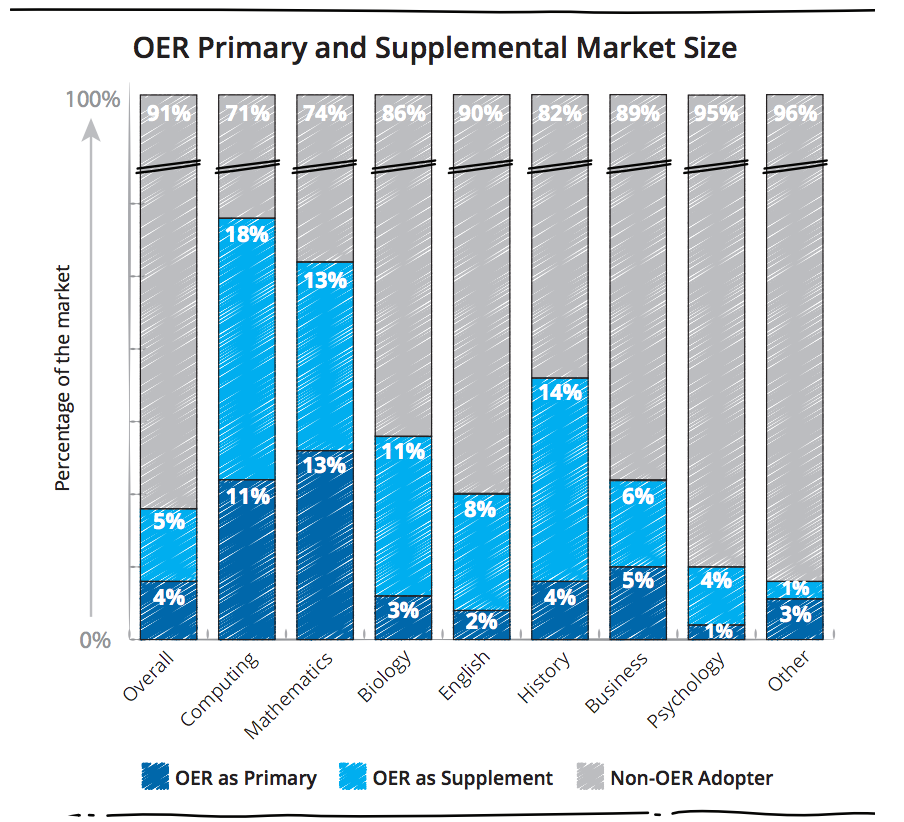
    What the data appear to show is significant growth in OER adoption for all faculty as well as for the subset teaching introductory courses. Adoption should continue, although it could be at a slower rate than was seen over the past year.

    It pays to read source material when the data describes important trends, especially when the results are surprising. I wish I had done this earlier.

  • Textbook Authors Sue over Cengage Unlimited Royalties

    Textbook Authors Sue over Cengage Unlimited Royalties

    Back in January, I wrote of Cengage’s “all you can eat” Unlimited pricing announcement:

    We don’t know whether Cengage will be a winner from this strategy, but we do know who will be the losers: textbook authors. Cengage, of course, denies this. Cengage CTO George Moore, when asked about the contract renegotiations with the authors to make this fly, said only that “Cengage renegotiates contracts with authors all time.” Michael Hansen claimed that Cengage’s interests and their authors are aligned, and that their authors are all very concerned about the affordability of textbooks.

    Really?

    In February of 2015, Greg Mankiw—Cengage’s blockbuster economics textbook author who has made literally millions of dollars from his relationship with Cengage—expressed perplexity at the The New York Times’ call for less expensive textbooks:

    To me, this reaction seems strange. After all, the Times is a for-profit company in the business of providing information. If it really thought that some type of information (that is, textbooks) was vastly overpriced, wouldn’t the Times view this as a great business opportunity? Instead of merely editorializing, why not enter the market and offer a better product at a lower price? The Times knows how to hire writers, editors, printers, etc. There are no barriers to entry in the textbook market, and the Times starts with a pretty good brand name.

    My guess is that the Times business managers would not view starting a new textbook publisher as an exceptionally profitable business opportunity, which if true only goes to undermine the premise of its editorial writers.

    Given that Mankiw was name-checked in the Cengage Unlimited announcement press release, management must have worked something out with him to keep him happy. We are hearing whispers from the company’s competitors that not all authors were given such an opportunity and that lawsuits may follow. We’ll see whether that bears out. Regardless, though, this model does fundamentally change the relationship that the publisher has with its authors. With buffet-style pricing at a low rental price point, a model like Cengage Unlimited is likely to do to textbook authors what Spotify and other music subscription services did to musicians. There may still be a handful of superstar authors whose books are such outsized hits that they can still command royalties and large advances. But the vast majority of authors will see their income shrink. They either will get smaller royalty agreements or will be paid once on a fee-for-services basis so that the company can own the content outright. My guess is that there will be a lot more of the latter than the former. Keep in mind that copyright negotiations for a textbook or textbook-equivalent involve more than just the author(s). There may be literally hundreds of permissions to track for photographs, videos, animations, and so on. To the degree that “good enough” wins out over “better enough”, publishers will be under strong pressure to own as much of their content outright as they can.

    Today’s Inside Higher Ed headline: Textbook Authors Sue Cengage Over Subscription Model.

    To be clear, I don’t know if, contractually, this lawsuit has merit or what is likely to happen with this particular suit. But the handwriting is on the wall. If textbook prices come down, then textbook royalties also have to come down.

    Regardless, all of this is transitional. As students are asking, “Why should we pay all this money for content that is increasingly available online for free?”, textbook publishers are asking themselves the same question. Rights management is an expensive nightmare for them. Their businesses would be much more manageable if they could use either OER, fee-for-service content that they own outright, or both. Their biggest challenge is that faculty are used to using a particular textbook and may have some attachment to the particular author. If the publishers replace that book with one that doesn’t have all of those royalty entanglements, then faculty are more likely to look around at competitors’ offerings since, hey, if they have to rework their class for a book anyway, they might as well look around. If it weren’t for that problem, I suspect that publishers would be swapping out titles more quickly.

  • Cengage Unlimited – Marketing ploy or significant change in strategy?

    Cengage Unlimited – Marketing ploy or significant change in strategy?

    One week ago Cengage announced Unlimited, an all-you-can-read subscription for their digital course materials. For $120 per academic term, students get access to any and all of Cengage’s 20,000 digital titles with the ability to also get a print rental for $7.99 (shipping costs) per title. Once the subscription ends, students keep access to up to six digital textbooks for another year at no additional cost.

    When interviewed for an Inside Higher Ed article, I commented:

    Phil Hill, the co-publisher of the blog e-Literate and a partner at MindWires Consulting, said that he was “impressed” by the Cengage announcement. “It’s like someone at Cengage woke up and decided to take this digital content transformation seriously,” he said. “If you combine Cengage Unlimited with the OpenNow announcement, both of them really represent a rethinking of Cengage’s business model.” While Cengage and other publishers have dipped their toes into digital-first models, Cengage is “taking the lead,” he said.

    To me this is big news – a real change in business model from one of the big three academic publishers in higher education. Publishers have long suffered from their own historical success in two key areas. One is the restrictive content licensing terms that have restricted student and faculty to narrow usage while also restricting the publisher based on author rights. The other is the business model that treats content as a scarce resource, leading to high unit costs (the $300+ textbook) and a focus on top-line revenue. Both issues make it difficult for the publishers to rethink models and take advantage of digital content to address growing concerns on affordability, but Cengage Unlimited appears to represent a rethinking of how to get past these barriers and bet on future usage patterns.

    Initially, the main person who seemed to throw cold water on this interpretation was Cengage’s own CEO Michael Hansen from comments also at IHE.

    While Hansen said that the announcement of Cengage Unlimited was significant, he said he didn’t think it represented a big shift in strategy for the company.

    This comment confused me. Is Cengage Unlimited a marketing ploy rather than a significant change in strategy? The Netflix of Textbooks usage in national media certainly adds to the skepticism.

    Michael and I had the opportunity to interview CEO Hansen along with EVP and Chief Product Officer Fernando Bleichmar last week. Both Hansen and Bleichmar were quite direct in answering our questions, and I came away reassured that this move does represent a significant change in strategy that goes beyond what we have seen from academic publishers in the past.

    When asked about how to read interpret his comments, Hansen replied that “nothing changes and everything changes”. What doesn’t change is that the executive team believes digital experience is better experience for students. They have built products over five years that they believe serve this purpose, and Cengage have set a strategic goal of being 90 percent digital by 2019.

    What has changed is that Cengage executives now fully recognize that affordability is a barrier for students. According to Hansen, while faculty tend to appreciate the better learning experience possible through digital technology, “we in the industry have put our heads in the sand on affordability”, thinking students and faculty would ‘see the beauty’ of what publishers produce and be willing to pay higher prices. Yet Bleichmar pointed out that 70% of students are not using digital, largely due to affordability.

    From our perspective, publishers have in general recognized the problem of affordability and have made efforts to reduce prices particularly through digital offerings. Cengage Unlimited, however, is the first time a publisher has made affordability the centerpiece of their strategy -both in business model and in branding.

    There will be real implications to the changes due to Unlimited. One is that it will now be very difficult for Cengage to get more than a handful of students paying for $200 or $300 textbooks. The $120 price along with print rental option should place a cap on what it makes sense to spend on any one book, particularly for general education courses. Take the infamous Greg Mankiw’s Principle of Economics textbook. Currently the MindTap (digital platform) access for six months costs $130, and if you add the bound book it costs $355. If Cengage Unlimited is successful, the days are over when the publisher can get these unit prices. There will also be a cap on what Cengage can make with multiple digital offerings. Bleichmar acknowledged that Cengage would have to make up in volume what they are giving up in price-per-unit.

    A recent model that several publishers have been trying lately is ‘inclusive access’ as described by Inside Higher Ed just a month ago.

    Major education publishers — including Pearson, Cengage and McGraw-Hill Education — report that the number of colleges offering “inclusive-access” programs has grown rapidly in recent years. Where previously students might have been assigned textbooks individually, now many institutions are signing up whole classes of students to automatically receive digital course materials at a discounted rate, rather than purchasing individually. The “inclusive” aspect of the model means that every student has the same materials on the first day of class, with the charge included as part of their tuition.

    According to Hansen and Bleichmar, Unlimited is a much bigger deal than inclusive access, moving from à la carte to a all-you-can-eat model. Cengage will offer both, but they believe Unlimited will have a bigger impact on affordability.

    There is absolutely short-term risk involved in this move, but Hansen pointed out that this risk should be compared to that of the current trajectory. “The risk of doing nothing is much higher than what we’re facing right now” without a change.

    Cengage’s short video on YouTube actually plays to this idea that Unlimited represents a change from the past, no longer seeing previous boundaries as limitations to live within. Yes, it’s marketing material, but in this case I believe it represents the thinking of a company coming up with new strategies.

    Will this model work? That we do not know. One factor to consider is that college textbook adoption has never been a rational model. The consumer (student) has had limited ability to choose products based on affordability, even if that situation has changed somewhat with rental and used book options, piracy, and the choice to not acquire required course materials. In addition, the ability to find different options is typically tricky and requires time and know-how. It would be a mistake to think that even if Unlimited represents a rational better choice students will automatically jump at the chance. Furthermore, open educational resources (OER) have made real inroads recently and represent even lower-cost options (often free, often $25 per textbook when bundled in platform).

    What I do feel confident about is that Cengage is making a big bet with a new model that is more significant than ‘inclusive access’ or previous attempts from publishers to go digital. This is not just a marketing ploy, it’s a change in strategy driven by new understanding of affordability concerns.

    Update: Cengage no longer goes by Cengage Learning. Post edited accordingly.

  • Cengage OpenNow: Big news on the OER front hiding in plain sight

    Cengage OpenNow: Big news on the OER front hiding in plain sight

    In the week prior to the OpenEd conference, Cengage Learning made a fairly big announcement with OpenNow, a “suite of digital products for general education courses with open educational resources (OER) content”. In an article from Inside Higher Education, I noted that this news was not out of the blue.

    Phil Hill, the co-publisher of the blog e-Literate and a partner at MindWires Consulting, said he was not surprised by Cengage’s OER announcement. “If you’ve been paying attention, you’ll know that Cengage has been saying for at least a year that they wanted to get into this space,” he said. Hill says he was surprised, however, at how aggressively Cengage seemed to be promoting OER with this announcement. “We’ve seen other publishers dipping their toes in, but this seems as if it is central to Cengage’s strategy.” He noted that the announcement could cause other publishers to accelerate their OER strategies. “The movement is not going away,” he said.

    Rather than looking at this specific news in isolation, it would be helpful to put this in some historical context showing the interplay of the OER movement and changing strategies from the big textbook publishers. We advise a number of large and small publishers in our role as consultants, and they occasionally ask us to help them to better understand some of the points we’ve been making about OER in our posts over the years. Put another way, here comes a thread of historical e-Literate quotes.

    In response to a 2011 article in the Chronicle titled “Publishers Criticize Federal Investment in Open Educational Resources”, Michael (then an employee of Cengage) chastised his fellow textbook industry professsionals, writing:

    Many different open source-related business models have been tried with varying degrees of success. Some open source projects have become sustainable as pure volunteer efforts while others have needed commercial support.

    I see no reason to believe that open educational resources will be any different. Right now, we’re in the early days. It’s very hard to predict which sustainability models will work or who the winners and losers will be. But I think it’s reasonable to predict that, five years from now (a) there will still be for-profit textbook publishers (though their all-digital products probably won’t be called textbooks by then) and (b) most or all for-profit textbook publishers will be involved with the production, support, and/or distribution of OERs in some way or other. There will likely be some OER projects that will have achieved long-term sustainability without commercial support and others that will have achieved long-term sustainability because of commercial support.

    It’s more than six years later, but (a) note the burgeoning category of courseware, and (b) see Pearson, McGraw-Hill Education, and Cengage initiatives, among others. Put simply, it was apparent that publishers needed OER strategies at least as far back as 2011.

    Fast forward to 2014 when Michael had departed Cengage to enter the joyous world of market analysis and consulting, he offered the observation that many publishers actually like OER:

    For the most part, OER was just not something publishers thought a lot about.

    That has changed in US higher education as it has become clear that textbook profits are collapsing as student find more ways to avoid buying the new books. The traditional textbook business is clearly not viable in the long term, at least in that market, at least at the scale and margins that the bigger publishers are used to making. So these companies want to get out of the textbook business. A few of them will say that publicly, but many of them say it among themselves. They don’t want to be out of business. They just want to be out of the textbook business. They want to sell software and services that are related to educational content, like homework platforms or course redesign consulting services. But they know that somebody has to make the core curricular content in order to for them to “add value” around that content. As David Wiley puts it, content is infrastructure. Increasingly, textbook publishers are starting to think that maybe OER can be their infrastructure. This is why, for example, it makes sense for Wiley (the publisher, not the dude) to strike a licensing deal with OpenStax. They’re OK about not making a lot of money on the books as long as they can sell their WileyPlus software. Which, in turn, is why I think that Wiley (the dude, not the publisher) is not crazy at all when he predicts that “80% of all US general education courses will be using OER instead of publisher materials by 2018.” I won’t be as bold as he is to pick a number, but I think he could very well be directionally correct. I think many of the larger publishers hope to be winding down their traditional textbook businesses by 2018.

    This point is crucial, as OER is not just an opportunity to co-opt a movement but a potential strategy for publishers to solve an existential problem.

    In 2016 Cengage released a survey on OER adoption and attitudes, which to me signaled that they were getting quite serious about figuring out their strategy.

    According to [VP of Content Strategy] Costantini, the reason Cengage did this study is that in their view OER is another type of content, and there are high-level conversations at schools about adoption. Costantini described Cengage as making a move for a while to not be as proprietary, with the MindTap platform as an example where multiple content types – proprietary and OER – can be combined or used individually. Cengage views themselves as excellent curators, and OER content fits into this view. They want to accelerate this shift, and internally they need to better understand the dynamics of OER usage.

    By spring of 2017, Cengage put further meat on the OER bone with the release of a podcast series, where I noted:

    And this new podcast fits in the same mold. Cengage does not fully understand OER, but they seem to like it and see it as a way to help them out of a hole, and while they learn more, the company is sharing their learnings through surveys, resource pages, and podcasts.

    Given some mistakes in how the podcast was released, I suggested that Cengage learn and use David Wiley’s description of the 5 Rs of open (Retain, Reuse, Revise, Remix, Redistribute) in their material. ((Disclosure: David Wiley’s company Lumen Learning is a client of MindWires.)) With this historical context in mind, let’s turn back to the OpenNow announcement and the next stage of Cengage’s move into OER strategy.

    In an interview with Cheryl Constantini, she described how Cengage released MindTap ACE last year and learned some key lessons about OER. While many people want affordable solutions, the market feedback according to Cengage was that if you’re going to go OER, go all in with OER – mixing with proprietary doesn’t resonate. This led to OpenNow as a pure OER play, unlike MindTap ACE.

    Constantini also described the market feedback on the need for simplicity and that MindTap ACE had too many features. This led to the choice of using Learning Objects, a platform Cengage acquired in 2016, to be the base for OpenNow. The approach is to take OER standard textbooks, realign them as outcomes-based design along with associated assessments and added videos, and release everything with an open license. Nine of the 12 initial courses are from OpenStax, and three are re-licensed courses from Cengage now with CC-BY licenses. The videos use YouTube open licenses.

    For each course Constantini estimates that the modifications take $50k – $100k of internal work, including verifying of licenses for embedded elements. I would note a certain irony here in that OpenStax produces more-or-less traditional digital textbooks requiring publishers or OER services companies like Lumen to break apart and realign to competencies or outcomes.

    Cengage charges $25 per student per course for OpenNow.

    The assessments and instructor manuals raise a “burning issue” about whether they should be accessible by students or not. Initially Cengage is adopting the OpenStax pattern of licensing openly but controlling by passwords; however, this is a subject they need to think through and figure out over time.

    At the OpenEd conference last month, there was significant interest in the OpenNow presentation with people spilling over into the hallway. The movement of publishers into the OER space is real, and this release from Cengage should be viewed as part of a long-term shift in strategy. And one that attempts to fully embrace OER as seen by this interesting description:

    • High-quality, 100% OER narrative and assessment content from Cengage, OpenStax and other third-party sources.
    • CC-BY-licensed (5Rs), so instructors and institutions can adapt and reuse all narrative and assessment content as needed.

    Update: Added description of pricing model.

  • Cengage and OER Podcast Series: Two steps forward and one step back

    Cengage and OER Podcast Series: Two steps forward and one step back

    Last fall I wrote about Cengage, one of the big three publishers for higher education, sponsoring and releasing a survey on Open Education Resources (OER). The survey headline:

    Open Educational Resources (OER) in higher education have the potential to triple in use as primary courseware over the next five years, from 4 percent to 12 percent, according to a survey of more than 500 faculty by Cengage Learning. In addition, the use of OER for supplemental learning materials may nearly quadruple in size, from 5 percent to 19 percent.

    But the hidden headline could have been viewed by skeptics as “a publisher fully interested in OER – what’s the catch?”. As time goes on, it is looking more and more like there is no catch other than Cengage promoting OER and trying to understand the nature of OER internally while sharing those lessons. Today’s news is that on the company’s OER resource page they have launched a new podcast series titled “Journey to OER”.

    (more…)

  • About That Cengage OER Survey

    Last month Cengage Learning released a white paper titled “Open Educational Resources (OER) and the Evolving Higher Education Landscape” where the headline called out expected increases in OER adoption:

    Open Educational Resources (OER) in higher education have the potential to triple in use as primary courseware over the next five years, from 4 percent to 12 percent, according to a survey of more than 500 faculty by Cengage Learning. In addition, the use of OER for supplemental learning materials may nearly quadruple in size, from 5 percent to 19 percent.

    The 4 percent adoption of OER as primary courseware aligns with the Babson Survey Research Group (BSRG) finding of 5.3% using open textbooks (yes, we’re assuming the terms are interchangeable at least for the survey results). But the expectation that OER adoption may triple for primary usage and quadruple for supplemental is new. The BSRG did not estimate market growth – they just identified perceptions and barriers.

    There were enough causes for skepticism, however, that prevented me from taking the report at face value. A traditional textbook publisher touting OER growth while offering little data or methodology to back up their claims. The tendency for  some OER advocates to run with half-baked numbers. The question of open-washing and associated risk of redefining OER.

    I contacted Cengage and spoke to Cheryl Costantini, VP of Content Strategy to learn more about the study. Unfortunately, the deeper I dug the more credence I give to the results (unfortunate in terms of attention-grabbing blog post headlines). Long and short – the report seems like solid information despite a few flaws and need for broader sample size. (more…)

  • Parent Company of University of Phoenix Could Be Sold to Owner of McGraw-Hill Education

    Apollo Education Group, parent company of the University of Phoenix as well as Apollo Global, is in “advanced talks” to be purchased by Apollo Global Management, owner of McGraw-Hill Education and of Cengage debt. Got that?

    To clarify, the Apollo Education Group is the parent company of the University of Phoenix, and they have a subsidiary called Apollo Global, which is a joint venture with the Carlyle Group, another private equity firm. While the confusion is understandable, Apollo Global Management previously shared nothing in common with the Apollo Education Group other than their admiration for the choir-directing sun-god.

    With that in mind, here is the news from the Wall Street Journal today:

    A deal between Phoenix-based Apollo Education and Apollo Global Management, a New York private-equity firm, could be worth about $1 billion, some of the people said, with one of them adding an agreement could be reached in the next few weeks. Apollo Education had been in discussions with a number of private-equity firms since late last year, but Apollo Global Management is the only one still in the running now, this person said.

    It is possible, as always, in such situations that there will be no deal, and another buyout firm could re-emerge.

    (more…)