
e-Literate

Present is Prologue

Tag: certificates

  • MOOCs Now Focused on Paid Certificates and OPM Market

    MOOCs Now Focused on Paid Certificates and OPM Market

    Writing in EdSurge, Dhawal Shah from Class Central describes the mostly-complete transformation of the large MOOC providers – Coursera, Udacity, edX, FutureLearn – away from lifelong learners and towards paid certificates and a form of Online Program Management for Master’s degrees. No one still claims that MOOCs will disrupt the university as previously hyped. Referring to these previous claims:

    Now, more that five years later, we know this [disruption of universities] is not the case. I started Class Central at the end of Nov 2011 as a side project to keep track of free online courses, so I’ve followed the space closely right from the beginning. MOOC providers have learned a lot in the last five years, and they’re now more certain about who their real audience is—and they’re not the dabblers and lifelong learners who take courses just for curiosity’s sake.

    Paid Certificates

    The description of the current MOOC target audience is a twist on an old term. Shah paraphrases Coursera’s previous CEO Rick Levin and then clarifies:

    The real audience is not the traditional university student but what [Levin] calls the “lifelong career learner,” someone who might be well beyond their college years and takes these online courses with the goal of achieving professional and career growth. [snip]

    Traditional lifelong learners might learn due to their love of learning, but in the case of lifelong career learners, the “lifelong” part is driven by the necessity of constantly adapting to the changing job market. Learning for the sake of learning sounds appealing, but, at least anecdotally, I hear from many people find they are more likely to make significant progress or even complete a course when they are tied to professional outcomes (that’s certainly my experience).

    Typical paid programs lead to certificates and may be sponsored by the employer and may be tied to a monthly subscription.

    Shah also describes how the MOOC providers have dramatically reduced the offerings and features available for free, lamenting at the end:

    But if you are true lifelong learner—the ones that helped start all the hype in the first place—the MOOC experience has largely been reduced to basically a YouTube playlist with a cumbersome user interface.

    Unless, of course, you are willing to pay.

    OPM Progress

    Shah also linked to a previous post of his at Class Central describing the progress made by the MOOC providers in creating an Online Program Management (OPM) business model. Udacity started this movement with their Master’s of Computer Science degree at Georgia Tech, but now the other vendors are following suit. Coursera announced their fourth program in March (three of them at the University of Illinois), edX added one at Georgia Tech, and FutureLearn announced three programs at Deakin University in Australia. All told, there are now 10 programs identified where the MOOC providers are acting as OPM providers, albeit from four universities. From the April post:
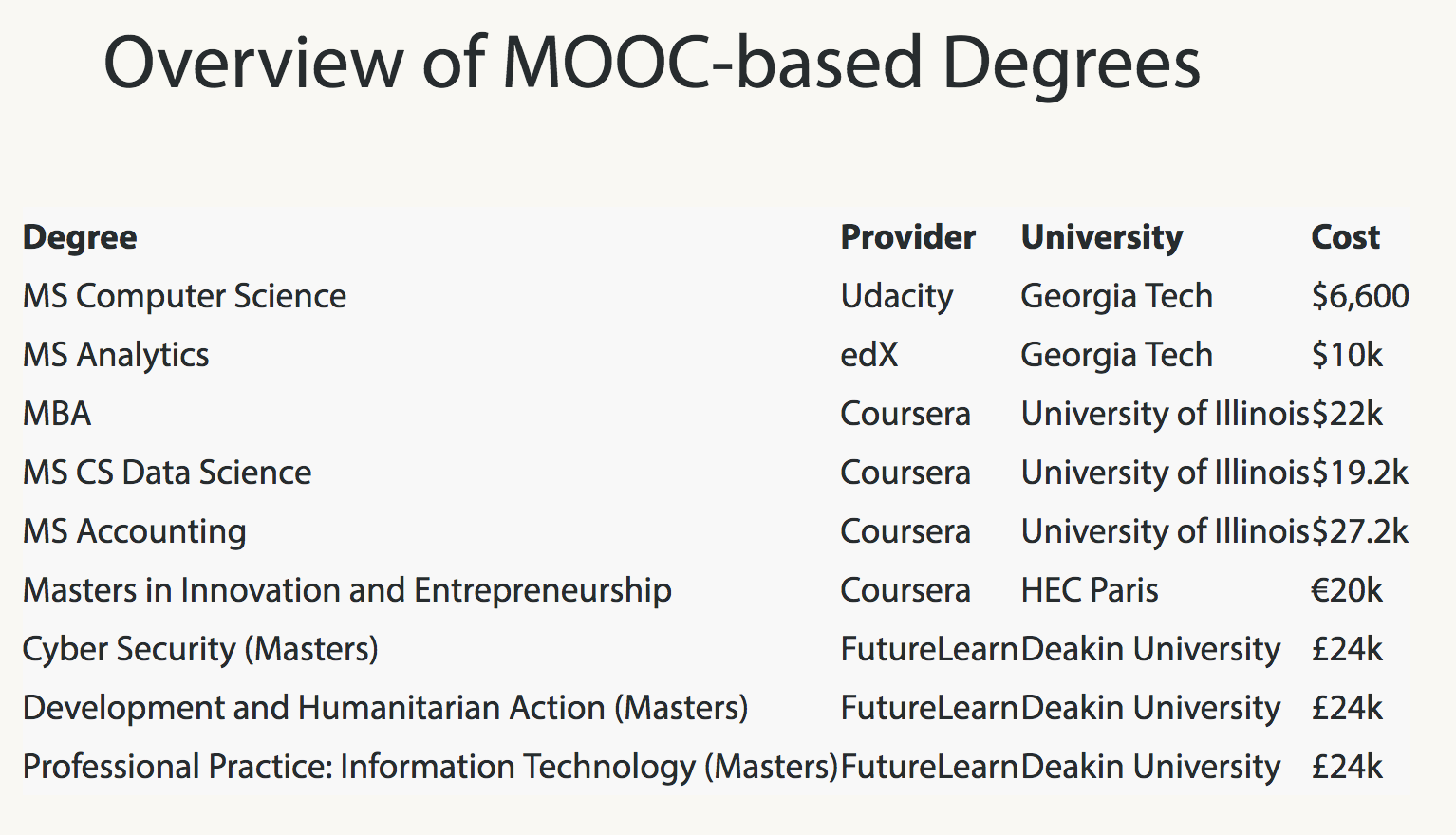
    In a post describing the OPM market last year I noted:

    The OPM market is interesting and dynamic. Here we see strong arguments for both bundled revenue-sharing models and for unbundled fee-for-service models. I personally do not believe that the market is moving away from revenue sharing as much as there is pressure for additional models. There are a growing number of choices available to schools, but there is also a crowded marketplace that is becoming more difficult to understand and compare vendors.

    The 10 programs mentioned above now represent one of these “additional models” in the crowded marketplace.

    For those wanting to understand where the large, commercial MOOC market stands in 2017, I recommend reading both of Dhawal Shah’s posts – from April at Class Central and July at EdSurge.
  • College Scorecard: With victories like these, who needs failures?

    Goldie Blumenstyk had a fascinating interview with the Depart of Education’s Ted Mitchell on Friday that is well worth reading and / or watching (they have video of the interview along with full transcript). One of Mitchell’s key points jumped off the page for me.

    I think it [College Scorecard] was one of the department and the administration’s greatest victories

    Really? I can see the consolidation of student loans, a strong focus on college affordability, shifting of conversation away from just elite schools, and significant push on funding public schools as worthy victories to mention. But the College Scorecard – I don’t buy it.

    Blumenstyk pushed back on Mitchell, which led to this interesting exchange [emphasis added].

    GOLDIE BLUMENSTYK: I’m glad you mentioned the College Scorecard. I was thinking about that a little bit. It’s probably one of the places where the department had perhaps its biggest defeat, or maybe you might consider it a retreat. We were originally envisioning the Scorecard as a tool for accountability. Obviously, a lot of colleges and a lot of other people opposed that idea. And it became a complicated process even to create the effective scorecard. What did you learn from that process?

    TED MITCHELL: So I guess I would have a slightly different interpretation.

    GOLDIE BLUMENSTYK: I would imagine. (more…)

  • College Scorecard: ED quietly adds in 700 missing colleges

    It’s worth giving credit where credit is due, and the US Department of Education (ED) has fixed a problem that Russ Poulin and I pointed out where they had previously left ~700 colleges out of the College Scorecard.

    When the College Scorecard was announced, Russ noticed a handful of missing schools. When I did the whole data OCD thing, I discovered that more than 700 2-year institutions were missing, including nearly 1-in-4 community colleges. Eventually we published an article in the Washington Post describing this (and other) problems.

    The missing community colleges were excluded on purely statistical grounds. If the college granted more certificates (official awards of less than a degree) than degrees in a year, then they were excluded as they were not “primarily degree-granting” institutions. We label this the “Brian Criterion” after the person authoring two discussion board posts that explained this undocumented filter. (more…)

  • College Scorecard Article Published In Washington Post

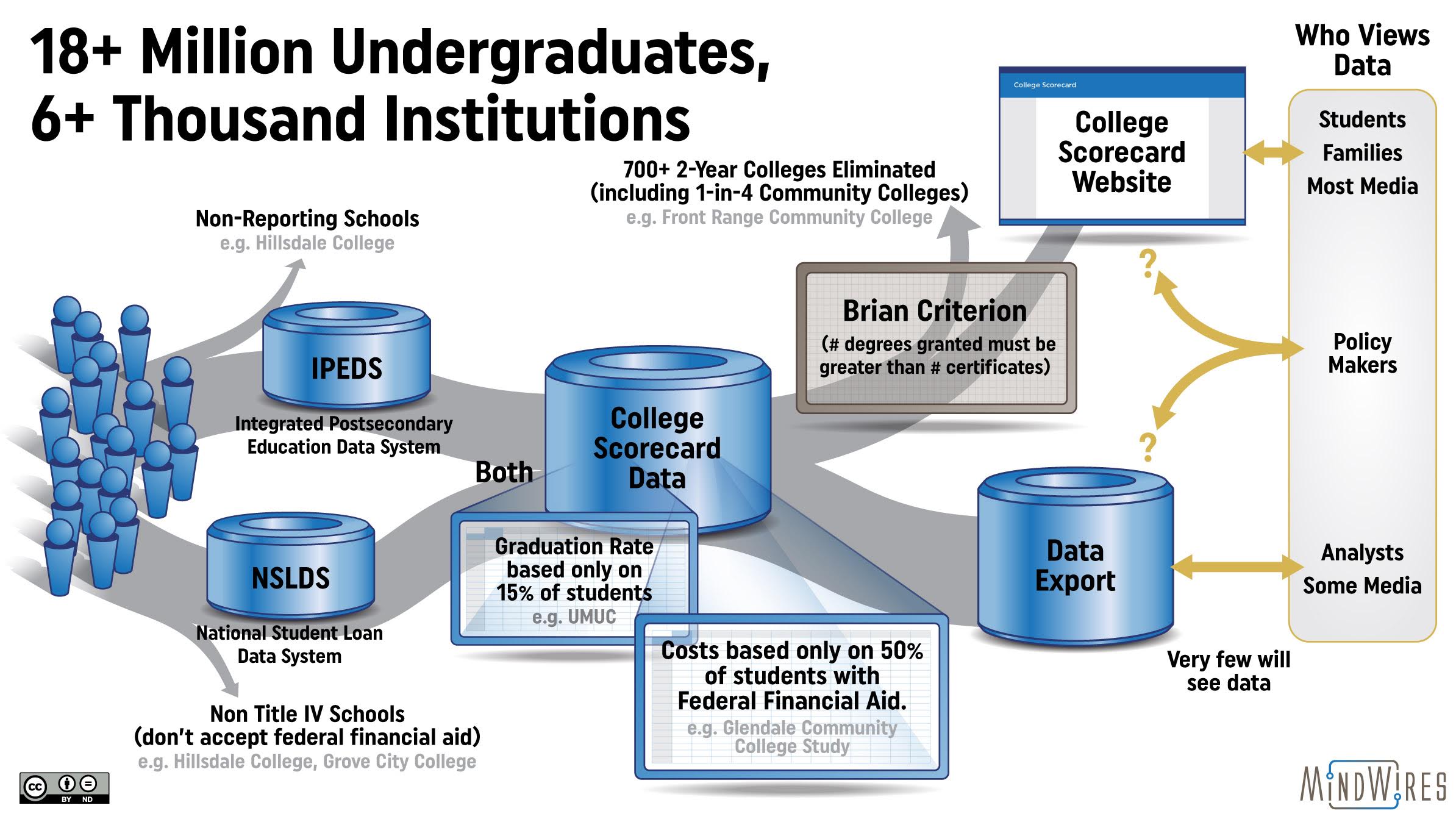
    I have written several posts looking at the new College Scorecard and its inherent flaws in the data, often starting with observations from Russ Poulin at WCET. Today Susan Svrluga, education reporter at the Washington Post, posted a new article co-written by me and Russ and titled “Hundreds of colleges missing from Obama’s College Scorecard?”. The gist of the article is taking a holistic view of data problems and why they exist.

    In a nutshell, the College Scorecard combines data from multiple sources – primarily from the Education Department’s own Integrated Postsecondary Education Data System (IPEDS) and National Student Loan Data System (NSLDS) – and publishes the results of both as a consumer-facing Web site and an analyst-friendly data download. The essence of the problem is that throughout this process the data is filtered based on questionable assumptions, leading to the fuzzy lens viewing subsets of the real data.

    Poulin Hill College Scorecard Graphic

  • Forbes Fantasies: Why Hillsdale College is not in the College Scorecard (hint, boring reasons)

    Richard Vedder wrote a particularly uninformed article in Forbes on Friday about the Education Department (ED) not including Hillsdale College in the new College Scorecard. Freed from the burden of facts or research, Vedder let loose the dogs of conspiracy [emphasis in original].

    The Obama Administration, with much hype, released its College Scorecard recently, designed to help students find the college that best fits their interest. The Scorecard includes some interesting information, such as data on student repayment of college loan debt, the average post-graduate earnings, et cetera. But as we delve more into it, something arguably sinister is revealed: the Scorecard excludes mention of several prominent colleges with a conservative or traditional academic orientation.

    Vedder then speculates that the reasons for the omission are A) Hillsdale not accepting any form of federal financial assistance and the associated regulations and B) Hillsdale having a conservative orientation. At the end of the short post Vedder comes back to reality.

    It may be my sinister thinking is unwarranted, that there were reasons unrelated to ideology or refusal to accept financial aid that figure in the exclusion of these schools. But even so, they are legitimate, even accredited, educational institutions, and their exclusion diminishes the utility and the perceived integrity of the new Scorecard.

    Would that Richard of the First Paragraph would talk to Richard of the Last Paragraph before posting, because Richard the Last got it right. The sinister thinking is unwarranted. (more…)

  • College Scorecard Problem Gets Worse: One in three associate’s degree institutions are not included

    Late yesterday I posted about the Education Department (ED) new College Scorecard and how it omits a large number of community colleges based on an arbitrary metric.

    In particular, the Education Department (ED) is using a questionable method of determining whether an institution is degree-granting rather than relying on the IPEDS data source. In a nutshell, if an institution awarded more certificates than degrees, then it is not labeled as “predominantly awarded 2-year or 4-yeard degrees” and therefore excluded.

    I am not quite confident that the explanation for the vast majority of missing schools is based on this finding. In short, if an institutions awards more certificates than degrees, ED removes them from the public-facing website even if they are technically degree-granting institutions.

    Originally it appeared this situation encompassed 17% of all community colleges, but further analysis shows it to be more significant. (more…)

  • 17% Of Community Colleges Are Not Included In College Scorecard

    In addition to the highly-misleading usage of ‘first-time full-time’ qualification for official graduate rates reported in the College Scorecard, there appears to be another major issue with the data. In particular, the Education Department (ED) is using a questionable method of determining whether an institution is degree-granting rather than relying on the IPEDS data source. In a nutshell, if an institution awarded more certificates than degrees, then it is not labeled as “predominantly awarded 2-year or 4-yeard degrees” and therefore excluded.

    Russ Poulin noted in his WCET post that several community colleges were missing from the Scorecard based on a quick spot check:

    • Colorado – Aims, Front Range, Pueblo, and Otero Community Colleges.
    • Arizona – Rio Salado College.
    • California – Bakersfield College.

    The consumer website itself offers no explanation that certain degree-granting schools are excluded. The Technical Paper that corresponds to the data release explains that selection of schools on page 28: (more…)