e-Literate

Present is Prologue

Tag: Cloud

  • Blackboard Learn Ultra in 2018: Is it ready and does it matter?

    Blackboard Learn Ultra in 2018: Is it ready and does it matter?

    One of our longest-running series of posts is on the prospects and status of Blackboard’s Learn Ultra, the user experience redesign and move to the cloud of the world’s second-most-used (behind Moodle) and highest-revenue-producing academic LMS. It is fashionable to claim the LMS is dead or passé, yet this product category remains the centerpiece of educational technology at colleges, universities, and K-12 districts. To understand Learn Ultra is to understand much of the overall LMS market.

    Looking at the timeline of e-Literate coverage, the broad story emerges:

    • 2012: Blackboard acquires Moodlerooms, and one benefit was the see of a cloud-based platform strategy.
    • 2014: Blackboard prematurely announced Learn Ultra (new user experience) and Learn SaaS (move to the cloud).
    • 2015: Learn Ultra is already a year late (more realistically, the BbWorld14 announcement was wildly unrealistic), but the University of Phoenix selects Learn Ultra as its next-generation learning platform.
    • 2016: Blackboard switches CEOs, admits that Learn Ultra is still not ready, and struggles with a major messaging problem around the transition.
    • 2017: No coverage – maybe we got tired of lack of not having customers to talk to.
    • 2018: Blackboard makes Learn Ultra the core of its message at its users conference BbWorld18.

    (Note: It might be easier to view this as a full page timeline instead of the embed within this post.)

    What we have been asked multiple times, by institutions, by investors, by other ed tech companies: is Learn Ultra ready, and does it matter? The unsurprising answer to both questions is a qualified and somewhat confusing it depends. To describe a little further, Learn Ultra’s Base Navigation is ready, but the Course View is not ready for meaningful adoption; furthermore, Learn Ultra is important to Blackboard’s future, but we think SaaS is more important to its present.

    Is It Ready?

    To ask this question requires an understanding of terminology, as we first described in this post. Blackboard1 is pushing the metric that there are 61 or 62 Learn Ultra customers “in production” or “using Ultra”, yet we have found very few that use, or even plan to use, Learn Ultra as their primary, institution-wide LMS. What gives? What became quite clear at this year’s BbWorld 18 users conference is that when Blackboard says in production, what they mean is that the LMS administrator has enabled the Ultra navigation, which uses the new Ultra user experience framework as the landing page / dashboard with activity feed that users see before entering a specific course. The company calls this Base Navigation, but at this point every course can be configured to be in the Original Experience or the Ultra Experience. Thus, enabling the possibility of running a course in Ultra counts as in production (note that Blackboard now lists 91 clients on Ultra).
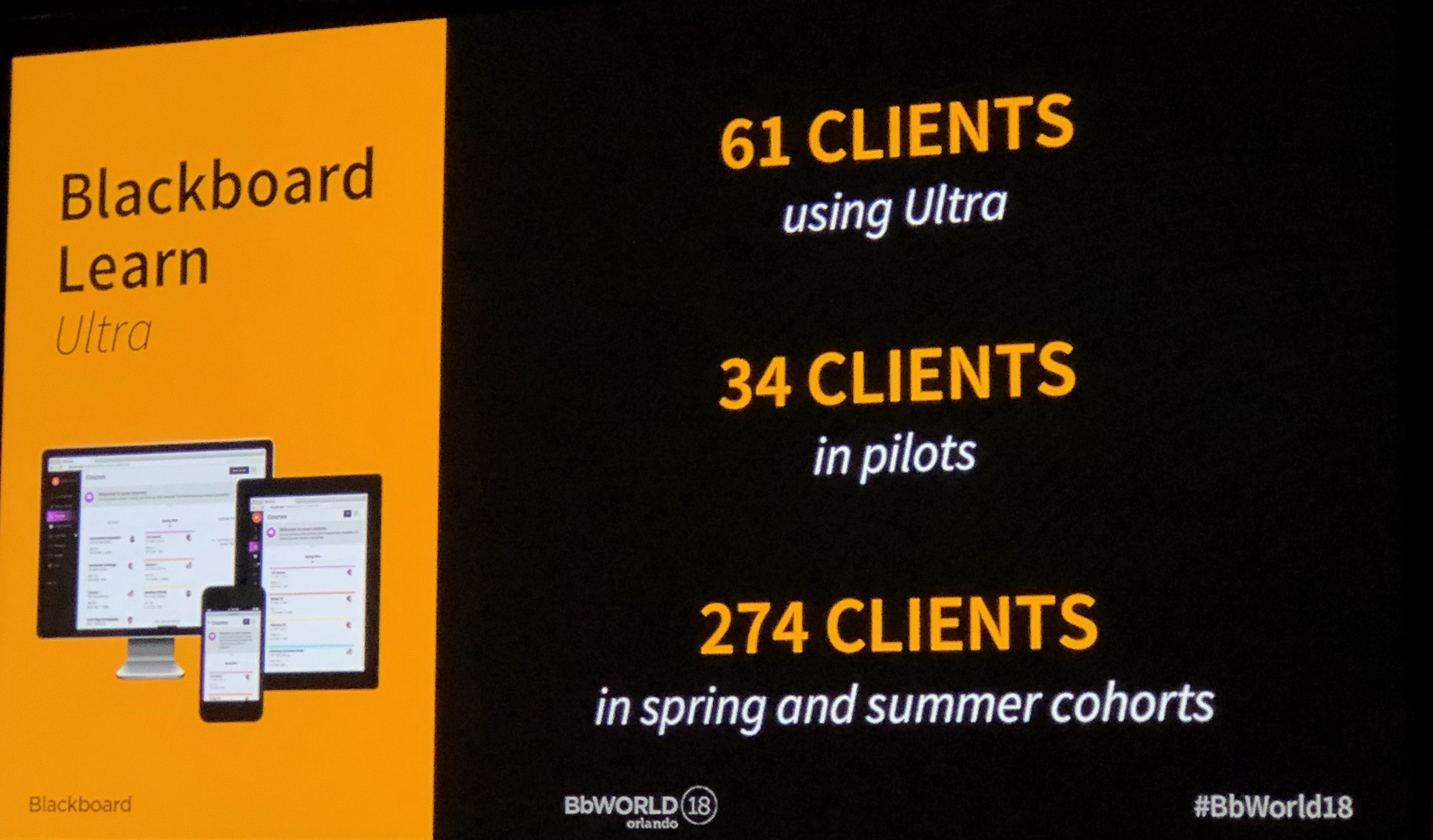
    Slide from BbWorld18

    Once a school has enabled Learn Ultra Base Navigation, they could choose to move exclusively to Ultra (e.g. the University of Phoenix, Northwest Florida State College, and a few others), or they could choose to keep all courses in Original (e.g. Northeastern State University), or they could choose to have some courses in Ultra and some in Original (used by the majority of schools investigating Ultra). This last mode is known as Dual Course mode, and even Blackboard executives seemed surprised to find out that the vast majority of schools putting Ultra in production are in fact running in Dual Course. For many of these schools, there are no definitive plans to move exclusively to Ultra.

    Upon re-reading this description, I believe that I should give more credit than just describing a landing page and base navigation. The cross-course functionality is and has been a long-term goal of Ultra, as we described as early as 2016.

    Creating a brand for a set of design goals is inherently fraught. Let’s look at two examples of how it makes communication of Blackboard’s strategy tricky for them. First, there’s mobile. Blackboard came out last year with a mobile app called Bb Student. It provides students with that activity stream view across courses and, of course, it’s mobile-first. (In fact, it’s mobile-only at the moment.) Furthermore, the company has made the product available for both traditional 9.x customers (which at this point is pretty much everybody) and their SaaS customers. People inside the company feel like they should be getting more credit for delivering on two major design goals (mobile first and stream-based activity views) as well as for delivering it to customers on the 9.x platform (which was more significant of a technical achievement than is immediately obvious).

    This is not a matter of Blackboard moving the goal posts, per se, and it is probably more accurate to say that Ultra cross-course functionality enabled by Base Navigation is ready and showing some benefits.
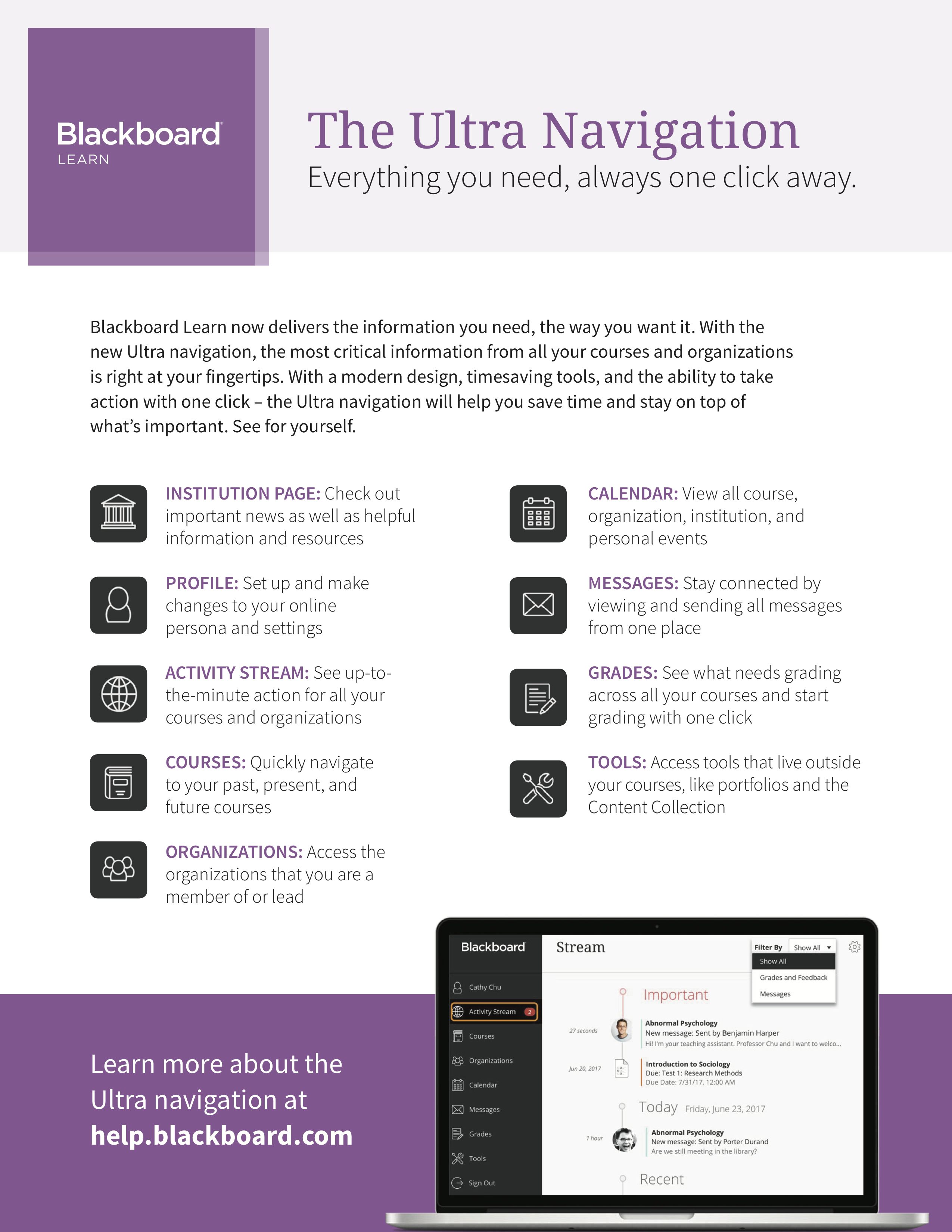
    Learn Ultra Base Navigation Brochure

    The challenge is that this move is not sufficient to make a material change in Blackboard’s company prospects. At best, Learn Ultra Base Navigation without usage of Course View will slightly slow down the rate of customers defecting for another LMS. For Learn Ultra to matter and to make Learn newly competitive, they need customers to also use Course View as the primary choice at their institution, and that usage by-and-large is not ready outside of a handful of schools.As an example from BbWorld18, Belmont University presented their experience moving to Learn SaaS (the important issue in the present, and a predecessor for  adopting Ultra)  and to “the Ultra Experience”. But after we asked a question about faculty adoption of the Ultra Course Experience, the administrator clarified that there are no courses running Ultra – all they have done is enable the Ultra base navigation, and they do not expect to do any course migrations for at least another year. This full adoption of Learn Ultra might become important in the future, but it is not driving decisions today.

    Does It Matter?

    Given that we’ve been asking for three entire years whether Learn Ultra is ready, one obvious follow-up question is whether it matters any longer. I do think the question matters as Blackboard is pinning their corporate turnaround on Learn Ultra as the core piece, and this message was heavily promoted at BbWorld 18.

    This messaging makes some sense in that we consider it unlikely that Blackboard can gain significant numbers of new clients (those moving from another LMS to Blackboard Learn, beyond a dozen or fewer schools) without Learn Ultra. Learn Original Experience has too much baggage and is too dated to compete with Canvas or Brightspace by D2L, at least in North America. The company’s new Learn LMS clients are largely the University of Phoenix and ANGEL contract conversions.

    To be fair, the exceptions include several schools in North Dakota (migrating from Moodle) as well as Northwest Florida State College (migrating from D2L). But even with NW Florida State, they based their decision on Learn Ultra.

    Based on interviews with clients arranged by Blackboard, and based on our own connections at BbWorld, what we consistently heard during dozens of interviews and from listening to panel discussions was that Learn Ultra Course View makes sense primarily for programs or schools that have not been on Blackboard Learn before. Bb Learn clients seem to have too many expectations of needing the same functionality they had before, pushing Ultra to be largely feature-compatible with Original and thus losing some of its simplicity in the process. When the Illinois Institute of Technology migrated from Learn self-hosting to SaaS, which enabled them to explore Ultra, they chose one program and a handful of faculty that were willing to jump into Learn Ultra, but for almost all others they are sticking with the Original Course View for the time being. The soonest they would expect moving primarily to Learn Ultra at the Course View would bet 3-5 years from now. You can hear the same dynamic in a recent Rod’s Pulse Podcast (shared under CC-BY-NC-SA license and also available at Inside Higher Ed), with Rod Murray interviewing Rob McCunney about their school (University of the Sciences) and its migration to SaaS and Ultra. It is a fascinating first-hand description of their experiences. Please note that they use use the terms Traditional and Original interchangeably.

    R Murray: We turned on the SaaS in January, but we really kept the Original Experience until July. In mid-July we flipped the switch to turn on the Ultra Experience. Now again for those of you are not as familiar with the way Blackboard works, that wasn’t changing the course format. They were still traditional courses, but you know all those tabs and modules disappeared, and we ended up with a new base navigation in Blackboard, which they called the Ultra Experience. So that was a major change, and we do have some summer sessions, but we felt this was the least painful way to turn it on. We didn’t want to wait till August just before our fall students came back.

    In terms of turning on the Ultra Experience, what were some of the major issues that you saw, that you were concerned with?

    R McCunney: Besides the fact that we lost the tabs and modules, so we kind of rolled out OneCampus as Rod said, I think one of the major things that that I noticed wasn’t really even on the admin side, it was just getting people used to something that was completely different as soon as they logged in to that institution page. Where’s my stuff, where is my modules? It just looks completely different than what they’re used to, and there’s some stuff missing, and we replaced it. We put stuff in other areas, and we communicated that, but that was probably the biggest hurdle. Just what is this, what is this Blackboard Ultra that you’re changing me to? And at that point, in July we only changed basically the institution page. Your average user, once they get into their course they didn’t notice anything different, but that initial freak out of here I don’t know where my form is. We told them a dozen times where it is, but it’s somewhere else. That was probably one of the major hurdles, and I didn’t anticipate that as being a big as an issue as it was. I thought there was going to be more nuts and bolts issues, which there were very few of those for the most part.

    R Murray: Right now of course we don’t have that many students here in the summer, so the real test will be in another week or so when students come back and really start. We all start kicking the tires, even on the traditional courses within the Ultra Experience.

    [snip]

    R Murray: The next big change that we have to live through has to do with converting courses to the Ultra course view. Now here at our university we certainly didn’t do it en masse, we went to play with it for at least this term and maybe next. But there are some courses that we decided made a lot of sense to convert to the Ultra course view. Those schools that those courses that are brand new, especially online courses that are brand new, it made sense to develop them directly in the [Ultra] course view.

    Schools are trying out the Ultra Experience in terms of the landing page and cross-course functionality, but by-and-large they are very cautious jumping into the Ultra Course View where most of the functionality resides.

    Based on this situation, we believe that the migration to Learn SaaS might be a better indicator – at least in the short run – than Ultra adoption of whether a school plans to stick with Blackboard. When a school moves to Learn SaaS, they all tend to sign contract extensions for 1 – 3 years or at least internally plan no LMS migrations for more than 1 – 3 years. And the migration to Learn SaaS does not suffer from the vague terminology issues – a school either uses Learn deployed on SaaS (through AWS) or they don’t.
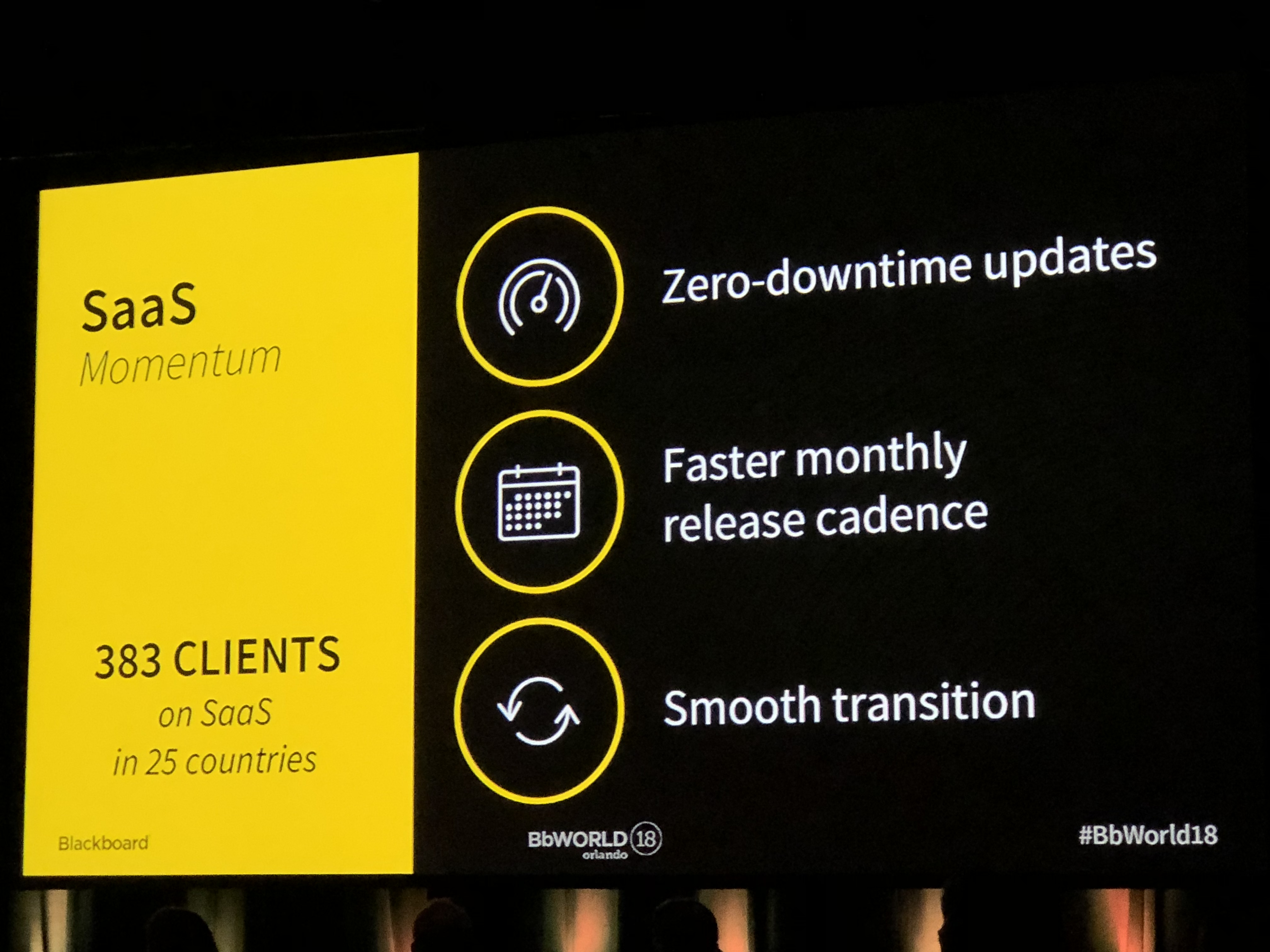
    Learn SaaS progress slide

    383 clients on Learn SaaS as of BbWorld 18 is good progress and easy to understand. This issue is what likely matters more to Blackboard clients today and for the next few years, but in the long run the company needs Learn Ultra to be accepted – including at the course level – in order to become more competitive and pick up new clients.

    In the end, Learn Ultra is partially ready and does matter, more so in the future, but the Learn SaaS migration matters much more today. This answer is a real improvement over the situation a year ago and even from the beginning of this year, but it is still a far cry from a simple yes and yes answer that Blackboard would like to have.

    Update: Fixed name of Rob McCunney
  • D2L Bets on The Cloud and Advances in User Experience

    D2L Bets on The Cloud and Advances in User Experience

    One of the arguments that we have made as part of our LMS Market Analysis service is that if you look beyond market share numbers, there has been a tectonic shift in the academic LMS market that started around 2012, moving from being Blackboard-centric to Canvas-centric. Meaning that the current market trends are largely driven by Canvas adoptions and market reactions to Canvas adoptions. This change has elevated the need for viable LMS solutions to have both a cloud-based deployment strategy as well as a more modern, intuitive user experience than what was acceptable just five years ago.

    Blackboard’s move to Learn SaaS (deployment) and Learn Ultra (new user experience) is a prime example of this market dynamic, and it has tended to get the lion’s share of analysis, including here at e-Literate. We have described that D2L has joined Canvas in “an emerging two-horse race for new implementations”, but we could do a better job of describing why we believe they are gaining in the market. ((Disclosure: D2L, Blackboard, and Instructure are subscribers in our LMS Market Analysis service and sponsoring participants in our Empirical Educator Project.))

    Short story – D2L has made fairly substantial bets on cloud deployment and a streamlined user experience, and the product design changes present the best explanation for the market gains.

    Head in the Cloud

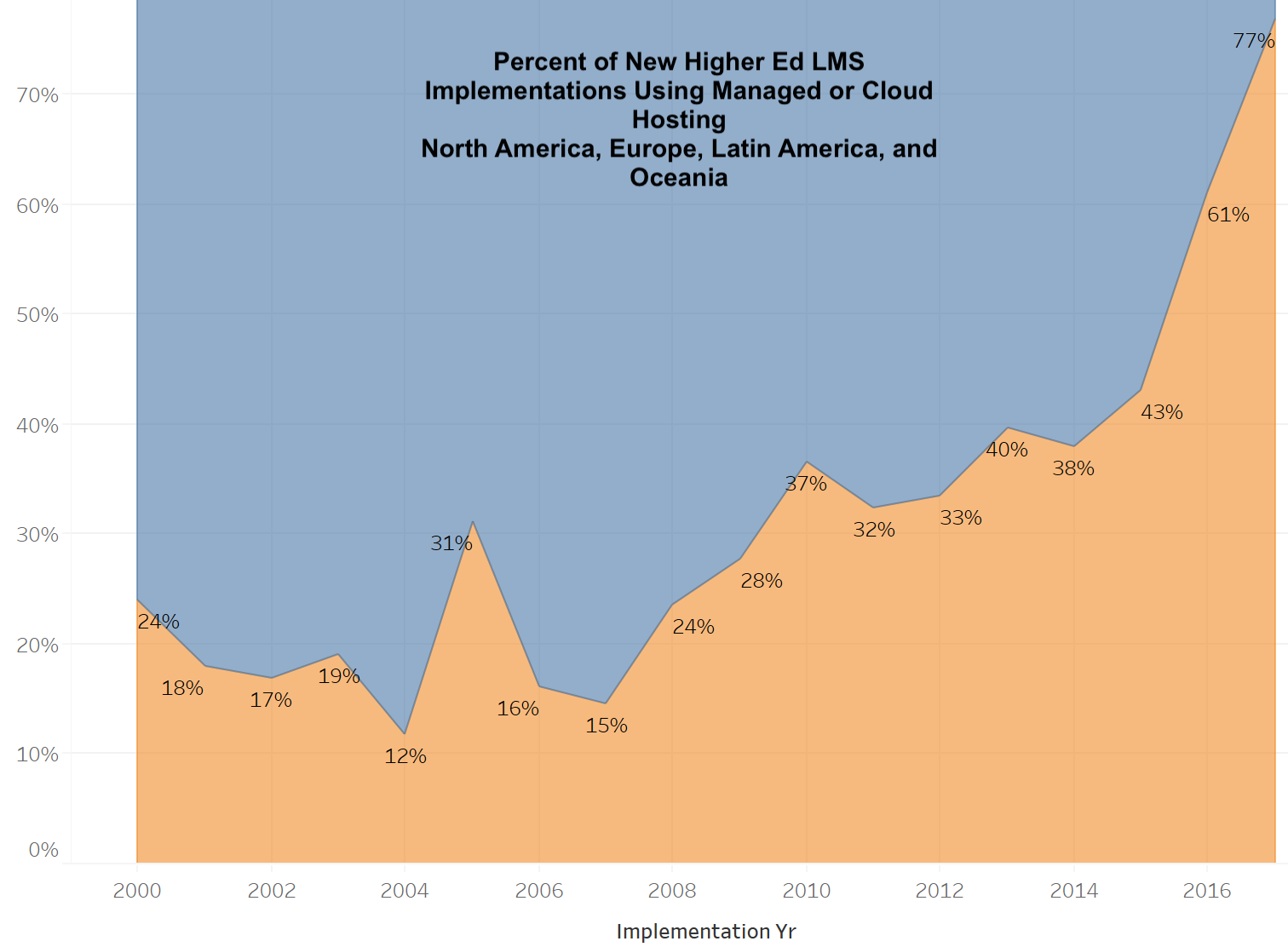
    The data looking at new LMS implementations (changing from one system to another) in higher ed across the four global regions we cover in our market analysis shows a remarkable movement away from self hosting, or on-premises hosting, towards a combination of managed hosting by the LMS vendor or cloud hosting designed by the vendor but running on AWS, in particular. From 15% external hosting to 77% in just one decade. Within the external models, there is another major shift away from managed hosting and towards cloud hosting.

    Growth of LMS external hosting

    D2L has long worked on managed hosting options, but in late 2013 the company introduced Continuous Delivery where software releases are pushed to customers incrementally, such that customers would jointly run the latest versions of Brightspace, their LMS. This move is important, as one primary benefit of cloud deployment is to remove the explosion of software configurations and versions that make it expensive and difficult to diagnose and fix bugs and to release new features.

    Three years later in 2016 D2L announced their move to AWS for cloud deployment.

    AWS Data Centers for D2L

    While we heard grumblings from multiple clients during the transition – especially thru early 2017 – D2L clearly made some hard choices and and is aggressively moving to the cloud, not just as an option, but as their primary delivery model. According to David Koehn, VP of Product Management at D2L:

    • All new Brightspace implementations are on AWS cloud;
    • Virtually all current Brightspace implementations use Continuous Delivery; and
    • Approximately 50% of current customers are already on the AWS version of cloud deployment; and
    • By the end of 2018, a large majority of customers will be on cloud deployment.

    Contrast this move to the cloud with Blackboard’s where they plan to continue offering self hosting, managed hosting, and their own AWS-based cloud hosting options at the customer’s choice, while they believe SaaS and Ultra will lead on new sales. The primary constraint being that to go to Learn Ultra experience, you must first be on Learn SaaS, the cloud hosting option. But the key point is that Blackboard has tended to view the cloud as one deployment option among others, and the numbers show it. According to a company blog post this week from CEO Bill Ballhaus:

    As of today, more than 50 clients are running Ultra, with dozens more planning to start using the Ultra experience and courses in the second half of the year. Also, 361 clients around the globe have moved to SaaS deployment for Learn.

    Our data show more than 2,000 higher ed customers on Learn, but if you add in K-12 and corporate customers, this roughly equates to just over 10% on or moving to Learn SaaS and 2% on Learn Ultra. These are generous numbers, but more on that in a separate post.

    The point is that D2L is making a much more aggressive and focused bet on the cloud than is Blackboard, for better or worse. Canvas, of course, is designed natively for the cloud, and essentially 100% of their customers are on the AWS cloud.

    Run to Daylight

    David Koehn also pointed out that the real driver for the AWS cloud move by D2L is to enable a redesign of the user experience and to provide improved scalability and reliability. In other words, the cloud deployment is a means to the Daylight end.

    Daylight is the name for D2L’s redesign of the user experience and its streamlined user interface. When it was first announced just over a year ago, I was somewhat skeptical as the initial changes were evident in different fonts and cleaner look-and-feel, but not significant improvements in the workflow for faculty and students.

    As time goes on and I see more advanced demos, my view is changing. The Daylight Experience does have some real improvements not just in look-and-feel but in fewer and more intuitive clicks to get the same job done. A major focus on the release this summer (in time for D2L Fusion users conference) is more fully encouraging usage of the activity stream for higher ed clients (this feature was initially targeted at K-12 market but has been adapted for colleges and universities).

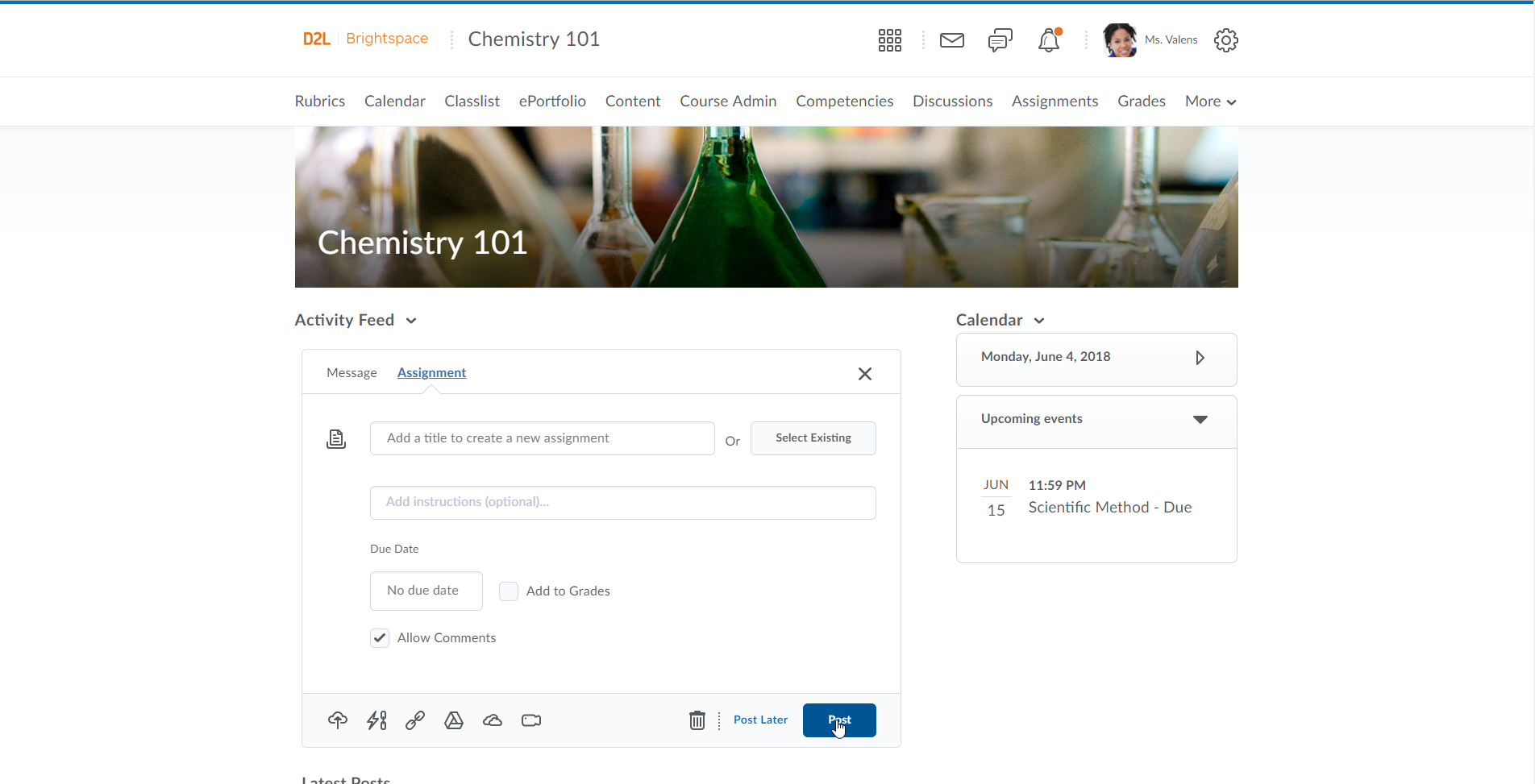
    Brightspace add assignment

    D2L has long played the Mutually Assured Destruction game of features, targeted at cumbersome procurement processes. D2L (along with Blackboard and Moodle) has a deep set of features which contrasts with Canvas and its streamlined set of features that rely on third-party integrations to solve some of the more specialized use cases. For D2L, it is important to maintain these features as a competitive differentiator with Canvas, and the design approach guiding them is Progressive Disclosure. This design technique relies on progressing from simple to complex, showing the user the information and options they need when they need it or request it and not before.

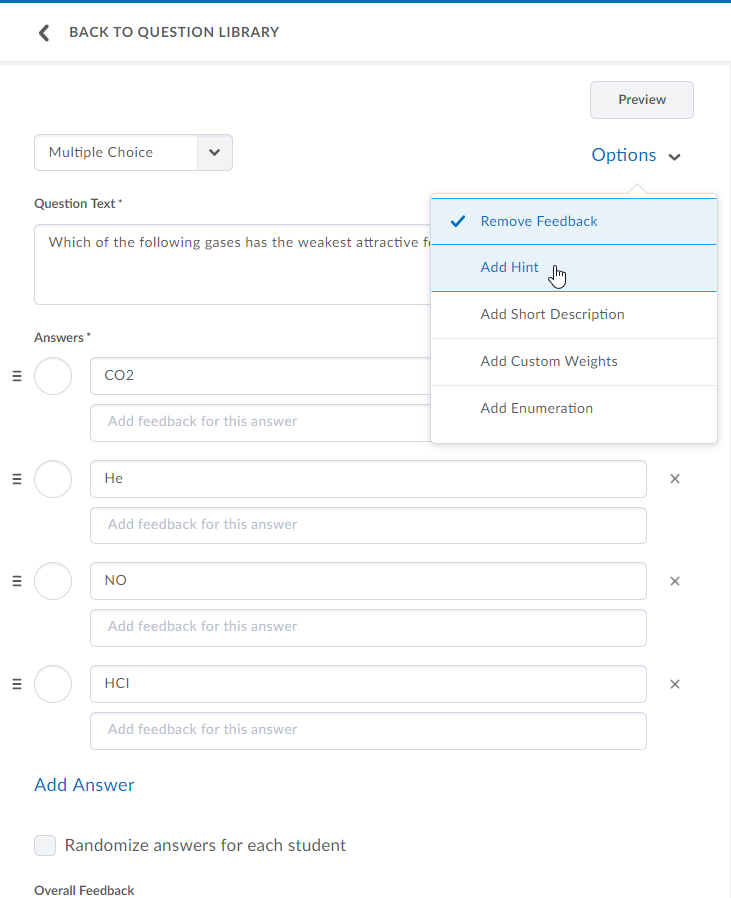
    Consider adding a multiple choice quiz, where the desire is to make this process very simple, but to then have a page or area that exposes more and more options as requested by user or in context of the quiz setup.

    Brightspace details on quiz

    As D2L further implements this design approach within the Daylight Experience, we are seeing a more modern and intuitive user experience for Brightspace customers, yet one that is showing real promise to also tap into deeper feature sets. And these changes are being used in production.

    Again by way of contrast, Blackboard’s user experience redesign for Learn Ultra has had a bumpy ride, with multi-year delays of getting any customers to use in production. They took more of a big bang approach to releasing Learn Ultra, and when customers pushed back saying that Ultra wasn’t ready, this led to additional delays and eventually a change in the design team. D2L’s Daylight has proven to be a more iterative release of their new user experience.

    What to Watch

    This year it is becoming difficult to separate LMS products from company finances. Instructure is trying to balance Canvas and Bridge growth to satisfy public markets along with a new executive team. Blackboard is dealing with corporate debt challenges while needing to fully release Learn Ultra. As mentioned in this post, D2L is moving strongly to the cloud with a new user experience while managing expenses. Schoology is trying to grow higher ed market under the radar. Moodle HQ took investment for the first time. There are a lot of open questions on the future of the academic LMS market, and we expect much to be revealed at the big summer (and fall) events.

    As for D2L Fusion, we plan to get a better read on how customers and prospects are reacting to the cloud deployment move and streamlined user experience. We are seeing real changes in the Brightspace design and deployment model, but do paying and prospective customers value these changes? Furthermore, will D2L be able to improve its customer service and delivery on promises made for new customers as well as it has improved its product design?

    As for Blackboard, Learn Ultra now has D2L’s Brightspace as a major user experience to compete with as well as Canvas. There is a lot more changing in the LMS market than what is obvious on the surface.

    Update: Clarified D2L numbers to be specifically for AWS cloud deployment. Also changed several instances of “cloud hosting” to be “cloud deployment” to make terminology more accurate.

  • Schoology Layoffs: Focusing on smaller higher ed opportunities

    Schoology Layoffs: Focusing on smaller higher ed opportunities

    We’ve noticed and had several people ask us about corporate changes at Schoology, the LMS vendor. More specifically, the questions have been based on whether they are laying off staff, and what that means for the higher ed LMS market. Short answers – yes to the layoffs, and the company will be more selective on which higher ed opportunities to pursue.

    Through phone and email interviews, I asked CEO Jeremy Friedman to respond to these questions.

    As you and I have talked about, operational efficiency is a strategic objective for Schoology in 2017. As we built our plan for the year we saw opportunities to focus our efforts and operate at a higher level. This meant that we decided to reduce our headcount by a little over 10%, primarily across sales and marketing. To be clear, we reduced how much we are going to spend in Sales and Marketing, and we increased how much we are going to spend in Research & Development and Customer Success. The net impact is a more efficient company that can invest more in product innovation and our customers.

    (more…)

  • Schoology: The strongest LMS you’ve never seen

    LMS evaluations are typically painful ordeals for not just committee members but also for the vendors. They have to provide multiple demos, have lots of Q&A, and write 100+ page proposals based on extensive feature requirements and perhaps even more painful terms and conditions. But there is one case that might be worse – not even getting to compete when your product appears to be an excellent fit. And that is the situation that Schoology finds it in for the majority of higher ed evaluations.

    Schoology’s original market was aimed US-based K-12 institutions, and for paying school or district LMS selections Schoology is probably one of the two strongest competitors, along with Canvas. Schoology does have an international presence and over the past year and a half have targeted an expansion into higher ed. Michael wrote a post after the company raised $32 million in new funding last fall, largely to fund this expansion. I described the institution-wide adoption by Wheaton College in Spring 2016, following the Colorado State University Global Campus adoption in early 2015. But what I don’t see is a real acceleration in the higher ed market yet. There are a few significant LMS active evaluations that include Schoology, but the majority of higher ed LMS evaluations over the past two years have not treated Schoology as a real competitor. Based on what I’ve seen, this lack of evaluation is not based on the product itself. (more…)

  • About The Blackboard Partnership With IBM And Amazon Web Services

    Leading into BbWorld16, Blackboard’s annual users conference in the air conditioned bunker of The Venetian in Las Vegas, the company announced that they were partnering with IBM.

    Blackboard Inc. and IBM (NYSE: IBM) today announced a collaborative agreement for IBM to manage Blackboard’s datacenters and cloud infrastructure. The two companies will also work together to develop innovative educational solutions, taking advantage of IBM Watson’s cognitive computing technology and Blackboard’s broad capabilities suite.

    Under the agreement, IBM will manage much of Blackboard’s technology infrastructure, including the company’s 28 global data centers and its existing public cloud footprint. IBM will also provide support for Blackboard’s expanding use of the public cloud. Blackboard will leverage IBM’s expertise and software to offer customers some of the most flexible, reliable, security-rich and resilient environments available.

    What the initial press release did not capture, and what has become quite apparent at BbWorld16, is that this is really a three-way partnership between Blackboard, IBM, and Amazon (for Amazon Web Services, or AWS). Peter George, Blackboard’s SVP of Products, noted this critical distinction in his blog post “Partnering with AWS and IBM for cloud services and infrastructure management”. (more…)

  • Clarification on Cloud, SaaS and Multi-tenant Language

    In several recent posts I have argued about the importance of cloud-based platforms, and Michael Feldstein has written some insightful analysis on the subject. Quite often the terms Cloud and SaaS (software as a service) are misunderstood, or at least used differently as the terms get redefined, which is common in technology markets.

    Last week I wrote a post that included a comment about Desire2Learn and their usage of cloud and SaaS terms.

    The terms cloud and SaaS, as used in Desire2Learn’s and NEA’s descriptions, tend to blur the distinction between Desire2Learn’s enterprise software virtualization model and multi-tenant platform models. Desire2Learn has made great strides in developing a virtualized cloud servers for business model that is not multi-tenant (where all or most clients run on the same defined application instance on the same version).  There are arguments that this issue only matters to the provider. I’ll write more on this subject in a subsequent post, but for now I’ll just point out that the cloud model used by Desire2Learn has significant differences with the model used by Instructure’s Canvas LMS, Pearson’s OpenClass, Lore’s platform, and the majority of new learning platforms coming out.

    John Baker, CEO of Desire2Learn, did not agree with this statement as shared in the comments.

    One key correction is that our Cloud or Software-as-a-Service (SaaS) solutions are multi-tenant. Multi-tenancy has been part of our solution for over a decade. It may also be important to point out that approximately 90 percent of our clients use our SaaS offering. We’d be happy to share more infromation with you and others on how we have evolved over the years.

    (more…)