
e-Literate

Present is Prologue

Tag: Community Colleges

  • College Scorecard: With victories like these, who needs failures?

    Goldie Blumenstyk had a fascinating interview with the Depart of Education’s Ted Mitchell on Friday that is well worth reading and / or watching (they have video of the interview along with full transcript). One of Mitchell’s key points jumped off the page for me.

    I think it [College Scorecard] was one of the department and the administration’s greatest victories

    Really? I can see the consolidation of student loans, a strong focus on college affordability, shifting of conversation away from just elite schools, and significant push on funding public schools as worthy victories to mention. But the College Scorecard – I don’t buy it.

    Blumenstyk pushed back on Mitchell, which led to this interesting exchange [emphasis added].

    GOLDIE BLUMENSTYK: I’m glad you mentioned the College Scorecard. I was thinking about that a little bit. It’s probably one of the places where the department had perhaps its biggest defeat, or maybe you might consider it a retreat. We were originally envisioning the Scorecard as a tool for accountability. Obviously, a lot of colleges and a lot of other people opposed that idea. And it became a complicated process even to create the effective scorecard. What did you learn from that process?

    TED MITCHELL: So I guess I would have a slightly different interpretation.

    GOLDIE BLUMENSTYK: I would imagine. (more…)
  • A Retrospective on Implementing Common Course Management Systems

    At e-Literate we mostly avoid blogging about our consulting work through MindWires Consulting, but we have an opportunity with our work for California’s Online Education Initiative (OEI) to share information with the higher education community on a topic of growing importance. The OEI is California Community College System’s approach to help individual colleges collaborate with their online courses and programs, including a OEI Course Exchange to be launched this Fall in pilot mode that will “allow students to register for online courses across participating colleges without requiring students to complete separate application and matriculation processes”.

    Last year we at MindWires helped OEI select a Common Course Management System (yes, they use the CMS language instead of LMS) by providing market analysis and facilitating the group decision-making process. This year they asked us to review similar efforts at other consortia in the US and Canada. The point of a CCMS is not the technology platform itself but rather what the common e-learning infrastructure could allow a consortium to do – address issues such as course redesign, professional development, student support, etc. Even though the OEI was based on selecting a common system from the beginning and has experienced significant adoption already, there is still a great deal of value in learning from others that have gone before. We are releasing the result of this work with the report – “A Retrospective on Implementing Course Management Systems: Motivations, Benefits, Drawbacks and Recommendations“. (more…)

  • College Scorecard: ED quietly adds in 700 missing colleges

    It’s worth giving credit where credit is due, and the US Department of Education (ED) has fixed a problem that Russ Poulin and I pointed out where they had previously left ~700 colleges out of the College Scorecard.

    When the College Scorecard was announced, Russ noticed a handful of missing schools. When I did the whole data OCD thing, I discovered that more than 700 2-year institutions were missing, including nearly 1-in-4 community colleges. Eventually we published an article in the Washington Post describing this (and other) problems.

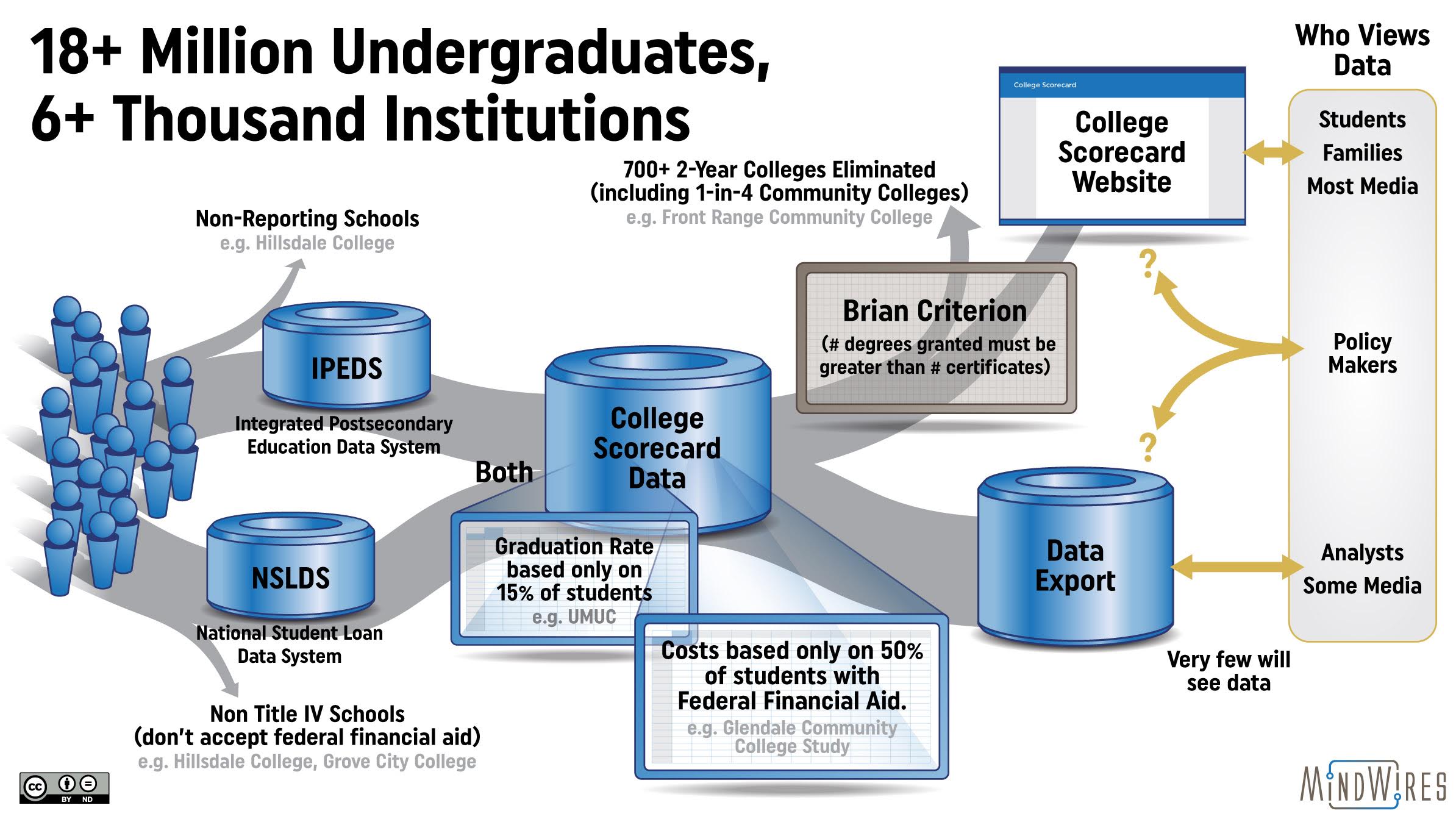
    The missing community colleges were excluded on purely statistical grounds. If the college granted more certificates (official awards of less than a degree) than degrees in a year, then they were excluded as they were not “primarily degree-granting” institutions. We label this the “Brian Criterion” after the person authoring two discussion board posts that explained this undocumented filter. (more…)

  • College Scorecard Article Published In Washington Post

    I have written several posts looking at the new College Scorecard and its inherent flaws in the data, often starting with observations from Russ Poulin at WCET. Today Susan Svrluga, education reporter at the Washington Post, posted a new article co-written by me and Russ and titled “Hundreds of colleges missing from Obama’s College Scorecard?”. The gist of the article is taking a holistic view of data problems and why they exist.

    In a nutshell, the College Scorecard combines data from multiple sources – primarily from the Education Department’s own Integrated Postsecondary Education Data System (IPEDS) and National Student Loan Data System (NSLDS) – and publishes the results of both as a consumer-facing Web site and an analyst-friendly data download. The essence of the problem is that throughout this process the data is filtered based on questionable assumptions, leading to the fuzzy lens viewing subsets of the real data.

    Poulin Hill College Scorecard Graphic

  • College Scorecard Problem Gets Worse: One in three associate’s degree institutions are not included

    Late yesterday I posted about the Education Department (ED) new College Scorecard and how it omits a large number of community colleges based on an arbitrary metric.

    In particular, the Education Department (ED) is using a questionable method of determining whether an institution is degree-granting rather than relying on the IPEDS data source. In a nutshell, if an institution awarded more certificates than degrees, then it is not labeled as “predominantly awarded 2-year or 4-yeard degrees” and therefore excluded.

    I am not quite confident that the explanation for the vast majority of missing schools is based on this finding. In short, if an institutions awards more certificates than degrees, ED removes them from the public-facing website even if they are technically degree-granting institutions.

    Originally it appeared this situation encompassed 17% of all community colleges, but further analysis shows it to be more significant. (more…)

  • 17% Of Community Colleges Are Not Included In College Scorecard

    In addition to the highly-misleading usage of ‘first-time full-time’ qualification for official graduate rates reported in the College Scorecard, there appears to be another major issue with the data. In particular, the Education Department (ED) is using a questionable method of determining whether an institution is degree-granting rather than relying on the IPEDS data source. In a nutshell, if an institution awarded more certificates than degrees, then it is not labeled as “predominantly awarded 2-year or 4-yeard degrees” and therefore excluded.

    Russ Poulin noted in his WCET post that several community colleges were missing from the Scorecard based on a quick spot check:

    • Colorado – Aims, Front Range, Pueblo, and Otero Community Colleges.
    • Arizona – Rio Salado College.
    • California – Bakersfield College.

    The consumer website itself offers no explanation that certain degree-granting schools are excluded. The Technical Paper that corresponds to the data release explains that selection of schools on page 28: (more…)

  • e-Literate TV Preview: Essex County College and changing role of faculty

    As we get closer to the release of the new e-Literate TV series on personalized learning, Michael and I will be posting previews highlighting some of the more interesting segments from the series. When we first talked about the series with its sponsors, the Bill & Melinda Gates Foundation, they agreed to give us the editorial independence to report what we find, whether it is good, bad, or indifferent.

    In this video preview (about 4:18 in duration), we hear from two faculty members who have first-hand experience in using a personalized learning approach as well as a traditional approach to remedial math. We also hear from students on what they are learning about learning. In our case studies so far, the real faculty issue is not that software is being designed to replace faculty, but rather that successful implementation of personalized learning necessarily changes the role of faculty. One of our goals with e-Literate TV is to allow faculty, staff and students to describe direct experiences in their own words. Take a look.

    Stay tuned for the full episodes to be released on the In The Telling platform ((ITT is our partner in developing this series, providing video production as well as the platform.)). You can follow me (@PhilOnEdTech), Michael (@mfeldstein67), or e-Literate TV (@eLiterateTV) to stay up to date. You can also follow the e-Literate TV YouTube channel. We will also announce the release here on e-Literate.