
e-Literate

Present is Prologue

Tag: Course Materials

  • About The New Florida Virtual Campus Survey On Textbooks

    As long-time readers know, I strongly believe that the national discussion about the costs of textbooks and course materials is more productive when we focus on actual student behaviors and impacts, rather than artificial numbers used by many organizations. There may be short-term benefit from claiming or implying that the average college student spends $1200 or more per year on textbooks, but the reality is closer to $650. See “How Much Do College Students Actually Pay For Textbooks?” for more details, thanks in particular to information from NACS.

    The second-best source available on actual student expenditures on textbooks and course materials is the bi-annual survey from the Florida Virtual Campus (FLVC), which serves Florida’s state colleges, universities, and K-12 districts. Two weeks ago they released the third survey “2016 Student Textbook and Course Materials Survey”, a study of more than 22,000 students in the public colleges and universities. This report is particularly informative for asking questions about the impact of textbook costs – what do students end up doing. That is the interesting question.

    The whole report is worth reading, but I’d like to highlight two key points. The first is confirmation that the average actual spending on college textbooks is in the $600 – $650 per year range. In the FLVC survey, students spend just over $300 in one semester on textbooks. (more…)
  • Reprise: How Much Do Community College Students Actually Pay For Textbooks?

    [ed. The basic arguments in this post were covered here at e-Literate in 2015 and in The Chronicle more recently. The data has been updated into a new post based on recent news events.]

    Last month the nonprofit advocacy group Achieving the Dream announced a new initiative to fund 38 community colleges who are willing to build entire programs with open educational resources. While this is a noble effort aimed at reducing financial barriers for students to get two-year degrees, the group perpetuated the same myth that has plagued higher education for years.

    The annual costs of textbooks are about $1,300 per year for a full-time community college student and amount to about a third of the cost of an Associate’s degree.

    In the Washington Post’s coverage, they add this description.

    A community college reform group has selected a handful of schools in Virginia and Maryland to develop degree programs using open-source materials in place of textbooks, an initiative that could save students as much as $1,300 a year.

    Are they right? Do community college textbooks cost “about $1,300 per year,” and is there a chance to help them save this amount? The short answer is no. Community college students actually spend just over half this amount — approximately $700 per year — despite the rising list prices of textbooks. (more…)

  • Data To Back Up Concerns Of Textbook Expenditures By First-Generation Students

    David Wiley has added to the conversation ((My initial post, Mike Caulfield responseBracken Mosbacker, my response to Mike, Mike follow-up)) over use of data on college textbook pricing and student spending patterns with “The Practical Cost of Textbooks”. The key argument is to go beyond prices and spending and look at the most direct measure of asking students themselves how textbooks costs have impacted them. He then looks at the Florida Virtual Campus surveys (also included in my post), concluding:

    What impact does the cost of textbooks have on students? Textbook costs cause students to occasionally or frequently take fewer courses (35% of students), to drop or withdraw from courses (24%), and to earn either poor or failing grades (26%). Regardless of whether you have historically preferred the College Board number or the student survey number, a third fact that is beyond dispute is that surveys of students indicate that the cost of textbooks negatively impacts their learning (grades) and negatively impacts their time to graduation (drops, withdraws, and credits).

    And yes, we need to do something about it.

    Amen. Surveying over 18,000 students, the FVC surveys are quite important and should be on everyone’s radar.

    More Out Of Data

    (more…)

  • Asking What Students Spend On Textbooks Is Very Important, But Insufficient

    Mike Caulfield responded to my post on data usage to understand college textbook expenditures. The core of my argument is a critique of commonly cited College Board data. That data originating from financial aid offices leads to the conclusion that students on average either spend or budget $1,200 per year with that number rising, while there is more reliable data originating from students showing the number to be half that amount and dropping.

    In Mike’s response post yesterday, he generally agreed with the observation but is concerned that “readers of that piece are likely to take away the wrong conclusion from Phil’s figures (even if Phil himself does not)”. There is a risk that people see the lower numbers and conclude the “crisis is overblown”, leading to this observation:

    If we’re looking to find out if prices for some set of goods are too high, then by definition we cannot look at what people are spending as a reliable gauge, because one of the big effects of “prices too high” is that people can’t afford what they need.

    If you don’t pay attention to this you get in all sorts of tautologies.

    In the specific world of textbooks, Mike considers the lower-cost method of renting used textbooks, noting:

    So which figure do we use here? The chances of getting everything you need as a rental are low. Sure, you could be the super-prepared student who knows how to work the system and get them *all* as rentals — but not every student can be first in line at the bookstore. And the ones at the back of the line — guess their socio-economic class and first generation status?

    This is an important issue, and I appreciate Mike’s understanding that I am not arguing that college textbook pricing is an overblown crisis. I agree that the crisis is real and that the hardest-hit are likely low socio-economic class and first generation students.

    But let’s move past these agreements and drop the gloves. (more…)

  • Bad Data Can Lead To Bad Policy: College students don’t spend $1,200+ on textbooks

    The average US college student does not spend or budget more than $1,200 for textbooks, with that number rising each year, as commonly reported in the national media. The best data available continues to show that students spend roughly half of that amount, and that number is going down over time, not up.

    Last spring I wrote a post documenting that the College Board is not a reliable source for college textbook expenditures. With last week’s release of College Board data, it is worth repeating that data for their “Books and Supplies” category are:

    average amounts allotted in determining total cost of attendance and do not necessarily reflect actual student expenditures.

    Much more reliable data from the National Association of College Stores (NACS) and the Student Monitor consistently show that students on average spend between $530 – $640 per year for textbooks or “required course materials”. ((Read the spring post and a a postscript if you’d like to see the details.))

    There is also fairly clear data from NACS and Student Monitor showing that student expenditures on textbooks or “required course materials” is going down ((Note that NACS used to be a biannual study and does not have data for AY2009 and AY2011.)). (more…)

  • About the Diverging Textbook Prices and Student Expenditures

    This is part 3 in this series. Part 1 described the most reliable data on A) how much US college textbook prices are rising and B) how much students actually pay for textbooks, showing that the College Board data is not reliable for either measure. Part 2 provided additional detail on the data source (College Board, NCES, NACS, Student Monitor) and their methodologies. Note that the textbook market is moving into a required course materials market, and in the immediate series I use both terms somewhat interchangeably based on which source I’m quoting. They are largely equivalent, but not identical.

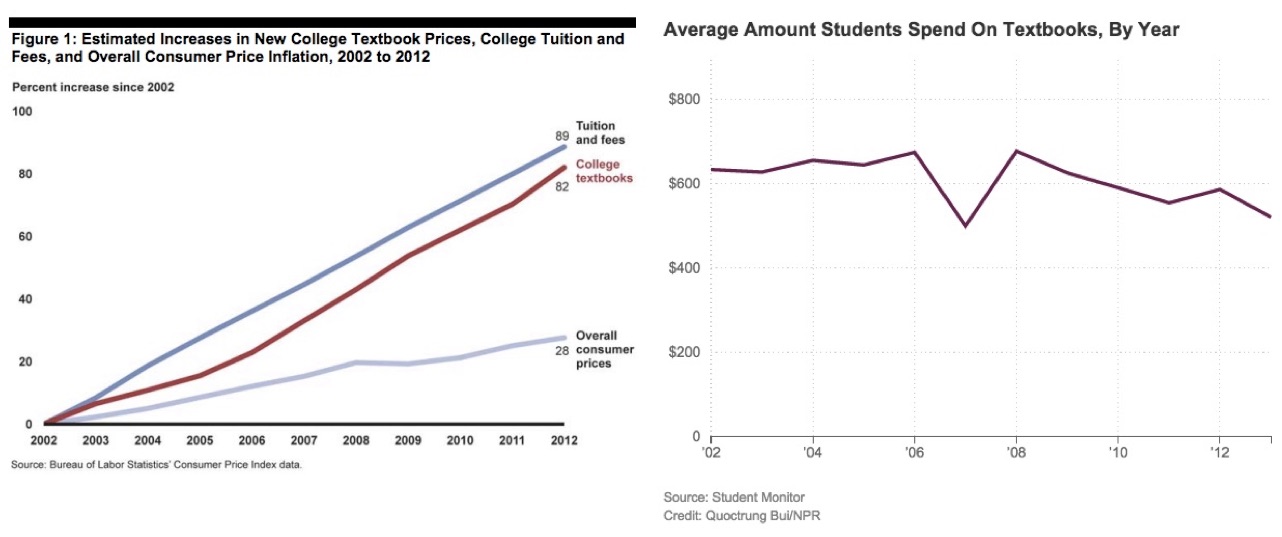
    Based on the most reliable data we have, the average college textbook prices are rising at three times the rate of inflation while average student expenditures on textbooks is remaining flat or even falling, in either case below the rate of inflation. Average student expenditures of approximately $600 per year is about half of what gets commonly reported in the national media. The combined chart comes from this GAO Report (using CPI data) and this NPR report (using Student Monitor data).

    Combined Chart

    Does this indicate a functioning market, and does this indicate that we don’t have a textbook pricing problem? No, and no. (more…)

  • Postscript on Student Textbook Expenditures: More details on data sources

    There has been a fair amount of discussion around my post two days ago about what US postsecondary students actually pay for textbooks.

    The shortest answer is that US college students spend an average of $600 per year on textbooks despite rising retail prices.

    I would not use College Board as a source on this subject, as they do not collect their own data on textbook pricing or expenditures, and they only use budget estimates.

    <wonk> I argued that the two best sources for rising average textbook price are the Bureau of Labor Statistics and the National Association of College Stores (NACS), and when you look at what students actually pay (including rental, non-consumption, etc) the best sources are NACS and Student Monitor. In this post I’ll share more information on the data sources and their methodologies. The purpose is to help people understand what these sources tell us and what they don’t tell us.

    College Board and NPSAS

    My going-in- argument was that the College Board is not a credible source on what students actually pay:

    The College Board is working to help people estimate the total cost of attendance; they are not providing actual source data on textbook costs, nor do they even claim to do so. Reporters and advocates just fail to read the footnotes.

    Both the College Board and National Postsecondary Student Aid Study (NPSAS, official data for the National Center for Education Statistics, or NCES) currently use cost of attendance data created by financial aid offices of each institution, using the category “Books and Supplies”. There is no precise guidance from DOE on the definition of this category, and financial aid offices use very idiosyncratic methods for this budget estimate. Some schools like to maximize the amount of financial aid available to students, so there is motivation to keep this category artificially high. (more…)