The average US college student does not spend or budget more than $1,200 for textbooks, with that number rising each year, as commonly reported in the national media. The best data available continues to show that students spend roughly half of that amount, and that number is going down over time, not up.
Last spring I wrote a post documenting that the College Board is not a reliable source for college textbook expenditures. With last week’s release of College Board data, it is worth repeating that data for their “Books and Supplies” category are:
average amounts allotted in determining total cost of attendance and do not necessarily reflect actual student expenditures.
Much more reliable data from the National Association of College Stores (NACS) and the Student Monitor consistently show that students on average spend between $530 – $640 per year for textbooks or “required course materials”. ((Read the spring post and a a postscript if you’d like to see the details.))
There is also fairly clear data from NACS and Student Monitor showing that student expenditures on textbooks or “required course materials” is going down ((Note that NACS used to be a biannual study and does not have data for AY2009 and AY2011.)).
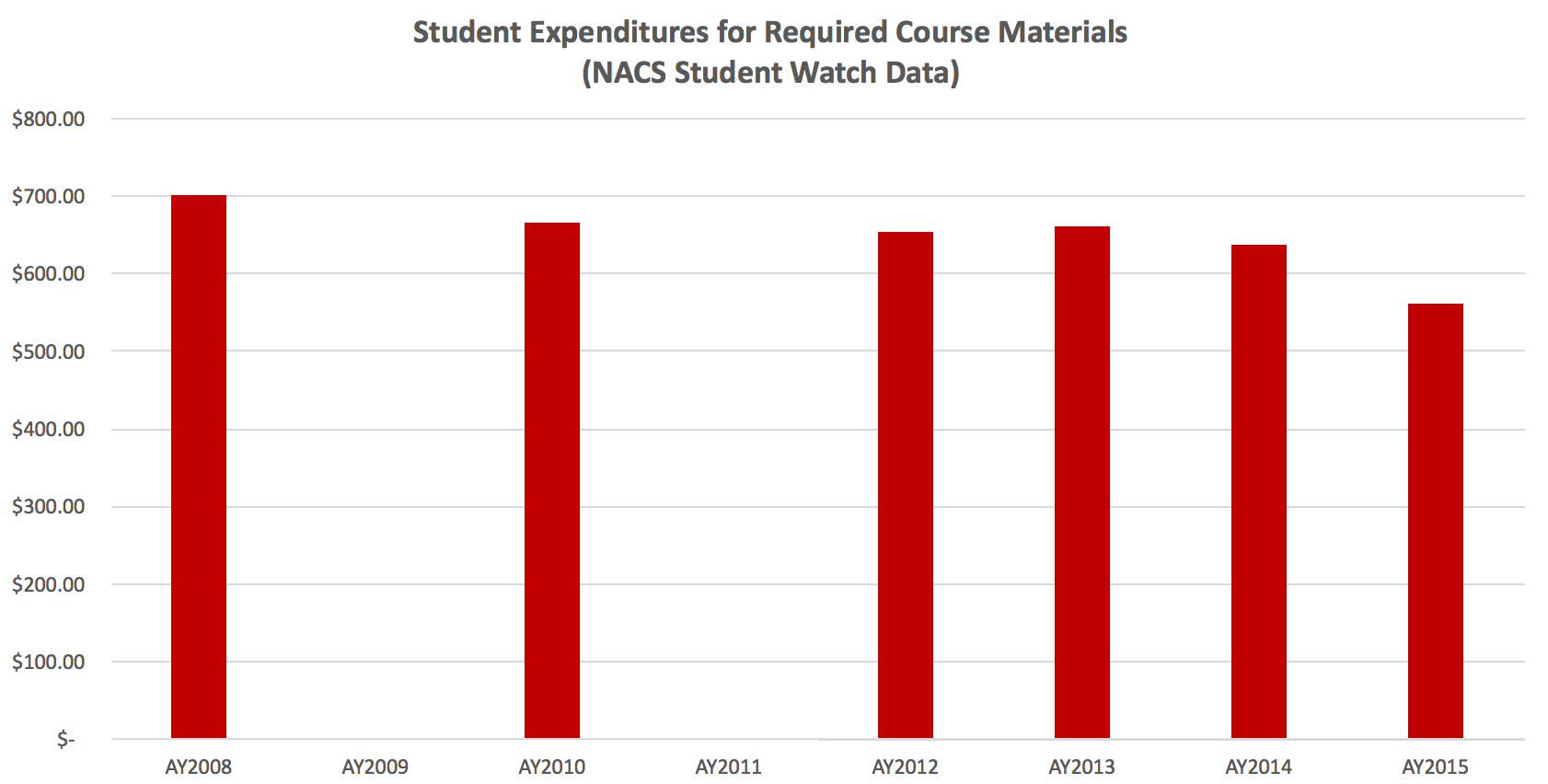
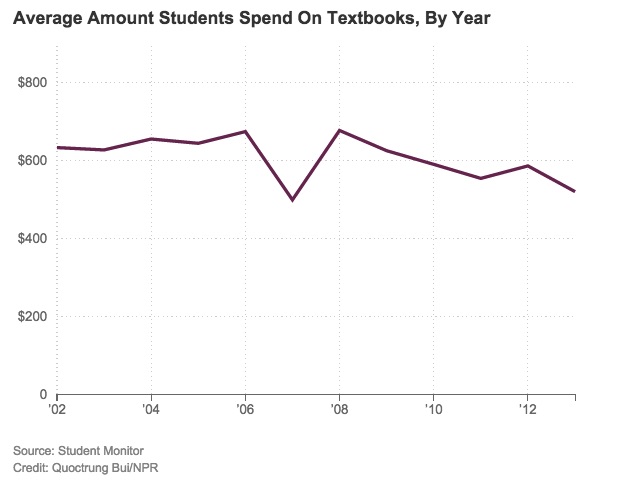
This week Campus Technology published an article on California State University’s Affordable Learning Solutions project, extensively quoting assistant vice chancellor for academic technology services Gerry Hanley. This article included an estimate from the system that further backs up the $530 – $640 figures.
[Hanley’s] rough estimate: As of a few years ago, learners at the 23-campus, 460,200-student university system were spending $300 million a year on course materials — about $651 per student per school year.
That $1,200 Figure
The College Board data in its recent report shows the “Books and Supplies” category is ranging from $1,249 to $1,364 across the college sectors.
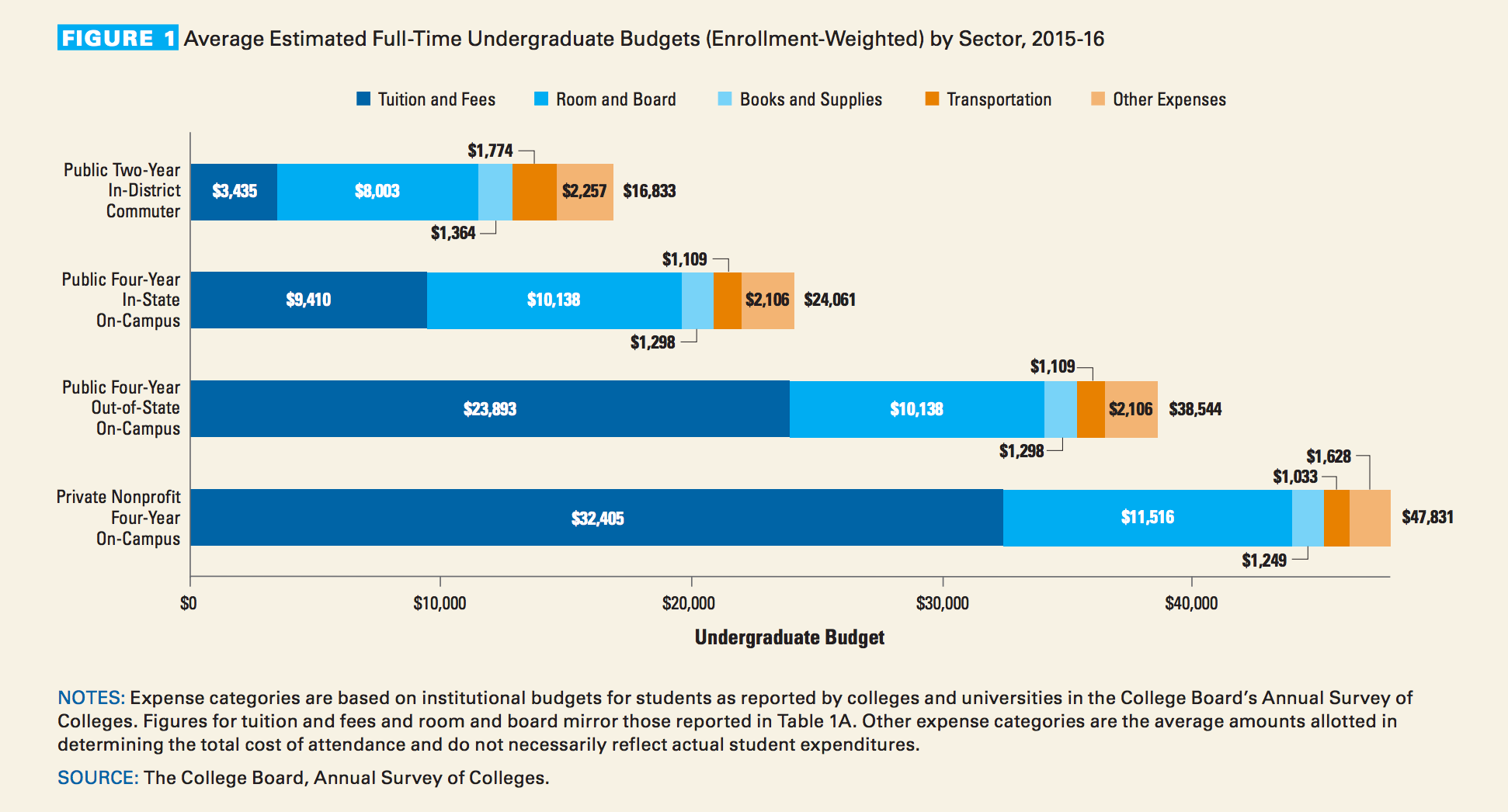
Furthermore, the College Board data shows this category rising year over year. Why is that? The reason is that the College Board gets this data from its member institutions who provide the books and supplies budget estimates they use for the National Center for Education Statistics’, or (NCES) Integrated Postsecondary Education Data System (IPEDS), which are self-reporting of campus financial aid offices which often want to maximize student eligibility ((Update: Note that this is but one example of flawed data. There is little federal guidance on how to determine the Books & Supplies category and no consistency in how financial aid offices do so.)) of loans and grants ((See postscript post for more details.)).
Update: Edited paragraph above to clarify that CB gets data from NCES which in turn gets data from financial aid offices and their self reporting. NPSAS does not act as a collection point of the data.
We have the College Board non-data implying that students spend more than $1,200 per year on textbooks, with that number rising each year, when the best data shows the expenditures of roughly half the amount, $600, with that number dropping.
This is why it is frustrating to see the continued usage of College Board data in the media and now in a bill introduced in the US Senate. SB2176 is the “Affordable College Textbook Act” sponsored by Senators Durbin, Franken and King. As described in the bill:
According to the College Board, during the 2014–2015 academic year, the average student budget for college books and supplies at 4-year public institutions of higher education was $1,225.
I should note that the description given to the media by OER advocates has changed since last spring from “students typically spend” and “average student spends as much as” to the more accurate “student budget for”. But this is a technicality that, while less misleading, is still misleading. I also have not seen anything indicating that the $1,225 number has led to bad policy in this bill.
The Affordable College Textbook Act was introduced in the 2013, did not get out of committee, and was reintroduced with minor changes a month ago. The bill would create a grant program for OER pilot programs, targeted at proposals that can:
demonstrate the greatest potential to— (1) achieve the highest level of savings for students [etc]
The primary purpose of the bill is to create savings for students; it should start with understanding what students actually spend and not a somewhat arbitrary financial aid number.
For what it’s worth, it should be noted that NACS is one of the groups actively supporting this bill.
Why Does This Matter?
I have had several people argue that this distinction does not really matter, but I maintain that it does for two reasons.
The first reason is simply a matter of transparency. For those advocating for open educational resources (OER), open should include open process and open data sources. The primary barrier to adoption of OER is faculty acceptance and not the existence of pilot programs. If faculty by and large start to believe that advocates are using misleading data, that will not help with getting more faculty to use open resources.
The second reason is that we have moved beyond the $1,200+ number being used just in media circles and now having it potentially embedded in legislation and policy decisions. What happens when policy makers or even vendors start to base real decisions on this number? What if a program or institution or state body decided that enough is enough, we need to cut that $1,200 average down to $700 per student by executive decision? Or what if a vendor convinced an administrator that they could supply all texts, digitally, for $700 per student as long as the school required 100% adoption? Those are hypotheticals, but if this scenario played out in some form, students would actually end up having to spend more money, not less, on textbooks or required course materials. We would also have missed the chance to spend policy capital on efforts that do help students save money.
Cal State and the AFS program should be commended for using actual student expenditure data as they set goals of reducing student expenses by 50%. If they had started with the College Board data for current state but then surveyed student actual expenditures to determine savings, Cal State would have almost met their own goal already, and there would be little reason to push any further for savings.
There is growing acceptance of the potential for OER, which means that decisions with bigger impact are likely to be made in the future. Having misleading information that ignores the actual expenditures by students can lead to bad policy decisions.
Updates:
- Tanya Joosten makes an excellent point in the comments that I’d like to bump into post: “Another potential problem is that when low income students look at the anticipated costs of attendance, it dissuades them from even applying or actually registering because the overall costs (e.g., $24,061 as indicated in the graph for a 4 year public institution) look unobtainable with their or their family income.”
- Mike Caulfield has a response post “Asking What Students Spend on Textbooks Is the Wrong Question”. I have response to his post “Asking What Students Spend On Textbooks Is Very Important, But Insufficient”.
Another potential problem is that when low income students look at the anticipated costs of attendance, it dissuades them from even applying or actually registering because the overall costs (e.g., $24,061 as indicated in the graph for a 4 year public institution) look unobtainable with their or their family income.
That is an excellent point, Tanya. Hmm, follow-up blog post . . .