e-Literate

Present is Prologue

Tag: COVID-19

  • Announcing a #ResilienceNetwork Procurement Solution for COVID

    One of the massive challenges facing colleges as they prepare for the return to school during COVID is procuring everything they need, from equipment to keep people safe, to educational software and services to keep students learning online. That’s why I’m delighted to announce that E&I Cooperative Services is joining the Empirical Educator Project as a sponsor and contributing their COVID-19 Recovery Solutions Navigator as a resilience network project.

    You may not have heard of E&I, but if you work at a U.S. college or university, chances are very good that your institution has a relationship with the cooperative. E&I is the only member-owned, non-profit purchasing cooperative solely focused on serving the needs of education. They use the aggregate purchasing power of more than 5,000 member institutions to develop competitively solicited contracts that comply with generally accepted procurement standards, including those of state systems.  E&I has been a member-owned organization since its founding in 1934, and membership is free.

    We all know what a bottleneck the procurement process can be. It’s extra time (and costs) that a lot of colleges don’t have right now. E&I has been working with its members to map out their needs, create a list of solutions, and offer competitively-solicited or adoptable contracts as quickly as the process will allow. The E&I team has been working hard to get ahead of this part of the problem for you, both by anticipating solutions you may need and negotiating contract terms so you don’t have to. The COVID-19 Recovery Solutions Navigator is itself a contribution to the resilience network, since it provides a map of potential needs that will help accelerate institutions’ internal planning conversations. The contract negotiation that E&I handles is priceless.

    As part of their participation in EEP, E&I has engaged e-Literate to advise them on potential areas of need in teaching and learning and, more broadly, student success. Because procurement can only proceed so quickly and still pass muster with compliance requirements, there will likely be several waves of these RFP solicitations. The first, which focuses on online learning program consulting and faculty training, can be found here.

    This is the heart of it, though:

    E&I’s intent of this Request for Proposal is to solicit qualified, experienced, financially sound, and responsible firms to provide Online Learning Program Consulting and Faculty Training as required by members. The Respondent(s) must have the expertise and experience with providing faculty training for online course development & pedagogical design. This may include the building of new or expansion of online programs for higher education institutions and K-12 school districts. Additionally, E&I is soliciting qualified, experienced, financially sound, and responsible firms to provide consulting for institutional and/or organizational change management for online learning programs.

    Proposals are due by 1:00 PM ET on Thursday July 23, 2020, so if you are a vendor that wants to be considered in this process (or work with a vendor that you think should submit a proposal), now is the time to apply.

    More support for COVID and empirical education is coming

    As I mentioned earlier, this is the first teaching and learning-related solicitation. E&I will be conducting at least one more teaching and learning-related COVID RFPs in areas that are yet to be determined. Suggestions are welcomed.

    E&I has also signed an MOU with EEP to collaborate on the creation and execution of procurement processes that incorporate research and evidence of impact directly into the procurement process. While we are focused on the urgent needs of the COVID crisis for now, we also intend to make it easier for institutions to evaluate and procure educational products and services through a process that takes evidence of educational impact into account.

    Register for the e-Literate LIVE! event on Wednesday, August 26th from 1:30 PM to 3:00 PM ET with E&I leadership to talk with them about their #resiliencenetwork EEP contribution and provide input for the next steps in the project.

  • Surviving the Third Wave of COVID and Beyond

    We have now fully transitioned into the second wave of the COVID crisis for higher education. Educators and students, having survived the sudden and painful transition to remote education, are now turning to the fall and frantically searching for a less painful and more meaningful educational experience than the one they just endured. I’m beginning to see hopeful signs in the sector-wide collaboration in this phase. Within a week, there will be an announcement of the first initiative that will demonstrate what a proportionate response could look like. Stay tuned for the details.

    But the third wave is coming fast. It will be a financial crisis that tears at the social fabric of academia and threatens to unmake colleges and universities as we know them, not only because of the economic hardship itself but also because many academic institutions do not have the unity of vision and effective governance to navigate this next wave without a great deal of distracting and destructive infighting. As the early budget cuts are starting to roll in, so are the early skirmishes being fought in faculty senates and in the academic press.

    As I read one harbinger of the next wave of the crisis—”Bashing Administrators While the University Burns” by Gabriel Paquette in The Chronicle—I was struck by just how intimately related the coming challenges are to many of the themes covered here in e-Literate. If we want to weather the coming waves with as little permanent damage as possible, we would do well to revisit these lessons afresh and consider them as intimately connected to academia’s core challenges rather than as one niche of debatable importance.

    Ahistoricity

    It’s easy to read Paquette’s piece as the expected administrator’s response to a labor dispute with faculty brought on by budgetary pressures. But if we read the piece more closely, there is a lot here to unpack.

    Take this passage, for example:

    Myths provide comfort but offer little practical guidance. It is easy enough to conjure a vision of a lost academic paradise where philosopher-kings served as presidents, and departments were semiautonomous cantons. This paradise, the myth continues, was decimated by the irruption of centralized authority, the eclipse of academic [sic] by corporate values, and the corruption brought by private philanthropy and athletics. The only chance for redemption, according to this view, is a restoration of the prelapsarian idyll.

    If such an idyll ever existed, its heyday coincided with an age when universities were bastions of race-, gender-, and class-based privilege, with a minute fraction of the population enrolled in higher education. This scholastic arcadia could not withstand the pressures brought by the expansion of access to (and democratization of) higher education, the conversion of universities into vehicles of social mobility, the administration of enormous government contracts and grants, and universities’ newfound status as economic bulwarks of entire communities. The resulting transformation gradually made traditional modes of academic organization obsolete. What replaced this beloved anachronism was not necessarily superior to it. But it was a form of management better suited to the complex, large-scale multiversity.

    Bashing Administrators While the University Burns

    Back in 2017, when describing research on cultural differences in learning, I wrote,

    We are currently facing two civilizational educational challenges. By “civilizational,” I mean that they go beyond country- or region-specific challenges. They are unprecedented in the history of humanity. The challenges I’m talking about are universal access to quality education and universal lifelong learning, both of which are almost certainly ones that you’re well aware of. But we don’t talk enough about how unprecedented they are, what we need to learn to do differently to meet them, and how we could go about learning what we need to learn.

    Research in Translation: Cultural Limits of Self-Regulated Learning

    Notably, that post was about a study examining the differential impact of teaching techniques in MOOCs on students from different cultures. Yes indeed, the world has changed. As much as there has been good reason to decry the early hype and continuing shortcomings of the MOOC model, nobody was asking this kind of research question back in the good old days of the Great Depression. (The previous one.) We cannot commit ourselves to the ideal of equal access to quality education for a global population of 7.8 billion people and simultaneously remain committed to the ideal of small in-person seminars as the paragon of quality education. The two are simply incompatible. I am not suggesting that we lower our standards. Rather, I am suggesting—and I believe Paquette is suggesting—that we take a good hard look at how much our standards may be influenced by hidden assumptions of privilege. Why should a “quality education” for the 21st-Century masses look identical to the “quality education” of the 19th-Century elites? Where do these ideas of quality come from? Whose goals do they serve? And what trade-offs do they entail?

    Paquette continues,

    Among the drivers of the much-lamented “administrative bloat” are government regulation and student services. The former has added layers of compliance most university denizens applaud, including the creation of offices to uphold civil-rights laws and Title IX, unmistakable signs of social and political progress. Similarly, the advent of a vast support apparatus is not an affront to the university’s academic mission. The monochromatic student body of yesteryear has been replaced, felicitously and partially as a result of faculty advocacy, with a heterogeneous one more reflective of society’s diversity at large. Students from less privileged backgrounds often depend on support services to flourish, with staffs large enough to meet high demand.

    This faculty critique of the contemporary university is predicated, then, on a surprising ahistoricity. Such critiques obscure from view the rationale for current structures of governance.

    Bashing Administrators While the University Burns

    This part of Paquette’s argument is more complicated. On one hand, there are many reasons why administrative costs have grown dramatically, not all of which are as straightforwardly benign as Title IX compliance. On the other, the very complexity of these decisions is further justification for the careful and cool-headed accounting conversation that Paquette calls for.

    Consider robo-graded homework platforms. Why do they exist? Five or ten years ago, publishers would tell you it’s because faculty appreciate the labor-saving convenience. (They have better answers now, but those answers have nothing to do with why robo-graded homework platforms were created to begin with.) Faculty will often tell you it’s because they just can’t grade multiple homework assignments a week in a 400-person class, even with the help of TAs. Why do we have 400-person classes? Because as universities strive to teach more students without having access to proportionately more money, it turns out that large lecture classes are very cost-effective. In a different sector, they would be called “profitable.” They generate more revenue than they cost. Where does that extra revenue go? It’s hard to tell in many cases because a lot of colleges and universities are allergic to this kind of accounting. But one place that money often goes is to subsidize courses and programs that would be called “unprofitable” in a different world. Foreign language departments. Upper-division and graduate programs. Is this the right educational trade-off to make? I don’t know. I’m not sure there is one universally correct answer to that question.

    But I do know answers to two different questions that are highly relevant to the previous one. First, was this set of trade-offs made consciously by most institutions? No, it was not. The vast majority of the people involved in making the incredibly complex chain of decisions that are relevant here—down to how many graduate students academia should be producing in different disciplines—are almost completely ignorant of these economics. They certainly are not trained to have sophisticated conversations about them (even if their institutions were capable of performing the necessary accounting, which many are not).

    Second, could a different set of technology-assisted trade-offs have been made? For sure. Technology is good at reducing the cost of repetitive work that requires relatively little judgment. For example, when I was a product manager at Oracle in the mid-2000s, I was shocked to discover that most faculty were still copying students’ final course grades from their electronic LMS grade book and pasting them manually into their electronic registrar grade book. Every minute spent doing so was a minute less that a given instructor had to perform other, higher-value work. If you work at a college or university, think about how much of your day is spent performing such mind-numbing tasks, like manually entering data into a spreadsheet when that data exists somewhere else in electronic form. Academia could have relentlessly sought out such inefficiencies first. But they didn’t. They still haven’t.

    Here’s another example: Businesses understand that losing paying customers is bad. If they go away, not only do you lose the revenue, you also have to spend money to attract a new customer to replace that revenue. Many universities treat student retention as a mission issue. They’d rather not fail their students that way, all things considered. Not all universities even see it as that much of a problem. So-called “weeder” programs are still all too common. But in reality, in addition to being an issue of ethical responsibility, retention is also one place where universities leak money. This is an area where the institution can be more financially sustainable by serving its students better. Technology can definitely help with this problem in multiple ways. And yet, many segments of academia have been slow to prioritize retention, as well as the related challenges of degree completion and time-to-graduation.

    Hang together or hang separately

    Ultimately, Paquette is not as focused on taking sides in an adminstration/faculty budget war as he is on pointing out that war is not the answer:

    Denunciation, recrimination, and grandstanding are pit stops on the road to oblivion. This is not to say that faculty criticisms of university leadership are unfounded or invalid. But they are a dead end unless accompanied by the constructive aim of collective betterment. The allure of mounting the barricades is almost irresistible, but what’s the point if we all end up guillotined? What use is rehearsing old grievances if students balk at further indebtedness, and our revenue models collapse?

    I anticipate one of two scenarios in the coming years. In the first, the familiar feuds persist, and the university edifice crumbles, with old enmities slight consolation for those who remain amid the ruins. In the second, instinctive self-preservation and mutual interest incite faculty-administrative cooperation, institutional moribundity is reversed, and a new university is erected on the foundations of the old. Viva la revolución, indeed.

    Bashing Administrators While the University Burns

    In one of my earlier posts on COVID, I quoted Ben Franklin as saying, “We must, indeed, all hang together or, most assuredly, we shall all hang separately.” That is as true intra-institutionally as it is inter-institutionally. In recent months, e-Literate has proudly featured two guest posts by Susan Baldridge, co-author of The College Stress Test. Both posts were about having hard internal conversations about institutional change. They may have seemed tangential to e-Literate‘s core focus. They were not.

    What does it mean to be “e-literate”? When I came up with that name many years ago, it was meant to be self-deprecating. But it also contains a serious message I believe in passionately, now more than ever. Academics—educators—take literacy very seriously. It is a word with deep meaning and many nuances. A life-changing word. E-literacy is a kind of literacy. Today, as we all learn how a funeral or a wake over Zoom can be meaningful and resonant, as we learn how social media can be used simultaneously to bring us together and tear us apart, as we struggle to support friends and loved ones and colleagues and local businesses and total strangers from a distance, we are learning to be more e-literate. Just as literacy is about more than employing the technology of the printed word, e-literacy is about more than EdTech. It’s about culture. It’s about understanding how we change ourselves—consciously or not—when we choose to depend on certain tools in certain ways. And it’s about making mindful choices.

    We are entering the third wave of the crisis. If you want to understand what that means, then just turn on the TV news for five minutes. This is the moment when either we all come together or we all fall apart.

    We need to think harder, and we need to share what we are learning with each other so that we can learn faster together. That’s what the written word was invented for. That’s what literacy is about.

  • COVID-19: What comes next

    One of the weird things about humans is that we most want to be told what will happen next at the exact moment when the future is uncertain because the outcome depends upon decisions we have yet to make. Most of the time, the future is predictable partly because there isn’t a lot we can do to change it. This is not one of those times.

    Like so many aspects of this civilizational crisis, our choices—as individuals, institutions, and societies—will shape the future. We can decide to let our institutions fall apart. We can try to hold them together with chewing gum and string. We can let others decide for us, which risks letting the most powerful and self-interested actors determine our future. Or we can choose to mindfully rebuild. Each of us gets some say in what happens next (though, tragically, some more than others).

    I don’t know how all of this will play out, and pretending otherwise would be harmful. We all need to dwell in the uncertainty that enables us to make choices, and we need to make our choices together as a sector. For this reason, I’m reluctant to advocate too forcefully for my views of what is likely happen, or even what should happen. There may be time for that later. But at this moment, as our educational first responders are struggling to deal with the first wave of the crisis while beginning to brace themselves for the second wave, I think it important for those of us who are not in that role to exercise some situational awareness. Now is not a great time to pontificate or prognosticate—at least not without extra doses of humility and empathy.

    That said, we are far enough into the first wave that it is time to start thinking about the future. For some of us, that will mean learning to walk, chew gum, and juggle chain saws at the same time. So with that in mind, I’m going to offer up some of the change vectors I’ve been thinking about lately as conversation starters

    Everyone will be cash-strapped

    Students and their parents have lost income. Adjunct faculty, upon whom so many colleges and universities rely, are also highly vulnerable to a social safety net with many holes in it. Universities face the possibility of refunding student tuition and fees, and may well experience a major shift in enrollments next year as students reconsider their options. States face massive budget deficits.

    While all of this is obvious, the implications are not. We don’t know yet how our federal governments will respond. Or the states. Or the institutions. Or the students. Or anyone, really.

    When I think about these sorts of multi-level problems, I try to find the highest organizational level at which I think I can have a significant influence. For climate change, I am more focused on state and local actions than at Federal or global ones because I feel more able to influence my state and local governments. For COVID-19 and higher education, it may be at the institutional level. University communities have never been terribly good at understanding the mechanics of their institutional sustainability models. How much money comes from public funding vs. grants vs. tuition vs. alumni donations? Which programs cross-subsidize which others? What have been the drivers of cost increases? How are these dynamics shifting? Now is the time to get smarter about this so that we can make smarter decisions going forward. While this sort of thinking feels uncomfortably close to reducing education to a consumer commodity, there will be no higher education if universities can’t get their budgets to balance. This is a particularly urgent conversation to be having.

    Online isn’t going away any time soon

    While I find some of the cheerleading for #pivotonline to be too soon and sometimes too opportunistic—particularly from folks who are not working on the front lines—we shouldn’t expect the need for online education to magically disappear by September, or for the world to eventually revert to the way it used to be. What holds for all other aspects of the post-coronavirus world also holds for education. Social distancing is a reality that we will be living with for a long time. Long enough that new patterns of life and work will set in. The implications are both deep and wide.

    First, this change will impact the sustainability models I referenced above. Students are already asking for their housing costs to be refunded for the semester. Those who have been paying attention to the trends in online pricing are aware of a wide range of price-relevant experiments in various stages of progress in the market, from xMOOCs to stackable credentials to affordable degrees at scale to premium-priced OPM-designed master’s degrees. There is no one right answer here. Colleges and universities will find different combinations that fit their missions, sustainability needs, and organizational capabilities.

    Second, we will need to pay extra attention to equity. This is an area that was already beginning to get some much-needed focus, but the current crisis will bring the problem into sharper relief. For example, universal access to affordable broadband is more obviously an equity issue when it is inextricably tied to access to education. More broadly, we know, based on a rich body of research, that underserved students underperform relative to their peers online. (This is likely even more true in hastily and poorly executed remote education courses like the ones that are being thrown up out of necessity this term.) We need to redouble efforts to understand their needs and fill gaps in our support for them.

    One potential bright spot in the larger crisis is the opportunity to introduce more faculty to both new ways of thinking about their teaching practices and closer relationships with expert support staff. We know that both of these things tend to happen when faculty are introduced to online teaching on a more orderly and voluntary basis. Unlike with face-to-face instruction, many instructors don’t feel like they should be expected to somehow know how to be master teachers online and therefore are less reluctant to see themselves as novices and students. On the other hand, if the transition goes disastrously poorly at a moment when faculty (like all of us) are feeling vulnerable in other parts of their lives, the trend could turn in a different direction. This is a moment when the deep structure of academic culture will get rewired, one way or another. We need to be mindful about how we support and enable the support staff so that they have the best chance of steering the change in a productive direction.

    The curricular materials ecosystem is especially fragile

    This one may be less obvious to some. The curricular materials ecosystem was already in danger. Almost none of the textbook publishers were financially healthy even before the virus hit. OER is doing fine, but it is not on a growth path that is remotely fast enough to fill the giant hole in course coverage that would be left should the publishers start to implode. And while it may be tempting for some to say “good riddance” to the traditional providers, try telling frazzled faculty who are in the midst of a sudden, unplanned, and unwelcome online transition that they will also have to cobble together a replacement for their textbook in the process.

    At the same time, if we really are facing a new reality of a large-scale and long-term switch to online education, then we need to find the means and measures for closing online achievement gaps for transitioning students in general and underserved populations in particular. To do this, we will need to embrace digital affordances. The sector is in no way prepared for this. We don’t have the privacy policies, procurement practices, or widespread literacy among faculty regarding how to make effective use of digital affordances. Furthermore, if the publishers collapse, where will these digital products come from? The majority of sophisticated courseware authoring platforms have either died on the vine or been acquired by the publishers. There is very little in the way of sustainable open-source alternatives. Nor is there an alternative ecosystem in place to produce content for these platforms.

    As part of this larger shift, we need to engage in some big, out-of-the-box, but reality-grounded thinking about how we might reconfigure the entire curricular materials ecosystem to create more stable and beneficial sustainability models. I don’t have a lot to say about this yet but hope to have more to say about it soon.

    Working together more effectively

    Finally, folks who have been reading e-Literate regularly over the last few years know that my current professional obsession is about how ineffectively higher education collaborates as a sector, despite the deep reservoirs of goodwill and generosity among the people who work in it. I have written quite a bit about the Empirical Educator Project in general and the idea of a resilience network in particular. We need to work on improving our collaboration now more than ever.

    As Ben Franklin memorably put it, “We must, indeed, all hang together or, most assuredly, we shall all hang separately.”

    Truer words….

  • Please License Your COVID-19 Resources CC-BY or Public Domain


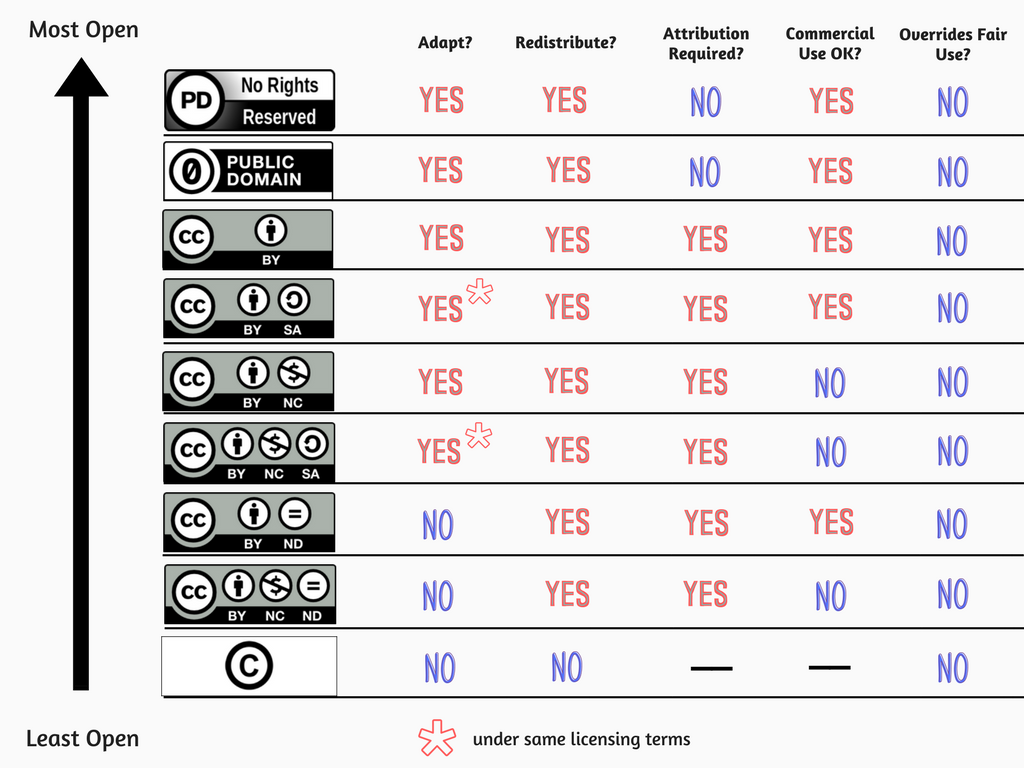
    CC BY Aaron McCollough (adapted from a table by Anita Walz)

    I’ve started sorting through the generous mess that is the COVID-19 educational resource sharing with an eye toward a lasting resiliency network that I wrote about yesterday. One good place to start (of many, I’m finding) is Lumen Learning’s list of recommended resources. ((Disclosure: Lumen is a sponsor of the Empirical Educator Project.)) While Lumen is sharing their curation free with everybody online, one of the strengths that the commercial providers offer during this time of crisis is that they also often have fairly direct lines of communication with their customers. Their survival depends on their ability to cut through the noise and reach particular people with well-targeted messages. In times like these, their communications and marketing teams can be turned into information distribution networks. We need to reach educators efficiently with high-quality information. We need these distribution networks.

    Right now, a lot of EdTech companies are doing what Lumen is doing. They are curating their own lists of content and getting them out to their customers. Many of these resources are being produced by and for academics. The companies are curating and distributing. Ideally, we would be working as a sector consistently, over time, to create and organize educational resiliency content that organizations with effective distribution capabilities. These could be commercial providers, universities, or professional associations. The most important thing is to get high-quality information to people who need it at their moment of need.

    In this kind of situation, we should reduce the friction of sharing as much as possible. One source of friction is licensing. People that want to share high-quality content created by others need to consider whether the creator has granted them the right to do so. That is the law, and it is also the right thing to do. But it is a source of friction to sharing. If your top priority is to create content that will reach and help as many people as possible, then you should reduce that friction as much as possible.

    There is a simple way to do that. First, make sure that your content bears an explicit license that grants sharing rights. Don’t make people come to you and ask for permission. Second, choose the most permissive license that you can justify. The most permissive license possible would be a public domain mark. This simply says, “I am giving this to the world and don’t need credit or payment. Please use it.” The second-most permissive option would be the Creative Commons Attribution license (CC-BY). This license says, “I am giving this to the world, and all I ask in return is that you give me credit for my work.” Either of these licenses will enable the broadest range of distribution networks to pick up your contribution with as little friction as possible.

    I do not recommend Creative Commons license conditions such as Non-Commercial or Share-Alike for this kind of resource. Non-Commercial (CC-BY-NC) is the worst. If a commercial entity shares your CC-BY-NC-licensed resource to their customers and they don’t charge for it, is that commercial use? Nobody knows. So commercial entities have both legal and ethical reasons to be cautious about sharing CC-BY-NC resources. Share-Alike (CC-BY-SA) is not quite as bad but also problematic. Again, if a commercial entity, or even a professional association, wanted to bundle your resources with some of their copyrighted material in order to help educators in their time of crisis, could they do it under this license? Do you want to prohibit that use?

    The Non-Derivatives clause (CC-BY-ND) if you’re worried about a piece of information with your name on it being chopped up in ways that you don’t approve. But every restriction clause creates a trade-off in terms of broadest use. Please think carefully about potential trade-offs with the ones that you impose.

    I am not making the blanket argument that all educational resources should be licensed CC-BY or public domain (although the argument could be made). I am urging my readers—both academic and commercial—to explicitly contribute as much of your crisis support content as possible under as permissive a sharing license as possible.