
e-Literate

Present is Prologue

Tag: Department of Education

  • US Department of Education: Almost a good idea on ed tech evaluation

    Richard Culatta from the US Department of Education (DOE, ED, never sure of proper acronym) wrote a Medium post today describing a new ED initiative to evaluate ed tech app effectiveness.

    As increasingly more apps and digital tools for education become available, families and teachers are rightly asking how they can know if an app actually lives up to the claims made by its creators. The field of educational technology changes rapidly with apps launched daily; app creators often claim that their technologies are effective when there is no high-quality evidence to support these claims. Every app sounds world-changing in its app store description, but how do we know if an app really makes a difference for teaching and learning?

    He then describes the traditional one-shot studies of the past (control group, control variables, year or so of studies, get results) and notes:

    This traditional approach is appropriate in many circumstances, but just does not work well in the rapidly changing world of educational technology for a variety of reasons.

    The reasons? (more…)
  • ED and CBE: Example of higher ed “structural barrier to change” that is out of institutions’ control

    There has been a great conversation going on in the comments to my recent post “Universities As Innovators That Have Difficulty Adopting Their Own Changes” on too many relevant issues to summarize (really, go read the ongoing comment thread). They mostly center on the institution and faculty reward system, yet those are not the only sources of structural barriers to change that lead institutions to this “difficulty adopting their own changes”. Increasingly there are outside forces that both encourage change and resist change, and it is important to recognize the impact of the entire higher education ecosystem.

    Yesterday Amy Laitinen from New America wrote an excellent article titled “Whatever Happened to the Department’s Competency-Based Education Experiments?” highlighting just such an example.

    About this time two years ago, President Obama went on his college affordability bus tour and unveiled his plan to take on the rising costs of higher education in front of thousands of students at SUNY Buffalo. Promoting innovation and competition was a key part of his plan and President Obama held up competency-based education (CBE) up as one of the “innovative new ways to prepare our students for a 21st century economy and maintain a high level of quality without breaking the bank.” The President touted Southern New Hampshire University’s College for America CBE approach. The university “gives course credit based on how well students master the material, not just on how many hours they spend in the classroom,” he explained. “So the idea would be if you’re learning the material faster, you can finish faster, which means you pay less and you save money.” This earned applause from students in the audience as well as from CBE practitioners around the country. [snip]

    The problem is that day was nearly two years ago and the CBE experimental sites are not yet off the ground. (more…)

  • About the Diverging Textbook Prices and Student Expenditures

    This is part 3 in this series. Part 1 described the most reliable data on A) how much US college textbook prices are rising and B) how much students actually pay for textbooks, showing that the College Board data is not reliable for either measure. Part 2 provided additional detail on the data source (College Board, NCES, NACS, Student Monitor) and their methodologies. Note that the textbook market is moving into a required course materials market, and in the immediate series I use both terms somewhat interchangeably based on which source I’m quoting. They are largely equivalent, but not identical.

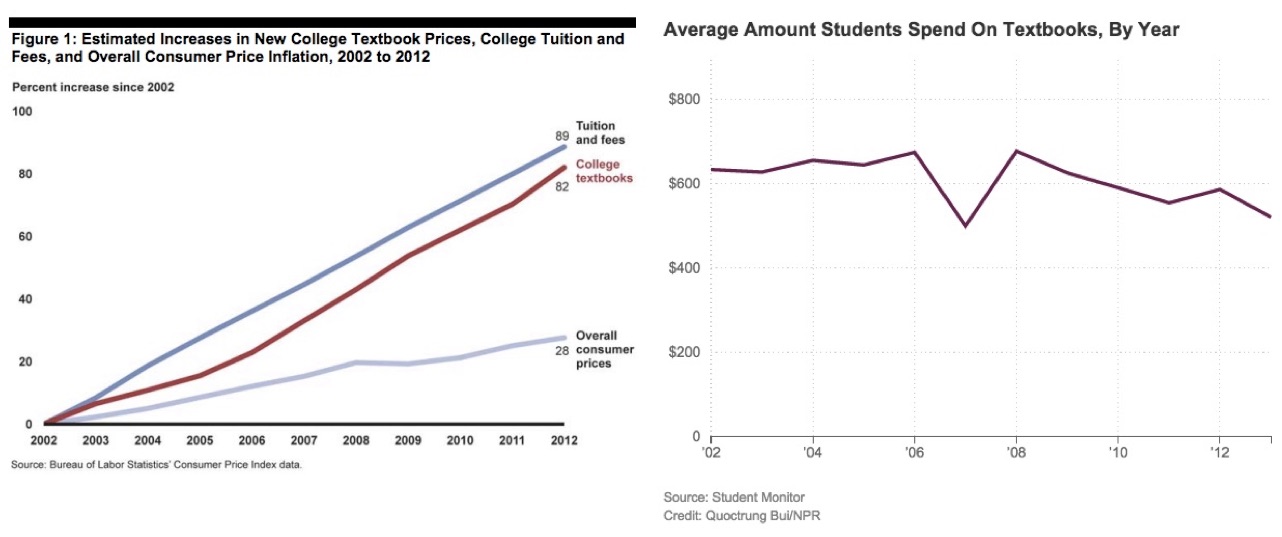
    Based on the most reliable data we have, the average college textbook prices are rising at three times the rate of inflation while average student expenditures on textbooks is remaining flat or even falling, in either case below the rate of inflation. Average student expenditures of approximately $600 per year is about half of what gets commonly reported in the national media. The combined chart comes from this GAO Report (using CPI data) and this NPR report (using Student Monitor data).

    Combined Chart

    Does this indicate a functioning market, and does this indicate that we don’t have a textbook pricing problem? No, and no. (more…)

  • Postscript on Student Textbook Expenditures: More details on data sources

    There has been a fair amount of discussion around my post two days ago about what US postsecondary students actually pay for textbooks.

    The shortest answer is that US college students spend an average of $600 per year on textbooks despite rising retail prices.

    I would not use College Board as a source on this subject, as they do not collect their own data on textbook pricing or expenditures, and they only use budget estimates.

    <wonk> I argued that the two best sources for rising average textbook price are the Bureau of Labor Statistics and the National Association of College Stores (NACS), and when you look at what students actually pay (including rental, non-consumption, etc) the best sources are NACS and Student Monitor. In this post I’ll share more information on the data sources and their methodologies. The purpose is to help people understand what these sources tell us and what they don’t tell us.

    College Board and NPSAS

    My going-in- argument was that the College Board is not a credible source on what students actually pay:

    The College Board is working to help people estimate the total cost of attendance; they are not providing actual source data on textbook costs, nor do they even claim to do so. Reporters and advocates just fail to read the footnotes.

    Both the College Board and National Postsecondary Student Aid Study (NPSAS, official data for the National Center for Education Statistics, or NCES) currently use cost of attendance data created by financial aid offices of each institution, using the category “Books and Supplies”. There is no precise guidance from DOE on the definition of this category, and financial aid offices use very idiosyncratic methods for this budget estimate. Some schools like to maximize the amount of financial aid available to students, so there is motivation to keep this category artificially high. (more…)