
e-Literate

Present is Prologue

Tag: developmental courses

  • Austin Community College’s ACCelerator: Big bet on emporium approach with no pilots

    While at SXSWedu, I was able to visit Austin Community College’s ACCelerator lab, which got a fair bit of publicity over the past month. While the centerpiece of ACCelerator usage is for developental math, the 600+ workstation facility spread over 32,000 square feet also supports Tutoring in a variety of subjectsFirst year experienceGroup advisingAcademic CoachingAdult EducationContinuing EducationCollege readiness assessment preparation, and Student skills workshops.

    ACCelerator

    But it is the developmental math course that has received the most coverage.

    Austin Community College welcomed second lady Dr. Jill Biden and Under Secretary of Education Dr. Ted Mitchell on Monday, March 9, to tour the Highland Campus’ ACCelerator and meet with students and faculty of the college’s new developmental math course, MATD 0421. [snip]

    “I teach a lot of developmental students,” says Dr. Biden. “The one stumbling block does seem to be math and math anxiety and ‘Can I do it?’. This (course) seems to be so empowering and so positive. Students can see immediate success.”
    (more…)

  • Alternate Ledes for CUNY Study on Raising Graduation Rates

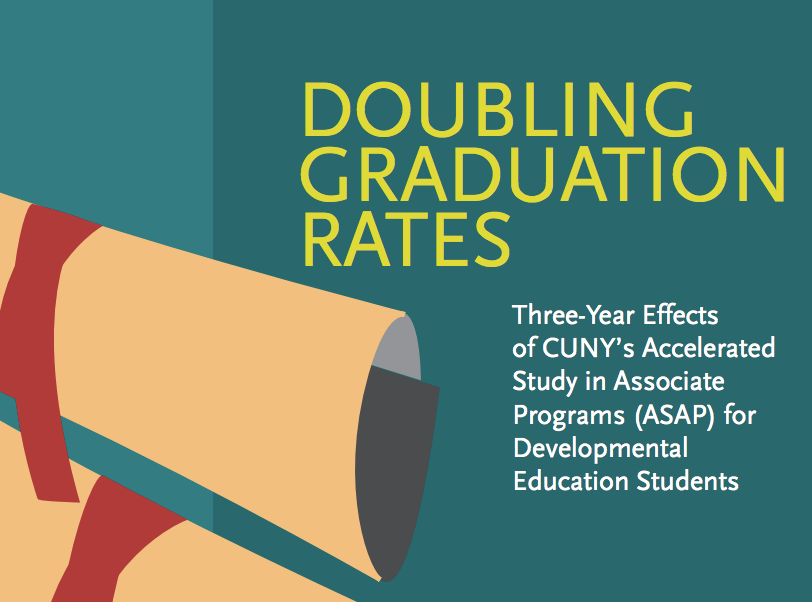
    Last week MDRC released a study on the City University of New York’s (CUNY) Accelerated Study in Associate Programs (ASAP) with near breathless terms.

    Title page

    • ASAP was well implemented. The program provided students with a wide array of services over a three-year period, and effectively communicated requirements and other messages.
    • ASAP substantially improved students’ academic outcomes over three years, almost doubling graduation rates. ASAP increased enrollment in college and had especially large effects during the winter and summer intersessions. On average, program group students earned 48 credits in three years, 9 credits more than did control group students. By the end of the study period, 40 percent of the program group had received a degree, compared with 22 percent of the control group. At that point, 25 percent of the program group was enrolled in a four-year school, compared with 17 percent of the control group.
    • At the three-year point, the cost per degree was lower in ASAP than in the control condition. Because the program generated so many more graduates than the usual college services, the cost per degree was lower despite the substantial investment required to operate the program.

    Accordingly the media followed suit with breathless coverage ((And this article comes from a reporter for whom I have tremendous respect.)). Consider this from Inside Higher Ed and their article titled “Living Up to the Hype”: (more…)

  • New post at 20MM: Two Approaches to Watch in Remedial Education Innovation

    The 20 Million Minds Foundation is starting a new blog, and for topics of mutual interest, Michael and I will be posting articles  several times a month on their site and occasionally cross-posting here. The first article of mine went up last week.

    Two Approaches to Watch in Remedial Education Innovation

    It is no secret that the current approach to remedial (or developmental) courses does not work. According to a study by Complete College America (see original for footnotes documenting sources):

    “The numbers tell a dispiriting story. Half of all undergraduates and 70 percent of community college students take at least one remedial course. Too many of these students never overcome being placed into a remedial course. Only about a quarter of community college students who take a remedial course graduate within eight years. In fact, most students who are referred to remedial education do not even complete the remedial sequence: One study found 46 percent of students completed the sequence in reading and only 33 percent completed it in math.”

    Following the maxim that “if it doesn’t work, try something else”, two community colleges on opposite coasts – Miami-Dade College in Florida and Cerritos College in California – are trying to change the game. What can we learn from these two divergent examples?

    Read the whole article here.