
e-Literate

Present is Prologue

Tag: Diffusions of Innovations

  • The Purgatory of Ed Tech Transformation Initiatives

    The Purgatory of Ed Tech Transformation Initiatives

    Doug Lederman at Inside Higher Ed wrote an excellent article describing the trajectory and demise of the “failed $75 million experiment” of the University of Texas System’s Institute for Transformational Learning (ITL).

    Starting in 2011, the Texas system invested nearly $100 million in the institute ($23 million remains unspent) to try to drive digital technologies into the approaches its campuses use to reach, educate and graduate students. Over five years, the institute helped several UT campuses launch distinctive new academic programs and developed three core pieces of technology that, among other things, deliver online learning and students’ transcript information via the blockchain. But its total revenue over the five years: $1 million, The Texas Tribune reported.

    Critics have derided that output as paltry given the investment and questioned whether the money could have been better spent. Advocates for the institute say it was the sort of necessary and worthwhile experiment that higher education institutions undertake all too rarely, even as they acknowledge a set of miscalculations that — along with political and cultural circumstances in part beyond its control — contributed to its undoing.

    Among those missteps, according to numerous people who worked closely with the institute, were a tendency to approach campus faculty members with arrogance rather than as partners, and a lack of clarity from the start about the endeavor’s goals and business plan. Those were compounded by a problem that afflicts many educational technology efforts, whether funded by Silicon Valley investors or campus leaders: too little patience for what is almost always a long, drawn-out process of adoption and proof.

    It’s worth reading the whole article, and sprinkled throughout are quotes from faculty and staff from the University of Texas system – ITL’s natural customer base – about overly optimistic claims, inability to understand or listen to its stakeholders, and real or perceived arrogance. I observed similar reactions when on the UT Austin campus for a video case study in Fall 2016 about their attempts to reinvent the large lecture class. When I asked about the overlap or collaboration with ITL on what seemed to be a perfect fit for that group’s objectives, I got eye rolls and comments about ITL being irrelevant for campus-based innovation efforts. Regardless of how that situation arose, the point is the same – there seems to have been a real breakdown of communication and trust between ITL and UT campus educators, despite the fact that “some of the work done by the institute has been divested to the various UT campuses.”

    ITL was not alone as a failed, or at least abandoned, initiative to transform education based on innovative ed tech, and there is a theme in general of focusing more on the supposed tech-based innovation rather than the issue of cultural change and understanding social barriers (and this includes a culture’s view on whether the innovation is worth adopting). This is not a new subject, and similar challenges from a vendor standpoint led to the 2014 post “Pilots: Too many ed tech innovations stuck in purgatory”, an adaptation of which forms the second half of this post.

    The general interest on dealing with the social change issues around real adoption of innovative education approaches – as well as the associated culture required to test theories, honestly assess results, and make continuous improvements in teaching practices – is what has led us at e-Literate to work on the Empirical Educator Project that Michael described a few weeks ago.

    Despite the billions of dollars invested and provided in grants over the past several years, the vast majority of ed tech is used in only a small percentage of courses at most campuses. ((I’m not arguing against faculty prerogative in technology adoption and for a centralized, mandatory approach, but noting the disconnect.)) Most ed tech applications or devices have failed to cross the barriers into mainstream adoption within an institution. This could be due to the technology not really addressing problems that faculty or students face, a lack of awareness and support for the technology, or even faculty or student resistance to the innovation. Whatever the barrier, the situation we see far too often is a breakdown in technology helping the majority of faculty or courses.

    Diffusion of Innovations – Back to the basics

    Everett Rogers wrote the book on the spread of innovations within an organization or cultural group in his book Diffusions of Innovations. Rogers’ work led to many concepts that we seem to take for granted, such as the S-curve of adoption:
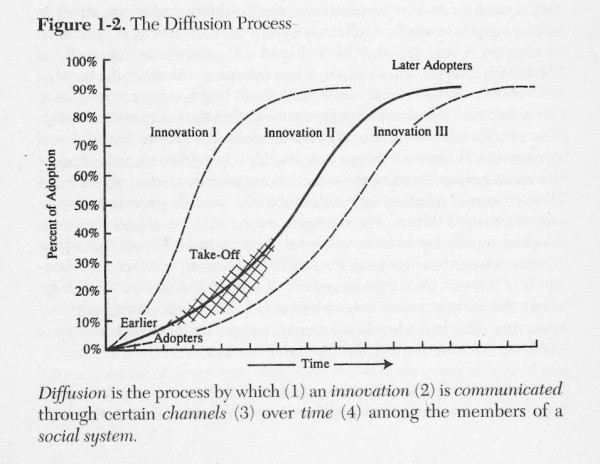
    Source: The Diffusion of Innovations, 5th ed, p. 11
    Source: The Diffusion of Innovations, 5th ed, p. 11

    leading to the categorization of adopters (innovators, early adopters, early majority, late majority, laggards), and the combined technology adoption curve.
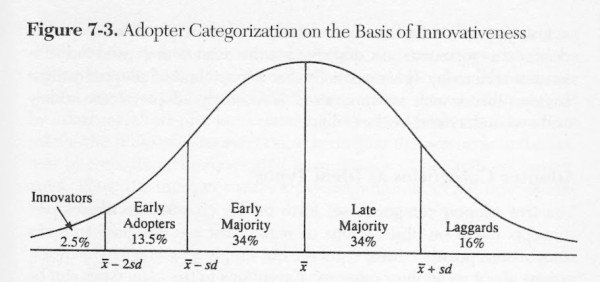
    Source: The Diffusion of Innovations, 5th ed., p. 281
    Source: The Diffusion of Innovations, 5th ed., p. 281

    But Rogers did not set out to describe the diffusion of innovations as an automatic process following a pre-defined path. The real origin of his work was trying to understand why some innovations end up spreading throughout a social group while others do not, somewhat independent of whether the innovation could be thought of as a “good idea”. From the first paragraph of the 5th edition:

    Getting a new idea adopted, even when it has obvious advantages, is difficult. Many innovations require a lengthy period of many years from the time when they become available to the time when they are widely adopted. Therefore, a common problem for many individuals and organizations is how to speed up the rate of diffusion of an innovation.

    Rogers defined diffusion as “a special type of communication in which the messages are about a new idea” (p. 6), and he focused much of the book on the Innovation-Decision Process. This gets to the key point that availability of a new idea is not enough; rather, diffusion is more dependent on the communication and decision-process about whether and how to adopt the new idea. This process is shown below (p. 170):
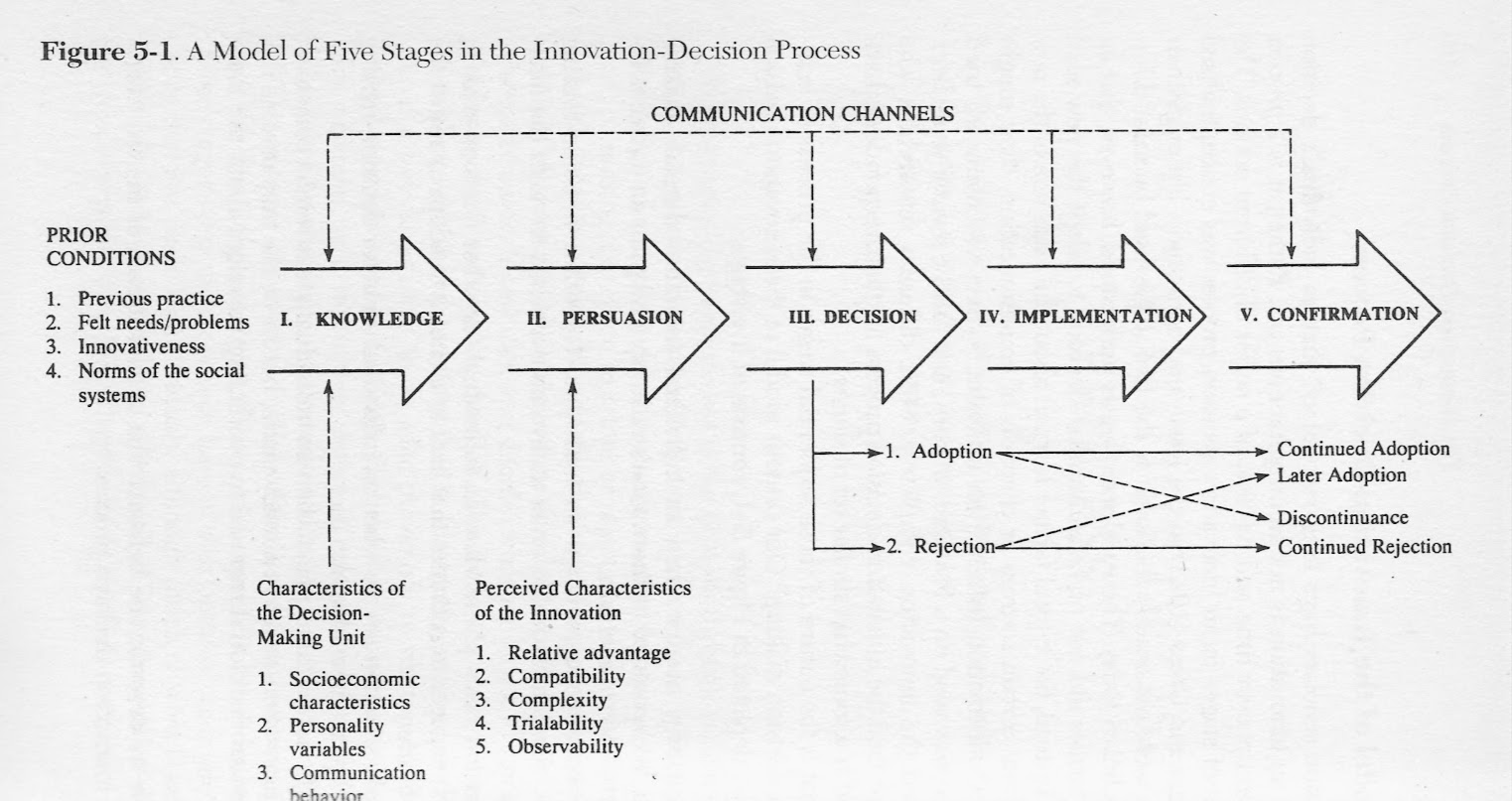
    Source: The Diffusion of Innovations, 5th ed., p. 170
    Source: The Diffusion of Innovations, 5th ed., p. 170

    What we are seeing in ed tech transformation initiatives in most cases, I would argue, is that the new ideas (applications, products, services) are stuck the Persuasion stage. There is knowledge and application amongst some early adopters in small-scale pilots, and there are good motivations in general from transformation groups like ITL and vendors, but majority of educators either have no knowledge of the innovation or are not persuaded that the idea is to their advantage, and there is little support or structure to get the organization at large (i.e. the majority of faculty for a traditional institution, or perhaps for central academic technology organization) to make a considered decision. It’s important to note that in many cases, the innovation should not be spread to the majority, either due to being a poor solution or even due to organizational dynamics based on how the innovation is introduced.

    The Purgatory of Transformation

    This stuck process ends up as an ed tech purgatory – with promises and potential of the heaven of full institutional adoption with meaningful results to follow, but also with the peril of either never getting out of purgatory or outright rejection over time.

    Ed tech innovators can often be too susceptible to being persuaded by simple adoption numbers such as 1,100 institutions or total number of end users (millions served), or by new the promise of ideas that look great on paper, but meaningful adoption within an institution – actually affecting the majority of faculty or courses – is necessary in most cases before there can be any meaningful results beyond anecdotes or marketing stories. The reason for the extended purgatory is most often related to people issues and communications, and the ed tech market (and here I’m including transformation initiatives, vendors, consultants, and campus support staff and faculty) has been very ineffective in dealing with real people at real institutions beyond the initial audience for an idea.

    As Larry Cuban stated in his commentary about Larry Berger’s “confession” that the engineeriomy model of personalized learning is flawed (also covered here at e-Literate):

    First, those confessing their errors about solving school problems seldom looked at previous generations of reformers seeking major changes in schools.They were ahistorical. They thought that they knew better than other very smart people who had earlier sought to solve problems in schooling.

    Second, the confessions seldom go beyond blaming their own flawed thinking (or others who failed to carry out their instructions) and coming to realize the obvious: schooling is far more complex a human institution than they had ever considered.

    Finally, few of these confessions take a step back to not only consider the complexity of schooling and its many moving parts but also the political, social, and economic structures that keep it in place (see Audrey Watters here). As I and many others have said often, schools are political institutions deeply entangled in American society, culture, and democracy. Keeping the macro and micro-perspectives in sight is a must for those seeking major changes in how teachers teach or how schools educate. Were that to occur the incidence of after-the-reform regret might decrease.

    Cover image credit: Ludovico Carracci [Public domain], via Wikimedia Commons
  • ED and CBE: Example of higher ed “structural barrier to change” that is out of institutions’ control

    There has been a great conversation going on in the comments to my recent post “Universities As Innovators That Have Difficulty Adopting Their Own Changes” on too many relevant issues to summarize (really, go read the ongoing comment thread). They mostly center on the institution and faculty reward system, yet those are not the only sources of structural barriers to change that lead institutions to this “difficulty adopting their own changes”. Increasingly there are outside forces that both encourage change and resist change, and it is important to recognize the impact of the entire higher education ecosystem.

    Yesterday Amy Laitinen from New America wrote an excellent article titled “Whatever Happened to the Department’s Competency-Based Education Experiments?” highlighting just such an example.

    About this time two years ago, President Obama went on his college affordability bus tour and unveiled his plan to take on the rising costs of higher education in front of thousands of students at SUNY Buffalo. Promoting innovation and competition was a key part of his plan and President Obama held up competency-based education (CBE) up as one of the “innovative new ways to prepare our students for a 21st century economy and maintain a high level of quality without breaking the bank.” The President touted Southern New Hampshire University’s College for America CBE approach. The university “gives course credit based on how well students master the material, not just on how many hours they spend in the classroom,” he explained. “So the idea would be if you’re learning the material faster, you can finish faster, which means you pay less and you save money.” This earned applause from students in the audience as well as from CBE practitioners around the country. [snip]

    The problem is that day was nearly two years ago and the CBE experimental sites are not yet off the ground. (more…)

  • Universities As Innovators That Have Difficulty Adopting Their Own Changes

    George Siemens made an excellent point in his recent blog post after his White House meeting.

    I’m getting exceptionally irritated with the narrative of higher education is broken and universities haven’t changed. This is one of the most inaccurate pieces of @#%$ floating around in the “disrupt and transform” learning crowd. Universities are exceptional at innovating and changing.

    While I agree with his primary point about false narratives with simplistic no-change assumptions, I think there is a risk about going too far the other direction. Universities have certainly changed, and there are many innovations within universities, but universities are not very good about diffusing the innovations that they do make. I made this same argument here and here. ((The first article had more of a technology focus, but the same applies to the pedagogical side of change.)) Campus changes are apparent, but too often I see innovative course designs showing real results, but courses in the same department remain unchanged.

    In my opinion Universities are exceptional at innovating, but they are not exceptional at changing.
    (more…)

  • Slides and Follow-up From Faculty Development Workshop at Aurora University

    Today I facilitated a faculty development workshop at Aurora University, sponsored by the Center for Excellence in Teaching and Learning and the IT Department. I always enjoy sessions like this, particularly with the ability to focus our discussions squarely on technology in support of teaching and learning. The session was titled “Emerging Trends in Educational Technology and Implications for Faculty”. Below are very rough notes, slides, and a follow-up.

    Apparent Dilemma and Challenge

    Building off of previous presentations at ITC Network, there is an apparent dilemma:

    • One one hand, little has changed: Despite all the hype and investment in ed tech, there is only one new fully-established LMS vendor in the past decade (Canvas), and the top uses of LMS are for course management (rosters, content sharing, grades). Plus the MOOC movement fizzled out, at least for replacing higher ed programs or courses.
    • On the other hand, everything has changed: There are examples of redesigned courses such as Habitable Worlds at ASU that are showing dramatic results in the depth of learning by students.

    The best lens to understand this dilemma is Everett Rogers’ Diffusions of Innovations and the technology adoption curve and categories. Geoffrey Moore extended this work to call out a chasm between Innovators / Early Adopters on the left side (wanting advanced tech, OK with partial solutions they cobble together, pushing the boundary) and Majority / Laggards on the right side (wanting full solution – just make it work, make it reliable, make it intuitive). Whereas Moore described Crossing the Chasm for technology companies (moving from one side to the other), in most cases in education we don’t have that choice. The challenge in education is Straddling the Chasm (a concept I’m developing with a couple of consulting clients as well as observations from e-Literate TV case studies): (more…)

  • On ECAR data and ed tech purgatory

    Recently I wrote a post about many ed tech products being stuck in pilots without large-scale adoption.

    In our consulting work Michael and I often help survey institutions to discover what technologies are being used within courses, and typically the only technologies that are used by a majority of faculty members or in a majority of courses are the following:

    • AV presentation in the classroom;
    • PowerPoint usage in the classroom (obviously connected with the projectors);
    • Learning Management Systems (LMS);
    • Digital content at lower level than a full textbook (through open Internet, library, publishers, other faculty, or OER); and
    • File sharing applications. [snip]

    This stuck process ends up as an ed tech purgatory – with promises and potential of the heaven of full institutional adoption with meaningful results to follow, but also with the peril of either never getting out of purgatory or outright rejection over time.

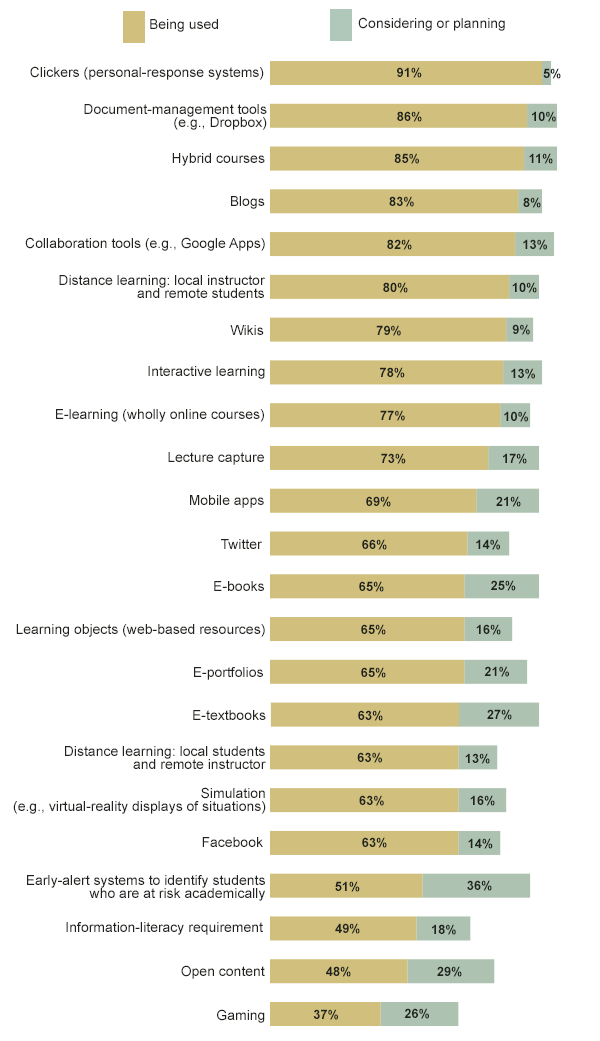
    With the Chronicle’s Almanac coming out this week, there is an interesting chart that on the surface might contradict the above information, showing ~20 technologies with above 50% adoption.

    Note: Data are drawn from responses by a subset of more than 500 of the nearly 800 institutions that participated in a survey conducted from June to October 2013. Reported statistics are either an estimated proportion of the population or an estimated median. Source: Educause Center for Analysis and Research
    Note: Data are drawn from responses by a subset of more than 500 of the nearly 800 institutions that participated in a survey conducted from June to October 2013. Reported statistics are either an estimated proportion of the population or an estimated median.
    Source: Educause Center for Analysis and Research [ECAR]
    The difference, however, is that ECAR (through The Chronicle) asked how many institutions have different ed tech products and our survey asked how many courses within an institution use different ed tech products.

    There are plenty of technologies being piloted but few hitting the mainstream, and adoption within an institution is one of the key indicators to watch.

  • Pilots: Too many ed tech innovations stuck in purgatory

    Steve Kolowich wrote an article yesterday in the Chronicle that described the use of LectureTools, a student engagement and assessment application created by faculty member Perry Sampson at the University Michigan. These two paragraphs jumped out at me.

    The professor has had some success getting his colleagues to try using LectureTools in large introductory courses. In the spring, the software was being used in about 40 classrooms at Michigan, he says.

    Adoption elsewhere has been scattered. In 2012, Mr. Samson sold LectureTools to Echo360 ((Disclosure: Echo360 was a recent client of MindWires)), an education-technology company, which has started marketing it to professors at other universities. The program is being used in at least one classroom at 1,100 institutions, according to Mr. Samson, who has kept his title of chief executive of LectureTools. But only 80 are using the software in 10 or more courses.

    93% of LectureTools clients use the tool for less than 10 courses total, meaning that the vast majority of customers are running pilot projects almost two years after the company was acquired by a larger ed tech vendor.

    We are not running out of ideas in the ed tech market – there are plenty of new products being introduced each year. What we are not seeing, however, are ed tech innovations that go beyond a few pilots in each school. Inside Higher Ed captured this sentiment when quoting a Gallup representative after the GSV+ASU EdInnovations conference this year: (more…)