e-Literate

Present is Prologue

Tag: DOE

  • Ed Tech Evaluation Plan: More problems than I initially thought

    Late last week I described the new plan from the US Department of Education (ED) and their Office of Educational Technology (OET) to “call for better methods for evaluating educational apps”. Essentially the ED is seeking proposals for new ed tech evaluation methods so that they can share the results with schools – helping them evaluate specific applications. My argument [updated DOE to be ED]:

    Ed tech apps by themselves do not “work” in terms of improving academic performance. What “works” are pedagogical innovations and/or student support structure that are often enabled by ed tech apps. Asking if apps works is looking at the question inside out. The real question should be “Do pedagogical innovations or student support structures work, under which conditions, and which technology or apps support these innovations?”. [snip]

    I could see that for certain studies, you could use the ED template and accomplish the same goal inside out (define the conditions as specific pedagogical usage or student support structures), thus giving valuable information. What I fear is that the pervasive assumption embedded in the program setup, asking over and over “does this app work” will prove fatal. You cannot put technology as the center of understanding academic performance.

    Upon further thought as well as prompting from the comments and private notes, this ED plan has even more problems that I initially thought. (more…)

  • US Department of Education: Almost a good idea on ed tech evaluation

    Richard Culatta from the US Department of Education (DOE, ED, never sure of proper acronym) wrote a Medium post today describing a new ED initiative to evaluate ed tech app effectiveness.

    As increasingly more apps and digital tools for education become available, families and teachers are rightly asking how they can know if an app actually lives up to the claims made by its creators. The field of educational technology changes rapidly with apps launched daily; app creators often claim that their technologies are effective when there is no high-quality evidence to support these claims. Every app sounds world-changing in its app store description, but how do we know if an app really makes a difference for teaching and learning?

    He then describes the traditional one-shot studies of the past (control group, control variables, year or so of studies, get results) and notes:

    This traditional approach is appropriate in many circumstances, but just does not work well in the rapidly changing world of educational technology for a variety of reasons.

    The reasons? (more…)

  • About the Diverging Textbook Prices and Student Expenditures

    This is part 3 in this series. Part 1 described the most reliable data on A) how much US college textbook prices are rising and B) how much students actually pay for textbooks, showing that the College Board data is not reliable for either measure. Part 2 provided additional detail on the data source (College Board, NCES, NACS, Student Monitor) and their methodologies. Note that the textbook market is moving into a required course materials market, and in the immediate series I use both terms somewhat interchangeably based on which source I’m quoting. They are largely equivalent, but not identical.

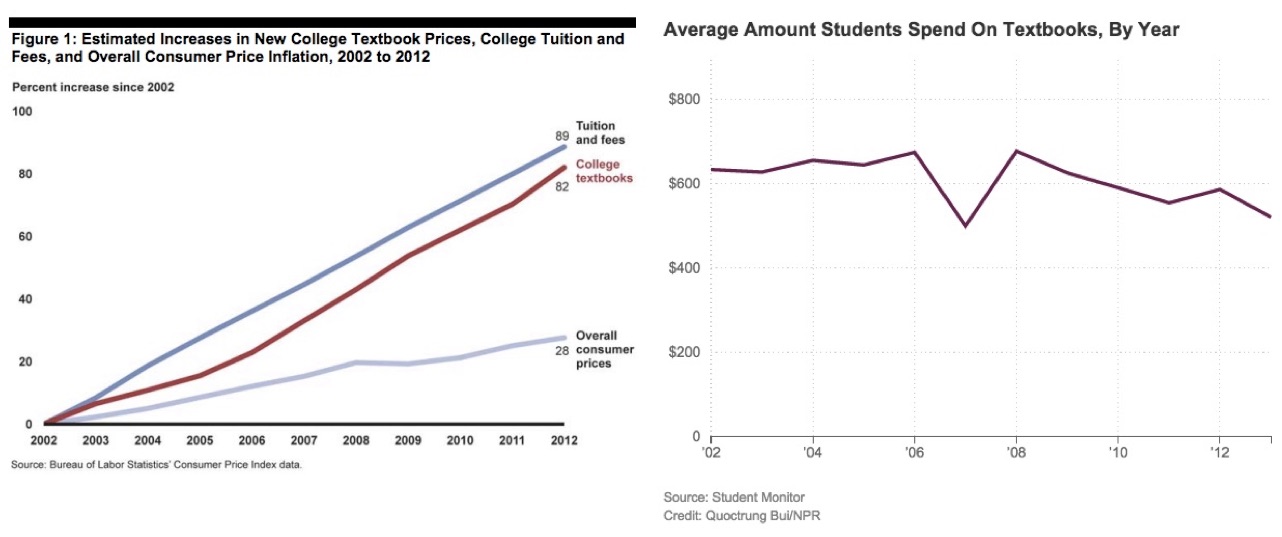
    Based on the most reliable data we have, the average college textbook prices are rising at three times the rate of inflation while average student expenditures on textbooks is remaining flat or even falling, in either case below the rate of inflation. Average student expenditures of approximately $600 per year is about half of what gets commonly reported in the national media. The combined chart comes from this GAO Report (using CPI data) and this NPR report (using Student Monitor data).

    Combined Chart

    Does this indicate a functioning market, and does this indicate that we don’t have a textbook pricing problem? No, and no. (more…)

  • Postscript on Student Textbook Expenditures: More details on data sources

    There has been a fair amount of discussion around my post two days ago about what US postsecondary students actually pay for textbooks.

    The shortest answer is that US college students spend an average of $600 per year on textbooks despite rising retail prices.

    I would not use College Board as a source on this subject, as they do not collect their own data on textbook pricing or expenditures, and they only use budget estimates.

    <wonk> I argued that the two best sources for rising average textbook price are the Bureau of Labor Statistics and the National Association of College Stores (NACS), and when you look at what students actually pay (including rental, non-consumption, etc) the best sources are NACS and Student Monitor. In this post I’ll share more information on the data sources and their methodologies. The purpose is to help people understand what these sources tell us and what they don’t tell us.

    College Board and NPSAS

    My going-in- argument was that the College Board is not a credible source on what students actually pay:

    The College Board is working to help people estimate the total cost of attendance; they are not providing actual source data on textbook costs, nor do they even claim to do so. Reporters and advocates just fail to read the footnotes.

    Both the College Board and National Postsecondary Student Aid Study (NPSAS, official data for the National Center for Education Statistics, or NCES) currently use cost of attendance data created by financial aid offices of each institution, using the category “Books and Supplies”. There is no precise guidance from DOE on the definition of this category, and financial aid offices use very idiosyncratic methods for this budget estimate. Some schools like to maximize the amount of financial aid available to students, so there is motivation to keep this category artificially high. (more…)

  • DOE Doubles Down on State Authorization: 25x increase in regulatory language

    Now that the Kabuki Theatre of the Department of Education’s negotiated rulemaking process has finished its penultimate act, can we all act surprised that the likely result includes the proposed State Authorization regulations growing by a factor of 25 with no comments allowed by one of the groups most affected?

    The gist of State Authorization is to force distance education and correspondence programs to comply not only with their home state regulations but to also comply with regulations for any state of residence for students. The proposed regulations from 2010 (struck down by courts in 2011) came in at 75 words:

    §600.9(c) If an institution is offering postsecondary education through distance or correspondence education to students in a State in which it is not physically located or in which it is otherwise subject to State jurisdiction as determined by the State, the institution must meet any State requirements for it to be legally offering postsecondary distance or correspondence education in that State. An institution must be able to document to the Secretary the State’s approval upon request.

    The most recent submission from DOE comes in at 1,912 words. You can read the full text here. This growth in regulatory language will have real costs. Today the president of Saint Leo College described how much of the administrative bloat in campuses is due to increasing federal regulations.

    Let me be clear, not all of the increases in college tuition and administrative bloat are caused by regulation, but some are—and far more than you think.

    (more…)

  • Proposed State Authorization: Dramatic increase in federal control of distance ed

    The Department of Education (DOE) released their proposed State Authorization regulations this week as part of the negotiated rulemaking process that seeks to replace previous rules struck down by courts in 2011. While the new process is more transparent than before (which was the basis of the court rulings), the proposed rulings would represent a dramatic increase in federal control of distance education and compliance burden for institutions. Greg Ferenbach from Cooley LLP noted these changes in a listserv discussion at WCET [used by permission from author, emphasis added]:

    What I don’t think many folks appreciate … is this proposal would be a huge change from the way things work today. From a quick read, it appears as though the proposal would require all states to authorize distance ed (with no exemptions for accreditation, etc.). Basically, this would be a mandate to either obtain specific state approval or participate in reciprocity as a condition for continuing to offer distance education with federal aid.

    Note that this is quite different from the last rule, which only mandated that you need to meet state requirements, if any, and thus it appears to impose a huge new burden on states and institutions. Think at least double.

    (more…)

  • Postscript on accreditation transparency: Basic financials of two accrediting commissions

    Last week I wrote a post on two significant accrediting actions related to City College of San Francisco and Tiffin University.

    If there really is a shift in the DOE’s views on accreditation or in the accrediting commissions’ interpretation of standards, then that could have fairly profound cascade effects on competency-based learning programs, private online colleges, MOOCs, and online service providers.

    That is also why the lack of transparency from the accrediting commissions is so troubling. They are making decisions that have profound effects on many institutions, not just the specific schools under review.

    Mathieu Plourde asked a good question in the comments.

    Do you know how these accrediting bodies get their funding? If it’s at least in part from government funding or through membership fees from public institutions, I’d say it’s time to make them open up their data.

    While I have not figured out if there is a method to force the accrediting commissions to “open up their data”, I would like to answer the first part of Mathieu’s question on funding.

    Accrediting commissions are designated non-profit organizations, typically designated as 501 (c) (3) by the IRS. This means they have to file annual returns (form 990) to maintain their tax-exempt status. One sight that has this information is the Foundation Center. I’ve pulled up the most recent forms for the  Accrediting Commission for Community and Junior Colleges (ACCJC), responsible for CCSF’s accreditation, and the Higher Learning Commission (HLC), responsible for Tiffin University’s accreditation. Some notes before getting to the data:

    • There are six regional accrediting agencies in the US covering postsecondary education. Each agency has one or two commissions as members that are responsible for the actual accreditation reviews, for a total of eight regional accrediting commissions (New England and Western agencies have two commissions each).
    • ACCJC is part of the Western Association of Schools and Colleges (WASC). Since there are two commissions in WASC, WASC files the form 990 instead of ACCJC. Their most recent form available is for the tax year ending June 30, 2011 (I do not know why the 2012 data is missing).
    • HLC is a member of the North Central Association of Colleges and Schools (NCACS). Since there is only one commission in NCACS, HLC files its own form 990. Their most recent form available is for the tax year ending August 31, 2012.
    • “Membership Dues” covers the fees paid by accredited institutions.
    • “Program Services” combines paid workshops, consulting and annual conference revenues – typically from the member institutions.
    • “Evaluation Visits” are primarily travel and direct expenses for peer review teams visiting institutions during review.

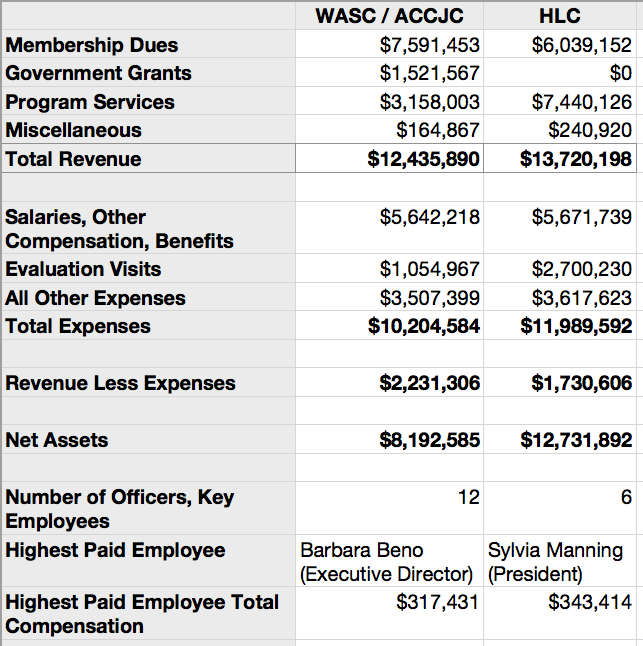
    The actual forms can be found here for WASC / ACCJC and here for HLC . I have combined the most relevant data into one table.
    Form 990


    I went back and forth on whether to highlight the ‘highest paid employee’ data. In the end I chose to include this in the table as it seems relevant in terms of the organization’s motivations for self-preservation. In the case of ACCJC, there have been many charges of conflict-of-interest for the commission members, and the Department of Education has even found that the commission does not have adequate conflict-of-interest policies. The people running accrediting commissions are few in number but make a decent living. There is more information available in the form 990s.

    So, for my long-winded answer to Mathieu: Accrediting commissions get their revenue primarily from membership dues and additional program services from member institutions, many of which are themselves public entities; they also make some revenue directly from government or foundation (e.g. Lumina Foundation, Gates Foundation) grants but not every year.