
e-Literate

Present is Prologue

Tag: ds106

  • Dammit, the LMS

    Count De Monet: I have come on the most urgent of business. It is said that the people are revolting!

    King Louis: You said it; they stink on ice.

    – History of the World, Part I

    Jonathan Rees discovered a post I wrote about the LMS in 2006 and, in doing so, discovered that I was writing about LMSs in 2006. I used to write about the future of the LMS quite a bit. I hardly ever do anymore, mostly because I find the topic to be equal parts boring and depressing. My views on the LMS haven’t really changed in the last decade. And sadly, LMSs themselves haven’t changed all that much either. At least not in the ways that I care about most. At first I thought the problem was that the technology wasn’t there to do what I wanted to do gracefully and cost-effectively. That excuse doesn’t exist anymore. Then, once the technology arrived as Web 2.0 blossomed—remember that term?—I thought the problem was that there was little competition in the LMS market and therefore little reason for LMS providers to change their platforms. That’s not true anymore either. And yet the pace of change is still glacial. I have reluctantly come to the conclusion that the LMS is the way it is because a critical mass of faculty want it to be that way.

    Jonathan seems to think that the LMS will go away soon because faculty can find everything they need on the naked internet. I don’t see that happening any time soon. But the reasons why seem to get lost in the perennial conversations about how the LMS is going to die any day now. As near as I can remember, the LMS has been about to die any day now since at least 2004, which was roughly when I started paying attention to such things.

    And so it comes to pass that, with great reluctance, I take up my pen once more to write about the most dismal of topics: the future of the LMS.
    (more…)

  • Educational Technology and the Sources of Innovation

    Based on Jon Udell’s excellent post, I spent the weekend getting reacquainted with work of Eric von Hippel, the researcher who pioneered the study of user-driven innovation.

    What’s interesting about von Hippel is that his research hits on the common themes of the open education movement, but does so in a slightly different key.

    Briefly, there are a number of intersecting debates about MOOCs. There is what Reich frames as the Dewey/Thorndike debate about what learning is. There is the centralized/de-centralized debate about what the web does best. There is the debate about about whether MOOCs are disruptive or innovative or neither, and the discussion over how much ability to remix teachers need to make classroom learning work well (answer, probably, is quite a bit).

    But people on both sides of the debates are often driven by a larger question that we are not naming directly enough: “What are the sources of innovation?”

    User Innovation

    This is the question that von Hippel has been investigating for over thirty years now. And if we see innovation not as something that has happened, but as something we want to continue to happen, this may be the most important question of all.

    (more…)

  • The IMS’s New “Caliper” Learning Analytics Interoperability Framework Is Deeply Interesting

    The IMS has announced the initial public release of something they call Caliper, which they characterize as a learning analytics interoperability framework. But it’s actually much, much more than that. In fact, it represents the functional core of something that my SUNY colleagues and I used to refer to as a Learning Management Operating System (LMOS), and is something that I have been hoping to see for eight years, because it promises to resolve the tension between the flexibility of lots of  separately developed, specialized learning tools and the value and convenience of an integrated system.

    Let’s take a peek at the framework to see why I’m so hopeful about this framework. But before we do that, you should fasten your seat belts and strap on your aviator goggles. It’s going to get geeky in here.

    (more…)

  • Instructure Steps Up for Open Education

    Friday evening, I wrote in a blog post:

    If you are a large for-profit education company—say, an LMS vendor or a textbook company—give $5,000 to the DS106 Kickstarter project. At that level of contribution, in addition to all the benefits of the lower levels, you’ll get a mention as doing a really swell thing on the fabulous e-Literate weblog.

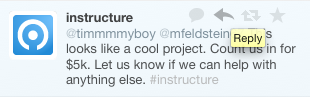
    I’m thrilled to say that it took Instructure less than 24 hours to step up to the plate:

    That is just spectacular. We should all take note of a company that did not hesitate when presented with an opportunity to help out a great grassroots open education project. I very much hope that other education companies will step up to the plate.

    There are a couple of things that I think are particularly praiseworthy about DS106. First, it’s  a course that teaches digital literacy in a way that has proven effective and inspiring for a wide range of students. That’s huge and much needed in and of itself. But I also think that the course presents a replicable model for doing open education on a wide range of topics on a small budget, while teaching students some basic digital literacy through its very structure. Even if the course subject isn’t something like digital storytelling, the DS106 model has each student set up her own blog and participate in a distributed community. If you think that is an unreasonably high barrier, then you probably haven’t set up a blog recently. Having students set up their own web sites, understand how they work at a basic level, and learn what it is like to have a digital space of their own is a good and appropriate set of educational goals for an incredibly broad range of learners.

    You may wonder why making a contribution would be worthwhile, given that the project has already well exceeded its initial funding goal. If you’d like to get a sense of what the DS106 organizers may do with the extra cash, then read Jim’s post about it, including the comments. For me, a common theme jumps out that I find very exciting, and that theme is about making the DS106 model easier and more accessible to a wider range of students and teachers—developing WordPress plugins that make course setup simpler, developing a languages course using the same teaching model, and so on. I would very much like to see a community grow around helping to spread this model, test its limits, and make it more accessible to people who want to do open education across a wide range of subjects.

    That’s why I’m hoping that folks like Ray Henderson, John Baker, Adrian Sannier, and others with significant budgets will step up and add further funding to this project. And, of course, you don’t have to be a captain of industry to make a contribution. You can contribute whatever money you think you can spare as an individual. Remember, DS106 achieved its initial funding goal in less than 24 hours, before Instructure stepped up. Individuals making $5 and $25 contributions did that. Your contribution matters. In fact, one of the lessons of DS106 in general is that you don’t have to have deep pockets and an enterprise IT infrastructure to make a big impact in education. To the degree that large contributors like Instructure are stepping up, it is because they are following your lead. Before smARThistory was “acquired” by Khan Academy, it was funded by contributors like you in a Kickstarter project.

  • Can Enlightenment Scale?

    I had the pleasure of listening to Jim Groom give a keynote speech at the Open Education conference this morning. I generally find listening to Jim equal parts inspiring and frustrating. Inspiring because he has a direct tap into the moral wellspring of passion for education that drew me into education in the first place. Frustrating because Jim (and Gardner Campbell, and other prominent thinkers in the school of thought formerly known as edupunk) and I haven’t seem to be able to find common ground on the meaning or value of the word “scale.” For Jim, I get the sense that scale is synonymous with industrialization. And I can guess why that might be so. If you believe that the essence of education starts with people discovering their own personal dignity, passion, and talents, it seems almost oxymoronic to talk about scaling that. You can’t mass produce personal journeys. I buy that. But I also am painfully aware of the fact that we, the human race, have so far failed to either catalyze that personal journey or provide the basic skills and practical education necessary for material comfort and basic dignity for the substantial majority of people alive on earth today. Heck, we’re failing a very substantial percentage of people alive in the United States today, despite the great wealth of this country. For me, it’s all about Archimedes. I’m looking for a large enough lever to move the world. I want to believe in scale. I need to believe in it.

    And so I came to think of Jim and his friends as gadflies. Irritants, in the best possible sense of the term. Good people who are doing good work and can remind me of important things on occasion, but not the kind of folks who are going to help me find that lever.

    I was wrong. And I should have known better. I had the opportunity to learn this lesson a long time ago.

    (more…)