
e-Literate

Present is Prologue

Tag: e-Literate TV

  • e-Literate TV Case Study Preview: Middlebury College

    As we get closer to the release of the new e-Literate TV series on personalized learning, Phil and I will be posting previews highlighting some of the more interesting segments from the series. Both our preview posts and the series itself start with Middlebury College. When we first talked about the series with its sponsors, the Bill & Melinda Gates Foundation, they agreed to give us the editorial independence to report what we find, whether it is good, bad, or indifferent. And as part of our effort to establish a more objective frame, we started the series by going not to a school that was a Gates Foundation grantee but to the kind of place that Americans probably think of first when they think of a high-quality personalized education outside the context of technology marketing. We decided to go to an elite New England liberal arts college. We wanted to use that ideal as the context for talking about personalizing learning through technology. At the same time, we were curious to find out how technology is changing these schools and their notion of what a personal education is.

    We picked Middlebury because it fit the profile and because we had a good connection through our colleagues at IN THE TELLING. ((Full disclosure: Since filming the case study, Middlebury has become a client of MindWires Consulting, the company that Phil and I run together.)) We really weren’t sure what we would find once we arrived on campus with the cameras. Some of what we found there was not surprising. In a school with a student/teacher ratio of 8.6 to 1, we found strong student/teacher relationships and empowered, creative students. Understandably, we heard concerns that introducing technology into this environment would depersonalize education. But we also heard great dialogues between students and teachers about what “personalized” really means to students who have grown up with the internet. And, somewhat unexpectedly, we saw some signs that the future of educational technology at places like Middlebury College may not be as different from what we’re seeing at public colleges and universities as you might think, as you’ll see in the interview excerpt below.

    Jeff Howarth is an Assistant Professor of Geography at Middlebury. He teaches a very popular survey-level course in Geographic Information Systems (GIS). But it’s really primarily a course about thinking about spaces. As Jeff pointed out to me, we typically provide little to no formal education on spacial reasoning in primary and secondary schooling. So the students walking into his class have a wide range of skills, based primarily on their natural ability to pick them up on their own. This broad heterogeneity is not so different from the wide spread of skills that we saw in the developmental math program at Essex County College in Newark, NJ. Furthermore, the difference between a novice and an expert within a knowledge domain is not just about how many competencies they have racked up. It’s also about how they acquire those competencies. Jeff did his own study of how students learn in his class which confirmed broader educational research showing that novices in a domain tend to start with specific problems and generalize outward, while experts (like professors, but also like more advanced students) tend to start with general principles and apply them to the specific problem at hand. As Jeff pointed out to me, the very structure of the class schedule conspires against serving novice learners in the way that works best for them. Typically, students go to a lecture in which they are given general principles and then are sent to a lab to apply those principles. That order works for students who have enough domain experience to frame specific situations in terms of the general principles but not for the novices who are just beginning to learn what those general principles might even look like.

    When Jeff thought about how to serve the needs of his students, the solution he came up with—partly still a proposal at this point—bears a striking resemblance to the basic design of commercial “personalized learning” courseware. I emphasize that he arrived at this conclusion through his own thought process rather than by imitating commercial offerings. Here’s an excerpt in which he describes deciding to flip his classroom before he had ever even heard of the term:

    In the full ten-minute episode, we hear Jeff talk about his ideas for personalized courseware (although he never uses that term). And in the thirty-minute series, we have a great dialogue between students and faculty as well as some important context setting from the college leadership. The end result is that the Middlebury case study shows us that personalized learning software tools do not just have to be inferior substitutes for the real thing that are only for “other people’s children” while simultaneously reminding us of what a real personal education looks like and what we must be careful not to lose as we bring more technology into the classroom.
  • Upcoming EDUCAUSE Webinars on Dec 4th and Dec 8th

    Michael and I will be participating in two upcoming EDUCAUSE webinars.

    Massive and Open: A Flipped Webinar about What We Are Learning

    On Thursday, December 4th from 1:00–2:00 p.m. ET we will be joined by George Siemens for an EDUCAUSE Live! webinar:

    In 2012, MOOCs burst into public consciousness with course rosters large enough to fill a stadium and grand promises that they would disrupt higher education. Two years later, after some disappointments, setbacks, and not a small amount of schadenfreude, MOOCs seem almost passé. And yet, away from the sound and the fury, researchers and teachers have been busy finding answers to some basic questions: What are MOOCs good for, and what can we learn from them? Phil Hill and Michael Feldstein will talk about what we’re learning so far. (more…)

  • A New e-Literate TV Series is in Production

    We have been quiet about e-Literate TV lately, but it doesn’t mean that we have been idle. In fact, we’ve been hard at work filming our next series. In addition to working with our old friends at IN THE TELLING—naturally—we’re also collaborating with EDUCAUSE Learning Initiative (ELI) and getting funding and support from the Bill & Melinda Gates Foundation.

    As we have discussed both here and elsewhere, we think the term “personalized learning” carries a lot of baggage with it that needs to be unpacked, as does the related concept of “adaptive learning.” The field in general is grappling with these broad concepts and approaches; an exploration of specific examples and implementations should sharpen our collective understandings about the promise and risks of these concepts and approaches. The Gates foundation has funded the development of an ETV series and given us a free editorial hand to explore the topics of personalization and adaptive learning.

    The heart of the series will be a series of case studies at a wide range of different schools. Some of these schools will be Gates Foundation grantees, piloting and studying the use of “personalized learning” technology or product, while others will not. (For more info about some of the pilots that Gates is funding in adaptive learning, including which schools are participating and the evaluation process the foundation has set up to ensure an object review of the results, see Phil’s post about the ALMAP program.) Each ETV case study will start by looking at who the students are at a particular school, what they’re trying to accomplish for themselves, and what they need. In other words who are the “persons” for whom we are trying to “personalize” learning? Hearing from the students directly through video interviews will be a central part of this series. We then take a look at how each school is using technology to support the needs of those particular students. We’re not trying to take a pro- or anti- position on any of these approaches. Rather, we’re trying to understand what personalization means to the people in these different contexts and how they are using tools to help them grapple with it.

    Because many Americans have an idealized notion of what a personalized education means that may or may not resemble what “personalized learning” technologies deliver, we wanted to start the series by looking at that ideal. We filmed our first case study at Middlebury College, an elite New England liberal arts college that has an 8-to-1 student/teacher ratio. They do not use the term “personalized learning” at Middlebury, and some stakeholders there expressed the concern that technology, if introduced carelessly, could depersonalize education for Middlebury students. That said, we heard both students and teachers talk about ways in which even an eight-person seminar can support more powerful and personalized learning through the use of technology.

    The second school on our list was Essex County College in Newark, New Jersey, where we are filming as of this writing (but will be finished by publication time). As you might imagine, the students, their needs, and their goals and aspirations are different, and the school’s approach to supporting them is different. Here again, we’ll be asking students and teachers for their stories and their views rather than imposing ours. We intend to visit a diverse handful of schools, with the goal of releasing a few finished case studies by the end of this year and more early next year.

    With the help of the good folks at ELI, we will also be bringing together a panel at the ELI 2015 conference, consisting of the people from the various case studies to have a conversation about what we can learn about the idea of personalized learning by looking across these various contexts and experiences. This will be a “flipped” panel in the sense that the panelists (and the audience) will have had the opportunity to watch the case study videos before sitting down and talking to each other. The discussion will be filmed and included in the ETV series.

    We’re pretty excited about the series and grateful, as always, to the support of our various partners. We’ll have more to say—and show—soon.

    Stay tuned.

  • New e-Literate TV Series on MOOCs

    hypecycle

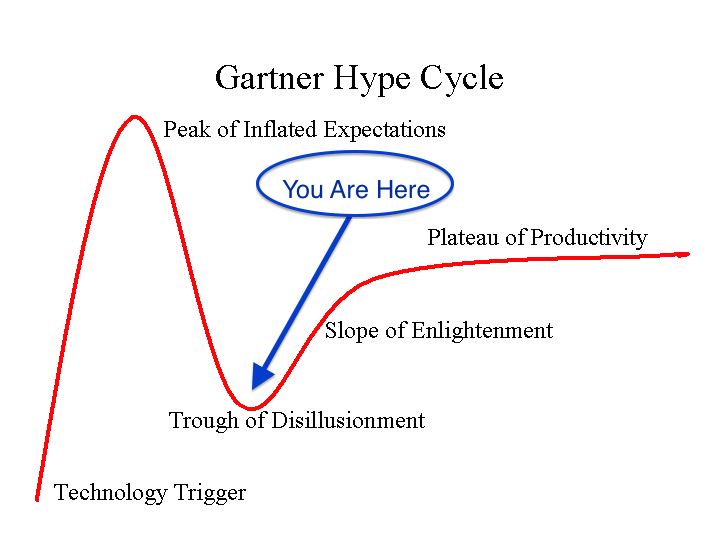
    If 2013 was the year that MOOC mania peaked in the Gartner hype cycle, then surely 2014 is the year in which they have entered the trough of disillusionment. And just as it was important last year to push back on the inflated expectations, it will be equally important this year to make sure we don’t throw out the baby with the bath water.

    With that in mind, I’m pleased to announce our new e-Literate TV series, “Massive and Open: What Are We Learning?” Filmed at the 2013 MOOC Research Initiative (MRI) conference, it delves into the current state of knowledge of the field. The interview with Stanford’s Amy Collier from our pilot series should really be considered Episode Zero for the series, as it explores the value of the first generation of MOOCs (particularly xMOOCs). To that, we have added three episodes from the new series:

    1. MOOC Research Initiative Grant Projects: After a brief introduction with MRI lead researcher George Siemens, Phil and I talk to a number of the grantees about the research they are undertaking. The range of research questions is eye-opening.
    2. MOOC Point/Counterpoint: We intercut interviews between MOOC enthusiast Keith Devlin and MOOC skeptic Jonathan Rees. The result is a rich and nuanced dialog between these two smart guys.
    3. Crowdsourced Answers to Popular MOOC Questions: We got MRI conference attendees to give their answers to frequently asked MOOC questions. The answers are varied and give a good sense of just how much our thinking about MOOCs is still all over the place.

    Enjoy!

  • First-hand experience moving to team-based course design

    As Michael mentioned, we have posted the last episode in the pilot e-Literate TV series with the topic of moving to a team-based course design for a flipped classroom usage. This episode provides an excellent opportunity to hear the first-hand experience of a faculty member going through this transition for the first time. Vanessa Perry of GWU had no real expectations or understanding of what this transition would encompass.

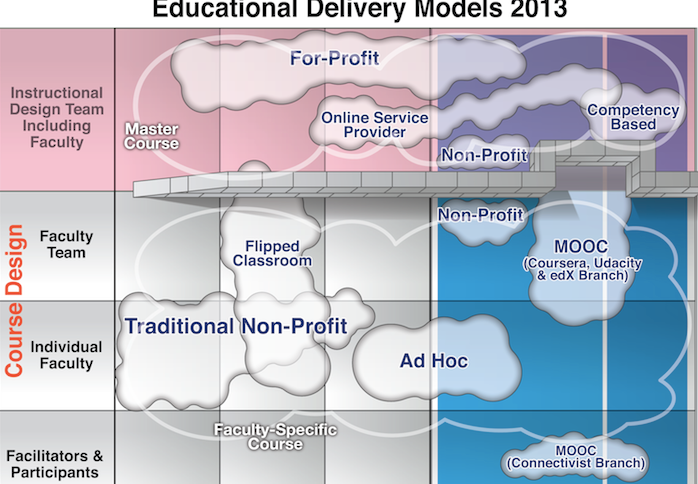
    The adoption of team-based course design presents a cultural barrier for traditional institutions, as shown by a wall in the graphic that was the basis for a 2012 EDUCAUSE Review article.

    The Wall

    Vanessa describes what this barrier, or wall, feels like as you attempt to cross it, as seen in this snippet from the interview (full transcript and video and graphics available at the full episode on e-Literate TV).

    (more…)

  • New e-Literate TV Episode: Flipped Classrooms and Team-based Course Design

    In our final episode of the pilot series, Phil interviews George Washington University Chair and Associate Professor of Marketing Vanessa Perry about her experiences developing a flipped class, with a focus on the team course development effort. Long-time followers of the blog know that Phil and I think the transition to team-based course design is both a major barrier and a major inflection point for institutions moving into digital education.

    Check it out.

  • New e-Literate TV Episode: MOOC Mania

    We have just published our third episode in the first ETV series—an interview with Stanford University’s Amy Collier about MOOCs. As is often the case with these episode, there are lots of different angles we could have taken. This episode is really the answer to a colleague who asks, “What is this thing that Tom Friedman has been talking about?” Amy does a terrific job of delivering a hype (and anti-hype) antidote.

    Take a look.

    We’ll have broader coverage in the full series about MOOCs we’ll be releasing after this current one, developed from the interviews that Phil and I conducted at the MOOC Research Initiative Conference.