The other day, I wrote a post about community-negotiated focus and how we want e-Literate TV to be a kind of “choose your own adventure in ed tech” experience, both for individuals and for campus communities. You can get a sense of how we’re trying to do that in the first series with Phil’s interview of Inside Higher Education Editors Doug Lederman and Scott Jaschik. They talk about the changing landscape of education, why different topics in educational technology come up in the first place, and how the ways in which those topics are raised can have either a positive or a negative impact. This is the anchor episode for the series and is intended to provoke discussion that would lead to the group finding a focus in their collaborative ed tech investigation that’s important to them.
Tag: e-Literate TV
-
e-Literate TV and Community-Negotiated Focus
The goal of e-Literate TV (ETV) is to help school communities develop a working consensus around how they can use learning technologies to achieve important educational goals. For example, we’d like to be able to help schools that are motivated to improve student retention to identify appropriate ways that technology can help them do that. To do that, we have to do more than just provide relevant information. We have to provide it in a structure that encourages a productive culture of conversation and consensus building about these sorts of issues. It’s education as change management.
In order to make ETV useful in that way, we’re developing (inventing? rediscovering?) a number of design principles. The first one, which I’ve written about before, is differentiated engagement. The ways in which deans, advising faculty, non-advising faculty, technology support staff, and other stakeholders need to be involved in a conversation about, for example, adopting a retention early warning system are different, as are the needs and interests of different individuals who have these roles. With the layered, hyper- and transmedia approach that we are able to take with our episodes, we can invite people to participate in the ways and to the degrees that are appropriate for them. We can help them find their zones of proximal curiosity, encouraging them to explore the issues a little further than they might have on their own while also recognizing that each individual is going to have limitations on how much they need or want to know.
A second design principle we’re exploring is what we can call “community-negotiated focus.” Every school community is going to have its own collective zone of interest within a given topic. For example, Berkshire Community College may only be interested in MOOCs in cases where they are being used in an attempt to support remedial students or underserved populations, while Colorado State University Pueblo may be interested in how MOOCs are being used to flip classrooms and related labor issues. Once again, one size does not fit all. Phil’s recent post about our commitment to release the ETV videos under a Creative Commons license is intimately related to our goal of enabling ETV to be a resource that particular academic communities can customize to serve their particular needs.
-
e-Literate TV Interviews from MRI13 Now Available
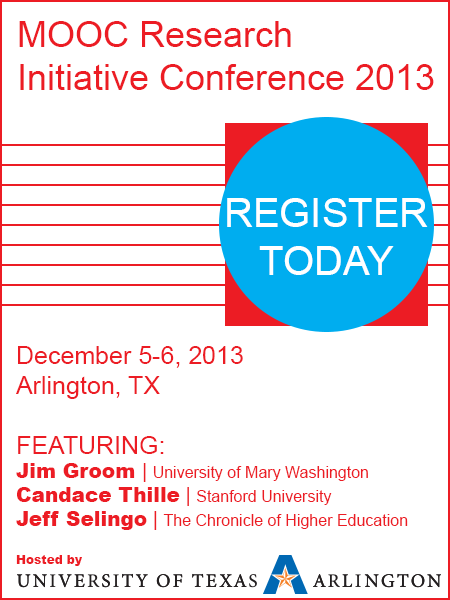
In December 2013 Michael I attended the MOOC Research Initiative Conference (aka #MRI13 or “The greatest MOOC conference in the history of MOOCs”). Thanks to a grant funded by the Gates Foundation through Athabasca University, we are creating three episodes of an upcoming e-Literate TV series based on the conference. We expect to release these episodes in March.
As part of developing material for the episodes, we interviewed a number of research grantees and ed tech luminaries. We had some great guests who spoke about what we have learned from MOOCs, what the potential applications are, what the downsides are, and where open education could and should go in the future. It was a unique opportunity to get so many well-informed people in one place on a common topic.
Today we releasing these videos through the e-Literate TV YouTube channel. These videos all carry a Creative Commons license to facilitate sharing and repurposing of the material.
-
The First e-Literate TV Episode Is Up!
Phil and I are thrilled to announce the release of our pilot e-Literate TV episode.
One thing you’ll want to pay attention to is the set of buttons in the upper left-hand corner of the TELLING STORY player:

These buttons correspond to the three modes available to you. From left to right:
- Watch is a lot like a closed captioned YouTube experience. The focus is on the video.
- Discover still puts a lot of emphasis on the video, but it also will selectively show related links and graphics. If any of them catch your fancy, you can click on them to take a deeper dive.
- Explore mode is for when you want the video to be playing in the background but you’re really focusing on the transcript and the supplementary resources (or “transmedia”).
We’re pretty excited about these capabilities and are eager to hear from you about how they work for you and how you might use them. They look beautiful on tablets, too!
In terms of content, we’re only launching one episode for now because we want to flight test the technology before we put out the full series, but we expect to publish the rest in about two weeks.
This one happens to be just Phil and me, but most of these episodes will be conversations with other people. You can get a good sense of what this will feel like from the videos we shot (with our partners IN THE TELLING) at the MOOC Research conference. These will be both released on their own and incorporated into an e-Literate TV series.
For example, here’s Phil’s interview with Dave Cormier about different kinds of MOOCs and their different uses:
Here’s my interview with Simon Buckingham Shum about how analytics can help us learn more about student learning, both in MOOCs and in other types of online learning experiences:
And here’s my interview with Stanford’s Keith Devlin talking about why he is passionate about MOOCs:
Phil and I will have a lot more to say about ETV in the coming days, and we’re very interested in your feedback. For now, since we’re prompting for a specific feedback question at the end of the episode on the ETV site, please give us your comments on it that aren’t related to the prompt question right here. In the coming days, we intend to add richer and broader discussion capabilities directly to the site.
-
e-Literate TV Update and Request for Help
We are fast approaching the release of our first e-Literate TV (ETV) series. Our latest estimate is that we will go live in mid-February with a collection of interview episodes filmed at EDUCAUSE 2013 covering the following topics:
- An overview of challenges in higher education that are driving conversations about educational technology
- A review of the online learning landscape
- A discussion MOOC mania
- An exploration of the genre of courseware
- A conversation about the basics of learning analytics and adaptive learning
- A review of one faculty member’s experience with classroom flipping
Meanwhile, we are already hard at work on the second series, which will be called “Massive and Open: What Are We Learning?” Filmed primarily at the the MOOC Research Initiative Conference, the series takes a deeper dive into how people are actually using the tools that MOOCs offer in different contexts and discusses their promise as well as their problems. We expect this to be the model for future series, where we explore one topic from a number of angles rather than offering a smorgasbord like the pilot series. We have a long list of topics we’d like to cover in future series, ranging from increasing educational access to personalized learning to the promise and perils of big data in education and more.
With the release of the first series around the corner, Phil and I would like to tell you more about our ideas for ETV and request your feedback and (verbal) support.
-
Massive, Open, and Course Design
Martin Weller has a great blog post up about course design responses to MOOC completion rates. He starts by arguing that, while completion rates are not everything in MOOCs, they are not nothing either. A lot depends on whether you think completion is an important metric to meet the course goals because, for example, the course is designed to help remedial students pass into a non-remedial track, or whether having students explore the content in a non-comprehensive way accomplishes your course goal. (Martin brings up an analogy by Stephen Downes that nobody complains about the low newspaper completion rates, which I have never heard before and which I love.)
This is good stuff, but it starts us down the path toward a more radical re-examination of how we think about course design. Because while Martin is focusing primarily on course goals and how those should determine metrics, he’s beginning to raise the question of how individual learner goals should influence course design. And once you start asking that question, it changes everything.
-
e-Literate TV trailer from EDUCAUSE 2013
Last week Michael announced a new project of ours called e-Literate TV. To recap, the idea is that there are new groups involved in decisions that impact ed tech and online education. Deans, provosts, presidents, boards of trustees, state legislators, and even national media are newly interested in topics with different levels of understanding and different perspectives.
This new situation can be frustrating for e-learning professionals who have been involved in ed tech for years, but we cannot and should not wish away this new interest. Instead, there is an opportunity to develop new ways to engage the various groups in discussions about the usage of technology to enable change in education.
This is the goal of e-Literate TV. One way we see e-Literate TV being used is by e-learning professionals sharing easy-to-consume ~10-minute videos with various stake holders as a method to enable more productive conversations. As such, all of the video segments will come with a creative commons license for easy sharing.
What event is complete without a cool tee shirt?