
e-Literate

Present is Prologue

Tag: Educational Delivery Models

  • APLU Panel: Effects of digital education trends on teaching faculty

    Last week I spoke on a panel at the Association of Public and Land-grant Universities (APLU) annual conference. Below are the slides and abridged notes on the talk.

    It is useful to look across many of the technology-drive trends affecting higher education and ask what that tells about faculty of the future. Distance education (DE) of course is not new, and the first DE course came out in the mid 1800s in a course from London on shorthand. These distance, or often correspondence, course have expanded over time, but with the rise of the Internet online education (today’s version of DE) has been accelerating over the past 20 years to become quite common in our higher education system.
    (more…)

  • First-hand experience moving to team-based course design

    As Michael mentioned, we have posted the last episode in the pilot e-Literate TV series with the topic of moving to a team-based course design for a flipped classroom usage. This episode provides an excellent opportunity to hear the first-hand experience of a faculty member going through this transition for the first time. Vanessa Perry of GWU had no real expectations or understanding of what this transition would encompass.

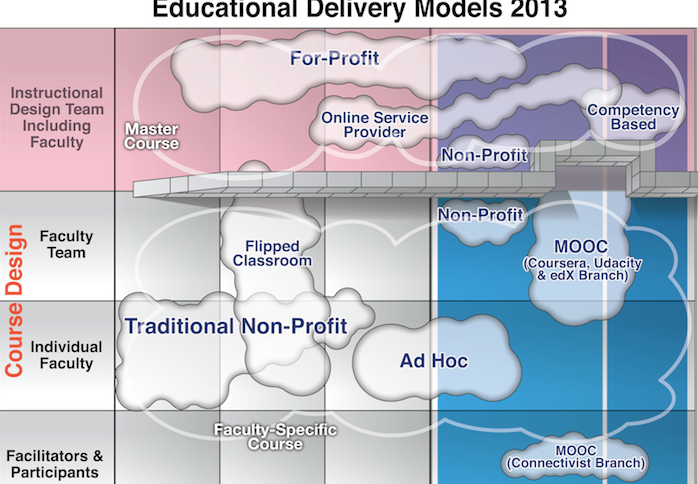
    The adoption of team-based course design presents a cultural barrier for traditional institutions, as shown by a wall in the graphic that was the basis for a 2012 EDUCAUSE Review article.

    The Wall

    Vanessa describes what this barrier, or wall, feels like as you attempt to cross it, as seen in this snippet from the interview (full transcript and video and graphics available at the full episode on e-Literate TV).

    (more…)

  • The Master Course: A Key Difference in Educational Delivery Methods

    In part 1 of this series of posts I presented a view of different educational delivery models based on course design and modality.

    Why does it matter that we describe these educational delivery models with finer granularity than just traditional and online? Because the aims of the models differ, as do the primary methods of how these models are created and delivered.

    To show an example of how the methods differ, let’s look at one of the most significant, but overlooked, concepts in this landscape – the master course. This concept of the master course changes the educational delivery methods of an institution, and in my opinion is the real differentiator between traditional institutions and for-profit institutions (both blended and fully online) and even non-profit fully-online organizations.

    (more…)