e-Literate

Present is Prologue

Tag: EDUCAUSE

  • A Sneak Preview of e-Literate TV at ELI

    Phil and I will be chatting with Malcolm Brown and Veronica Diaz about our upcoming e-Literate TV series on personalized learning in a featured session at ELI tomorrow. We’ll be previewing short segments of video case studies that we’ve done on an elite New England liberal arts college, an urban community college, and large public university. Audience participation in the discussion is definitely encouraged. It will be tomorrow at 11:45 AM in California C for those of you who are here at the conference, and also webcast for those of you registered for the virtual conference.

    We hope to see you there.

  • Upcoming EDUCAUSE Webinars on Dec 4th and Dec 8th

    Michael and I will be participating in two upcoming EDUCAUSE webinars.

    Massive and Open: A Flipped Webinar about What We Are Learning

    On Thursday, December 4th from 1:00–2:00 p.m. ET we will be joined by George Siemens for an EDUCAUSE Live! webinar:

    In 2012, MOOCs burst into public consciousness with course rosters large enough to fill a stadium and grand promises that they would disrupt higher education. Two years later, after some disappointments, setbacks, and not a small amount of schadenfreude, MOOCs seem almost passé. And yet, away from the sound and the fury, researchers and teachers have been busy finding answers to some basic questions: What are MOOCs good for, and what can we learn from them? Phil Hill and Michael Feldstein will talk about what we’re learning so far. (more…)

  • Flipped Classrooms: Annotated list of resources

    I was recently asked by a colleague if I knew of a useful article or two on flipped classrooms – what they are, what they aren’t, and when did they start. I was not looking for any simple advocacy or rejection posts, but explainers that can allow other people to understand the subject and make up their own mind on the value of flipping.

    While I had a few in mind, I put out a bleg on Google+ and got some great responses from Laura Gibbs, George Station, and Bryan Alexander. Once mentioned, Robert Talbert and Michelle Pacansky-Brock jumped into the conversation with additional material. It seemed like a useful exercise to compile the results and share a list here at e-Literate. This list is not meant to be comprehensive, but a top level of the articles that I have found useful.

    There are other useful article out there, but this list is a good starting place for balanced, non-hyped descriptions of the flipped classroom concept. ((I did not include any directly commercial sites or articles in the list above. Michelle’s book was included as the introduction is freely available.)) Let me know in the comments if there are others to include in this list.

  • Competency-Based Education: Not just a drinking game

    Ray Henderson captured the changing trend of the past two EDUCAUSE conferences quite well.

    The drinking game: sure inebriation in 13 from vendor claims of “mooc” “cloud” or “disrupting edu”. In 2014: “competency based.”

    Two years ago, the best-known competency-based education (CBE) initiatives were at Western Governors University (WGU), Southern New Hampshire University’s College for America (CfA), and SUNY’s Excelsior College. In an article this past summer describing the US Department of Education’s focus on CBE, Paul Fain noted [emphasis added]:

    The U.S. Department of Education will give its blessing — and grant federal aid eligibility — to colleges’ experimentation with competency-based education and prior learning assessment.

    On Tuesday the department announced a new round of its “experimental sites” initiative, which waives certain rules for federal aid programs so institutions can test new approaches without losing their aid eligibility. Many colleges may ramp up their experiments with competency-based programs — and sources said more than 350 institutions currently offer or are seeking to create such degree tracks.

    One issue I’ve noticed, however, is that many schools are looking to duplicate the solution of CBE without understanding the the problems and context that allowed WGU, CfA and Excelsior to thrive. By looking at the three main CBE initiatives, it is important to note at least three lessons that are significant factors in their success to date, and these lessons are readily available but perhaps not well-understood.

    Lesson 1: CBE as means to address specific student population

    (more…)

  • Kuali Foundation: Clarification on future proprietary code

    Well that was an interesting session at Educause as described at Inside Higher Ed:

    It took the Kuali leadership 20 minutes to address the elephant in the conference center meeting room.

    “Change is ugly, and change is difficult, and the only difference here is you’re going to see all the ugliness as we go through the change because we’re completely transparent,” said John F. (Barry) Walsh, a strategic adviser for the Kuali Foundation. “We’re not going to hide any difficulty that we run into. That’s the way we operate. It’s definitely a rich environment for people who want to chuck hand grenades. Hey, have a shot — we’re wide open.” [snip]

    Walsh, who has been dubbed the “father of Kuali,” issued that proclamation after a back-and-forth with higher education consultant Phil Hill, who during an early morning session asked the Kuali leadership to clarify which parts of the company’s software would remain open source.

    While the article describes the communication and pushback issues with Kuali’s creation of a for-profit entity quite well (go read the whole article), I think it’s worth digging into what Carl generously describes as a “back-and-forth”. What happened was that there was a slide describing the relicensing of Kuali code as AGPL, and the last bullet caught my attention: (more…)

  • First-hand experience moving to team-based course design

    As Michael mentioned, we have posted the last episode in the pilot e-Literate TV series with the topic of moving to a team-based course design for a flipped classroom usage. This episode provides an excellent opportunity to hear the first-hand experience of a faculty member going through this transition for the first time. Vanessa Perry of GWU had no real expectations or understanding of what this transition would encompass.

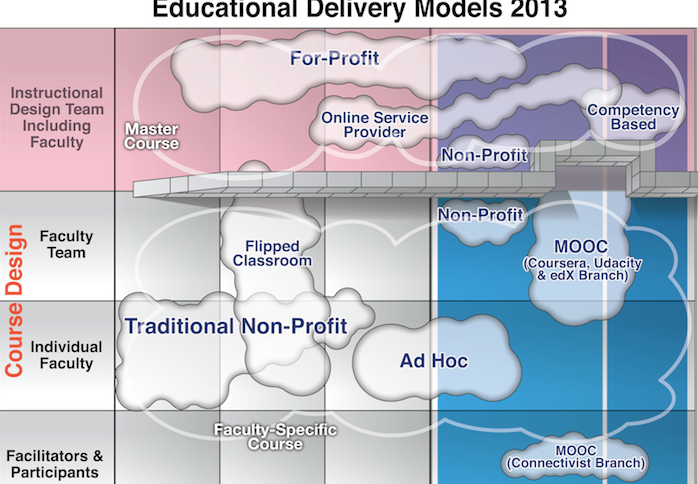
    The adoption of team-based course design presents a cultural barrier for traditional institutions, as shown by a wall in the graphic that was the basis for a 2012 EDUCAUSE Review article.

    The Wall

    Vanessa describes what this barrier, or wall, feels like as you attempt to cross it, as seen in this snippet from the interview (full transcript and video and graphics available at the full episode on e-Literate TV).

    (more…)

  • e-Literate TV trailer from EDUCAUSE 2013

    Last week Michael announced a new project of ours called e-Literate TV. To recap, the idea is that there are new groups involved in decisions that impact ed tech and online education. Deans, provosts, presidents, boards of trustees, state legislators, and even national media are newly interested in topics with different levels of understanding and different perspectives.

    This new situation can be frustrating for e-learning professionals who have been involved in ed tech for years, but we cannot and should not wish away this new interest. Instead, there is an opportunity to develop new ways to engage the various groups in discussions about the usage of technology to enable change in education.

    This is the goal of e-Literate TV. One way we see e-Literate TV being used is by e-learning professionals sharing easy-to-consume ~10-minute videos with various stake holders as a method to enable more productive conversations. As such, all of the video segments will come with a creative commons license for easy sharing.

    What event is complete without a cool tee shirt?
    What event is complete without a cool tee shirt?

    (more…)