Knewton CEO Jose Ferriera has an interesting and revealing blog post up about “the coming adaptive world.” In part, it is a response to a report on adaptive learning by Education Growth Advisors. Jose writes, “Despite our constant protestations to the contrary, observers often confuse Knewton with the many adaptive learning app makers who are now popping up. Or they confuse app makers with platforms. Or they think we’re all competitors.” It’s a bit of a red herring, since the report does distinguish between platform and publisher business models. That said, the meaning of the distinction between these two categories isn’t drawn terribly clearly, and it’s fair for Knewton to try to clarify its market positioning. But in doing so, Jose reveals what appears to be a shift in their thinking about the market for a platform like theirs which tells us something important about the ed tech market in general. (more…)
Tag: edunomics
-
We’re from the Valley and We’re Here to Help
The other week I had the pleasure of attending the annual GSV Advisors Education Innovation Summit in Scottsdale. For those who aren’t aware, the main purpose of the event is to help ed tech startups and investors find each other. After last year’s summit, I wrote a post called “What Are Ed Tech Entrepreneurs Good For?“, the main lessons of which could equally apply to this year:
- The main stage speakers generally tilted to the right, ideologically (although there was a visible effort to achieve more balance this year). But by and large, that didn’t matter, since the important work of the conference was generally driven by what ed tech startups were available for funding.
- Many of the ed tech entrepreneurs have good intentions but varying degrees of knowledge about the theory and pragmatics of education.
- The degree to which ed tech entrepreneurs need that knowledge varies widely depending on the specifics of what problems they are trying to solve with their offerings.
- The success or failure of these startups are often heavily influenced by the market conditions, which means that we should be thinking about things like improving institutional purchasing practices if we want more from our vendorsThe main difference this year was that the conference was roughly twice the size of last year’s.
I’ll have more to say about the dynamism and/or frothiness of the ed tech startup market in a future post. For now, I want to focus on that continuing disconnect between what happens on the main stage of the conference and what happens in the rest of it, because I think there is a lost opportunity. (more…)
-
The 2013 Ed Innovation Return on Education Awards
Well, it’s that time of year again. On April 15th, GSV Advisors‘ annual Education Innovation Conference will kick off. Reactions to the conference last year were a bit of a Rorschach Test, varying greatly depending on the person’s view of the role of venture capital in education in general (as well as whether they were attending the conference physically, watching remotely, or just reading the tweet stream). As I wrote about after last year’s conference in “What Are Ed Tech Entrepreneurs Good For?“, I am in the “cautious but positive” camp about the importance that venture funding could play in education.
Love it or hate it, this year’s conference is going to be bigger than ever. There are going to be 180 companies presenting, which is double the number from the previous year, and the conference organizers predict a 50% increase in attendance when all last-minute and walk-in registrations have been tallied. I will be attending again this year and expect to be able to give more thorough coverage than I was last year, thanks in part to the new freedom that comes from working at MindWires.
Anyway, one of the more interesting features of the conference this year is the Return on Education (ROE) awards. It’s basically a contest to recognize up-and-coming ed tech projects. There is no monetary award, but given that the conference is being heavily attended by education, business, and general news press, the winners can expect a lot of good PR and, likely, a lot of attention from people with money. There is a non-profit category for the awards, so it’s not just limited to start-ups. Projects have to be nominated by attendees, and there are 100 such nominations so far.
Nominees are judged on the following criteria:
- Significantly increase access to education;
- Greatly reduce the cost for learners and/or learning institutions;
- Dramatically improve learning outcomes;
- Provide substantial leverage to learning leaders (teachers, professors); and/or
- Make a sustainable and scaled impact.
The nomination form has fields asking for explanations on how the nominee fits each of these criteria.
Nominations are open until Friday. I’ll be curious to see what kinds of projects get nominated as well as what kinds of projects win.
-
Data Envy
While we have occasionally written about college costs and budgets here at e-Literate, it mostly hasn’t been part of our brief as a site that focuses on technology-mediated education. That is changing, in large part because cost and budgets are increasingly becoming the drivers for change, in California and elsewhere. But I’ve been astonished at how little information seems to be readily available and how little analysis is out in the academic press about even the basics of college and university finances work.
-
Interview with Mitch Kapor
I am delighted to share with you the rare treat of a conversation with famed entrepreneur, investor, and philanthropist Mitch Kapor. Probably best known as the founder of the Lotus Corporation and designer of Lotus 1-2-3, the man is consistently so far ahead of the curve it is not funny. He told me that the major he created for himself in “cybernetics” at Yale in the late 1960s was his attempt to create a cognitive science major before the field was invented. When I was an undergraduate in the late 1980s and wanted to create my own major in cognitive science, my advisor told me, “We don’t know enough about cognitive science yet to make an undergraduate major in it feasible.”
The reason I wanted to talk with Mr. Kapor was to get his take on having educational impact as a guy who is both invested in ed tech startups like Inkling and Piazza as well as an active participant (and founder) of educational foundations. He was kind enough to carve an hour out of his schedule for a delightful, honest, and wide-ranging interview:
-
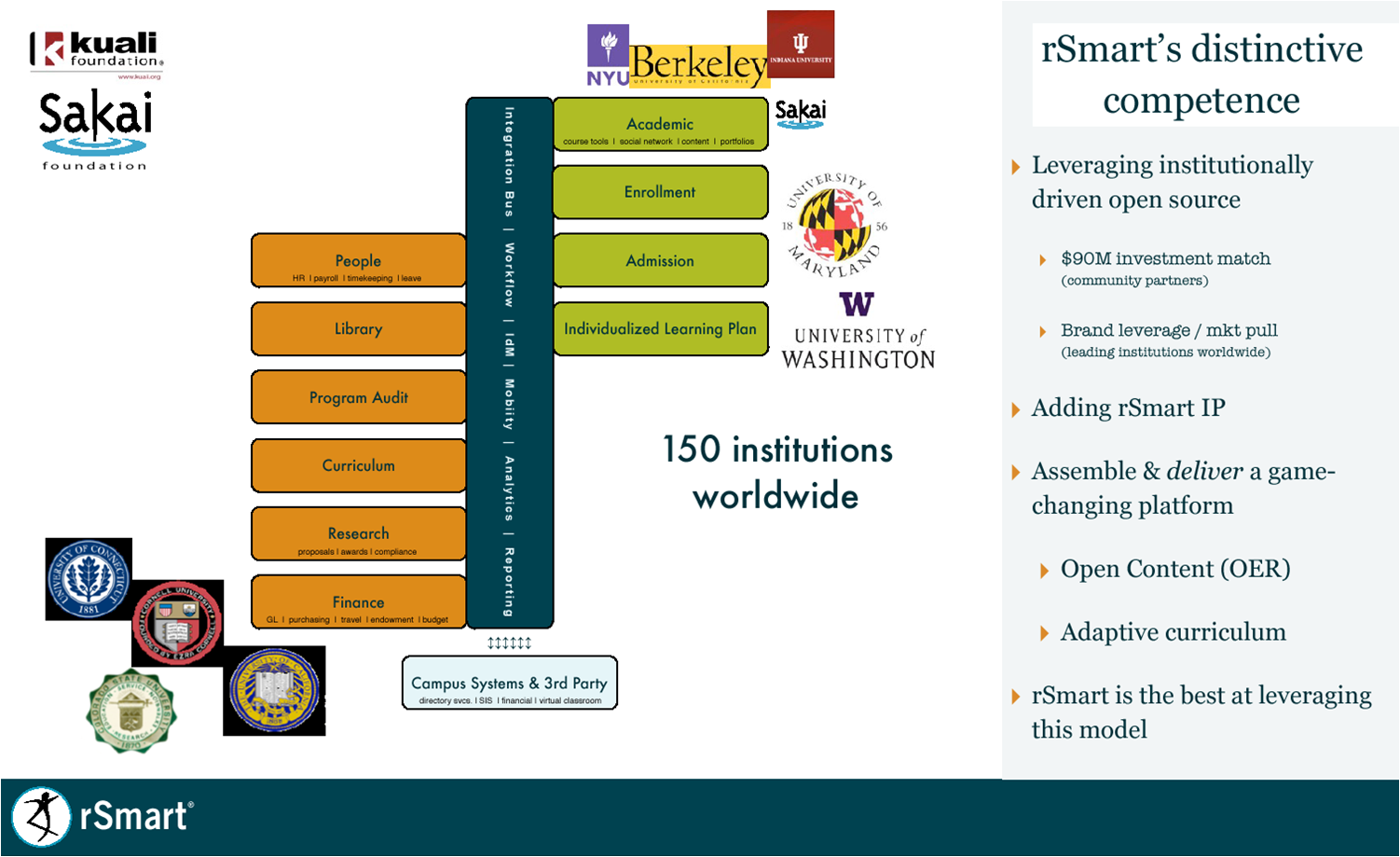
More Venture Capital for Higher Education: $10.75 million for rSmart
 On August 16 rSmart Group Inc. announced securing funding from Asahi Net Inc., GSV Capital Corp., and private investors. GSV investment advisor Michael Moe expressed confidence in the firm saying “rSmart is helping universities realize lower total cost of ownership and higher quality products that are easy to use. Most importantly, rSmart’s customers are becoming part of a sustainable, collaborative movement using solutions built by higher education for higher education. GSV wants to be part of this movement, and rSmart is the company to make it happen.”
rSmart is a more mature and experienced company than the 26 others who presented at the “sold out” April “Education Innovation Summit.” GSV Advisors and Arizona State University hosted the third annual Summit with presentations on innovation and by new companies seeking to enter the education market. (Presentations are available here; rSmart’s presentation is available here and here). rSmart has participated in the Kuali and Sakai open source software initiatives to meet the needs of colleges and universities. Moe lists open source as a major trend in education. rSmart also has had an international presence teaming with Asahi Net Inc. and its U.S. subsidiary in cloud services. rSmart Chairman John Robinson is a visionary with 35 years experience with innovative higher education software technology. rSmart is one of the first to contribute to software architecture that spans both administration and learning using current software design techniques and technology—a goal of the Kuali Foundation.
-
Blackboard’s New Platform Strategy
A few weeks ago, I had the opportunity to attend the BbWorld conference and conduct a private interview with Chief Technology Officer and President of Academic Platforms Ray Henderson. ((As an aside, I did not know that Ray also holds the CTO title until I went to the Blackboard web site to check his title when sitting down to write this post. I don’t know how new that title is.)) What I learned is that the company is embarking on a fairly radical, high-risk/high-reward strategy of re-architecting both their platform and their business model. The implications of what they are attempting are much larger than you might infer from the press releases.