
e-Literate

Present is Prologue

Tag: ERP

  • Some Ed Tech Perspective on UC’s Billion-Dollar Payroll System Fiasco

    Some Ed Tech Perspective on UC’s Billion-Dollar Payroll System Fiasco

    In 2011 the University of California laid out plans for a new payroll system called UCPath (for Payroll, Academic Personnel, Timekeeping, and Human Resources). The goal of the $170 million project was to save a reported $100 million per year eventually and to replace a 30-year-old Payroll Personnel System (PPS) that runs separately for each of the 11 UC locations with Oracle’s PeopleSoft payroll and HR systems. All systems were planned to be live by the end of 2014 and run centrally in a new UCPath processing center.

    In 2014 we described how the project had grown from $170 and 36 months to $220 million and 72 months. In spring of this year we described how the project was planned to cost $504 million and take 93 months (almost five years longer than originally planned).

    A few weeks ago the state auditor released a report claiming that the project would really cost $942 million. The $942 million does not mean that the $504 million estimate has changed since spring, but the auditor does claim that UC is not reporting the full costs of the implementation. From the audit summary on page 1:

    The Office of the President currently projects the implementation cost of UCPath to be $504 million—$334 million over its original estimate of $170 million—and it has delayed the date of UCPath’s implementation by nearly five years, to June 2019. Moreover, the $504 million estimate does not represent the full cost of the project because it includes just a fraction of the cost associated with the campuses’ implementation efforts and a shared services center, known as the UCPath Center. The full cost to the university of adopting UCPath is likely to be at least $942 million.

    Most of this information was available in the spring, but the state auditor makes a compelling, well-documented argument.

    The Worse Part

    However, this is not the big news from the audit. In my 2014 post I commented on Christopher Newfield’s analysis at Remaking the University on the claimed benefits from the project:

    What about the current estimate of benefits – is it $30 million per year as Chris described or closer to $100 million per year? One big concern I have is that the information on project benefits was not updated, presented to the regents, or asked by the regents.

    Well it turns out that was exactly the problem based on this finding from the audit:

    The Office of the President’s initial business case in 2011 asserted that UCPath would result in $753 million in cost savings, primarily from staffing reductions at the campuses. However, the UCPath project director told us that the Office of the President no longer expects to realize those projected savings. Several campuses also reported to us that they do not anticipate the staff reductions that the 2011 business case promised. In fact, in a status update to the University of California Board of Regents (regents) in July 2017, the Office of the President did not discuss any offsetting savings but rather discussed creating efficiencies and avoiding costs.

    You read that right. The $753 million in savings that was the basis for the project is not going to materialize. There clearly was a need to replace 30 year old systems, but the justification for the UCPath project and its specific approach was based on large staff cuts to be achieved by centralizing payroll for all 10 universities in the system. To get the true scale of the cost impacts of this project, look at this helpful chart from page 16 of the audit (note the $504 million in top right – that is the cost claimed by UC):
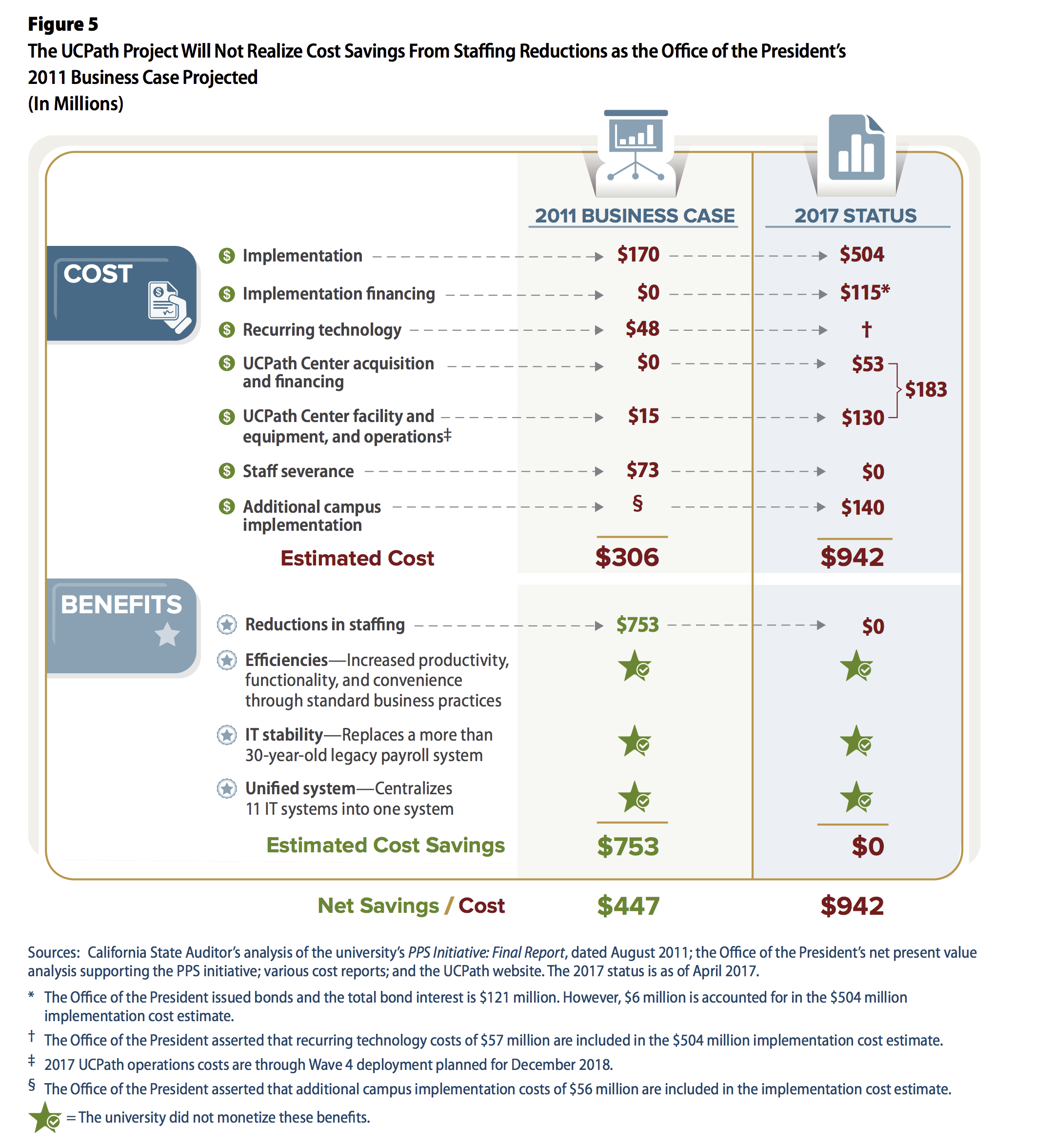
    What this means is that the net savings / cost have changed by almost $1.4 billion. Let that sink in. Billion with a ‘b’.

    UC Response

    The University of California Office of the President (UCOP) responded to the audit both formally in the audit report itself and informally through media statements. The official UCOP statement starting on page 35 of the audit mostly notes that President Napolitano was not at UC when UCPath started, that this is a necessary and complex project, claims they have already made improvements, and it disputes some of the specific recommendations as being heavy-handed. But at no point does UCOP dispute the findings. What is most problematic is the emphatic claim at the end:

    I have complete confidence in UC’s ability to continue successful implementation of UCPath, a necessary project with significant, expansive, and long-term benefits to the University.

    There is no serious re-questioning of assumptions or of UC’s ability to finish the job, despite plenty of evidence pointing to fundamental problems in the project.

    The UC response in the UCLA paper is even more problematic, as it mostly argues that the implementation only costs $504 million many other items are operational in nature.

    Claire Doan, a UC Office of the President spokesperson, said the state audit includes additional costs that should not contribute to the overall cost estimate. [snip]

    The UCPath Center will assume all payroll and human resources functions systemwide, according to the state audit. Doan added the UC believes the $130 million the state audit cited for the center’s operating cost should be included in the project’s operations budget, rather than its implementation budget, because the UC does not typically include operating expenses in project implementation costs.

    In other words, UCOP is complaining about accounting methods while not disputing the findings. UCOP wants to just look at IT implementation costs, while the state auditor is looking at “the full cost to the university of adopting UCPath”.

    Some Perspective

    We here at e-Literate are focused more on ed tech – the impact of changes to teaching and learning enabled by technology. So it might help to add some ed tech perspective on this story.

    Taking the well-grounded assumption that the project, or some form of it, was necessary, and making the assumption that UC’s original plan made some sense ($170 million for IT implementation), let’s look just at the impact of cost overruns.

    • Using the UCOP argument, the IT implementation cost overrun is currently $334 million
    • Using the state auditor argument, the total UCPath cost overrun is currently $636 million
    • Adding in the disappearance of planned savings, the change in savings / cost is almost $1.4 billion

    Keep in mind that much of the project is funded by a 20-year bond. Some comparisons using that time frame (we’ll factor in inflation and cost increases by adding 1.5x for a range):

    • Based on typical UC campus costs and extrapolating, the cost of providing an LMS for every UC campus for 20 years is likely $66 – $99 million
    • Using EDUCAUSE Core Data of $96 – $110 per student median spend in the US, the costs of centralized instructional technology support of all applications and services for every UC campus for 20 years is likely $500 –  $850 million

    The fallout from UCPath’s cost overruns and loss of planned savings likely exceeds the entire combined instructional technology budget for all 10 UC campuses. This project matters.

  • University of California’s Payroll Project Reboot Now At $504 Million

    University of California’s Payroll Project Reboot Now At $504 Million

    In July 2014 I wrote about the University of California’s project to update its payroll & HR systems to Peoplesoft systems and how the project had ballooned out of scope. The goal of the $156 million project was to save a reported $100 million per year eventually and to replace a 30-year-old Payroll Personnel System (PPS) that runs separately for each of the 11 UC locations with Oracle’s PeopleSoft payroll and HR systems. All systems were planned to be live by the end of 2014.

    At the time, I quoted Christopher Newfield at Remaking the University with this summary:

    The project timeline has grown from 48 to 72 months, and its costs are said to be $220 million (it had spent $131 million by May 2014) . Worse, the repayment schedule has mushroomed from seven to twenty years.

    Well, those were the good old days it appears. The project has now grown to more than half a billion dollars (estimates) according to the Sacramento Bee. The project is now four years behind schedule. (more…)

  • In Which I (Partially) Disagree with Richard Stallman on Kuali’s AGPL Usage

    Since Michael is making this ‘follow-up blog post’ week, I guess I should jump in.

    In my latest post on Kuali and the usage of the AGPL license, the key argument is that this license choice is key to understanding the Kuali 2.0 strategy – protecting KualiCo as a new for-profit entity in their future work to develop multi-tenant cloud hosting code.

    What I have found interesting is that in most of my conversations with Kuali community people ,even for those who are disillusioned, they seem to think the KualiCo creation makes some sense. The real frustration and pushback has been on how decisions are made, how decisions have been communicated, and how the AGPL license choice will affect the community.

    In the comments, Richard Stallman chimed in.

    As the author of the GNU General Public License and the GNU Affero General Public License, and the inventor of copyleft, I would like to clear up a possible misunderstanding that could come from the following sentence:

    “Any school or Kuali vendor, however, that develops its own multi-tenant cloud-hosting code would have to relicense and share this code publicly as open source.”

    First of all, thinking about “open source” will give you the wrong idea about the reasons why the GNU AGPL and the GNU GPL work as they do. To see the logic, you should think of them as free software licenses; more specifically, as free software licenses with copyleft. (more…)

  • Kuali, Ariah and Apereo: Emerging ed tech debate on open source license types

    With the annual Kuali conference – Kuali Days – starting today in Indianapolis, the big topic should be the August decision to move from a community source to a professional open source model, moving key development to a commercial entity, the newly-formed KualiCo. Now there will be two new announcements for the community to discuss, both centering on a esoteric license choice that could have far-reaching implications. Both the announcement of the Ariah Group as a new organization to support Kuali products and the statement from the Apereo Foundation center on the difference between Apache-style and AGPL licenses.

    AGPL and Vendor Protection

    Kuali previously licensed its open source code as Educational Community License (ECL), a derivative of the standard Apache license that is designed to be permissive in terms of allowing organizations to contribute modified open source code while mixing with code with different licenses – including proprietary. This license is ‘permissive’ in the sense that the derived, remixed code may be licensed in different manners. It is generally thought that this license type gives the most flexibility for developing a community of contributors.

    (more…)

  • Kuali Student Sunsetting $40 million project, moving to KualiCo

    The changes with Kuali are accelerating, and there are some big updates on the strategy.

    Earlier this week the Kuali Foundation distributed an Information Update obtained by e-Literate on many of the details of the transition to Kuali 2.0 and the addition of the for-profit KualiCo. Some of the key clarifications:

    • KualiCo will be an independent C Corporation with a board of directors. KualiCo will not be a subsidiary of Kuali Foundation. Capital structure, equity allocations, and business plans are confidential and will not be shared publicly for the same reasons these things are rarely shared by private companies. The board of directors will start out with three members and will move to five or seven over time. Directors will include the CEO and an equal number of educational administrators and outside directors. One of the educational administrators will be appointed by the Kuali Foundation. Outside directors will be compensated with equity. Educational administrators will not be compensated in any way and could only serve as a director with the explicit permission of their university administration with attention to all relevant institutional policies.
    • KualiCo’s only initial equity investor is the Kuali Foundation. The Kuali Foundation will invest up to $2M from the Foundation’s cash reserves. [snip] For its equity investment, the Kuali Foundation will have the right to designate a director on the KualiCo Board of Directors. The Kuali Foundation, through its director, will have an exceptional veto right to block the sale of the company, an IPO of the company or a change to the open source license. This helps ensure that KualiCo will stay focused on marketplace-winning products and services rather than on flipping the company on Wall Street.
    • The Kuali Foundation is not licensing the Kuali software code for Kuali products to KualiCo as Kuali software is already fully open source and could be used by anyone for any purpose — as is already being done today. No license transfer or grant is needed by KualiCo or anyone else.
    • The copyright for the AGPL3 software will be copyright KualiCo for the open source distribution that is available to everyone. It would very quickly become untenable to even try to manage multiple copyright lines as various sections of code evolve through the natural enhancement processes of an open source community.

    (more…)

  • Kuali Foundation: Clarification on future proprietary code

    Well that was an interesting session at Educause as described at Inside Higher Ed:

    It took the Kuali leadership 20 minutes to address the elephant in the conference center meeting room.

    “Change is ugly, and change is difficult, and the only difference here is you’re going to see all the ugliness as we go through the change because we’re completely transparent,” said John F. (Barry) Walsh, a strategic adviser for the Kuali Foundation. “We’re not going to hide any difficulty that we run into. That’s the way we operate. It’s definitely a rich environment for people who want to chuck hand grenades. Hey, have a shot — we’re wide open.” [snip]

    Walsh, who has been dubbed the “father of Kuali,” issued that proclamation after a back-and-forth with higher education consultant Phil Hill, who during an early morning session asked the Kuali leadership to clarify which parts of the company’s software would remain open source.

    While the article describes the communication and pushback issues with Kuali’s creation of a for-profit entity quite well (go read the whole article), I think it’s worth digging into what Carl generously describes as a “back-and-forth”. What happened was that there was a slide describing the relicensing of Kuali code as AGPL, and the last bullet caught my attention: (more…)

  • Kuali For-Profit: Change is an indicator of bigger issues

    On Friday the Kuali Foundation announced the creation of a new for-profit entity to be led by the former CTO of Instructure, Joel Dehlin. Jeff Young at the Chronicle described the change:

    Ten years ago, a group of universities started a collaborative software project touted as an alternative to commercial software companies, which were criticized as too costly. On Friday the project’s leaders made a surprising announcement: that it would essentially become a commercial entity. [snip]

    The Kuali Foundation will continue to exist as a non-profit, but it will be an investor in a new commercial entity to back the Kuali software development. Leaders insisted that they would maintain the values of the project despite creating the kind of organization that they once criticized. For one thing, the source software will remain free and open, but the company will sell services, like software hosting. On Friday the group issued an FAQ with details about the change.

    As Carl Straumsheim put it at Inside Higher Ed:

    The Kuali Foundation, after a decade of fighting commercial software vendors as a community source initiative, will launch a commercial company to better fight… commercial software vendors.

    Despite the positioning that this change is about innovating into the next decade, there is much more to this change than might be apparent on the surface. The creation of a for-profit entity to “lead the development and ongoing support” and to enable “an additional path for investment to accelerate existing and create new Kuali products fundamentally moves Kuali away from the community source model. Member institutions will no longer have voting rights for Kuali projects but will instead be able to “sit on customer councils and will give feedback about design and priority”. Given such a transformative change to the underlying model, there are some big questions to address.

    Financial Needs

    Kuali, being a non-profit foundation, has its financial records available online, and the tax reporting form 990s are easily obtained through sites such as GuideStar. Furthermore, instructional media + magic (im+m) has a public eLibrary where they have shared Kuali documentation over the years. ((Disclosure: Jim Farmer from im+m has been a guest blogger at e-Literate for many years.)) There does not appear to be a smoking gun found in the financials to directly explain the need for such a significant change, but there are hints of issues that provide some insight. (more…)