
e-Literate

Present is Prologue

Tag: Flipped Classroom

  • Teaching Using Adaptive Learning

    The entire six-part interview series with McGraw-Hill Education’s adaptive learning experts is now up on YouTube. (Full disclosure: In the months between the filming and the publication of these videos, McGraw-Hill became a client of MindWires.) Here’s a good segment on teaching:

    (https://www.youtube.com/watch?v=gSqoc6Y_4No)

    The first example Matt Haldeman gives is a math class, which is where we see adaptive learning used the most. The interesting part of it is how he describes the change in the teacher’s classroom activities. This is a critical aspect this often isn’t picked up when these products are used in higher ed math classes—particularly outside of developmental math.

    The second example is a history class, which is a less (stereo)typical example. The focus is on class preparation. In other words, the adaptive platform helps students come to class knowing what you hope they’ll know but often haven’t really absorbed from a reading assignment that is meant to give them the raw materials they need for an interesting class discussion on a topic.

    Here’s the whole series, if you want to all six segments in order:

    (https://www.youtube.com/watch?v=N6aYR0uCe9o&list=PLb2UcU-aVjN2aPSmGKILK2GHh6MgGswM9)
  • Explainer Video on Flipped Class, Learning Analytics, and Adaptive Learning

    We now have the second of our personalized learning explainer videos out. As a reminder, here’s the first one, which reframes personalized learning as a set of approaches for addressing the teaching problems of reaching hard-to-reach students:

    (https://youtu.be/8wDw33NLuT0)

    The new one starts to talk about the how, giving flipped class, learning analytics, and adaptive learning as examples of tools or approaches that can help teachers reach those hard-to-reach students:

    (https://youtu.be/USAHX56lWqE)

    Some folks continue to be confused about just how these things are supposed to help. We described some of our thinking in our original post on the first explainer and our recent piece in Inside Higher Ed. We are well aware of a number of hard limits on what we can accomplish, including but not limited to the following:

    • A couple of 3-minute videos are not going to change the world all by themselves.
    • The levers and barriers for change are different at different institutions.
    • Vendors are going to be out selling, the press is going to be out hyping, and institutional stakeholders are going to be looking for silver bullets no matter what.

    But we also find ourselves in the fortunate position of having some credibility with academic administrators, ed tech advocates, and vendors. If we can help our readers to nudge the inevitable and already ongoing conversations about courseware products in a more healthy direction, away from robot tutors in the sky and toward enabling teaching practices that reach more students, that would be a good thing. We’re creating these explainers as tools that can be used by any of the parties to those conversations to reframe the discussion. If we’re lucky, we’ll influence the ways in which the vendors pitch these products in the first place while also preparing educators to take advantage of the different pitch to ask more educationally relevant questions and nudge the procurement process in a healthier direction. We won’t always be so lucky. But we won’t always be unlucky either. A lot comes down to each of you and what you can accomplish in your respective contexts. We’re just trying to give you a few more tools to work with. You’re the change agents.

  • Flipped Classrooms: Annotated list of resources

    I was recently asked by a colleague if I knew of a useful article or two on flipped classrooms – what they are, what they aren’t, and when did they start. I was not looking for any simple advocacy or rejection posts, but explainers that can allow other people to understand the subject and make up their own mind on the value of flipping.

    While I had a few in mind, I put out a bleg on Google+ and got some great responses from Laura Gibbs, George Station, and Bryan Alexander. Once mentioned, Robert Talbert and Michelle Pacansky-Brock jumped into the conversation with additional material. It seemed like a useful exercise to compile the results and share a list here at e-Literate. This list is not meant to be comprehensive, but a top level of the articles that I have found useful.

    There are other useful article out there, but this list is a good starting place for balanced, non-hyped descriptions of the flipped classroom concept. ((I did not include any directly commercial sites or articles in the list above. Michelle’s book was included as the introduction is freely available.)) Let me know in the comments if there are others to include in this list.

  • First-hand experience moving to team-based course design

    As Michael mentioned, we have posted the last episode in the pilot e-Literate TV series with the topic of moving to a team-based course design for a flipped classroom usage. This episode provides an excellent opportunity to hear the first-hand experience of a faculty member going through this transition for the first time. Vanessa Perry of GWU had no real expectations or understanding of what this transition would encompass.

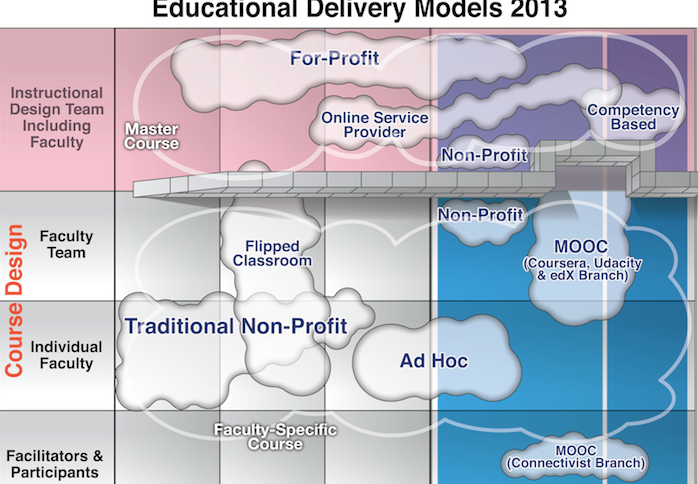
    The adoption of team-based course design presents a cultural barrier for traditional institutions, as shown by a wall in the graphic that was the basis for a 2012 EDUCAUSE Review article.

    The Wall

    Vanessa describes what this barrier, or wall, feels like as you attempt to cross it, as seen in this snippet from the interview (full transcript and video and graphics available at the full episode on e-Literate TV).

    (more…)

  • New e-Literate TV Episode: Flipped Classrooms and Team-based Course Design

    In our final episode of the pilot series, Phil interviews George Washington University Chair and Associate Professor of Marketing Vanessa Perry about her experiences developing a flipped class, with a focus on the team course development effort. Long-time followers of the blog know that Phil and I think the transition to team-based course design is both a major barrier and a major inflection point for institutions moving into digital education.

    Check it out.

  • Comment from member of research team on USA Today flipped classroom article

    Update 10/26: We now have Rachel Levy and Nancy Lape (who was the researcher interviewed by USA Today) both agreeing with Darryl’s comments. That’s three of the four members of the research team. While I do not claim to understand how the reporter developed her story line (I have asked for comment), it is quite clear that the article does not represent the work of the Harvey Mudd research team and has a misleading headline and lede.

    As a follow up to my response to the USA Today article on flipped classroom research, there was a very informative comment one Google+ from Darryl Yong (one of the members of the Harvey Mudd research team). I thought this comment deserved to be seen by a wider audience, so I’m reproducing in full.

    Thanks, Phil, for this post. The USA Today article paints an inaccurate picture of our work and I wanted to try to clarify some things and continue this conversation with you and your readers. (I am only writing on my own behalf and not for my collaborators on this study.)

    My biggest regret is that the article greatly oversimplifies things by portraying our study as an attempt to answer whether flipped classrooms work or not. That kind of research question is too blunt to be useful. Our goal is to better understand the conditions under which flipped classrooms lead to better student outcomes. As Phil and others here point out, there are many different manifestations of what we mean by the term “flipped classroom” and that we should be wary about talking about it as if there is one canonical implementation. How are the benefits of flipped classrooms affected by school and student contexts, and are there other benefits that we haven’t yet characterized? We don’t have any preconceived answers to these research questions. While folks might disagree with us whether these research questions are interesting or not, they should at least know that we’re aware of the good work that others have already done and we’re trying to build on it rather than debunk it.

    (more…)

  • A response to USA Today article on Flipped Classroom research

    Update 10/25: Bumped comment from Darryl Yong, a member of the research team, into its own post here.

    Update 10/26: We now have Rachel Levy and Nancy Lape (who was the researcher interviewed by USA Today) both agreeing with Darryl’s comments. That’s three of the four members of the research team. While I do not claim to understand how the reporter developed her story line (I have asked for comment), it is quite clear that the article does not represent the work of the Harvey Mudd research team and has a misleading headline and lede.

    USA Today published an article today titled “‘Flipped classrooms’ may not have any impact on learning“, based on research from four Harvey Mudd professors. This research is backed by a “$199,544 grant from the National Science Foundation to study the effects of the flipped classroom on students’ learning”. This is newsworthy, right? A real research report with NSF funding finding no statistical difference in learning outcomes from flipped classroom seems to contradict much of the recent promise of ed tech.

    Upon closer reading, however, there are some major problems with the story. Exaggerated claims by ed tech enthusiasts are not helpful, but neither are exaggerated claims by ed tech skeptics. We at e-Literate have been critical of both flavors (witness our analysis of San Jose State claims, Desire2Learn claims, and edX claims for examples of the former).

    Let’s review today’s story as an example of the latter.

    In a flipped classroom, students watch their professors’ lectures online before class, while spending class time working on hands-on, “real world” problems.

    The potential of the model has many educators thrilled — it could be the end of vast lecture halls, students falling asleep and boring, monotone professors.

    This is a decent summary, although I would argue there should not be a one-size-fits-all mentality. Flipped classrooms, even where successful, should not replace all lecture-based classes. But for national media, this is not a bad description.

    But four professors at Harvey Mudd College in Claremont, Calif. who are studying the effectiveness of a flipped classroom have bad news for advocates of the trend: it might not make any difference.

    This is the lede, and the claim that we should examine. What is the basis of their study?

    (more…)