e-Literate

Present is Prologue

Tag: Gates Foundation

  • Instructor Replacement vs. Instructor Role Change

    Two weeks ago I wrote a post about faculty members’ perspective on student-centered pacing within a course. What about the changing role of faculty members – how do their lives change with some of the personalized learning approaches?

    In the video below, I spoke with Sue McClure, who teaches a redesigned remedial math course at Arizona State University (ASU) that is based on the use of Khan Academy videos. There are plenty of questions about whether this approach works and is sustainable, but for now let’s just get a first-hand view of how Sue’s role changed in this specific course. You’ll see that it took some prodding to get her to talk about her personal experience, and I did have to reflect back what I was hearing. Note that the “coaches” she described are teaching assistants.

    (more…)

  • Pilots? We don’t need no stinkin’ pilots!

    Timothy Harfield commented on Arizona State University’s approach to pilots and scaling innovation at ASU.

    excellent comment on the problem of scaling innovation in #HigherEd. This is a central concern for @UIAinnovation.

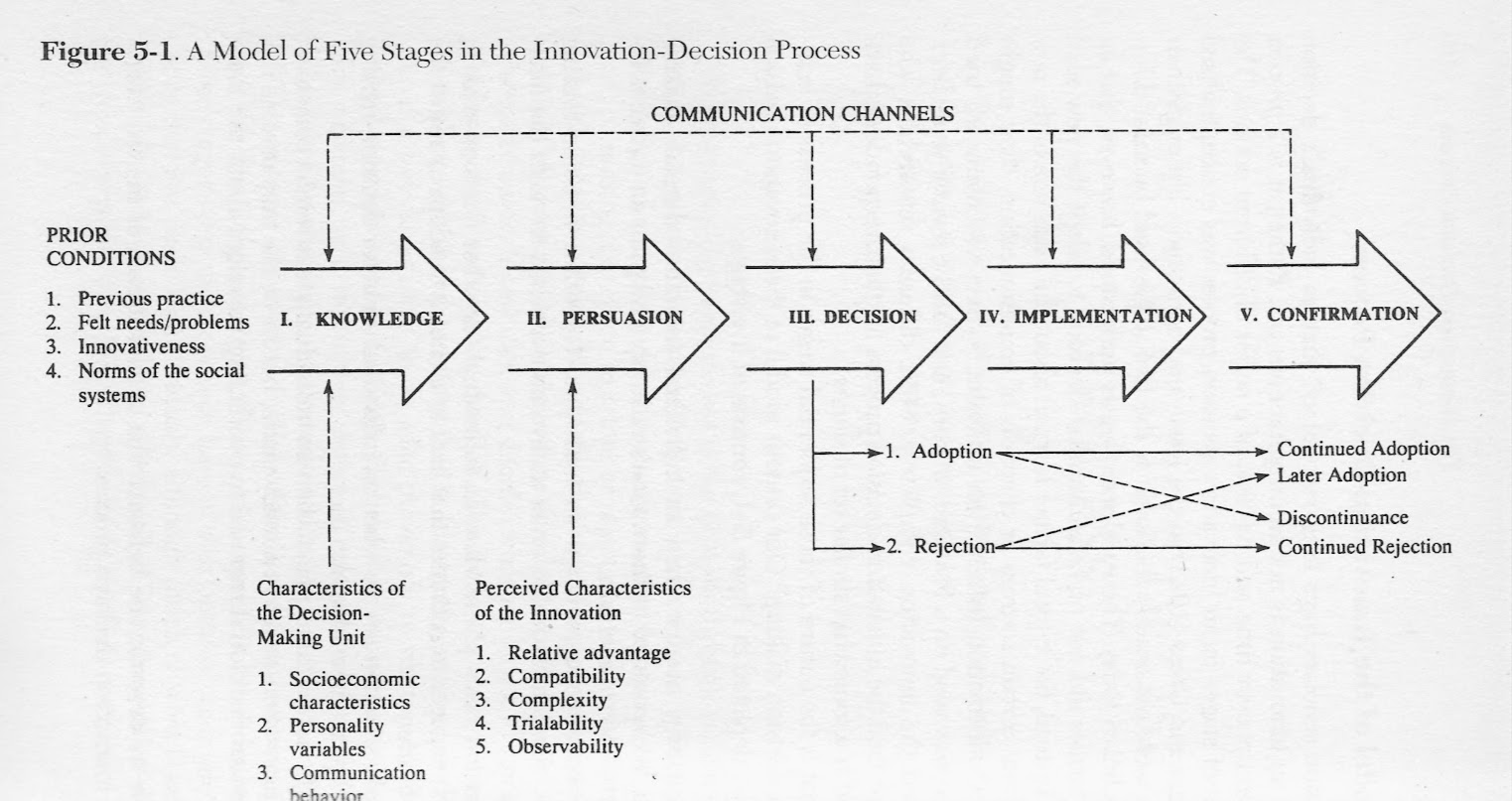
    The University Innovation Alliance is “a consortium of 11 large public research universities committed to making high-quality college degrees accessible to a diverse body of students”. I wrote about this “central concern” last summer in a post titled “Pilots: Too many ed tech innovations stuck in purgatory”, using the frame of Everett Rogers’ Diffusions of Innovations model. While the trigger for that post was on ed tech products, the same situation applies for the course design situation.

    5 Stages of Adoption

    What we are seeing in ed tech in most cases, I would argue, is that for institutions the new ideas (applications, products, services) are stuck the Persuasion stage. There is knowledge and application amongst some early adopters in small-scale pilots, but majority of faculty members either have no knowledge of the pilot or are not persuaded that the idea is to their advantage, and there is little support or structure to get the organization at large (i.e. the majority of faculty for a traditional institution, or perhaps for central academic technology organization) to make a considered decision. It’s important to note that in many cases, the innovation should not be spread to the majority, either due to being a poor solution or even due to organizational dynamics based on how the innovation is introduced.

    The Purgatory of Pilots

    This stuck process ends up as an ed tech purgatory – with promises and potential of the heaven of full institutional adoption with meaningful results to follow, but also with the peril of either never getting out of purgatory or outright rejection over time.

    (more…)

  • NYT Michael Crow Condensed Interview: More Info needed . . . and available

    The New York Times ran an “edited and condensed” interview with Arizona State University (ASU) president Michael Crow, titled “Reshaping Arizona State, and the Public Model”.

    Michael M. Crow sees Arizona State as the model of a public research university that measures itself by inclusivity, not exclusivity. In his 13 years as its president, he has profoundly reshaped the institution — hiring faculty stars from across the country, starting a bevy of interdisciplinary programs, growing the student body to some 83,000 and using technology to bring his ideas to scale, whether with web-based introductory math classes or eAdvisor, which monitors students’ progress toward their major. Last year, Dr. Crow made headlines when the university partnered with Starbucks to offer students the chance to complete their degree online for free. His new book, written with the historian William B. Dabars, is called, appropriately, “Designing the New American University.”

    (more…)

  • Release of ASU Case Study on e-Literate TV

    Today we are thrilled to release the third case study in our new e-Literate TV series on “personalized learning”. In this series, we examine how that term, which is heavily marketed but poorly defined, is implemented on the ground at a variety of colleges and universities.

    We are adding three episodes from Arizona State University (ASU), a school that is frequently in the news. Rather than just talking about the ASU problems, we are talking with the ASU people involved. What problems are they trying to solve? How do students view some of the changes? Are faculty being replaced by technology or are they changing roles? For that matter, how are faculty members involved in designing some of these changes?

    You can see all the case studies (either 2 or 3 per case study) at the series link, and you can access individual episodes below. (more…)

  • Release of e-Literate TV Series on Personalized Learning

    Today we are thrilled to release the initial episodes in our new e-Literate TV series on “personalized learning”. In this series, we examine how that term, which is heavily marketed but poorly defined, is implemented on the ground at a variety of colleges and universities. What does it really mean in practice? What problem is intended to solve? And how well is it working?

    e-LiterateLogoMED

    We have initially released case studies of approximately 30 minutes each from two very different schools – Middlebury College and Essex County College. You can see all the episodes (either 2 or 3 per case study) at the series link, and you can access individual episodes below.

    e-Literate TV, owned and run by MindWires Consulting, is funded in part by the Bill & Melinda Gates Foundation. When we first talked about the series with the Gates Foundation, they agreed to give us the editorial independence to report what we find, whether it is good, bad, or indifferent.

    As with the previous series, we are working in collaboration with In the Telling, our partners providing the platform and video production. Their Telling Story platform allows people to choose their level of engagement, from just watching the video to accessing synchronized transcripts and accessing transmedia. We have added content directly to the timeline of each video, bringing up further references, like e-Literate blog posts or relevant scholarly articles, in context. With In The Telling’s help, we are crafting episodes that we hope will be appealing and informative to those faculty, presidents, provosts, and other important college and university stakeholders who are not ed tech junkies.

    We will release three more case studies over the next month or two, and we also have two episodes discussing the common themes we observed on the campuses. We welcome your feedback, either in comments or on Twitter using the hashtag #eLiterateTV.

    Enjoy!

  • e-Literate TV Preview: Essex County College and changing role of faculty

    As we get closer to the release of the new e-Literate TV series on personalized learning, Michael and I will be posting previews highlighting some of the more interesting segments from the series. When we first talked about the series with its sponsors, the Bill & Melinda Gates Foundation, they agreed to give us the editorial independence to report what we find, whether it is good, bad, or indifferent.

    In this video preview (about 4:18 in duration), we hear from two faculty members who have first-hand experience in using a personalized learning approach as well as a traditional approach to remedial math. We also hear from students on what they are learning about learning. In our case studies so far, the real faculty issue is not that software is being designed to replace faculty, but rather that successful implementation of personalized learning necessarily changes the role of faculty. One of our goals with e-Literate TV is to allow faculty, staff and students to describe direct experiences in their own words. Take a look.

    Stay tuned for the full episodes to be released on the In The Telling platform ((ITT is our partner in developing this series, providing video production as well as the platform.)). You can follow me (@PhilOnEdTech), Michael (@mfeldstein67), or e-Literate TV (@eLiterateTV) to stay up to date. You can also follow the e-Literate TV YouTube channel. We will also announce the release here on e-Literate.

  • e-Literate TV Case Study Preview: Middlebury College

    As we get closer to the release of the new e-Literate TV series on personalized learning, Phil and I will be posting previews highlighting some of the more interesting segments from the series. Both our preview posts and the series itself start with Middlebury College. When we first talked about the series with its sponsors, the Bill & Melinda Gates Foundation, they agreed to give us the editorial independence to report what we find, whether it is good, bad, or indifferent. And as part of our effort to establish a more objective frame, we started the series by going not to a school that was a Gates Foundation grantee but to the kind of place that Americans probably think of first when they think of a high-quality personalized education outside the context of technology marketing. We decided to go to an elite New England liberal arts college. We wanted to use that ideal as the context for talking about personalizing learning through technology. At the same time, we were curious to find out how technology is changing these schools and their notion of what a personal education is.

    We picked Middlebury because it fit the profile and because we had a good connection through our colleagues at IN THE TELLING. ((Full disclosure: Since filming the case study, Middlebury has become a client of MindWires Consulting, the company that Phil and I run together.)) We really weren’t sure what we would find once we arrived on campus with the cameras. Some of what we found there was not surprising. In a school with a student/teacher ratio of 8.6 to 1, we found strong student/teacher relationships and empowered, creative students. Understandably, we heard concerns that introducing technology into this environment would depersonalize education. But we also heard great dialogues between students and teachers about what “personalized” really means to students who have grown up with the internet. And, somewhat unexpectedly, we saw some signs that the future of educational technology at places like Middlebury College may not be as different from what we’re seeing at public colleges and universities as you might think, as you’ll see in the interview excerpt below.

    Jeff Howarth is an Assistant Professor of Geography at Middlebury. He teaches a very popular survey-level course in Geographic Information Systems (GIS). But it’s really primarily a course about thinking about spaces. As Jeff pointed out to me, we typically provide little to no formal education on spacial reasoning in primary and secondary schooling. So the students walking into his class have a wide range of skills, based primarily on their natural ability to pick them up on their own. This broad heterogeneity is not so different from the wide spread of skills that we saw in the developmental math program at Essex County College in Newark, NJ. Furthermore, the difference between a novice and an expert within a knowledge domain is not just about how many competencies they have racked up. It’s also about how they acquire those competencies. Jeff did his own study of how students learn in his class which confirmed broader educational research showing that novices in a domain tend to start with specific problems and generalize outward, while experts (like professors, but also like more advanced students) tend to start with general principles and apply them to the specific problem at hand. As Jeff pointed out to me, the very structure of the class schedule conspires against serving novice learners in the way that works best for them. Typically, students go to a lecture in which they are given general principles and then are sent to a lab to apply those principles. That order works for students who have enough domain experience to frame specific situations in terms of the general principles but not for the novices who are just beginning to learn what those general principles might even look like.

    When Jeff thought about how to serve the needs of his students, the solution he came up with—partly still a proposal at this point—bears a striking resemblance to the basic design of commercial “personalized learning” courseware. I emphasize that he arrived at this conclusion through his own thought process rather than by imitating commercial offerings. Here’s an excerpt in which he describes deciding to flip his classroom before he had ever even heard of the term:

    In the full ten-minute episode, we hear Jeff talk about his ideas for personalized courseware (although he never uses that term). And in the thirty-minute series, we have a great dialogue between students and faculty as well as some important context setting from the college leadership. The end result is that the Middlebury case study shows us that personalized learning software tools do not just have to be inferior substitutes for the real thing that are only for “other people’s children” while simultaneously reminding us of what a real personal education looks like and what we must be careful not to lose as we bring more technology into the classroom.