e-Literate

Present is Prologue

Tag: Helix

  • Recommended Reading: CBE platforms represent a truly niche market

    Recommended Reading: CBE platforms represent a truly niche market

    Triggered by the news that we broke here at e-Literate that “Ellucian Stops Support for Brainstorm, its CBE platform”, Carl Straumsheim at Inside Higher Ed has a valuable follow-up article today looking more broadly at the CBE platform market. In “Finding a Niche in a Niche Market”, Carl interviews chief product and strategy officer at Ellucian, and several ed tech CEOs active in the market. The lede:

    Last year, Ellucian partnered with the consulting and research firm Eduventures and the American Council on Education to survey 251 colleges on their competency-based education strategies. The survey identified one major reason why the competency-based education market may be a tricky one for vendors to build a profitable business model in: most colleges aren’t ready to go all in yet. [snip]

    Additionally, Ellucian’s own customers told the company that they were not prioritizing spending money on platforms specifically for competency-based education when they could use their existing learning management systems for those experiments, [chief product and strategy officer] Williams said.

    (more…)

  • Ellucian Stops Support for Brainstorm, its CBE platform

    Ellucian Stops Support for Brainstorm, its CBE platform

    In a surprise move, Ellucian has decided to end support for Brainstorm, the competency-based education (CBE) platform it acquired from Helix Education two years ago. All Brainstorm customers are being notified of the end-of-life and aggressive measures are being used to help these customers quickly migrate to alternative platforms.

    Ellucian staff contacted me to share the general news of ending Brainstorm support. The stated reason for this change is that Ellucian perceives that there is insufficient market demand for full CBE programs, with many schools looking to ease into CBE in a minimalist fashion (I’m paraphrasing here). Brainstorm was designed primarily for non seat-time courses that are fully based on a competency framework and self-paced student access. We have covered Brainstorm / Helix on these issues here, including this observation:

    One educational model that is becoming more and more important is competency-based education (CBE). One of the challenges for this model is that the traditional LMS – based on a traditional model using grades, seat time and synchronous cohort of students – is not easily adapted to serve CBE needs.

    (more…)

  • State of Higher Ed LMS Market for US and Canada: Spring 2016 Edition

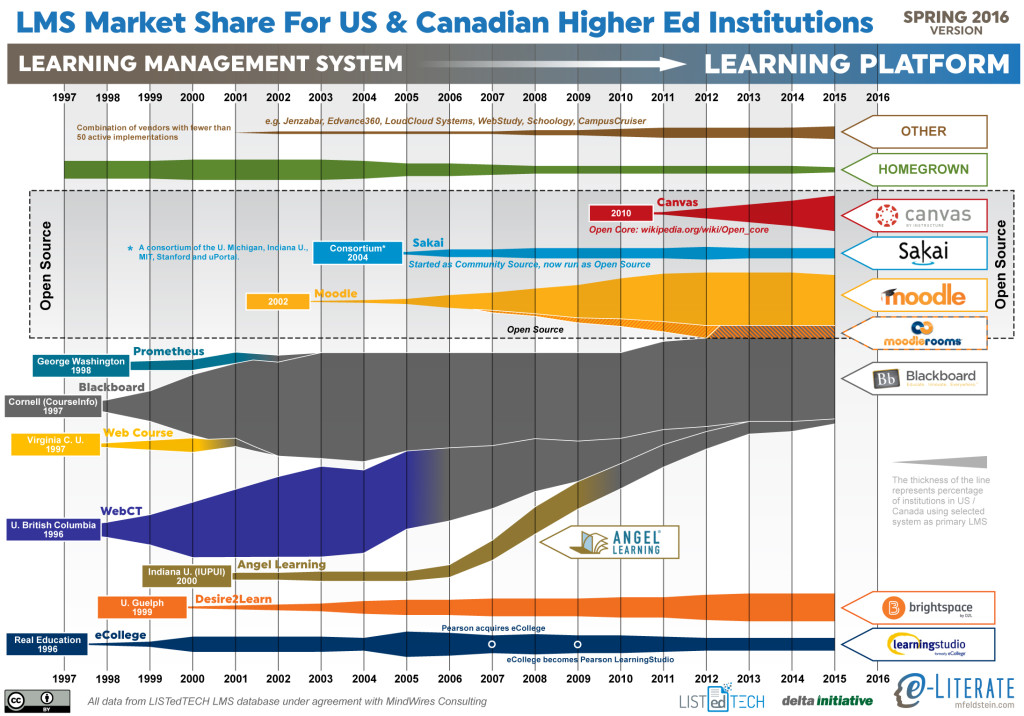
    This is the eighth year I have shared the LMS market share graphic, commonly known as the squid graphic, for (mostly) US higher education. The original idea remains – to give a picture of the LMS market in one page, highlighting the story of the market over time. The key to the graphic is that the width of each band represents the percentage of institutions using a particular LMS as its primary system.

    This year marks a significant change based on our upcoming LMS subscription service. We are working with LISTedTECH to provide market data and visualizations. This data source provides historical and current measures of institutional adoptions, allowing new insights into how the market has worked and current trends. This current graphic gets all of its data from LISTedTECH. Where previous versions of the graphic used an anchoring technique, combining data from different sources in different years, with interpolation where the data was unavailable. Now, every year’s data is based on this single data source.

    This graphic has been in the public domain for years, however, and we think it best to keep it that way. In this way we hope that the new service will provide valuable insight for subscribers but also improve what we continue to share here on the e-Literate blog.

    Since we have data over time now and not just snapshots, we have picked the end of each year for that data. For this reason, the data goes through the end of 2015. We have 2016 data but chose not to share partial-year results in an effort to avoid confusion.
    LMS_MarketShare_20160316

    A few items to note:

    • As noted in previous years, the fastest-growing LMS is Canvas. There is no other solution close in terms of matching the Canvas growth.
    • Blackboard continues to lose market share, although the vast majority of that reduction over the past two years has been from customers leaving ANGEL. Blackboard Learn lost only a handful of clients in the past year.
    • While the end-of-life occurs next year, Pearson’s has announced LearningStudio’s end-of-life for the end of 2017.
    • With the new data set, the rapid rise and market strength of WebCT becomes much more apparent than previous graphics.
    • There is a growing line for “Other”, capturing the growth of those systems with less than 50 active implementations as primary systems; systems like Jenzabar, Edvance360, LoudCloud Systems, WebStudy, Schoology, and CampusCruiser.
    • While we continue to show Canvas in the Open Source area, we have noted a more precise description as an Open Core model.

    For a better description of the upcoming LMS subscription service, read this post and / or sign up for more information here.

  • State of the US Higher Education LMS Market: 2015 Edition

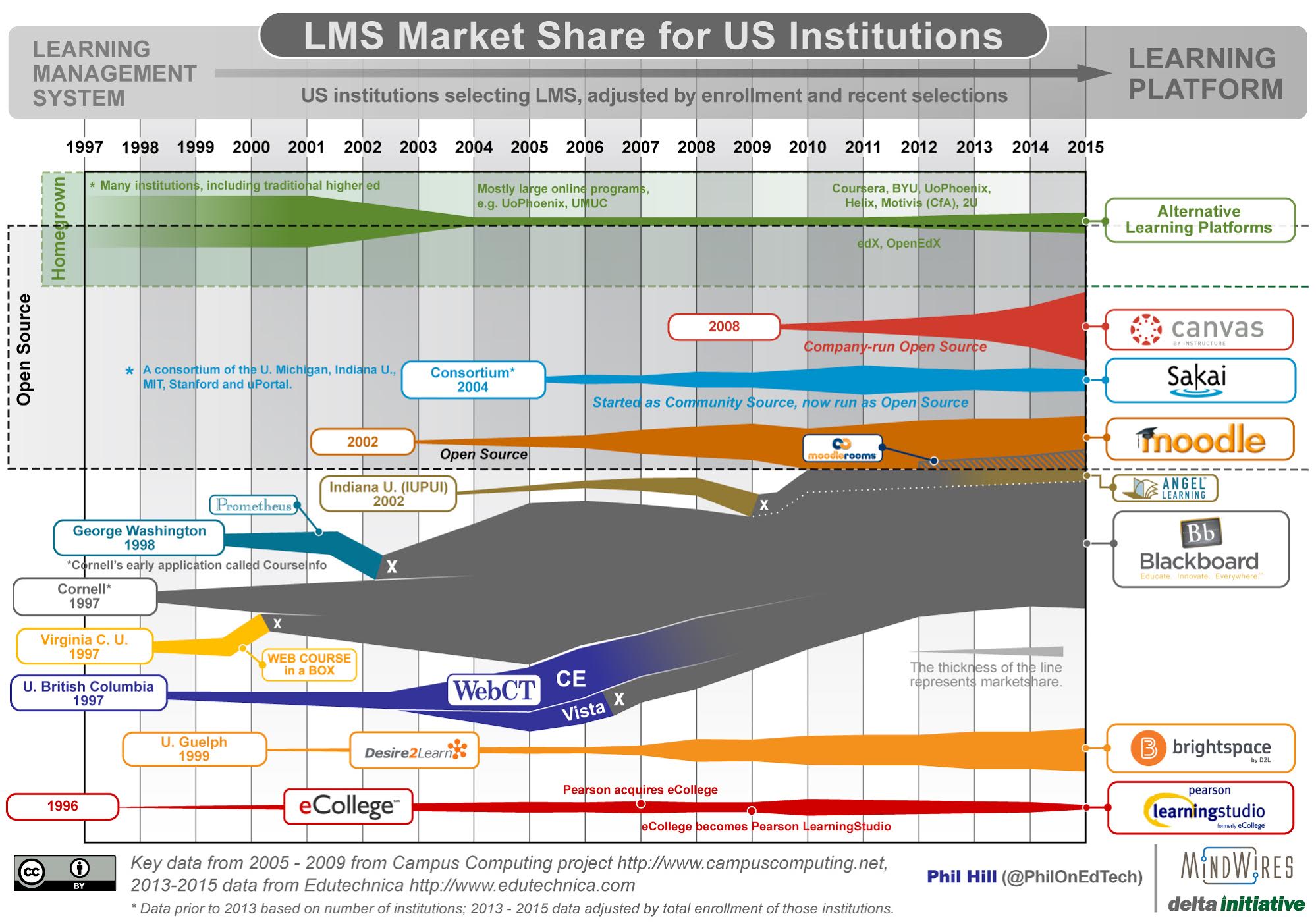
    I shared the most recent graphic summarizing the LMS market in October 2014, and thanks to revised data sources it’s time for an update. As with all previous versions, the 2005 – 2009 data points are based on the Campus Computing Project, and therefore is based on US adoption from non-profit institutions. This set of longitudinal data provides an anchor for the summary.

    The primary data source for 2013 – 2015 is Edutechnica, which not only does a more direct measurement of a larger number of schools (viewing all schools in IPEDS database with more than 700 FTE enrollments), but it also allows scaling based on enrollment per institution. This means that the latter years now more accurately represent how many students use a particular LMS. This post at Edutechnica provides the most recent data for Fall 2015.

    A few items to note:

    • The most important recent feature of the market – the rapid rise of Canvas, surpassing D2L and quickly closing in on Moodle – is quite visible now.
    • Blackboard Learn appears to have stopped its well-documented losses in US higher ed and has even risen in the past year. Its market share is far smaller than at its 2009 peak, but the company is no longer losing large numbers of clients each year.
    • D2L, Sakai, and Moodle have risen ever so slightly, but in effect have hit a plateau.
    • ANGEL and eCollege have lost market share.
    • There is a growing area of “Alternative Learning Platforms” that includes OpenEdX, 2U, Helix and Motivis (the newly commercialized learning platform from College for America).
    • While the data is more solid than 2012 and prior years, keep in mind that you should treat the graphic as telling a story of the market rather than being a chart of exact data.
    • Update (10/16): Removed “Curtin University as origin of Moodle based on Martin’s comments. Mea culpa – should have caught this earlier.
    • Update (10/23): Changed graphic title to refer to US and not North America.

    LMS_MarketShare_20151023

  • Ellucian Buys Helix LMS, But Will It Matter?

    At this year’s Ellucian users’ conference #elive15, one of the two big stories has been that Ellucian acquired the Helix LMS, including taking on the development team. I have previously described the Helix LMS in “Helix: View of an LMS designed for competency-based education” as well as the subsequent offer for sale in “Helix Education puts their competency-based LMS up for sale”. The emerging market for CBE-based learning platforms is quickly growing, at least in terms of pilot programs and long-term potential, and Helix is one of the most full-featured, well-designed systems out there. (more…)

  • Editorial Policy: Notes on recent reviews of CBE learning platforms

    Oh let the sun beat down upon my face, stars to fill my dream
    I am a traveler of both time and space, to be where I have been
    To sit with elders of the gentle race, this world has seldom seen
    They talk of days for which they sit and wait and all will be revealed

    – R Plant, Kashmir

    Over the past half year or so I’ve provided more in-depth product reviews of several learning platforms than is typical – Helix, FlatWorld, LoudCloud, Bridge. Understanding that at e-Literate we are not a review site nor do we tend to analyze technology for technology’s sake, it’s worth asking ‘why the change?’. There has been a lot of worthwhile discussion in several blogs recently about whether the LMS is obsolete or critical to the future of higher ed, and this discussion even raised the subject of how we got to the current situation in the first place.

    An interesting development I’ve observed is that the learning environment of the future might already be emerging on its own, but not necessarily coming from the institution-wide LMS market. Canvas, for all its market-changing power, is almost a half decade old. The area of competency-based education (CBE), with its hundreds of pilot programs, appears to be generating a new generation of learning platforms that are designed around the learner (rather than the course) and around learning (or at least the proxy of competency frameworks). It seems useful to get a more direct look at these platforms to understand the future of the market and to understand that the next generation environment is not necessarily a concept yet to be designed.

    (more…)

  • Helix Education puts their competency-based LMS up for sale

    Back in September I wrote about the Helix LMS providing an excellent view into competency-based education and how learning platforms would need to be designed differently for this mode. The traditional LMS – based on a traditional model using grades, seat time and synchronous cohort of students – is not easily adapted to serve CBE needs such as the following:

    1. Explicit learning outcomes with respect to the required skills and concomitant proficiency (standards for assessment)
    2. A flexible time frame to master these skills
    3. A variety of instructional activities to facilitate learning
    4. Criterion-referenced testing of the required outcomes
    5. Certification based on demonstrated learning outcomes
    6. Adaptable programs to ensure optimum learner guidance

    In a surprise move, Helix Education is putting the LMS up for sale.  (more…)