
Last week I covered the announcement from Instructure that they had raised another $40 million in venture funding and were expanding into the corporate learning market. Today I was able to see a demo of their new corporate LMS, Bridge. While Instructure has very deliberately designed a separate product from Canvas, their education-focused LMS, you can see the same philosophy of market strategy and product design embedded in the new system. In a nutshell, Bridge is designed to a simple, intuitive platform that moves control of the learning design away from central HR or IT control and closer to the end user.
While our primary focus at e-Literate is on higher ed and even some K-12 learning, the development of professional development and corporate training markets are becoming more important even in the higher ed context. At the least, this is important for those who are tracking Instructure and how their company plans might affect the future of education platforms.
The core message of Instructure regarding Bridge – just as with Canvas – is that it is focused on ease-of-use whereas the entrenched competition has fallen prey to feature bloat based on the edge cases. Despite this claim and despite Instructure’s track record with Canvas, what does this mean? I’m pretty sure every vendor out there claims ease-of-use whether or not there are elegant or terrible designs ((Although I would love to see the honest ad: “With a horrible, bloated user interface based on your 300-item RFP checklist!”)).
Based on the demo, Bridge appears to define ease-of-use in three distinct areas – streamlined, clutter-free interface for learners, simple tools for content creation by business units, and simple tools for managing learners and content.
Learner User Experience
Bridge has been designed over the past year based on Instructure’s design to avoid force-fitting Canvas into corporate learning markets. The core use cases of this new market are far simpler than education use cases, and the resultant product has fewer bells and whistles than Canvas. In Instructure’s view, the current market has such cumbersome products that learning platforms are mostly used just for compliance – take this course or you lose your job – and not at all for actual learning. The Bridge interface (shown alongside the mobile screen and on laptop) is simple.
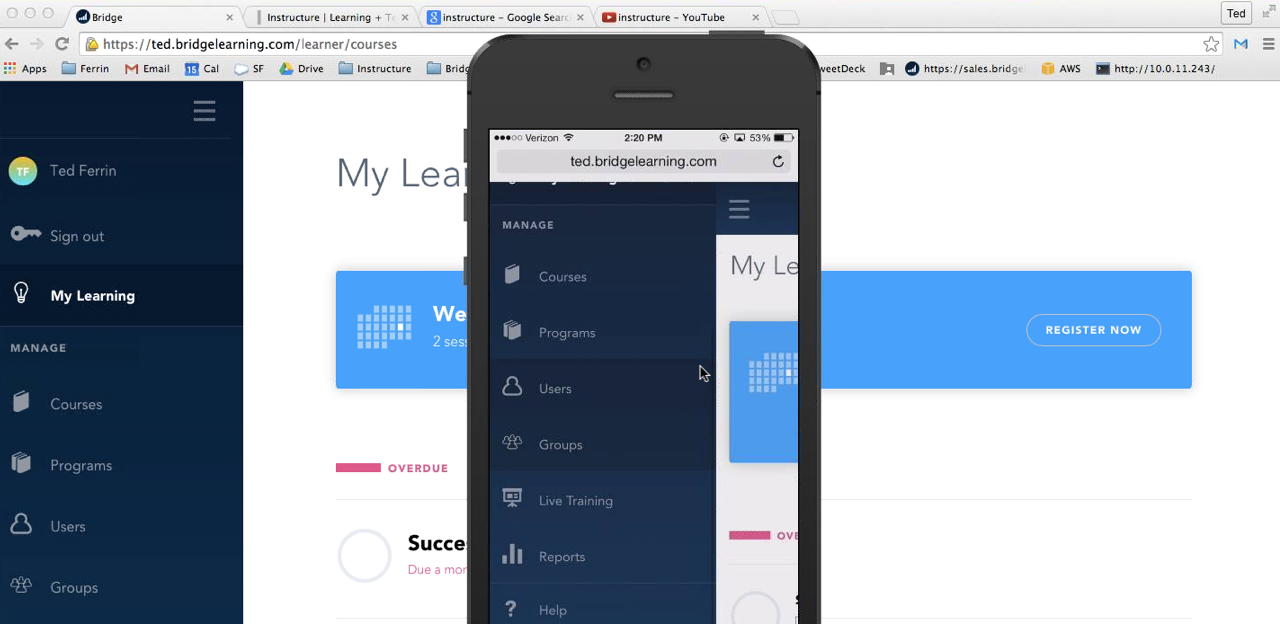
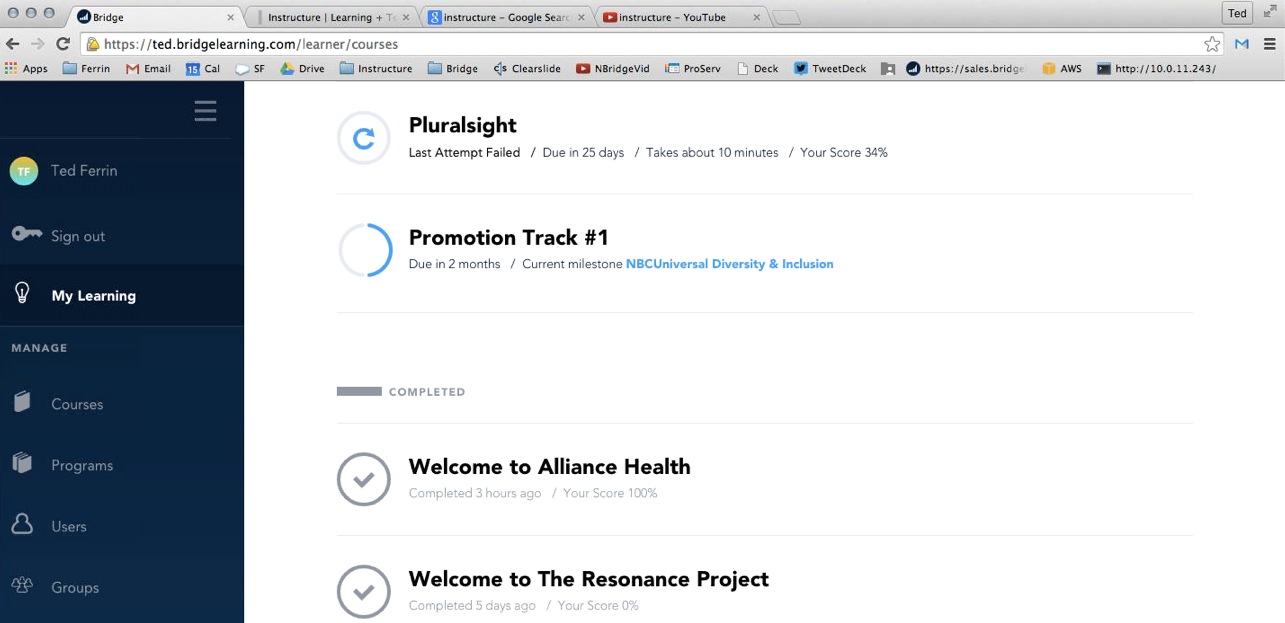
While this is a clean interface, I don’t see it as being that big of a differentiator or rationale for a new product line.
Content Creation
The content creation tools, however, start to show Instructure’s distinctive approach. They have made their living on being able to say no – refusing to let user requests for additional features to change their core design principle. The approach for Bridge is to assume that content creators have no need to have web design or instructional design experience, providing them with simple formatting and suggestion-based tools to make content creation easy. The formatting looks to be on the level of Google Docs, or basic WordPress, rather than Microsoft Word.
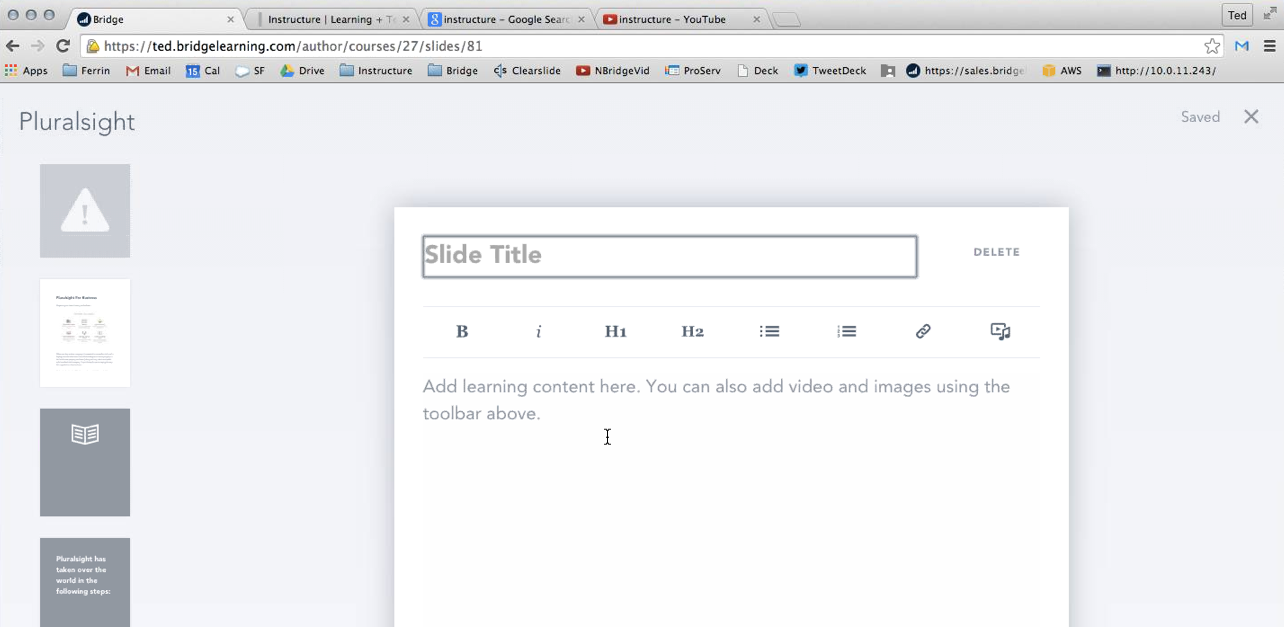
When creating new content, the Bridge LMS even puts up prompts for pre-formatted content types.

When creating quizzes, they have an interesting tool that adds natural language processing to facilitate simple questions that can be randomized. The author could write a simple sentence of what they are trying to convey to users, such as “Golden Gate Bridge is in San Francisco”. The tool selects each word and allows the author to add alternative objects that can serve in a quiz, such as suggesting San Mateo or San Diego (it is not clear if you can group words to replace the full “San Francisco” rather than “Francisco”). The randomized quiz questions could then be automatically created.

For content that is more complex, Instructure is taking the approach of saying ‘no’ – go get that content from a SCORM/AICC import coming from a more complex authoring tool.
Learner Administration Tools
Rather than relying on complex HR systems to manage employees, Bridge goes with a CSV import tool that reminds me of Tableau in that it pre-imports, shows the fields, and allows a drag-and-drop selection and re-ordering of fields for the final import ((I assume they can integrate with HR systems as well, but we did not discuss this aspect.)).
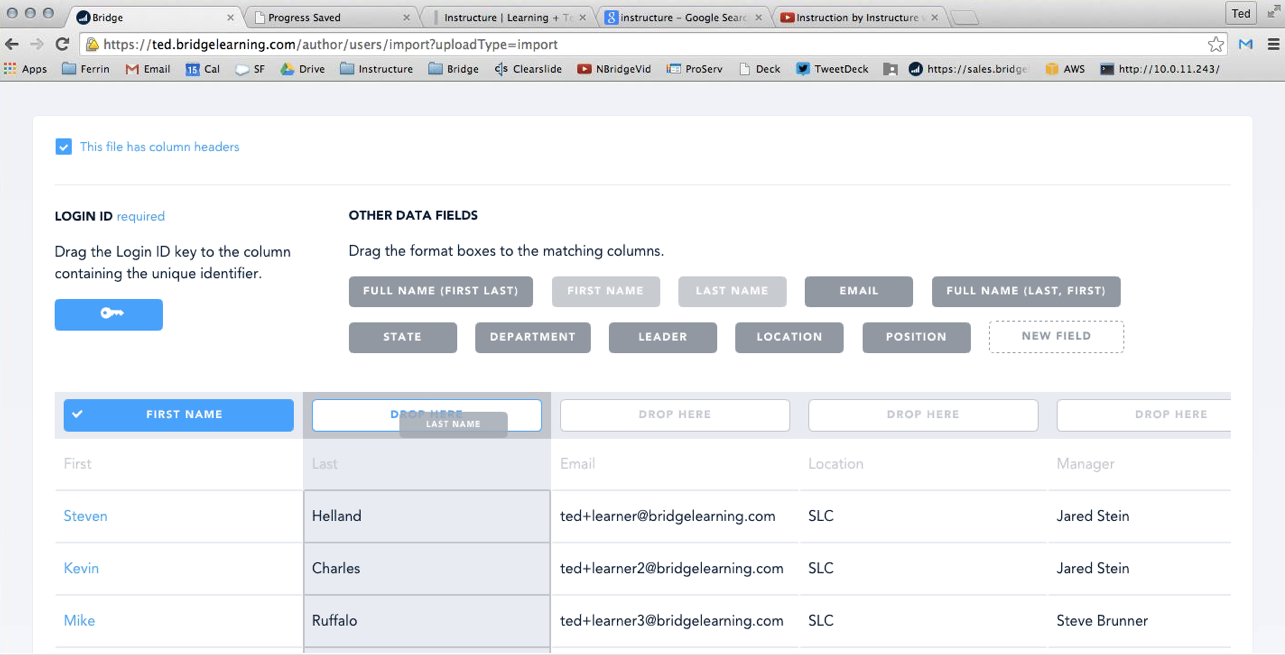
The system can also create or modify groups based on rules.
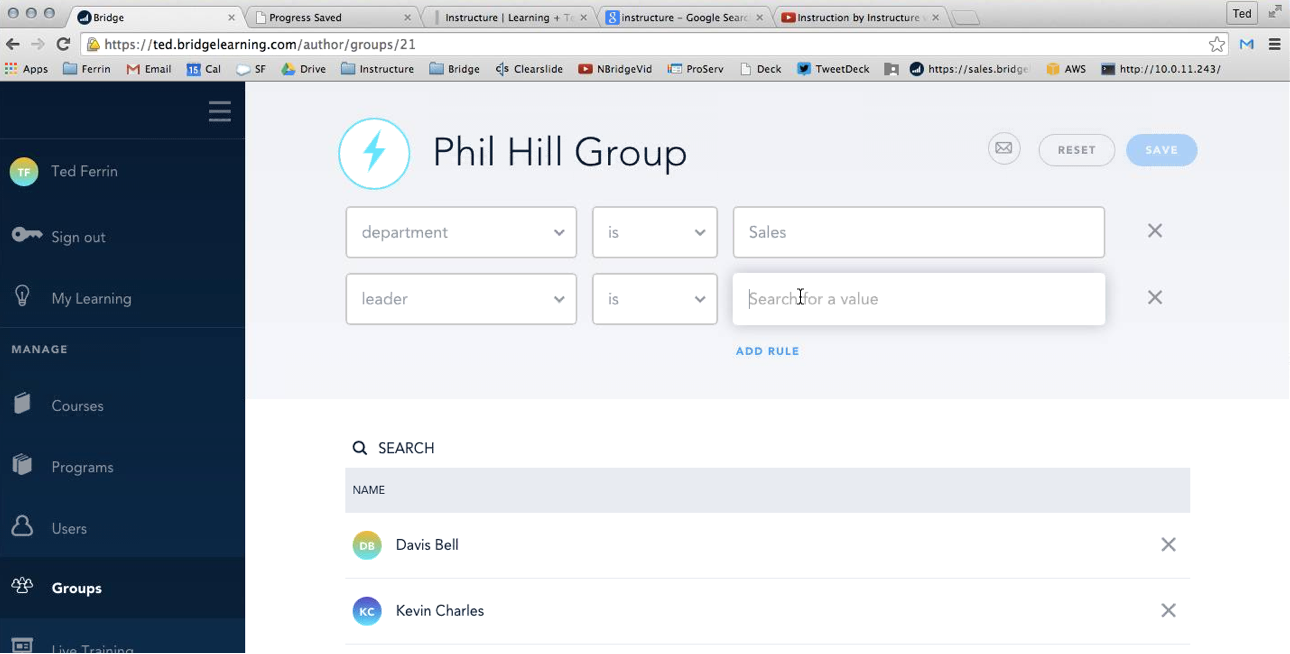
To pull this together, Bridge attempts to automate as much of the background process as is feasible. To take one example, when you hire a new employee or change the definition of groups, the system retroactively adds the revised list of learners or groups to assigned courses.
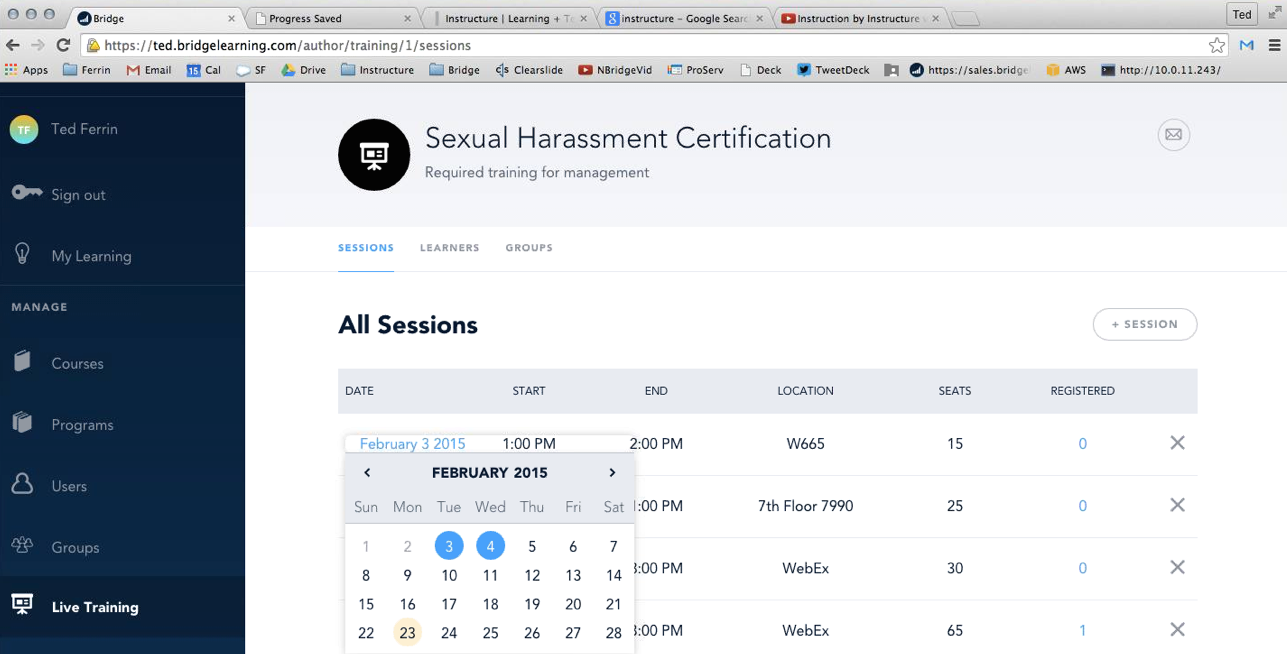
For live training, you can see where Bridge takes the opposite approach to Canvas. In Canvas (as with most education LMSs), it is assumed that more time in the system means more time learning – the core job of learners. In Bridge, however, the assumption is that LMS time-on-task should be minimized. For compliance training in particular, you want the employee to spend as little time as reasonable training so they can get their real job done. Bridge focuses not on the live training itself but rather on the logistics tasks in setting up the course (scheduling, registering, taking attendance).
Prospects and Implications
Taken together, the big story here is that Instructure seeks to change the situation where learning management in corporations is cloistered within HR, IT and instructional design units.. As they related today, they want to democratize content creation and center learning in the business units where the subject matter experts reside.
Their future plans focus on engagement – getting feedback and dialogue from employees rather than just one-way content dissemination and compliance. If they are successful, this is where they will gain lasting differentiation in the market.
What does this mean from a market perspective? Although I do not have nearly as much experience with corporate training as I do with higher education, this LMS seems like a real system and a real market entry into corporate learning. The primary competitors in this space are not Blackboard, as TechCrunch and Buzzfeed implied, but are Saba, SumTotal, SuccessFactors, Cornerstone, etc. Unlike education, this is a highly fragmented market. I suspect that this means that the growth prospects for Instructure will be slower than in education, but real nonetheless. Lambda Solutions shared the Bersin LMS study to give a view of the market.

This move is clearly timed to help with Instructure’s planned IPO that could happen as soon as November 2015 ((Note this is based on my heuristic analysis and not from Instructure employees.)). Investors can now see potential growth in an adjacent market to ed tech where they have already demonstrated growth.
I mentioned in my last post that the biggest risk I see is management focus and attention. I suspect with their strong fund-raising ($90 million to date) that the company has enough cash to hire staff for both product lines, but senior management will oversee both the Canvas and the Bridge product lines and markets.
Comments
2 responses to “First View of Bridge: The new corporate LMS from Instructure”
[…] to their core LMS but by creating a new product called FASTRAK. Like Instructure with their creation of a new LMS for a different market (corporate learning), LoudCloud determined that CBE called for a new design […]
[…] circles tends to be designed around formal learning programs and learning administrators needs. Like Instructure’s Bridge product, the new new Cisco offering is designed around end user needs, and it seems to be a very […]