e-Literate

Present is Prologue

Tag: higher education

  • Postscript to “This Time Is Different: Enrollment and Employment Divergence”

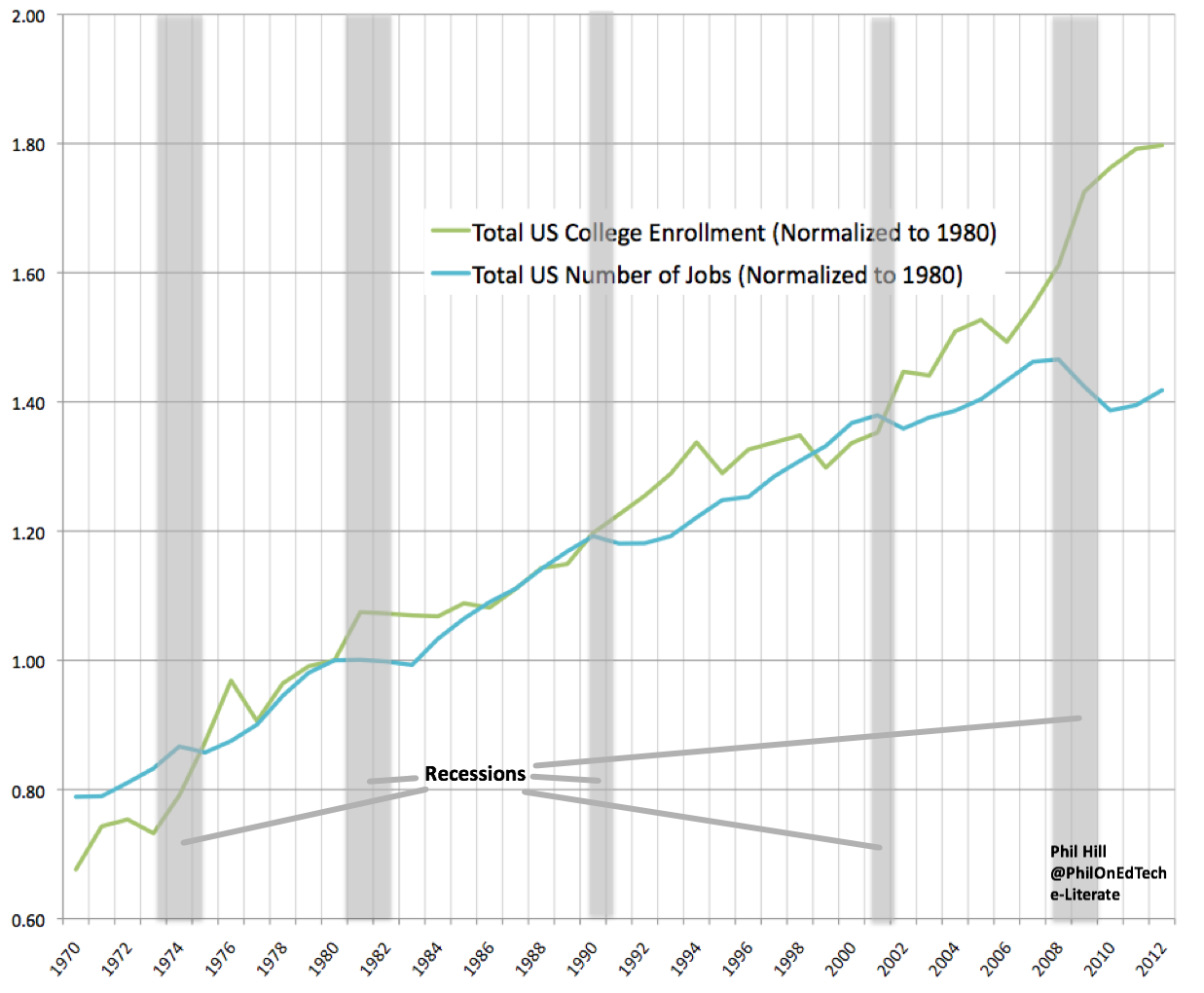
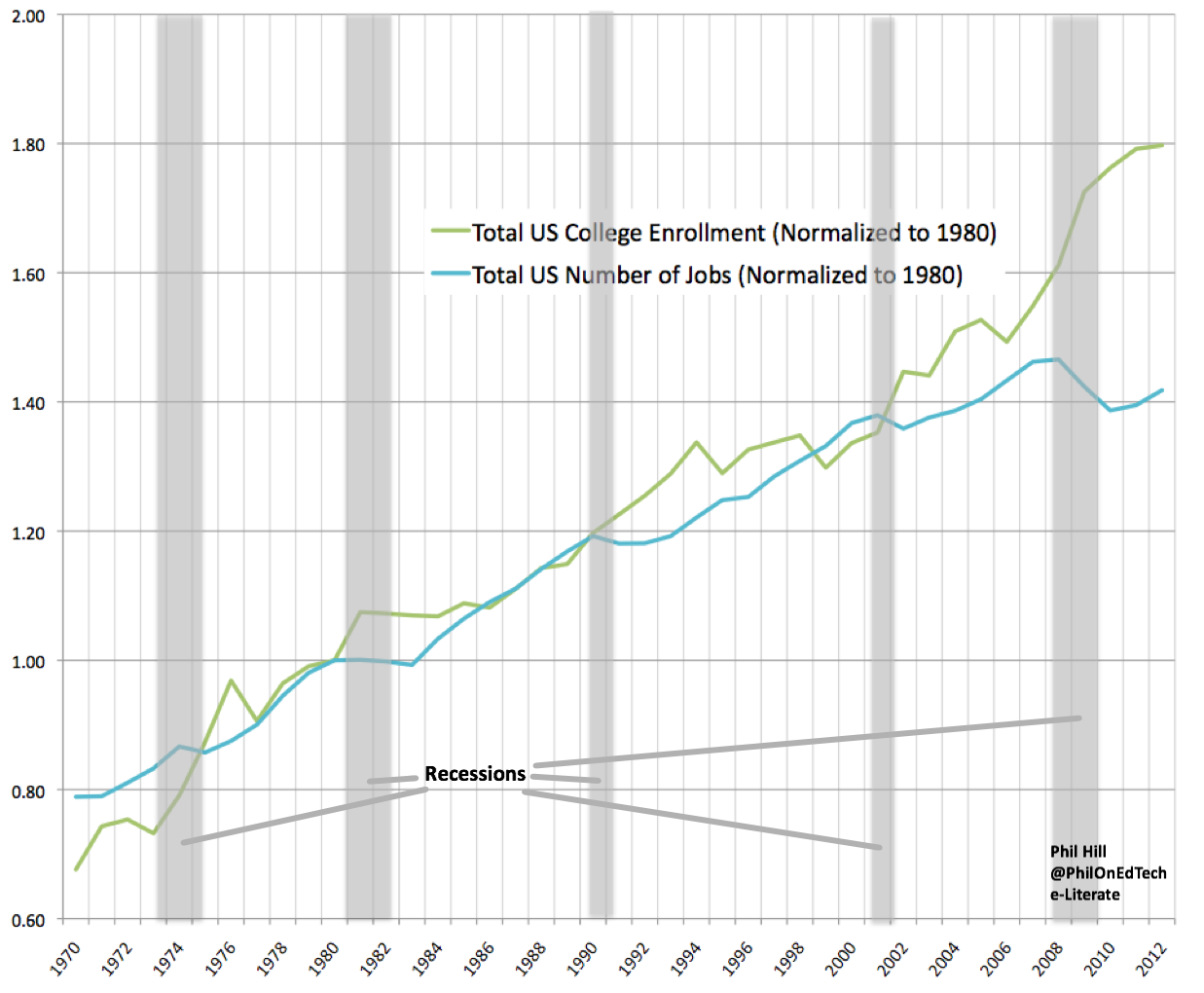
    In a post two days ago, I showed US data comparing enrollment and employment trends. The salient feature of the data that I called out was the significant divergence of the two trend lines since 2006.

    When you look at the data from 1970 – 2012, the results could explain some significant pressures experienced by higher education institutions. In a nutshell – this time is different, we are in uncharted territory.
    There are two related comments that I would like to address, both of which ask the question of whether the mix of full-time vs. part-time enrollment explains part of the divergence noted.

    The first (excerpted) comment is from Thomas Warger under the original post:

    I have to wonder how much of the gap you show here can be attributed to the increased availability of pay-as-you-go higher education–opportunities to take a few credits at a time at a community college or an online provider? Does “normalized for 1980″ factor for this relatively new phenomenon?

    The second comment is from Stephen Downes in his OLDaily blog:

    I don’t agree with the proposition that “this time it’s different.” Here’s what Phil Hill writes: “The conventional wisdom holds that enrollment jumps when employment drops, and the data does show some divergence followed a few years later by a correction. What is different this time is A) the magnitude of the divergence and B) the start of the divergence fully two years before the recession started in 2008.” I think the apparent spike in enrollments is created by a lot of part-time and online learning, and that it is a bit illusory. It’s also caused by echo-boom effects, as the population born between 1982-1995 is in post-secondary education between 2002-1015, give or take. If (and it’s a big if) employment improves, I would expect a dramatic drop in (traditional) enrollment.

    What’s really different is that world population is reaching a breaking point, climate change is disrupting food supplies and other industry, resource depletion has become a significant problem, and (by contrast) worldwide prosperity, literacy and general awareness has led to an increasingly restive global population. There is moreover a chronic economic imbalance, with increasingly large quantities of wealth simply being hoarded instead of invested (it’s an amount that if deployed would makemoney itself meaningless). U.S. demographic trends – which could be rendered obsolete with one major wave of immigration – are irrelevant in the face of these wider forcess.
    (more…)

  • This Time Is Different: US Enrollment and Employment Divergence

    When looking at long-term trends for higher education, it is useful to step back and look at the big picture. With this goal in mind, consider the comparison of post-secondary enrollment in degree-granting programs to the total number of jobs (both based on the US). The enrollment data is based on the National Center of Education Statistics (NCES) and the employment data is based on the Bureau of Labor Statistics and its Current Population Survey (CPS). To get the big picture I decided to keep this simple – combining full-time and part-time enrollment, and combining full-time and part-time employment. To see the trends, I normalized both data series to 1980.

    When you look at the data from 1970 – 2012, the results could explain some significant pressures experienced by higher education institutions. In a nutshell – this time is different, we are in uncharted territory.

    (more…)

  • Initial Thoughts on McGraw-Hill Education Acquisition

    Update (12/1): Added excerpts from NY Post article re. Apollo holding of Cengage debt

    Earlier this week came the official news that McGraw-Hill Education (MHE) was being purchased by Apollo Global Management, a publicly-traded global alternative investment firm – roughly the equivalent of private equity in nature. Based on the PR Newswire report:

    The McGraw-Hill Companies (NYSE:MHP) (“the Company”) today announced it has signed a definitive agreement to sell its McGraw-Hill Education business to investment funds affiliated with Apollo Global Management, LLC (NYSE: APO) (collectively with its subsidiaries, “Apollo”), for a purchase price of $2.5 billion, subject to certain closing adjustments.  As part of this transaction, McGraw-Hill will receive $250 million in senior unsecured notes issued by the purchaser at an annual interest rate of 8.5%.  The transaction, which is expected to close in late 2012 or early 2013, is subject to regulatory approval and customary closing conditions. [snip]

    The McGraw-Hill Companies announced in September 2011 it would separate into two industry-leading companies following a year-long strategic portfolio review.

    As noted in the article, this spinoff of the education division has been in the works for over a year, based on recommendations from a hedge fund investor in 2010 that led to a year-long strategic review. This review culminated in the Sep 2011 decision. It is clear from this review that MHE is a profitable, slow-growth (or no-growth) company.

    McGraw-Hill said on Monday [Sep 12, 2011] that it would break itself up, spinning off its education division to focus on its business information unit in an effort to lift its stagnant share price.

    The remaining business will concentrate on the higher-growth operations of Standard & Poor’s, along with the financial data provider Capital IQ and the energy and metals information service Platts. McGraw-Hill also said that it would cut costs and buy back $1 billion in stock this year. [snip]

    Several [companies], like Kraft and now McGraw-Hill, are splitting their operations into a high-growth operations and a lower-growth one that nonetheless generates steady profits and could pay a big dividend [emphasis added].

    (more…)

  • Babson Report on OER in US Higher Education

    The Babson Survey Research Group just released their report on OER usage in US higher education, “Growing the Curriculum: Open Education Resources in U.S. Higher Education”. The report is based on three different surveys among faculty and academic leaders, and it is heavy on attitudinal information – are you aware of OER, do you plan to use OER, what are the reasons to choose OER, what are the barriers to adoption, etc.

    Some of the key findings from the executive summary:

    • Most academic leaders are at least somewhat aware of open education resources (OER) and slightly over half list themselves as ‘Aware’ or ‘Very aware.’
    • Only one-half of all chief academic officers report that any of the courses at their institution currently use OER materials.
    • In 2011, most surveyed academic leaders report that open education resources will have value for their campus; 57 percent agree that they have value and less than five percent disagree.
    • Nearly two-thirds of all chief academic officers agree that open education resources have the potential to reduce costs for their institution.
    • There is wide agreement among academic leaders that open education resources will save time in the development of new courses.
    • Over one-half of academic leaders agree or strongly agree that open education resources would be more useful if there was a single clearinghouse.
    • Among faculty, cost (88% reporting as important or very important) and ease of use (86%) are most important for selecting online resources.
    • The time and effort to find and evaluate are consistently listed as the most important barriers by faculty to the adoption of open education resources.
    • Older faculty have a greater level of concern with all potential barriers to open education resource adoption than do younger faculty.
  • Analysis of Instructure Security Testing

    Instructure has engaged Securus Global to test the Canvas LMS product for security vulnerabilities. Instructure also invited me to be an independent observer – participating in the process and independently reporting on the testing and Instructure’s response to any vulnerabilities identified. Part 1 of this series of posts described the concept. Part 2 gave a mid-term update, describing the process involved and initial results. Part 3 described the full results of the security assessment. In this final post on the experience I’d like to address two subjects – my own impressions of the testing, and a call for more LMS vendors to follow suit and make their security testing more transparent.

    Results Themselves

    As described in part 3, the risk assessment found 10 vulnerabilities – 1 critical, 1 high, 4 moderate and 4 low risk – in the Canvas LMS system. I do not have a basis to judge the relative number of vulnerabilities found compared to Instructure’s competitors, as there is not an industry-specific standard on the depth and extent of penetration testing, but by all appearances the Canvas LMS system is a well-designed, generally secure application. I base this judgment on two factors:

    (more…)

  • Educational Publishers Appear to be Supporting SOPA

    UPDATE 12/23: Per the House Judiciary Committee, it is now confirmed that these companies are on the record supporting SOPA and the Protect IP companion legislation.

    Yesterday the House Judiciary Committee began the process of marking up the Stop Online Piracy Act (SOPA) bill. From all appearances, most of the amendments have been rejected, thus leaving SOPA essentially in its original form. While passage is not assured, it is certainly a possibility as described by CNET.

    After a marathon debate on the Stop Online Piracy Act, it’s clear that the Hollywood-backed bill enjoys enthusiastic support among key members of the U.S. House of Representatives and is one step closer to becoming law.

    That became obvious after every legislative attempt to defang, rewrite, or significantly alter SOPA over nearly a 12-hour period today ended in victories for large copyright holders–and defeat upon defeat for the bill’s critics.

    While the SOPA impacts are not fully understood, there are some real dangers to educational usage that we need to follow. As described in my first post on the subject, SOPA could have a major impact on institutions using any form of educational technology to share content outside of a tightly-controlled password-protected course site. As we saw at EDUCAUSE this year, much of the potential of educational technology is to facilitate sharing of content outside of the traditional “walled gardens” of traditional LMS solutions, and enabling collaboration more broadly.

    This year’s EDUCAUSE keynote speaker, Seth Godin, has a post up at The Domino Project that calls out many of the list of “companies behind one of the lobbying groups pushing for SOPA”. On this list, lo and behold, we find most of the educational publishing companies.

    Pearson Education, Cengage Learning, McGraw-Hill Education, Macmillan, Scholastic, etc. They are all on the list.

    (more…)

  • How Georgia Tech Has Shown the Perils of SOPA

    This has been a tough week for open education, at least in higher education.  First came the news that Georgia Tech has taken down a 14-year-old student wiki site that allowed discussions and collaboration across courses and across semesters.  Next came the news of more details on proposed intellectual property laws in Congress, dubbed SOPA for Stop Online Piracy Act, that are being drafted in a draconian manner to protect content providers while taking away reasonable “safe harbor” protections for internet site operators.  Despite the nominal differences in these two pieces of legislation, I think that the Georgia Tech FERPA decision has shown just how dangerous SOPA could be to higher education.

    Ramblin Wreck

    The system under consideration at Georgia Tech was “Swikis”, a site that students used for their coursework and broader educational usage.  As described in the Chronicle, all it took was for one student to cause the institution to shut down the whole Swikis program, despite the fact that students choose how to participate.  The reason for Georgia Tech’s decision was their interpretation over violating FERPA regulations.  No ambiguity here, just a simple interpretation by the institution despite the fact that FERPA was written into law in 1974, well before we had an internet and collaborative online software.

    (more…)