
In part 1 of this series, I talked about some design goals for a conversation-based learning platform, including lowering the barriers and raising the incentives for faculty to share course designs and experiment with pedagogies that are well suited for conversation-based courses. Part 2 described a use case of a multi-school faculty professional development course which would give faculty an opportunity to try out these affordances in a low-stakes environment. In part 3, I discussed some analytics capabilities that could be added to a discussion forum—I used the open source Discourse as the example—which would lead to richer and more organic assessments in conversation-based courses. But we haven’t really gotten to the hard part yet. The hard part is encouraging experimentation and cross-fertilization among faculty. The problem is that faculty are mostly not trained, not compensated, and otherwise not rewarded for their teaching excellence. Becoming a better teacher requires time, effort, and thought, just as becoming a better scholar does. But even faculty at many so-called “teaching schools” are given precious little in the way of time or resources to practice their craft properly, never mind improving it.
The main solution to this problem that the market has offered so far is “courseware,” which you can think of as a kind of course-in-a-box. In other words, it’s an attempt to move as much as the “course” as possible into the “ware”, or the product. The learning design, the readings, the slides, and the assessments are all created by the product maker. Increasingly, the students are even graded by the product.
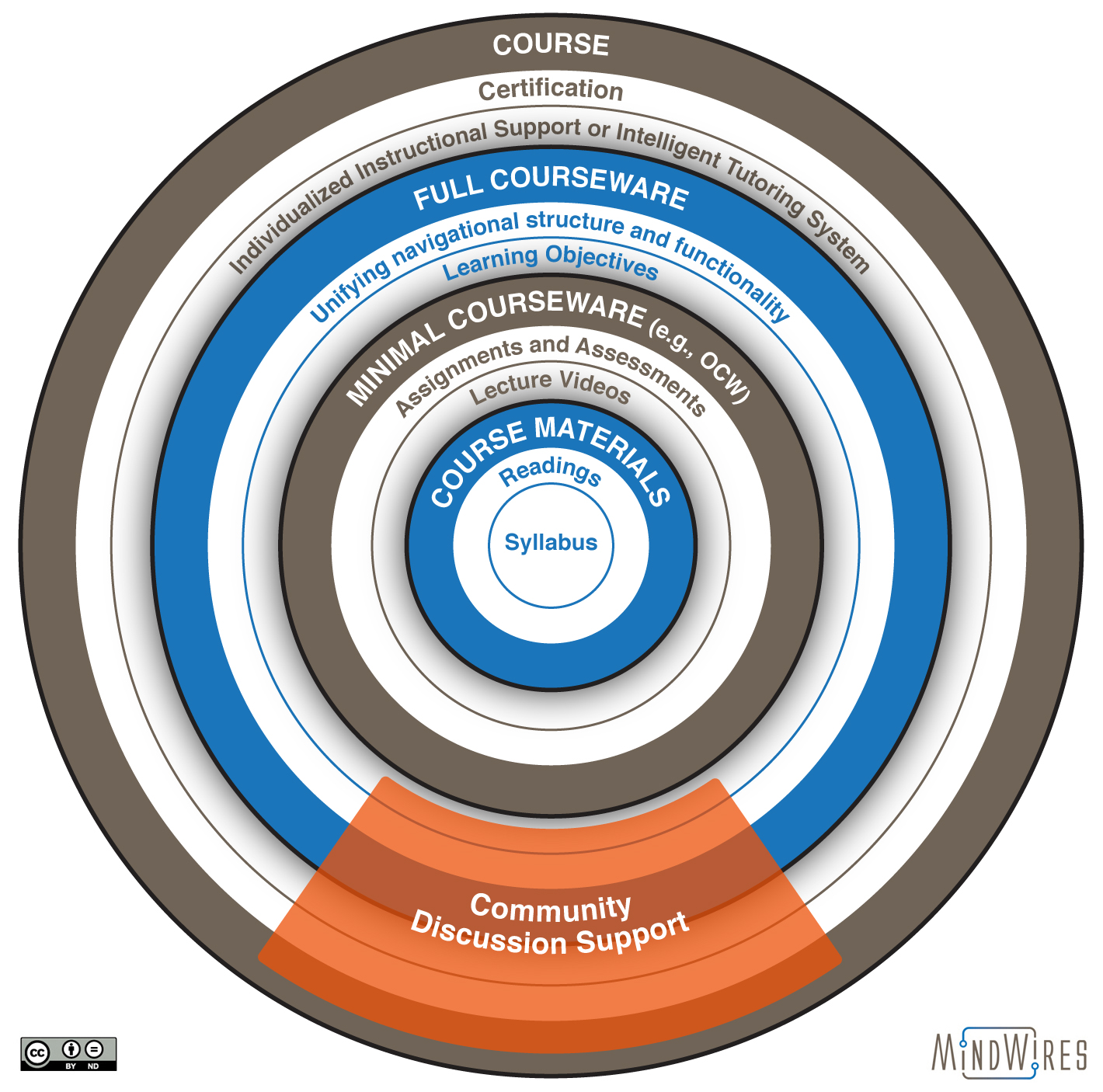
This approach as popularly implemented in the market has a number of significant and fairly obvious shortcomings, but the one I want to focus on for this post is these packages are still going to be used by faculty whose main experience is the lecture/test paradigm. ((Of course, I recognize that some disciplines don’t do a lot of lecture/test (although they may do lecture/essay). These are precisely the disciplines in which courseware has been the least commercially successful.)) Which means that, whatever the courseware learning design originally was, it will tend to be crammed into a lecture/test paradigm. In the worst case, the result is that we have neither the benefit of engaged, experienced faculty who feel ownership of the course nor an advanced learning design that the faculty member has not learned how to implement.
One of the reasons that this works from a commercial perspective is that it relies on the secret shame that many faculty members feel. Professors were never taught to teach, nor are they generally given the time, money, and opportunities necessary to learn and improve, but somehow they have been made to feel that they should already know how. To admit otherwise is to admit one’s incompetence. Courseware enables faculty to keep their “shame” secret by letting the publishers do the driving. What happens in the classroom stays in the classroom. In a weird way, the other side of the shame coin is “ownership.” Most faculty are certainly smart enough to know that neither they nor anybody else is going to get rich off their lecture notes. Rather, the driver of “ownership” is fear of having the thing I know how to do in my classroom taken away from me as “mine” (and maybe exposing the fact that I’m not very good at this teaching thing in the process). So many instructors hold onto the privacy of their classrooms and the “ownership” of their course materials for dear life.
Obviously, if we really want to solve this problem at its root, we have to change faculty compensation and training. Failing that, the next best thing is to try to lower the barriers and increase the rewards for sharing. This is hard to do, but there are lessons we can learn from social media. In this post, I’m going to try to show how learning design and platform design in a faculty professional development course might come together toward this end.