
e-Literate

Present is Prologue

Tag: IPO

  • Update on 2U: First full quarterly earnings and insight into model

    2U, the online service provider that went public in the spring, just released its financial report for the first full quarter of operations as a public company. The company beat estimates on total revenue and also lost less money than expected. Overall, it was a strong performance (see WSJ for basic summary or actual quarterly report for more details). The basics:

    • Revenue of $24.7 million for the quarter and $51.1 m for the past six months, which represents year-over-year increase of 32 and 35%;
    • EBITDA Losses of $7.1 m for the quarter and $10.9 m for the past six months, which represents year-over-year increase of -2% and 12%; and
    • Enrollment growth of 31 – 34% year-over-year.

    Per the WSJ coverage of the conference call:

    “I’m very pleased with our second quarter results, and that we have both the basis and the visibility to increase all of our guidance measures for 2014,” said Chip Paucek, 2U’s Chief Executive Officer and co-founder. “We’ve reached a turning point where, even with continued high investment for growth, our losses have stopped accelerating. At the midpoint of our new guidance range, we now expect our full year 2014 adjusted EBITDA loss to improve by 17% over 2013. Further, we’ve announced a schedule that meets our stated annual goal for new program launches through 2015.”

    The company went public in late March at $14 / share and is still at that range ($14.21 before the quarterly earnings release – it might go up tomorrow). As one of only three ed tech companies to have gone public in the US over the past five years, 2U remains worth watching both for its own news and as a bellwether of the IPO market for ed tech.

    Notes

    The financials provide more insight into the world of Online Service Providers (OSP, aka Online Program Management, School-as-a-Service, Online Enablers, the market with no name). On the conference call 2U’s CEO Chip Paucek reminded analysts that they typically invest (money spent – revenue) $4 – $9 million per program in the early years and do not start to break even until years 3 – 4. 2U might be on the high side of these numbers given their focus on small class sizes at big-name schools, but this helps explain why the OSP market typically focuses on long-term contracts of 10+ years. Without such a long-term revenue-sharing contract, it would difficult for an OSP to ever break even.
    (more…)

  • Links to External Articles and Interviews

    Last week I was off the grid (not just lack of Internet but also lack of electricity), but thanks to publishing cycles I managed to stay artificially productive: two blog posts and one interview for an article.

    Last week brought news of a new study on textbooks for college students, this time from a research arm of the  National Association of College Stores. The report, “Student Watch: Attitudes and Behaviors toward Course Materials, Fall 2013″, seems to throw some cold water on the idea of digital textbooks based on the press release summary [snip]

    While there is some useful information in this survey, I fear that the press release is missing some important context. Namely, how can students prefer something that is not really available?

    March 28, 2014 may well go down as the turning point where Big Data lost its placement as a silver bullet and came down to earth in a more productive manner. Triggered by a March 14 article in Science Magazine that identified “big data hubris” as one of the sources of the well-known failures of Google Flu Trends,[1] there were five significant articles in one day on the disillusionment with Big Data. [snip]

    Does this mean Big Data is over and that education will move past this over-hyped concept? Perhaps Mike Caulfield from the Hapgood Blog stated it best, including adding the education perspective . . .

    This is the fun one for me, as I finally have my youngest daughter’s interest (you made Buzzfeed!). Buzzfeed has added a new education beat focusing on the business of education.

    The public debut last week of education technology company 2U, which partners with nonprofit and public universities to offer online degree programs, may have looked like a harbinger of IPO riches to come for companies that, like 2U, promise to disrupt the traditional education industry. At least that’s what the investors and founders of these companies want to believe. [snip]

    “We live in a post-Facebook area where startups have this idea that they can design a good product and then just grow, grow, grow,” said Phil Hill, an education technology consultant and analyst. “That’s not how it actually works in education.”


  • Clarifications on UF Online Payments to Pearson Embanet

    I wrote a post over the weekend that included information from the Gainesville Sun about the University of Florida Online (UF Online) program and its expected payments to Pearson Embanet. Chris Newfield from Remaking the University also wrote on the subject today. Chris raises some very important issues in his post, including his point:

    Universities may have a cost disease, but they now have a privatization disease that is even worse.

    In the article, however, there seems to be a misunderstanding of how the revenue sharing agreement works. Given the importance of the questions that Chris raises, I think it is important to understand the payment model used by most Online Service Providers (OSP) such as in place at UF Online.

    The part of the blog post that is mistaken, in my understanding, is this [emphasis added]: (more…)

  • Embanet and 2U: More financial insight into Online Service Providers

    While I have written recently about UF Online and 2U, there is actually very little insight into the operations and finances of the market segment for Online Service Providers (OSP, also known as School-as-a-Service, Online Program Management). Thanks to 2U going public yesterday and the Gainesville Sun doing investigative work on UF Online, we have more information on one of the highest growth segments for educational technology and online learning.

    2U’s IPO

    2U went public yesterday, initially offered at $13.00 per share and closing the day at $13.98 (a 7.5% gain). The following is not intended to be a detailed stock market evaluation – just the basics to present the general scale of the company as insight into the market. While there is not a direct comparison, this IPO is a much better IPO than the most recent ed tech offering when Chegg (down 2.7% its first day and down 26% to date). Based on 2U’s first day of trading and the IPO filing: (more…)

  • 2U’s Upcoming IPO: Filing estimates $533 million company value

    One month ago 2U filed its registration for an IPO in 2014. 2U is an online service provider that helps traditional universities develop fully-online programs, currently based on 9 customers at the master’s level (see here for summary of revenue per student and per customer). On Monday the company set the terms for the IPO, as described by Bill Flook in the Washington Business Journal.

    2U Inc. on Monday set terms for its upcoming initial public offering. The Landover-based ed-tech company plans to sell 8 million shares at between $11 to $13 apiece. Selling stockholders plan to offload another 1.17 million shares in the offering.

    Altogether, the IPO would raise a total $110 million, assuming the 2U prices at the mid-point of that range. The company plans to list on the Nasdaq under the ticker symbol “TWOU.”

    (more…)

  • Four numbers to consider from 2U’s IPO filing

    With the emergence of large-scale MOOCs over the past few years, it has become common to hear discussions of online education in terms of access and scale – access to low or no cost courses and scale of tens or hundreds of thousands of students. Of course MOOCs are but one form of online ed, and with 2U, Inc filing for an IPO in 2014, we have another example of a very different, and lucrative, approach to online education. 2U’s model extends high-tuition, elite programs to a small group of students. To get a sense of this approach, consider four remarkable numbers that are based on 2U’s S-1 filing.

    To provide context for these numbers, 2U’s model is somewhat unique, as described in Techonomy:

    . . . 2U offers weekly live online (synchronous) classes and a sophisticated social networking platform that lets students and instructors interact. Most degrees offered through 2U also require completion of physical components such as global MBA residencies, student teaching apprenticeships, and, for nursing students, operating room training on campus and clinical experience in their communities. [snip]

    Another difference is that 2U classes are small—just 10 to 15 students and a professor onscreen in a Brady Bunch grid—so admission is selective.

    2U makes $10,000 – $15,000 in revenue per student per year

    From our inception through December 31, 2013, a total of 8,540 unique individuals have enrolled as students in our clients’ programs. [p 1]

    For the years ended December 31, 2011, 2012 and 2013, our revenue was $29.7 million, $55.9 million and $83.1 million, respectively. [p 2]

    (more…)

  • 2U registration for IPO offers insight into Online Service Provider market

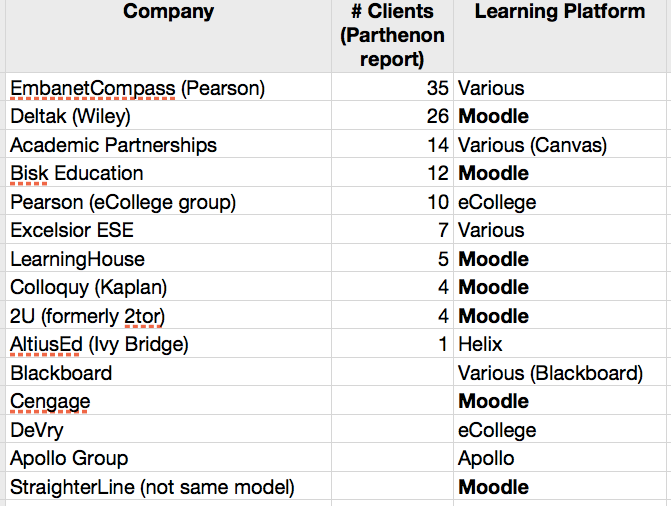
    One of the biggest growth areas in education has been the Online Service Provider market. Alternatively known as Online Education Service Provider (OESP), School-as-a-Service, or Online Program Management (OPM), this market offers services to traditional colleges and universities that are creating online programs. In August I listed the LMS used by the top OSP providers, and while the data for this table is a year old, it does give a sense of who the major players are.

    SaaS LMS Chart 2


    How big are these companies? EmbanetCompass had estimated 2012 revenues of $130 million when Pearson acquired the company for $650 million. Deltak had estimated 2012 revenues of $54 million when Wiley acquired the company for $220 million. Academic Partnerships had estimated 2012 revenues of $43 million. I don’t have updated 2013 numbers, but various estimates have this market growing at 50% or more per year.

    Yesterday 2U, Inc submitted a S-1 document with the SEC, registering the company’s intention to go public in 2014. (more…)