
e-Literate

Present is Prologue

Tag: K-12

  • Preliminary Data on K-12 LMS Market

    Preliminary Data on K-12 LMS Market

    Over the past several months, we have worked with our partners at LISTedTECH as they ramp up their efforts to collect data on LMS usage in the K-12 market in the United States. This is a massive effort as the market includes more than 130,000 individual public and private schools, and more than 13,600 school districts, according to recent NCES documentation. We are aware of several private data sources with estimates on the K-12 LMS market, but there are no public sources.

    Part of the challenge is that the K-12 market is messier than higher education’s and its roughly 7,200 institutions. One reason is that the general IT infrastructure in K-12 is less mature than in higher ed, and for smaller schools there are a lot of ad hoc implementations running on a local server not even in a data center. Another reason is the availability of free options such as Google Classroom, or freemium options such as that offered by Schoology and Canvas for individual faculty.

    As we build up the data and improve our methods, we believe we are starting to see some interesting trends in the data worth sharing.

    Our initial sample looks at 6,875 public schools from across the country in the NCES-designated primary, middle, high and other (special ed, vocational or alternative) categories. These results were analyzed over several data collection methods along with manual evaluation of that data. That said, we expect to see movement in the numbers as we collect and verify additional data, including LMS usage at private schools.

    As in our analysis of the higher ed market, we are focusing on school-wide implementations of LMS platforms. At many K-12 schools, in the absence of a school-wide implementation, individual teachers opt to use an LMS for their particular classroom, often for free. We do not consider this case a school-wide adoption and therefore do not include those use cases in our data. This methodology does not fully analyze total usage of a platform like Schoology that has a freemium model, including a free option for individual teachers and an enterprise solution which is a school-wide adoption based on a fee per student model. A platform like Google Classroom likewise has usage by individual teachers as well as school-wide implementations.

    Before we share the preliminary data, some caveats are in order to hopefully avoid anyone misrepresenting this information:

    • This is preliminary data that will likely change as we learn more. While we believe there are some broad trends already emerging, there will be refinements as we increase our coverage over time. We expect the changes to be in small adjustments to specific numbers but not in big changes to market shape.
    • This view is based on number of schools that have implemented an LMS, which is a different metric than district-wide implementations (where many or most of the purchasing decisions occur) or implementations scaled by student enrollments. We will add these views in the future.
    • This view is based on installed base (which represents total estimated deployments), which is different than new implementations in a given time period (which would measure market momentum). Again, we will add these views over time, just as we have done for the higher ed LMS market.
    • Due in particular to the free options available in K-12, there will be schools that have more than one LMS available at the institutional level. Google Classroom in particular is often available as an option at a school even when there is another LMS.
    • As is our practice at e-Literate, we’ll describe the caveats and present the data as is. As we learn more, if the relative percentages change significantly, we will share updates.
    • For more information on our data methods, see this post.

    The first graph presents a view of K-12 school-wide LMS implementations in the United States for the 8 states (and DC) where we have at least 17% coverage of known schools (Alaska, Delaware, District of Columbia, Florida, Massachusetts, Minnesota, Texas, Wisconsin).
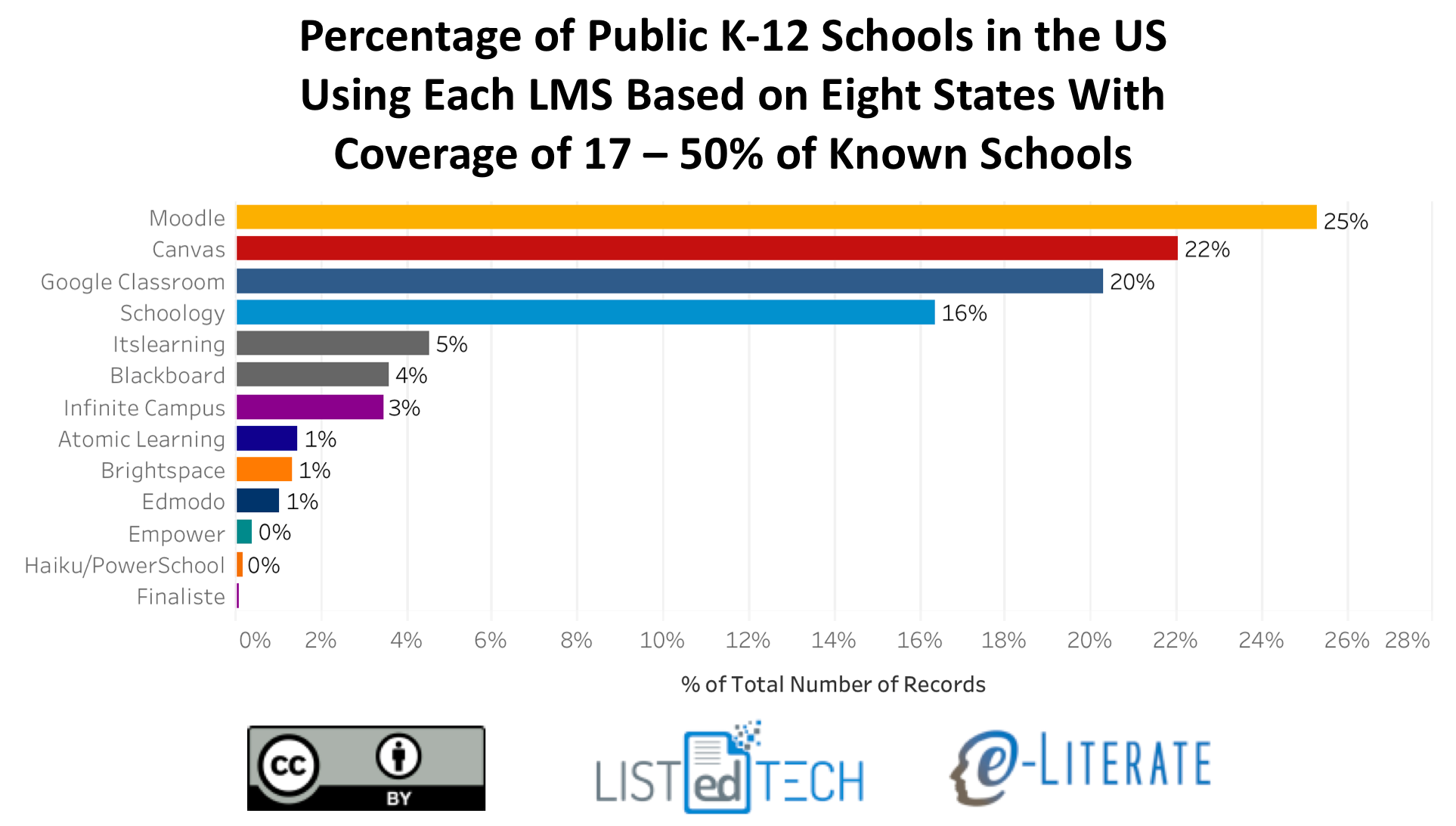
    LMS Market Share for K-12 in US, 8 States

    To get a sense of how representative this initial market share is, we made the same calculations across all 6,875 schools from 50 states and DC that in our data thus far. The data for each LMS matched within ~2% for each LMS (e.g. Canvas went from 22% to 24%, Moodle went from 25% to 24%) between the two views.

    As in the higher education market, there appears to be four top contenders in K-12 – Moodle, Canvas, Google Classroom, and Schoology – with all others having 5% or less of market share. Moodle and Canvas are both present in the Big Four for both higher education and K-12, but in K-12 Google Classroom and Schoology are the other big players. We believe that this is the first data set showing just how widely Google Classroom has been adopted. ((Disclosure: Instructure, Schoology, Blackboard, and D2L are subscribers to our LMS Market Analysis service; Instructure and Blackboard also are sponsors for an upcoming event we are organizing.))

    The general distribution is somewhat consistent across school levels – primary, middle, high school, and others – with some interesting smaller variations. The following view also gives a sense of our relative data coverage by level. In this case we are using all our data across the 6,875 schools. Note that totals are higher than this number due to multiple systems being available at some schools.
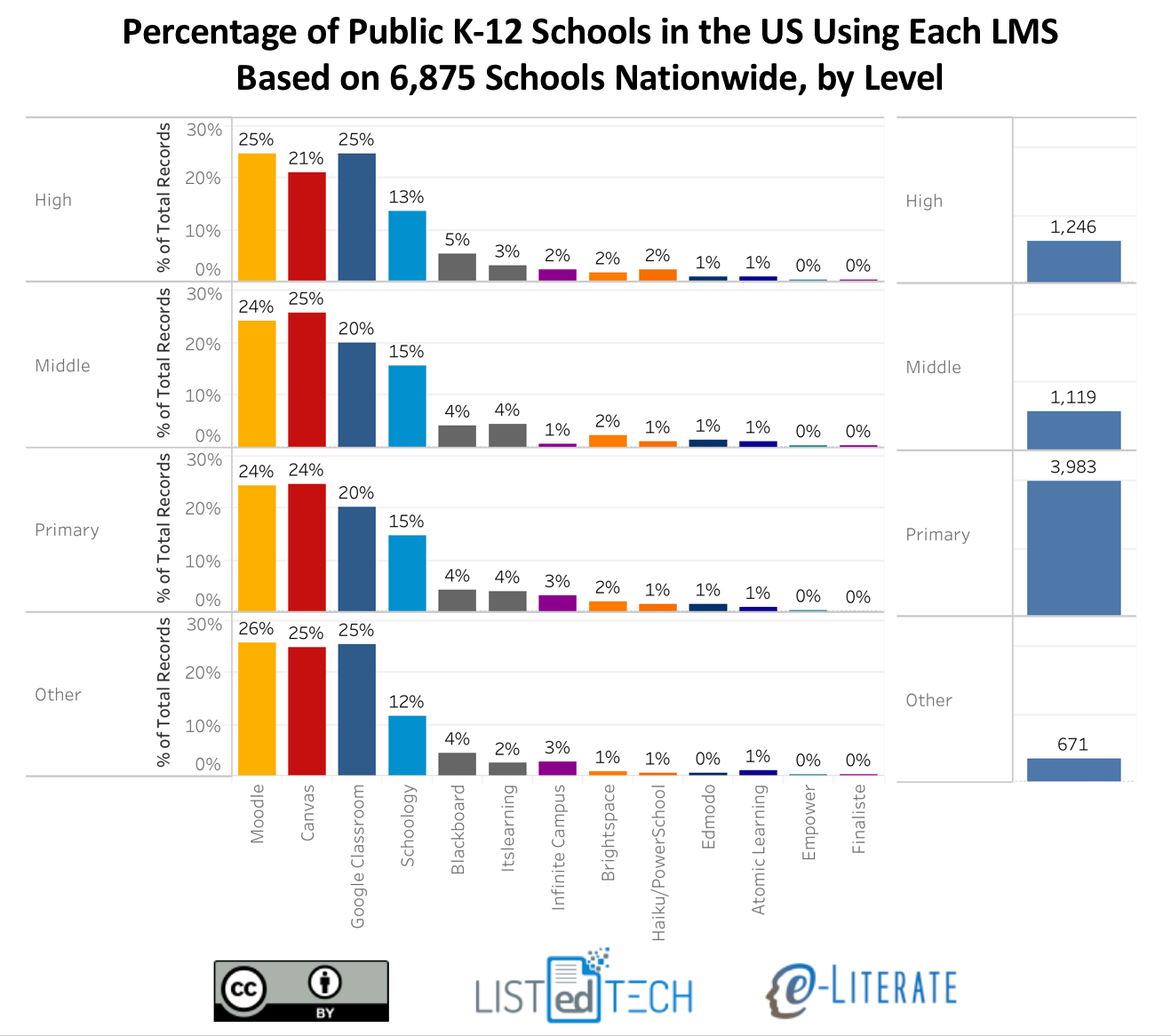
    LMS Market Share for US K-12, By Level

    We hope this new data provides a broader view of the academic LMS market. We’d love to hear your feedback and questions.

  • Instructure: Accelerating growth in 3 parallel markets

    I’m not sure which is more surprising – Instructure’s continued growth with no major hiccups or their competitors’ inability after a half-decade to understand and accept what is at its core a very simple strategy. Despite Canvas LMS winning far more new higher ed and K-12 customers than any other vendor, I still hear competitors claim that schools select Canvas due to rigged RFPs or being the shiny new tool despite having no depth or substance. When listening to the market, however, (institutions – including faculty, students, IT staff, academic technology staff, and admin), I hear the opposite. Canvas is winning LMS selections despite, not because of, RFP processes, and there are material and substantive reasons for this success.

    The only competitor I see that seems to understand the depth of the challenge they face is Blackboard. Other LMS solutions are adding “cloud” options or making incremental improvements to usability, but only Blackboard is going for wholesale changes to both its User Experience (UX) and cloud hosting architecture. Unfortunately, I question whether Blackboard will be able to execute this strategy, but that is a story for another post.

    Like last year’s post about InstructureCon, I believe that the company growth chart ((The chart shows the number of clients, which is essentially the number of contracts signed with institutions, school districts, or statewide systems adopting either Canvas or Bridge LMS products.)) gives a lot more information than just “gosh, we’re doing well”. (more…)

  • Google Classroom Addresses Major Barrier To Deeper Higher Ed Adoption

    A year ago I wrote about Google Classroom, speculating whether it would affect the institutional LMS market in higher education. My initial conclusion:

    I am not one to look at Google’s moves as the end of the LMS or a complete shift in the market (at least in the short term), but I do think Classroom is significant and worth watching. I suspect this will have a bigger impact on individual faculty adoption in higher ed or as a secondary LMS than it will on official institutional adoption, at least for the next 2 – 3 years.

    And my explanation [emphasis added]:

    But these features are targeted at innovators and early adopter instructors who are willing to fill in the gaps themselves.

    1. The course creation, including setting up of rosters, is easy for an instructor to do manually, but it is manual. There has been no discussion that I can find showing that the system can automatically create a course, including roster, and update over the add / drop period.

    (more…)

  • Early Review of Google Classroom

    Meg Tufano is co-Founder of SynaptIQ+ (think tank for social era knowledge) and leader of McDermott MultiMedia Group (an education consulting group focused on Google Apps EDU). We have been checking out Google Classroom – with her as the teacher and me as the student. I include some of Meg’s bio here as it is worth noting her extensive experience designing and teaching online courses for more than a decade.

    Meg posted a Google Slides review of her initial experiences using Google Classroom from a teacher’s perspective, which I am sharing below with minimal commentary. The review includes annotated slides showing the various features and Meg’s comments.

    I have not done as much work to show the student view, but I will note the following:

    • The student view does not include the link to the Chrome Store that Meg finds to be too confusing.
    • The biggest challenge I’ve had so far is managing my multiple Google accounts (you have to be logged into the Google Apps for Edu as your primary Google account to enter Classroom, which is not that intuitive to students).
    • I wonder if Google will continue to use Google tools so prominently in Classroom (primary GDrive, YouTube, GDocs) or if the full release will make it easier to embed non-Google tools.
    • I have previously written “Why Google Classroom won’t affect institutional LMS market … yet”, and after initial testing, nothing has changed my opinion.
    • I have one other post linking to video-based reviews of Google Classroom here.
  • Why Google Classroom won’t affect institutional LMS market … yet

    Yesterday I shared a post about the new Google Classroom details that are coming out via YouTube videos, and as part of that post I made the following statement [emphasis added]:

    I am not one to look at Google’s moves as the end of the LMS or a complete shift in the market (at least in the short term), but I do think Classroom is significant and worth watching. I suspect this will have a bigger impact on individual faculty adoption in higher ed or as a secondary LMS than it will on official institutional adoption, at least for the next 2 – 3 years.

    The early analysis is based on this video that shows some of the key features:

    (more…)

  • Google Classroom: Early videos of their closest attempt at an LMS

    For years the ed tech community has speculated about Google entering the LMS market, including Wave (discontinued, but some key features embedded in other tools), Apps for Education, and even incorrectly with Pearson OpenClass. Each time there is some possibilities, but Google has not shown interest in fully replacing LMS functionality.

    Google Classroom, announced in May and with new details coming out this week, is the closest that Google has come to fully providing an LMS. The focus is much more on K-12 than on higher education.

    For background on the concept, see this video from May which emphasizes roster integration (with some instructor setup required), document sharing through Google Drive, server and security through the cloud, discussions tied to assignments, and a focus on ‘letting teachers and students teach or learn their way’.

    Yesterday Google shared a new video that directly shows the user interface and some key features.

    (more…)

  • Breaking Up the LMS: K-12 District Selects Part of LoudCloud Systems’ LMS

    This is a guest post by Phil Hill from Delta Initiative, follow on Twitter  @PhilOnEdTech or his blog

    It’s been a busy week for LMS announcements, and I expect more announcements leading up to EDUCAUSE.  First, the Hawaii Virtual Learning Network (for K-12) is moving from Moodle to Blackboard, which as Michael Feldstein points out, is a new development to watch.  Then Brown University announced they are moving from Blackboard to Instructure’s Canvas as their LMS.  This morning, Jefferson County school district, the largest district in Colorado, announced that they have chosen a module from  LoudCloud Systems’ LMS as the basis for their Instructional Improvement System.

    That’s right – they purchased a module from the overall LMS.  Normally I cover higher ed more than K-12, but this announcement is worth watching since it shows how the New Mentality in LMS Market is or will be changing our expectations on what an LMS can provide.

    (more…)