
e-Literate

Present is Prologue

Tag: Kuali

  • Unizin Updates: Clarification on software development and potential new members

    In a recent post on Kuali, I characterized Unizin as a community source initiative. Brad Wheeler, CIO at Indiana University and co-founder of Kuali and Unizin, responded via email (with permission to quote):

    Unizin is not a Community Source effort in the way that I understand Community Source as we started applying the label 10+ years ago. Unizin is better understood, as you have reported, as a cloud-scale service operator somewhat like I2. It does not plan to do lots of software development other than as needed for integrations. No biggie, just a nuanced observation from the end of the story.

    Brad is correct, and I note that Unizin document has been fairly consistent in the lack of plans for software development, as seen in Unizin FAQs:

    Is Unizin another open- or community-source project like Sakai or Kuali?
    No – those endeavors focus on building software as a community, for use by individual institutions. Unizin strives to foster a community more concerned with creating and sharing content and improving outcomes.

    I have already revised the Kuali post to add a clarification on this point. I asked Brad whether this means that Unizin is ruling out software development. His reply:

    Unizin is working on its roadmap for each area. If we do need to head down some development approach that is more than integration, we’ll give thought to the full range of options for best achieving that, but there is no plan to begin an open/community source effort at this time.

    All public indications are that Unizin plans to source existing technologies (as they have done with Canvas as the LMS) for content repository and learning analytics functionality, focusing any software development on integrations.
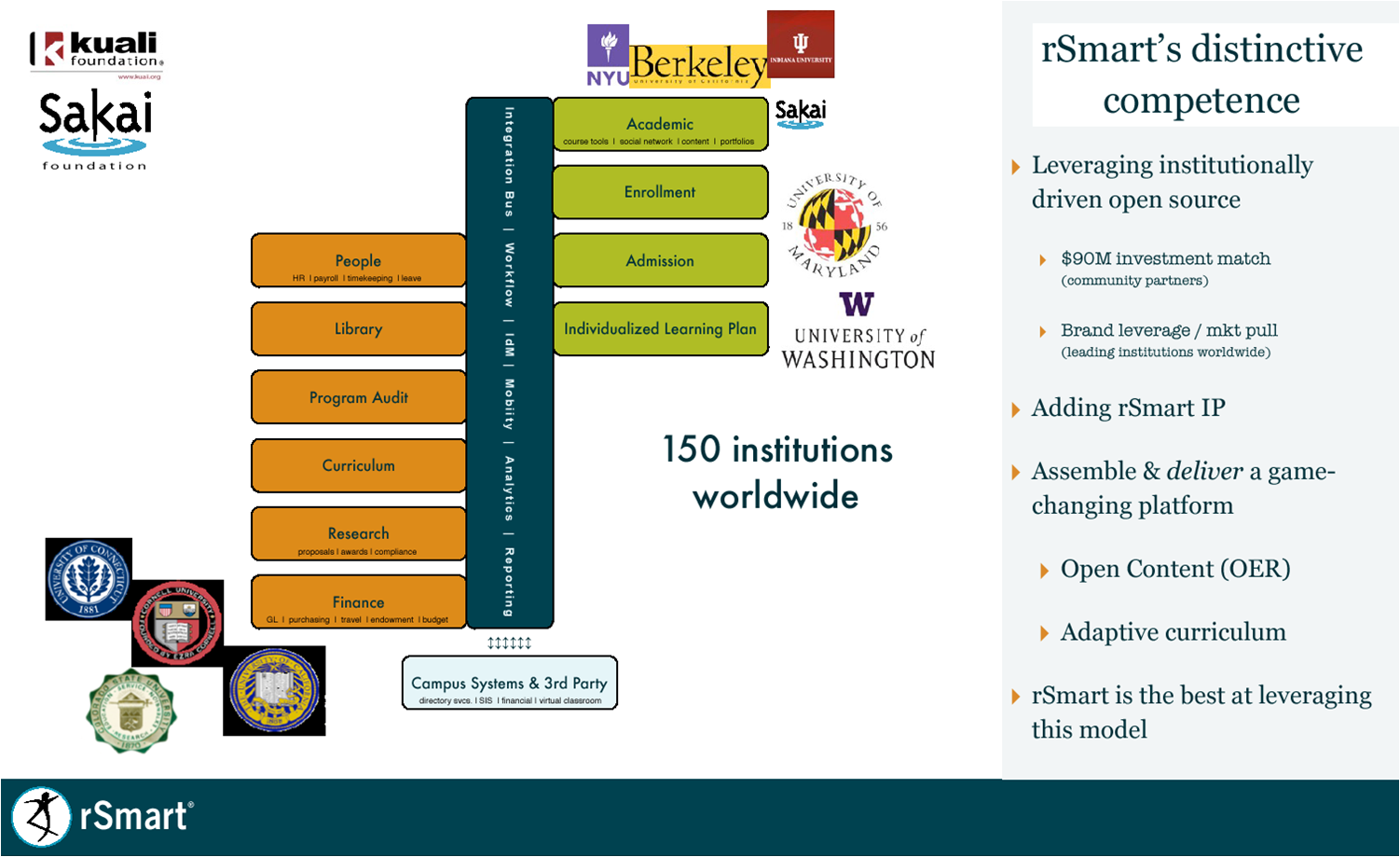
    Potential New Consortium Members

    (more…)

  • Community Source Is Dead

    As Phil noted in yesterday’s post, Kuali is moving to a for-profit model, and it looks like it is motivated more by sustainability pressures than by some grand affirmative vision for the organization. There has been a long-term debate in higher education about the value of “community source,” which is a particular governance and funding model for open source projects. This debate is arguably one of the reasons why Indiana University left the Sakai Foundation (as I will get into later in this post). At the moment, Kuali is easily the most high-profile and well-funded project that still identifies itself as Community Source. The fact that this project, led by the single most vocal proponent for the Community Source model, is moving to a different model strongly suggests that Community Source has failed.

    It’s worth taking some time to talk about why it has failed, because the story has implications for a wide range of open-licensed educational projects. For example, it is very relevant to my recent post on business models for Open Educational Resources (OER).

    (more…)

  • Kuali For-Profit: Change is an indicator of bigger issues

    On Friday the Kuali Foundation announced the creation of a new for-profit entity to be led by the former CTO of Instructure, Joel Dehlin. Jeff Young at the Chronicle described the change:

    Ten years ago, a group of universities started a collaborative software project touted as an alternative to commercial software companies, which were criticized as too costly. On Friday the project’s leaders made a surprising announcement: that it would essentially become a commercial entity. [snip]

    The Kuali Foundation will continue to exist as a non-profit, but it will be an investor in a new commercial entity to back the Kuali software development. Leaders insisted that they would maintain the values of the project despite creating the kind of organization that they once criticized. For one thing, the source software will remain free and open, but the company will sell services, like software hosting. On Friday the group issued an FAQ with details about the change.

    As Carl Straumsheim put it at Inside Higher Ed:

    The Kuali Foundation, after a decade of fighting commercial software vendors as a community source initiative, will launch a commercial company to better fight… commercial software vendors.

    Despite the positioning that this change is about innovating into the next decade, there is much more to this change than might be apparent on the surface. The creation of a for-profit entity to “lead the development and ongoing support” and to enable “an additional path for investment to accelerate existing and create new Kuali products fundamentally moves Kuali away from the community source model. Member institutions will no longer have voting rights for Kuali projects but will instead be able to “sit on customer councils and will give feedback about design and priority”. Given such a transformative change to the underlying model, there are some big questions to address.

    Financial Needs

    Kuali, being a non-profit foundation, has its financial records available online, and the tax reporting form 990s are easily obtained through sites such as GuideStar. Furthermore, instructional media + magic (im+m) has a public eLibrary where they have shared Kuali documentation over the years. ((Disclosure: Jim Farmer from im+m has been a guest blogger at e-Literate for many years.)) There does not appear to be a smoking gun found in the financials to directly explain the need for such a significant change, but there are hints of issues that provide some insight. (more…)

  • Kuali: A Primer for Community Source Administrative Systems in Higher Ed

    I was recently invited to attend a user conference – Kuali Days in Austin, TX – and was struck by the disconnect between Kuali’s relatively low profile and the excitement expressed by the institutional representatives attending the conference. Before getting to any analysis of Kuali and its prospects, however, I need to lay out the basics to help me keep the terminology straight.

    My focus in consulting and writing is on educational technology – those systems that directly impact a student’s educational needs. While there are a range of administrative systems within the Kuali portfolio of projects, I will place more emphasis on those systems which are closer to the student experience.

    Based on interviews at the conference, the core value that Kuali provides are:

    • Administrative systems designed for specific needs (for higher education, by higher education); and
    • Dramatically lower hard costs for administrative systems.

    What is the Kuali Project and Foundation?

    In 2004, a group of technologists were looking to collaborate on a shareable Financial System based on a homegrown system designed at Indiana University. Within the CIC (a forum for technology collaboration mostly amongst the former Big 10 schools), there were several discussions about the nature of sharing. Even though the source code and design would be shared, who would own the software and intellectual property? Who would manage common development? These questions led to the concept of a third-party organization.

    The Kuali Project was created in early 2005 based on founding partners Indiana University, The University of Arizona, the University of Hawaii, Michigan State University, San Joaquin Delta Community College, Cornell University, NACUBO and the rSmart Group.

    (more…)

  • More Venture Capital for Higher Education: $10.75 million for rSmart

    On August 16 rSmart Group Inc. announced securing funding from Asahi Net Inc., GSV Capital Corp., and private investors. GSV investment advisor Michael Moe expressed confidence in the firm saying “rSmart is helping universities realize lower total cost of ownership and higher quality products that are easy to use. Most importantly, rSmart’s customers are becoming part of a sustainable, collaborative movement using solutions built by higher education for higher education. GSV wants to be part of this movement, and rSmart is the company to make it happen.”

    rSmart is a more mature and experienced company than the 26 others who presented at the “sold out” April “Education Innovation Summit.” GSV Advisors and Arizona State University hosted the third annual Summit with presentations on innovation and by new companies seeking to enter the education market. (Presentations are available here; rSmart’s presentation is available here and here). rSmart has participated in the Kuali and Sakai open source software initiatives to meet the needs of colleges and universities. Moe lists open source as a major trend in education. rSmart also has had an international presence teaming with Asahi Net Inc. and its U.S. subsidiary in cloud services. rSmart Chairman John Robinson is a visionary with 35 years experience with innovative higher education software technology. rSmart is one of the first to contribute to software architecture that spans both administration and learning using current software design techniques and technology—a goal of the Kuali Foundation.

    (more…)

  • More on the Sakai/Jasig Merger

    As I have mentioned here before, the Sakai and Jasig foundations are in the process of evaluating a merger to create a kind of Apache Foundation for higher education. The new organization would be called the Apereo Foundation. The two communities will be voting on the merger some time in the next month or so. Documentation and discussion can be found here.

    I’d like to tell you why I think this merger is vitally important for higher education in general and Sakai in particular.

    (more…)

  • Backward University IP Polices Force Convoluted Sakai License

    A couple of weeks back, I was somewhat disturbed to read a post by Unicon’s John Lewis on the forthcoming Version 2.0 of the Educational Commons License (ECL), which is used by both the Sakai and the Kuali projects. While pointing out some significant improvements over the previous version, John notes correctly that the proliferation of open source licenses has a cost in terms of confusion in the marketplace and wonders why Sakai and Kuali can’t just use the Apache license upon which ECL is based. (After all, he observes, Moodle uses plain vanilla GPL.) So John did a little digging, and the only difference he could find between ECL and the Apache license was a clause on patents. Specifically, ECL weakens Apache’s patent protection clause.

    Seeing this, I contacted Chris Coppola, the Sakai board member who has been leading the charge on licensing issues. Chris was gracious enough to post more detail on the issue and help me get in contact with other folks who could help me make sure that I understand the legal implications correctly. Now, I happen to trust Chris’s judgment and motivation, and I am confident that the license would have come out the right way if he had final say. Unfortunately, he does not. Nor does anyone on the Sakai Foundation Board. As a result, ECL 2.0 is disturbingly flawed from the perspective of the edupatent crisis. (more…)