
Indiana University has been the driving force behind the creation of a new organization to develop a “learning ecosystem”. At least ten schools are being quietly asked to contribute $1 million each over a three-year period to join the consortium. The details of what that $1 million buys are unclear at this point. The centerpiece for the short-term appears to be a contract with Instructure for use of the Canvas LMS. But there are also hints of ambitious plans regarding learning object repositories and learning analytics.
What is remarkable is the level of secrecy surrounding the project. Several sources from involved schools have indicated that very few people have been informed regarding their institutions’ prospective involvement. When school discussions do take place, care is being taken to keep them quiet. For example, a video recording of a presentation to faculty about Unizin at Colorado State University has since been removed from public access after it received some attention on Twitter (although e-Literate downloaded a copy of the video before it was removed from public access).
Nevertheless, details of the project are beginning to leak out. In this post, I will share the facts that we have been able to confirm. Phil and I will both follow on with some analysis and inferences early next week. And of course, we will continue to bring you updates as news breaks.
The (Prospective) Members
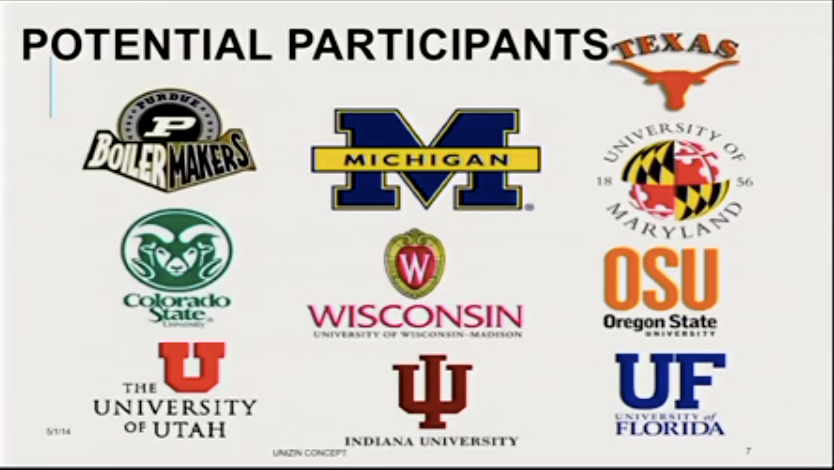
As far as we can tell, there are no definite commitments to join this group yet other than from Indiana, although University of Michigan and Colorado State University are beginning to socialize the idea on their respective campuses. The recording obtained by e-Literate is a presentation by CSU Dean of Libraries Pat Burns and Associate Provost for Innovation Mike Palmquist to what was apparently a group of faculty members. The ten potential Unizin members listed on the presentation slides (along with their current LMSs) are as follows:
- Colorado State University (Blackboard)
- Indiana University (Sakai)
- Oregon State University (Blackboard)
- Purdue University (Blackboard)
- University of Florida (Sakai, with some use of Canvas)
- University of Maryland (Canvas)
- University of Michigan (Sakai)
- University of Texas (Blackboard, with at least one campus in the process of moving to Canvas)
- University of Wisconsin (Desire2Learn)
- University of Utah (Canvas)
An article in the University of Michigan campus newspaper about a briefing to the faculty senate corroborates Michigan, Indiana, and Florida as participants in Unizin discussions. There may be others involved in the discussions as well. For example, we have some evidence that Rice University is or was considering joining. A bond issuance document by the university refers to its participation in something called “Coalition for Online Teaching and Learning (COLT)”. A CV for a Vice Provost at Purdue University describes one of her job duties as representing the university at “the Coalition for Online Learning and Teaching (now referred to as UniZin, the online learning ecosystem consortium)”. ((Pray that your spouse’s divorce lawyer never hires Phil Hill as a private investigator.))
While the group seems only loosely connected to the Big 10’s Committee on Institutional Cooperation (CIC), the group does share some common key players with an earlier position paper by a CIC task force motivated by the perceived need to take back control of distance learning from MOOC providers such as Coursera.
At the recorded CSU meeting, one of the presenters—it’s impossible to tell which is the speaker from the recording we have—acknowledges that the meetings were largely conducted in secret when challenged by a faculty member on the lack of faculty involvement. He cited sensitive negotiations among the ten universities and Instructure as the reason.
The CSU presenters specifically state that CSU was “invited” to join Unizin—the name is apparently a portmanteau of “university” and “zinfandel”—and suggested that one of the reasons for their inclusion was their experience with distance education relative to the other members. According to the meeting notes of the CSU technology fee advisory board dated April 7, 2014, Pat Burns said,
They want similar universities and in a lot of ways we are very similar to these other universities and institutions. We are way ahead in some areas. We do about $38 million a year in online education. We are leaders in online education and how to do that right.
More on this later in the post.
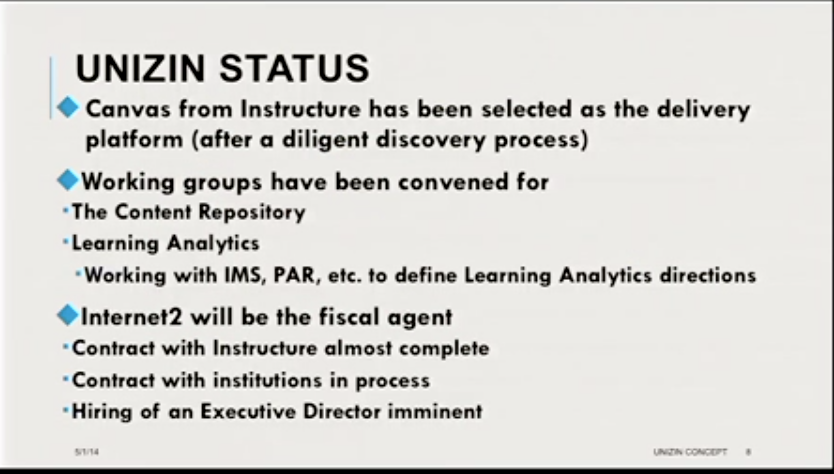
As I mentioned before, each university will be expected to contribute $1 million. According to the CSU presentation, Internet2 is acting as the “fiscal agent” and the hiring of an executive director for the project is “imminent”.
The LMS Deal
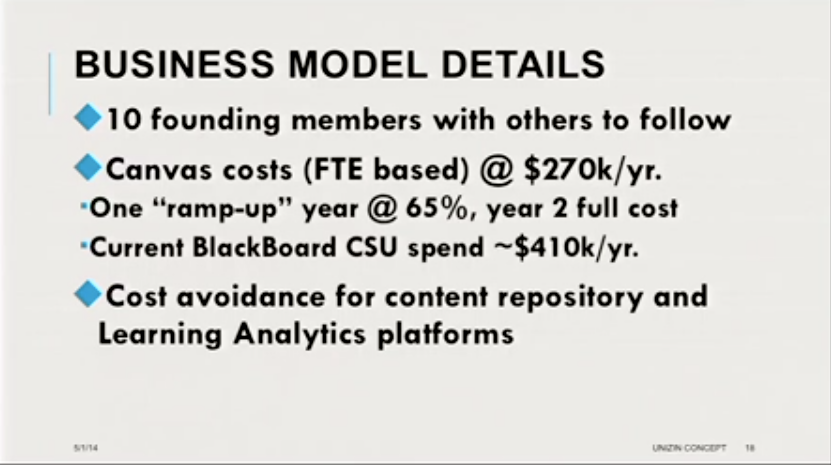
Although there are ambitious larger plans for the coalition, the immediate driver of the deal appears to be the formation of a buyers’ club to license Instructure Canvas. Indiana University, which is leading the discussions of the coalition, has already announced that they will be moving to Canvas after a selection process comparing that LMS to Blackboard and Desire2Learn (ironically using product evaluation categories developed during the design process for Sakai OAE). According to CSU presentation and documents, the Canvas license would cost $150,000 the university less per year than their Blackboard license under this deal. However, because the university would be paying in $1,000,000 over three years up front, they expect “about a seven-year payback,” according to the meeting minutes. (The presenter in the video recording said “seven to ten years.”)
The level of due diligence each campus has put into the selection of Canvas seems to vary widely. Indiana has documented extensive research at their LMS selection site. A Canvas pilot was run at the University of Wisconsin, while Oregon State University is in the process of piloting Canvas. On the other hand, CSU seems mainly to rely on IU’s research as their due diligence. Some of the faculty members in the audience seemed to know more about Canvas functionality versus Blackboard and Blackboard-to-Canvas migration issues than the staff did.
We have no evidence that the current deal includes special provisions about opening the source code of the platform, much but not all of which Instructure releases under the AGPL open source license. However, the CSU presenters speculated the the coalition could self-host, stop paying fees to Instructure, and develop the LMS themselves in the future. No mention was made of the fact that the Sakai schools in the Unizin coalition would be leaving just such an open source coalition in favor of a hosted and externally developed solution.
Prospective: Learning Object Repository (LOR) and Analytics
In addition to the LMS, the coalition has ambitions to add a LOR and a learning analytics platform.
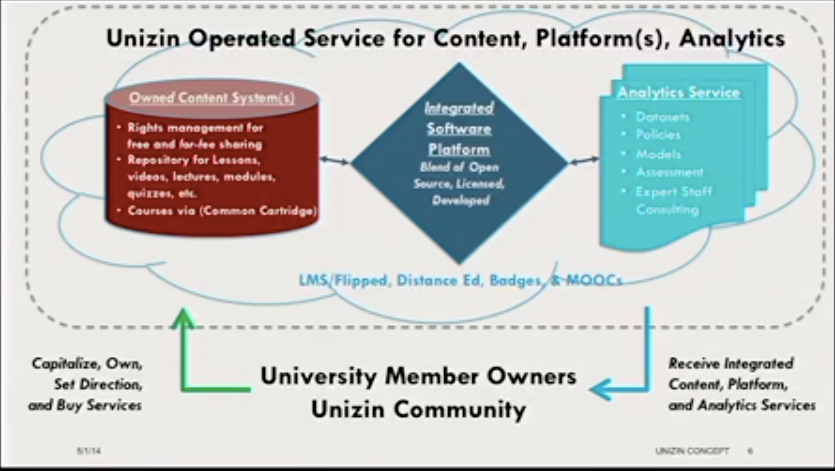
It is not clear whether Unizin intends to build or buy these components, or even whether that decision has been made at this time. However, the CSU presenters (correctly) mentioned that University of Wisconsin has significant expertise and experience in learning analytics, suggesting that this is one reason why they were asked to join the coalition. Wisconsin is involved in the Open Learning Analytics initiative and has been one of a few early adopters of Desire2Learn’s analytics platform. Purdue is also famous for its Course Signals learning analytics platform (and infamous for its lack of transparency about problems with their research). Likewise, LORs have been developed by both the University of Utah and Rice. These pieces, along with the CSU comments about the coalition pooling development resources, suggest that consortium-based development (with or without an open source license) is an option being considered.
According the CSU presenters, all content would be stored in a “monolithic” content repository for the coalition, “outside of vendor platforms” (which may be another indicator that Unizin intends to develop its own software, or may just mean “outside the LMS”). The repository would also act as a “reflector,” meaning that it could contain links to externally hosted content.
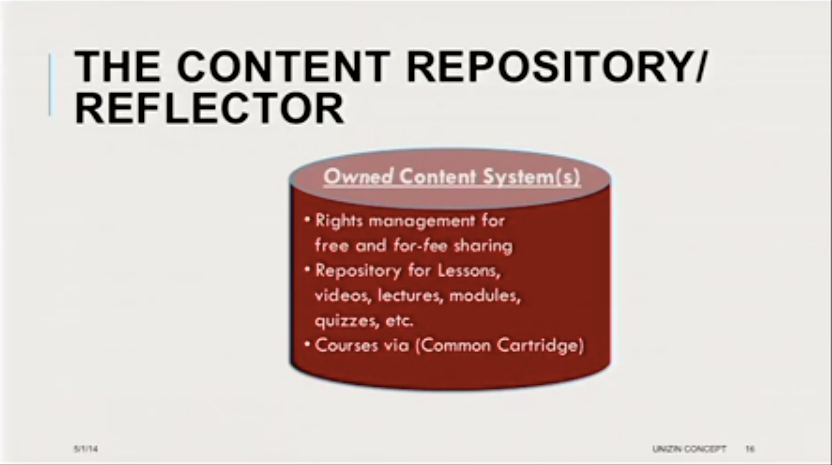
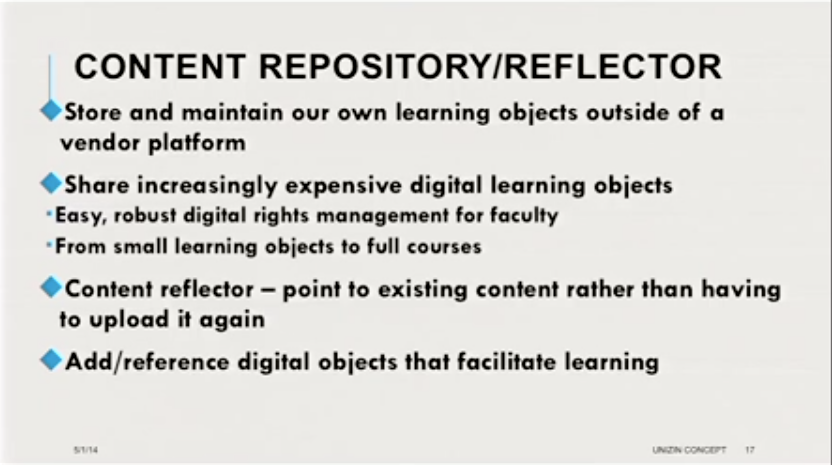
Various rationales were given by the CSU presenters regarding the need for a centralized LOR. One was that they claimed it would make future LMS migrations easier if the content were externally stored. Another was that it would make inter-campus course sharing easier. On this last point, while this possibility was mentioned several times, with the example that CSU might share engineering courses with IU in exchange for foreign language courses, it does not appear that there were any concrete sharing arrangements worked out.
The scope of the analytics ambitions seem broad:
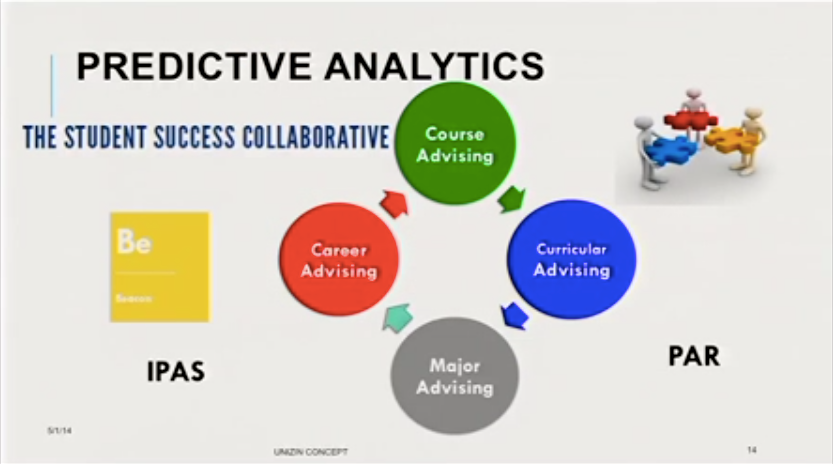
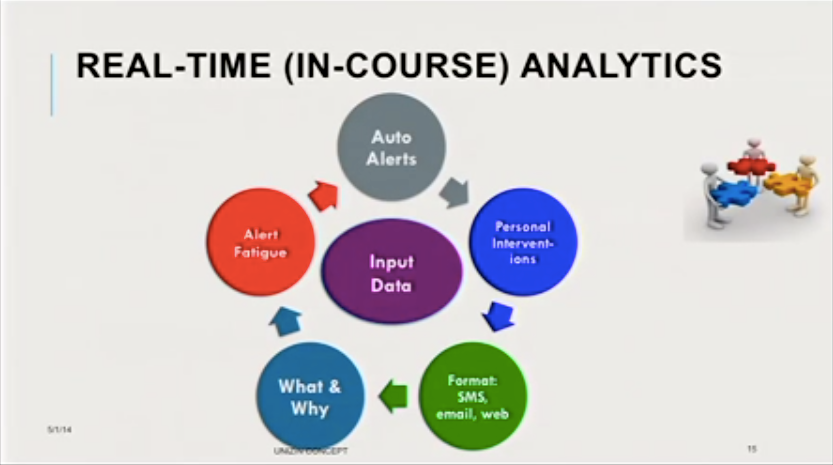
These slides contain a menu of just about every kind of learning analytics in the market today. There is no indication that specific plans or priorities have been developed for Unizin analytics at this time.
Unanswered Questions
That sums up what we know about Unizin at this time. As I mentioned earlier, Phil and I will be writing next week about what we think we can infer from what we know. In the meantime, I want to close this post with some questions focusing on what we don’t know:
- What does that $1 million per campus pay for?
- Will the coalition be hosting Canvas itself, or will Instructure do that?
- Internet2 already has a pricing agreement with Instructure through NET+; how is Unizin’s different and (presumably) better?
- Both Apereo and Kuali are foundations that host open source software projects relevant to Unizin’s ambitions and of which at least a few of the Unizin schools are contributing members; why are neither of these foundations (apparently) involved in the project?
- What are the real drivers for the content repository development? Ease of LMS migration seems like an inadequate explanation for an effort of this size, and the course sharing ambitions seem vague.
- How does Unizin intend to solve the content re-use problem which has plagued pretty much every other LOR initiative in the long history of LOR initiatives?
- What would the first goals of the learning analytics project be (given how many possible goals are articulated), and how would they interact with the content repository requirements?
- How will faculty react when Unizin is made public on their campuses? And does this reflect a broader shift in the role of faculty governance?
Comments
9 responses to “Unizin: Indiana University’s Secret New “Learning Ecosystem” Coalition”
[…] This information was passed on to me by my colleague, Joel Hartman (University of Central Florida), and appeared on the e-Literate website. […]
Nice piece of reporting, Michael. It will be interesting to see how this unfolds. I’m sure it will be topic of great interest at the upcoming Apereo Conference. See you there.
[…] the week since we published our Unizin exposé, there has been nary a peep from the group to us, or apparently to the traditional news outlets […]
[…] interesting part for today’s post is that Unizin chose Canvas as mean of distribution for its consortium. Most universities who are on the list of potential partners in the consortium currently use […]
[…] all goes back to that really glib e-mail that Historiann posted a few weeks back. As Michael explains it language only slightly less […]
[…] Unizin: Indiana University’s Secret New “Learning Ecosystem” Coalition […]
[…] Unizin: Indiana University’s Secret New “Learning Ecosystem” Coalition […]
[…] harder and watching our language; for instance, I used “ecology” above, and I’m far form alone, but we use ecology in ways similar to how Bateson accuses us of using “instinct”. In […]
[…] a recent post on Kuali, I characterized Unizin as a community source initiative. Brad Wheeler, CIO at Indiana University and co-founder of Kuali […]