e-Literate

Present is Prologue

Tag: LMS

  • Better Ed Tech Conversations

    This is another follow-up to the comments thread on my recent LMS rant. As usual, Kate Bowles has insightful and empathetic comments:

    …From my experience inside two RFPs, I think faculty can often seem like pretty raucous bus passengers (especially at vendor demo time) but in reality the bus is driven by whoever’s managing the RFP, to a managed timetable, and it’s pretty tightly regulated. These constraints are really poorly understood and lead to exactly the predictable and conservative outcomes you observe. Nothing about the process favours rethinking what we do.

    Take your focus on the gradebook, which I think is spot on: the key is how simply I can pull grades in, and from where. The LMS we use is the one with the truly awful, awful gradebook. Awful user experience, awful design issues, huge faculty development curve even to use it to a level of basic competence.

    The result across the institution is hostility to making online submission of assignments the default setting, as overworked faculty look at this gradebook and think: nope.

    So beyond the choosing practice, we have the implementation process. And nothing about this changes the mind of actual user colleagues. So then the institutional business owner group notices underuse of particular features—oh hey, like online submission of assignments—and they say to themselves: well, we need a policy to make them do it. Awfulness is now compounding.

    But then a thing happens. Over the next few years, faculty surreptitiously develop a workable relationship with their new LMS, including its mandated must-use features. They learn how to do stuff, how to tweak and stretch and actually enjoy a bit. And that’s why when checklist time comes around again, they plead to have their favourite corner left alone. They only just figured it out, truly.

    If institutions really want to do good things online, they need to fund their investigative and staff development processes properly and continuously, so that when faculty finally meet vendors, all can have a serious conversation together about purpose, before looking at fit.

    This comment stimulated a fair bit of conversation, some of which continued on the comments thread of Jonathan Rees’ reply to my post.

    The bottom line is that there is a vicious cycle. Faculty, who are already stretched to the limit (and beyond) with their workloads, are brought into a technology selection process that tends to be very tactical and time-constrained. Their response, understandably, tends to be to ask for things that will require less time from them (like an easier grade book, for example). When administrators see that they are not getting deep and broad adoption, they tend to mandate technology use. Which makes the problem worse rather than better because now faculty are forced to use features that take up more of their time without providing value, leaving them with less time to investigate alternatives that might actually add value. Round and round it goes. Nobody stops and asks, “Hey, do we really need this thing? What is it that we do need, and what is the most sensible way of meeting our needs?”

    The only way out of this is cultural change. Faculty and administrators alike have work together toward establishing some first principles around which problems the technology is supposed to help them solve and what a good solution would look like. This entails investing time and university money in faculty professional development, so that they can learn what their options are and what they can ask for. It entails rewarding faculty for their participation in the scholarship of teaching. And it entails faculty seeing educational technology selection and policy as something that is directly connected to their core concerns as both educational professionals and workers.

    Sucky technology won’t fix itself, and vendors won’t offer better solutions if customers can’t define “better” for them. Nor will open source projects fare better. Educational technology only improves to the extent that educators develop a working consensus regarding what they want. The technology is a second-order effect of the community. And by “community,” I mean the group that collectively has input on technology adoption decisions. I mean the campus community.

  • Walled Gardens, #GamerGate, and Open Education

    There were a number of interesting responses to my recent LMS rant. I’m going to address a couple of them in short posts, starting with this comment:

    …The training wheels aren’t just for the faculty, they’re for the students, as well. The idea that the internet is a place for free and open discourse is nice, of course, but anyone who pays attention knows that to be a polite fiction. The public internet is a relatively safe place for straight, white, American males, but freedom of discourse is a privilege that only a small minority of our students (and faculty, for that matter) truly enjoy. If people didn’t understand that before, #notallmen/#yesallmen and GamerGate should certainly have driven that home.

    As faculty and administrators we have an obligation–legal, and more importantly moral–to help our students understand the mechanisms, and unfortunately, often the consequences, of public discourse, including online communications. This is particularly true for the teenagers who make up the bulk of the undergrad population. Part of transformative teaching is giving people a safe space to become vulnerable and open to change. For those of us who think still of the “‘net” in terms of it’s early manifestations that were substantially open and inclusive research networks and BBS of largely like-minded people (someone else mentioned The Well, although The Well, of course, has always been a walled garden), open access seems tempting. But today’s internet is rarely that safe space for growth and learning. Just because students can put everything on the internet (YikYak, anyone?) doesn’t mean that they should.

    In many, if not most, situations, A default stance of of walled garden with easy-to-implement open access options for chosen and curated content makes a great deal of sense….

    There are lots of legitimate reasons why students might not want to post on the public internet. A few years back, when I was helping my wife with a summer program that exposed ESL high schoolers to college and encouraged them to feel like it could be something for them, we had a couple of students who did not want to blog. We didn’t put them on the spot by asking why, but we suspected that their families were undocumented and that they were afraid of getting in trouble.

    This certainly doesn’t mean that everybody has to use an LMS or lock everything behind a login, but it does mean that faculty teaching open courses need to think about how to accommodate students who won’t or can’t work on the open web. I don’t think this sort of accommodation in any way compromises the ethic of open education. To the contrary, ensuring access for everyone is part of what open education is all about.

  • Dammit, the LMS

    Count De Monet: I have come on the most urgent of business. It is said that the people are revolting!

    King Louis: You said it; they stink on ice.

    – History of the World, Part I

    Jonathan Rees discovered a post I wrote about the LMS in 2006 and, in doing so, discovered that I was writing about LMSs in 2006. I used to write about the future of the LMS quite a bit. I hardly ever do anymore, mostly because I find the topic to be equal parts boring and depressing. My views on the LMS haven’t really changed in the last decade. And sadly, LMSs themselves haven’t changed all that much either. At least not in the ways that I care about most. At first I thought the problem was that the technology wasn’t there to do what I wanted to do gracefully and cost-effectively. That excuse doesn’t exist anymore. Then, once the technology arrived as Web 2.0 blossomed—remember that term?—I thought the problem was that there was little competition in the LMS market and therefore little reason for LMS providers to change their platforms. That’s not true anymore either. And yet the pace of change is still glacial. I have reluctantly come to the conclusion that the LMS is the way it is because a critical mass of faculty want it to be that way.

    Jonathan seems to think that the LMS will go away soon because faculty can find everything they need on the naked internet. I don’t see that happening any time soon. But the reasons why seem to get lost in the perennial conversations about how the LMS is going to die any day now. As near as I can remember, the LMS has been about to die any day now since at least 2004, which was roughly when I started paying attention to such things.

    And so it comes to pass that, with great reluctance, I take up my pen once more to write about the most dismal of topics: the future of the LMS.

    (more…)

  • LISTedTECH: New wiki site and great visualizations

    Last year I wrote about a relatively new site offering very interesting data and visualizations in the ed tech world. LISTedTECH was created by Justin Menard, who is Business Intelligence Senior Analyst at University of Ottawa. First of all, the site is broader in scope than just the LMS – there is a rich source of data & visualizations on MOOCs, university rankings, and IPEDS data. Most of the visualizations are presented by Tableau and therefore interactive in nature, allowing the user to filter data, zoom in on geographic data, etc. Since e-Literate is not set up for full-page visualizations, I have included screen shots below, but clicking on the image will take you to the appropriate LISTedTECH page.

    Top_Learning_Management_System__LMS__by_State_or_Province_-_LISTedTECH

    (more…)

  • State of the US Higher Education LMS Market: 2014 Edition

    I shared the most recent graphic summarizing the LMS market in November 2013, and thanks to new data sources it’s time for an update. As with all previous versions, the 2005 – 2009 data points are based on the Campus Computing Project, and therefore is based on US adoption from non-profit institutions. This set of longitudinal data provides an anchor for the summary.

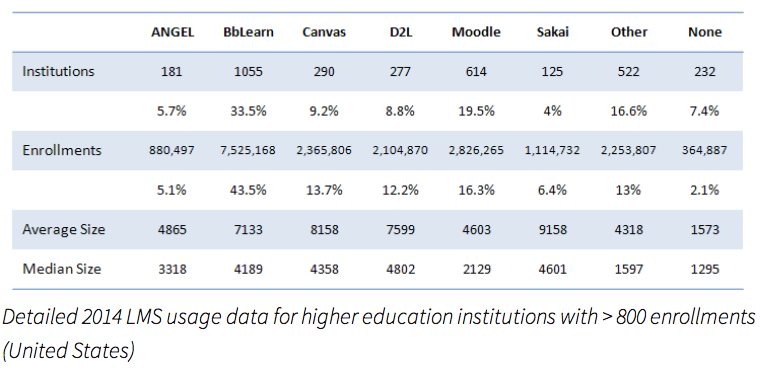
    The primary data source for 2013 – 2014 is Edutechnica, which not only does a more direct measurement of a larger number of schools (viewing all schools in IPEDS database with more than 800 FTE enrollments), but it also allows scaling based on enrollment per institution. This means that the latter years now more accurately represent how many students use a particular LMS.

    A few items to note:

    • Despite the addition of the new data source and its inclusion of enrollment measures, the basic shape and story of the graphic have not changed. My confidence has gone up in the past few years, but the heuristics were not far off.
    • The 2013 inclusion of Anglosphere (US, UK, Canada, Australia) numbers caused more confusion and questions than clarity, so this version goes back to being US only.
    • The Desire2Learn branding has been changed to Brightspace by D2L.
    • The eCollege branding has been changed to Pearson LearningStudio.
    • There is a growing area of “Alternative Learning Platforms” that includes University of Phoenix, Coursera, edX and OpenEdX, 2U, Helix and Motivis (the newly commercialized learning platform from College for America).
    • While the data is more solid than 2012 and prior years, keep in mind that you should treat the graphic as telling a story of the market rather than being a chart of exact data.

    LMS_MarketShare_20141107

    Some observations of the new data taken from the post on Edutechnica from September:

    • Blackboard’s BbLearn and ANGEL continue to lose market share in US -[1] Using the 2013 to 2014 tables (> 2000 enrollments), BbLearn has dropped from 848 to 817 institutions and ANGEL has dropped from 162 to 123. Using the revised methodology, Blackboard market share for > 800 enrollments now stands at 33.5% of institutions and 43.5% of total enrollments.
    • Moodle, D2L, and Sakai have no changes in US – Using the 2013 to 2014 tables (> 2000 enrollments), D2L has added only 2 schools, Moodle none, and Sakai 2 schools.
    • Canvas is the fasted growing LMS and has overtaken D2L – Using the 2013 to 2014 tables (> 2000 enrollments), Canvas grew ~40% in one year (from 166 to 232 institutions). For the first time, Canvas appears to have have larger US market share than D2L (13.7% to 12.2% of total enrollments using table above).
  • New LMS Market Data: Edutechnica provides one-year update

    In Fall 2013 we saw a rich source of LMS market data emerge.

    George Kroner, a former engineer at Blackboard who now works for University of Maryland University College (UMUC), has developed what may be the most thorough measurement of LMS adoption in higher education at Edutechnica (OK, he’s better at coding and analysis than site naming). This side project (not affiliated with UMUC) started two months ago based on George’s ambition to unite various learning communities with better data. He said that he was inspired by the Campus Computing Project (CCP) and that Edutechnica should be seen as complementary to the CCP.

    The project is based on a web crawler that checks against national databases as a starting point to identify the higher education institution, then goes out to the official school web site to find the official LMS (or multiple LMSs officially used). The initial data is all based on the Anglosphere (US, UK, Canada, Australia), but there is no reason this data could not expand.

    There is new data available in Edutechnica’s one-year update, with year-over-year comparisons available as well as improvements to the methodology. Note that the methodology has improved both in terms of setting the denominator and in terms of how many schools are included in the data collection.

    The Fall 2014 data which now includes all schools with more than 800 enrollments:

    (more…)

  • Helix: View of an LMS designed for competency-based education

    Within higher education, we tend to talk about LMS solutions based on an institutional perspective – which systems can serve as the official LMS for an entire institution. While this view is important and forms the basis for my LMS graphics, the emergence of new educational delivery models has led to the development of some interesting program-specific LMS models. One example that I have already written about is 2U’s platform (built on top of Moodle and Adobe Connect) for their specific Online Service Provider (OSP) business.

    One educational model that is becoming more and more important is competency-based education (CBE). One of the challenges for this model is that the traditional LMS – based on a traditional model using grades, seat time and synchronous cohort of students – is not easily adapted to serve CBE needs. As described in this CBE primer:

    OBE [Outcome-based education] can be implemented in various modalities, including face-to-face, online and hybrid models.

    Competency-based education (CBE) is a narrower concept, a subset or instance of OBE, where the outcomes are more closely tied to job skills or employment needs, and the methods are typically self-paced. Again based on the Malan article, the six critical components of CBE are as follows:

    1. Explicit learning outcomes with respect to the required skills and concomitant proficiency (standards for assessment)
    2. A flexible time frame to master these skills
    3. A variety of instructional activities to facilitate learning
    4. Criterion-referenced testing of the required outcomes
    5. Certification based on demonstrated learning outcomes
    6. Adaptable programs to ensure optimum learner guidance

    (more…)