
With Jim Farmer’s post, we have completed the series. I want to thank both the authors and the readers who have commented on this post. I’m hopeful that this process has shaped the final product, which will be a journal issue published some time early next year. We hope to have the contents of that issue published through some open access venue and will keep you posted on the details as they shape up.
Tag: On-the-Horizon
-
Distributed Learning is Here: Ask Any College Student
This is a guest post by Jim Farmer for a special issue on distributed learning environments for On the Horizon. Jim is Coordinator, Scholarly Systems Group at Georgetown University and editor at the eReSS project, University of Hull.
This fall more than 17 million students will be using publisher-provided online services. More than 5 million students will be enrolled in distance learning courses. More than 15 million will be using the Internet. 6.7 million will use Wikipedia. More than 11 million students will use the public library propelled by the increased use of libraries by today’s youth—often to use online materials.
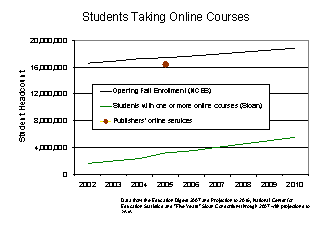 Almost 15 million students work full or part-time; 8.3 million use computers at work. An estimated 4.4 million student employees will receive online training from their employers.
These estimates do not include the several learning and library systems that may be available on the campus. Nor the online tutorial services and learning resources marketed directly to students.
Today’s college students are already in an environment of distributed learning and increasingly they, not their professors, are making decisions about which resources and services they use.
This rich distributed learning environment benefits graduate students who are motivated, demonstrated their ability to learn, and have faculty advisors guiding their learning. The current distributed learning environment may not be best for beginning undergraduate students who are less well prepared, have instructors with large class sizes, and who have less financial resources to purchase access to learning services.
-
Perspectives from a Geek with a Startup
This is a guest post by Michael Staton for the On the Horizon series on distributed learning environments. Michael studied poverty alleviation for his BA and MA at Clark University, where he developed a lifelong commitment to education and entrepreneurship. He then spent 3 years as a high school educator and was thrust into internet start ups in the education space. Seeing Facebook Platform as a disruptive opportunity, he co-founded Inigral, Inc as a consumer internet company set out accelerate real world relationships in an academic context using the product “Courses on Facebook.” Courses quickly gained traction in the Fall of 2007 and Founders’ Fund, an investor in Facebook, made a Series A investment. Inigral is also about to release a product to help K-12 educators cope with the pressures of the accountability movement. Michael is also the author of the Edumorphology and College Readiness for the 21st Century weblogs.
I spend most of my time in the midst of internet entrepreneurs. I work in an office with four other internet companies, go to beta launches in San Francisco, and attend panel discussions in Silicon Valley. Something that is conspicuously evident is that I’m one of the few entrepreneurs trying to solve problems in education. Another thing that’s evident, as ironic as it sounds, is that many internet entrepreneurs have given the problems in education considerable thought, many have even tried to contribute to or build a product to address needs in education at some point.
Start-ups in education are rare, but it’s not for lack of desire to work in the space. Venture Capital appreciates the education market size: it’s huge. Everyone gets an education, and mind-numbing amounts of money are spent to that end. Entrepreneurs tend to be young risk takers, and their first-hand knowledge of problems in the education sector is ripe. However, very few go-getters can convince an Angel Investor or VC that their product for the education market is worth an investment. To boot, older entrepreneurs advise young ones to stay away from the space. Why the reluctance? The market barriers.
In my paper, I comprehensively address barriers to market entry into the education market and propose some easy solutions. I focus on a set of interdependent forces particularly destructive to outside innovation; there is a causal relationship between public rhetoric and legal protections based on misunderstandings of internet use and political decision making, creating a risk-averse, zero sum purchasing process that requires an abnormally large and unhealthy investment in sales and support efforts.
-
Distributed Learning Environment Posts Coming
I am delighted to announce the beginning of a series of guest posts on distributed learning environments by the authors who will be contributing to a forthcoming special double issue on the topic in On the Horizon. Each post will provide an introduction to the article that will appear in the issue when it is published some time in the first half of next year. We have a rather ambitious schedule for the series; I hope to publish three of these guest posts a week over the next month or so. The first, by the OU’s Martin Weller, will be up shortly. I encourage you all to comment on the posts. Your input may well help to shape the final articles.